Buying Guide
Property Title Search Report: What Buyers Should Check
Know what to ask a property lawyer to cover and how to turn title-report qualifications into closing conditions.

Table of contents
A title report is useful only when it explains the property you are buying, the evidence checked and the issues that remain. A one-line “clear title” statement attached to a pile of photocopies can leave the buyer unsure what was actually investigated.
Ask for the reasoning behind the conclusion. A well-scoped title search report should help you understand whether the seller can convey the intended interest and which conditions should be met before closing.
What a title search report is meant to do
A property lawyer examines documents and relevant records to trace ownership or other transferable rights, identify material gaps and assess the proposed transaction. The exact scope depends on the property and the engagement.
It is not the same as an encumbrance search, a valuation, an engineering inspection or a planning feasibility report. Some lawyers may coordinate several checks, but the report should say what was included and what was not.
The Transfer of Property Act and Registration Act are central parts of the conveyancing framework. Applying them to a particular file requires examining the actual documents and facts rather than ticking the names of Acts on a checklist.
Give the lawyer a precise brief
Provide the property schedule, seller details, intended purchase interest, price discussions and proposed payment timetable. Explain whether you are buying a plot, resale flat, leasehold interest, inherited property or land developed by someone other than the recorded owner.
Ask the lawyer to identify the property reviewed in the report. It should be clear whether the review covers an entire project, one phase, a parent parcel or the exact unit you are purchasing.
Agree the scope of record searches and the look-back period based on the property's history and applicable requirements. Avoid assuming that a universal “30-year search” automatically cures every issue. A relevant defect or source of rights may require examination beyond a mechanical date range.
| Report component | What a buyer should expect to understand | Useful question |
|---|---|---|
| Property identity | Exact land or unit reviewed | Does this cover my selected plot? |
| Ownership chain | How rights passed between parties | Are any links missing? |
| Seller authority | Who must sign or authorise | Can this seller convey the whole interest? |
| Searches | Offices, databases, dates and scope | What was actually searched? |
| Qualifications | Limits and unresolved matters | What must happen before payment? |
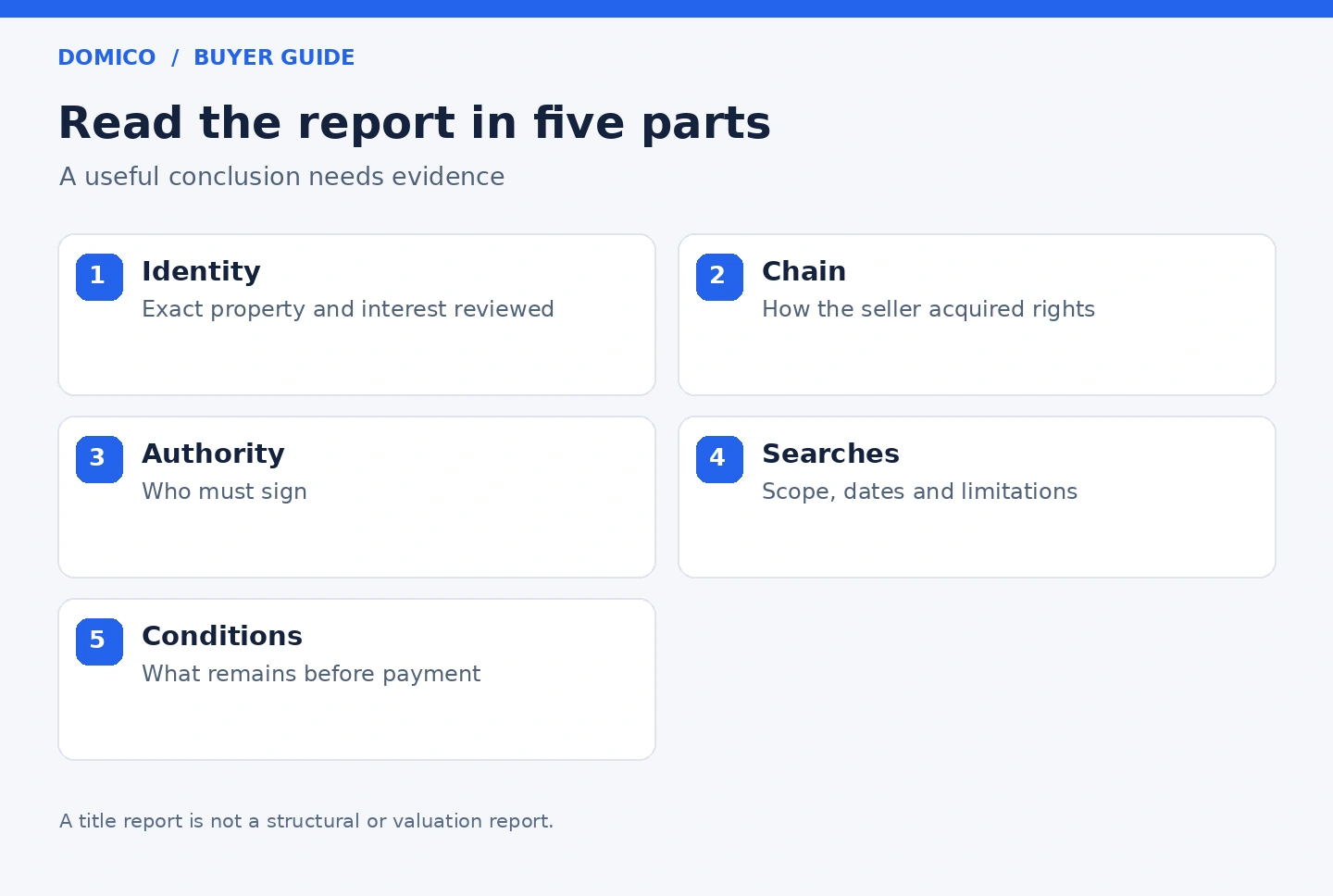
The ownership chain should tell a coherent story
Ask for a chronological account of material transfers and events. The report should explain how the current seller obtained the rights claimed and identify the documents supporting each relevant link.
Events can include purchases, inheritance, partition, gift, allotment, lease, court orders or development agreements. Their legal effect differs. A mutation entry should not silently replace the underlying acquisition document in the chain.
Where the chain starts with a government or development-authority allotment, review its terms and subsequent compliance. Where a developer sells land owned by others, examine the authority to develop, market and convey the selected interest.
The report need not reproduce every page. It should make the important links understandable and flag evidence that has not been supplied.
Seller authority deserves its own section
Ownership and authority to execute are related but distinct. A co-owner may own a share without having authority to sell everyone else's interest. A company employee may manage sales without being the person authorised to convey land. A power-of-attorney holder may have management powers but no power to sell.
Ask the report to identify required signatories and the supporting authority for each. In inherited property, the lawyer should assess the applicable succession position rather than assuming the person in possession is the only heir.
If any owner is a minor, deceased, unavailable or acting through a representative, obtain the specific legal analysis and documents needed. These should be named conditions, not buried under a general assumption that “seller declarations will be obtained.”
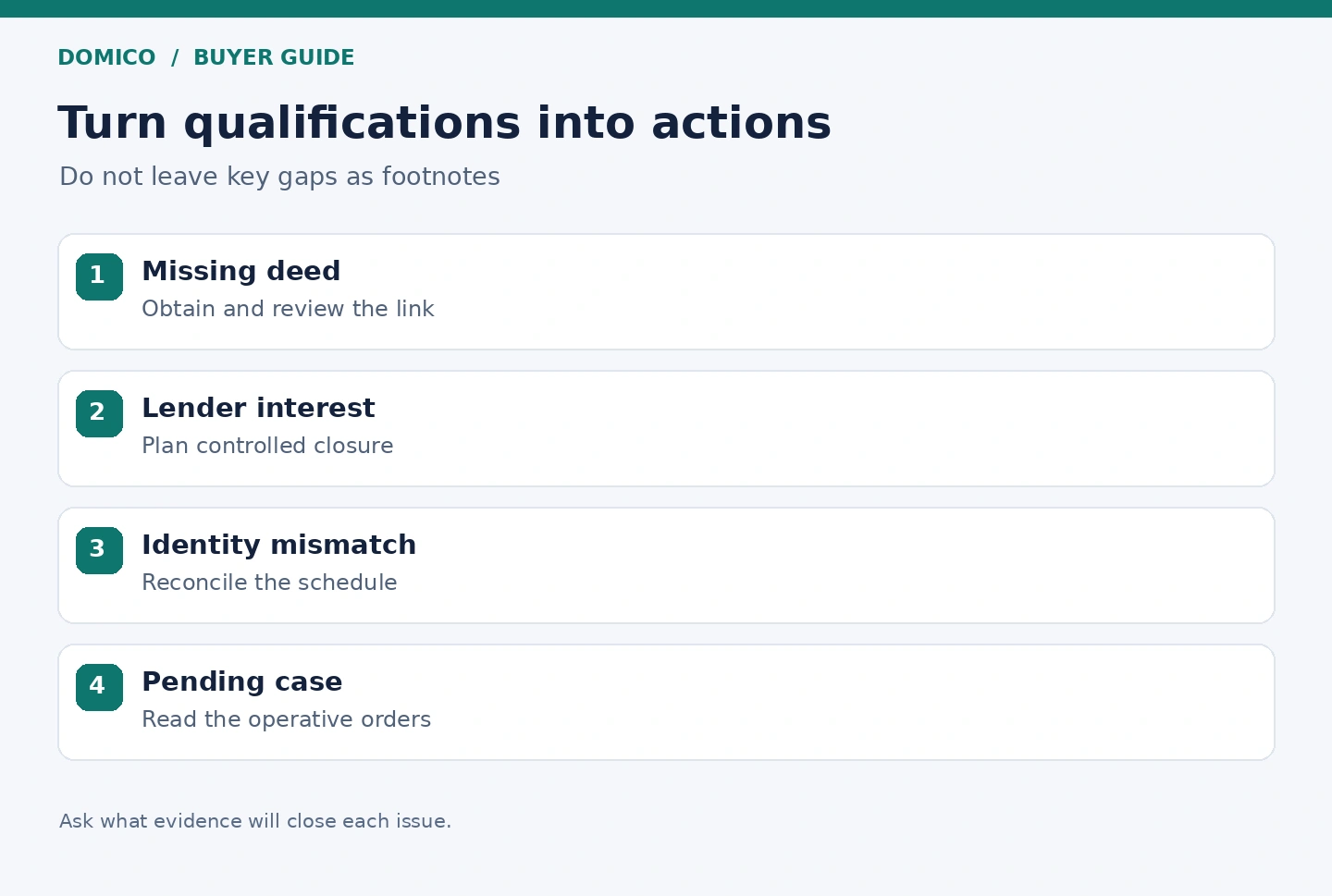
Searches should be described with their limits
Registration records, land records, court searches and security-interest investigations can each contribute evidence. Their availability and indexing differ. The report should identify what property descriptions, names, periods and jurisdictions were used.
The MP government's public service information includes registration-record and certified-copy services. The official eCourts service supports court case-status investigation. Neither should be treated as a single universal search proving the absence of every possible claim.
Ask how changes in survey numbers, spelling variations or old manual records were handled. A no-result search using the wrong identity is not meaningful reassurance.
Read qualifications as action items
A qualification may be routine or material. The buyer needs to know which. Examples include originals not inspected, a missing earlier deed, a lender's charge requiring closure or an unresolved discrepancy in the property schedule.
Ask the lawyer to distinguish issues that can be resolved before closing from risks that remain afterwards. Request the exact document or outcome needed to close each point.
Avoid accepting a report whose positive conclusion depends on assuming away the central issue. If the seller's authority is uncertain, “subject to confirmation of title” does not tell the buyer that title has been confirmed.
| Qualification in the file | Action to discuss | Evidence of resolution |
|---|---|---|
| Original deed not inspected | Establish location and reason | Inspection or documented alternative assessment |
| Existing lender interest | Agree controlled closure process | Lender confirmation and release evidence |
| Missing ownership link | Obtain and review underlying document | Complete relevant chain |
| Name or plot mismatch | Reconcile identity and correct as needed | Consistent verified schedule |
| Pending case | Review pleadings and operative orders | Case-specific legal conclusion |
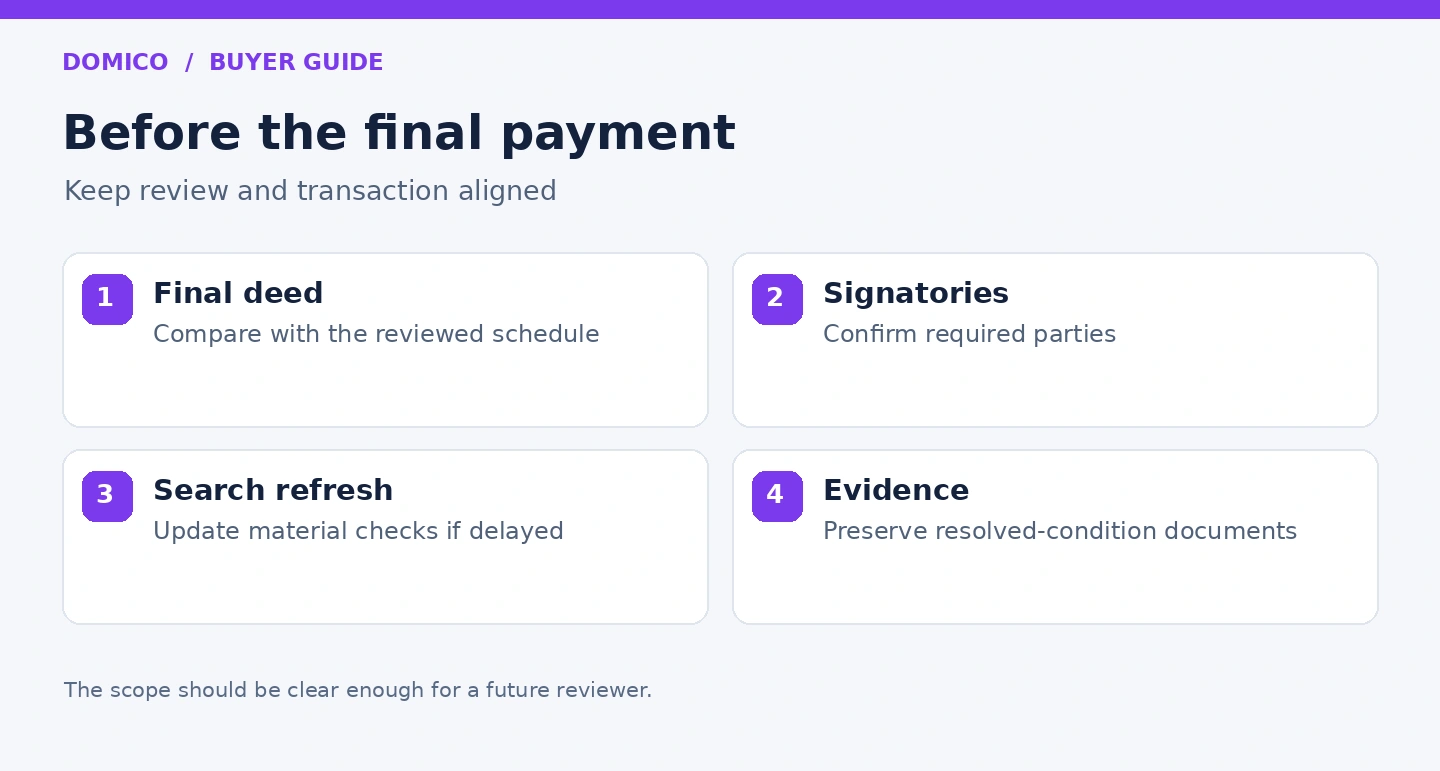
Worked example: a positive report with one critical condition
Consider an illustrative flat purchase priced at ₹62 lakh. The report traces the seller's purchase but notes an existing housing loan with a sample outstanding amount of ₹18 lakh. The buyer is asked to pay a ₹6 lakh advance directly to the seller.
The important question is not whether the report contains the words “marketable title.” It is how the lender's interest will be dealt with, where the originals are held and how payments, release and registration will be coordinated.
The buyer asks the lawyer to set out the closing sequence and documentary milestones. The lender's actual closure figure may change with date and charges; the illustrative ₹18 lakh is not a final payoff statement.
A report that identifies the issue and translates it into a workable closing condition is more useful than a report that gives a broad reassurance without explaining the transaction mechanics.
Planning, possession and structure need separate conclusions
Ask whether planning land use, layout approval, building permissions, possession and physical boundaries were examined, and to what extent. A legal title opinion does not automatically establish that a particular extension is approved or that a building is structurally sound.
For a plot, commission an appropriate measurement and access review where needed. For a flat, inspect the approved configuration, occupation-related documentation, society position and the actual unit. An architect or engineer may be required for questions outside the lawyer's professional scope.
The buyer benefits when advisers clearly state the limits of their work. A defined limit tells you what other evidence to obtain; an unstated assumption can leave the same question unchecked by everyone.
Use the report before agreeing irreversible milestones
Commission the review early enough to change the decision or terms. A report obtained after a large non-refundable payment gives the buyer less flexibility.
Share the final proposed agreement and deed with the lawyer who reviewed title. Documents can change between the initial investigation and execution. Confirm that the property schedule, signatories, payment structure and stated conditions remain consistent with the opinion.
If closing is delayed, ask which searches need refreshing. Preserve the report, supporting documents and evidence that conditions were met. Future finance or resale becomes easier when the purchase file explains what was checked and how gaps were resolved.
Printable buyer worksheet
Download the topic-specific review checklist. Use it to record evidence, unanswered questions and follow-up actions for the exact property.
Frequently asked questions
Is a bank's title report enough for me?
Understand its scope and whether you can rely on it for your purchase. A lender commissions work for its own purpose. You may need an independent review of contractual terms, seller obligations and issues outside the bank's lending assessment.
How many years should the search cover?
Ask the lawyer to choose and explain a scope appropriate to the property's history, legal requirements and transaction. A fixed period is not a substitute for tracing a relevant earlier source of rights or investigating a known defect.
Does “clear title” mean there is no possible risk?
No professional search can eliminate every unknown fact. Read the evidence, scope, qualifications and conditions behind the conclusion. The report should enable an informed decision, not promise an impossible absence of all future disputes.
Should the lawyer inspect original documents?
Ask which originals are relevant, whether they were inspected and where they are held. If originals are unavailable, the report should explain the reason, alternative evidence and remaining risk rather than quietly treating photocopies as equivalent in every respect.
What is the most useful output for a buyer?
A clear property identity, coherent chain, identified signatories, documented search scope and a short list of conditions before payment. A long report is useful only if those conclusions can be understood and acted on.
The best title report does more than say yes or no. It explains what must be true for you to buy with a clear understanding of the property.
Related buyer guides
Property Documents Checklist Before Buying in India
Booking Amount and Property Cancellation Terms
Sale Deed vs Agreement to Sell vs Mutation
Sources and further checks
- buyer-guide-100
- homebuyers
- title-search-report
- indore
Planning to buy or rent in Indore? Browse verified properties in Indore or read more Indore guides.