Buying Guide
Bank Valuation Below Property Price: Cash Gap Guide
Understand why a bank valuation can be below the sale price, calculate the extra down payment and compare review, negotiation and financing options.

Table of contents
The seller’s price and the bank’s lending value are two different numbers.
You agree to buy a home for ₹60 lakh and expect an 80% loan. Then the lender's assessment arrives at ₹54 lakh. The difference can suddenly require several extra lakh from your savings, even though your income is sufficient for the EMI.
This situation is easier to manage when you understand the lender's calculation before making a large commitment. A bank valuation is an assessment for lending. It is not a promise to finance the negotiated price, and it is not the same as the value used for stamp duty.
Three values a buyer should keep separate
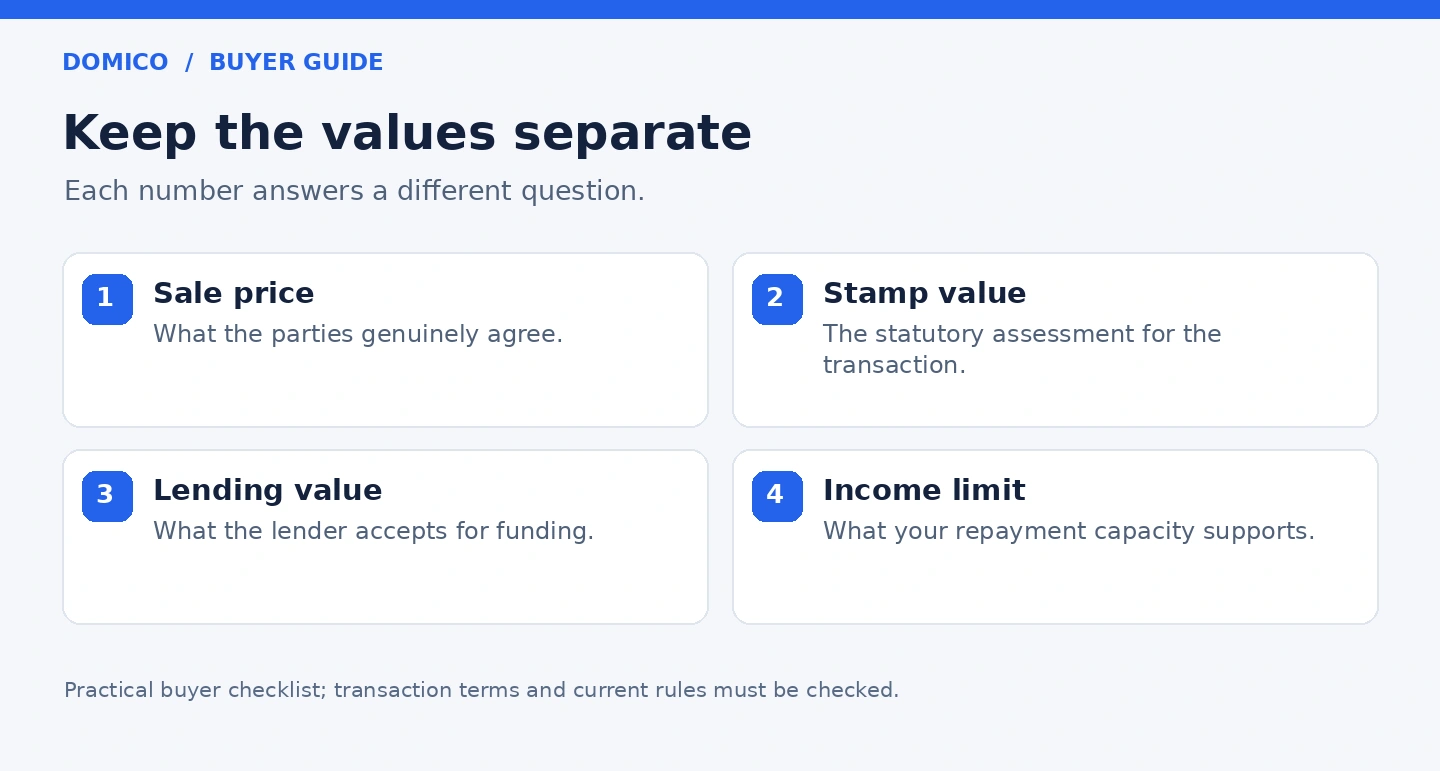
The transaction price is what the parties genuinely agree to pay and receive. The stamp duty or guideline assessment serves a statutory valuation purpose. The lender's accepted property value helps determine the amount it is prepared to fund, alongside income eligibility, product limits and other conditions.
They can differ without any one number automatically proving the others wrong. A seller may price in furnishings, an unusually high expectation or a claimed future development benefit. A lender may discount a difficult-to-sell location, property condition or unsupported construction. The useful response is to identify the reason for the difference.
| Value | Main purpose | Buyer’s question |
|---|---|---|
| Agreed sale price | Records the genuine transaction | What exactly is included? |
| Stamp duty value | Supports statutory duty assessment | Which official valuation applies to this deed and property? |
| Bank-accepted value | Supports lending assessment | What value and funding basis has the lender accepted? |
| Income-based eligibility | Tests repayment capacity | What EMI and loan amount does the household qualify for? |
The RBI housing-finance guidance explains loan-to-value considerations and treatment of transaction expenses. For your purchase, obtain the lender's current funding calculation rather than assuming an old regulatory ceiling is your approved loan.
Work out the cash gap correctly
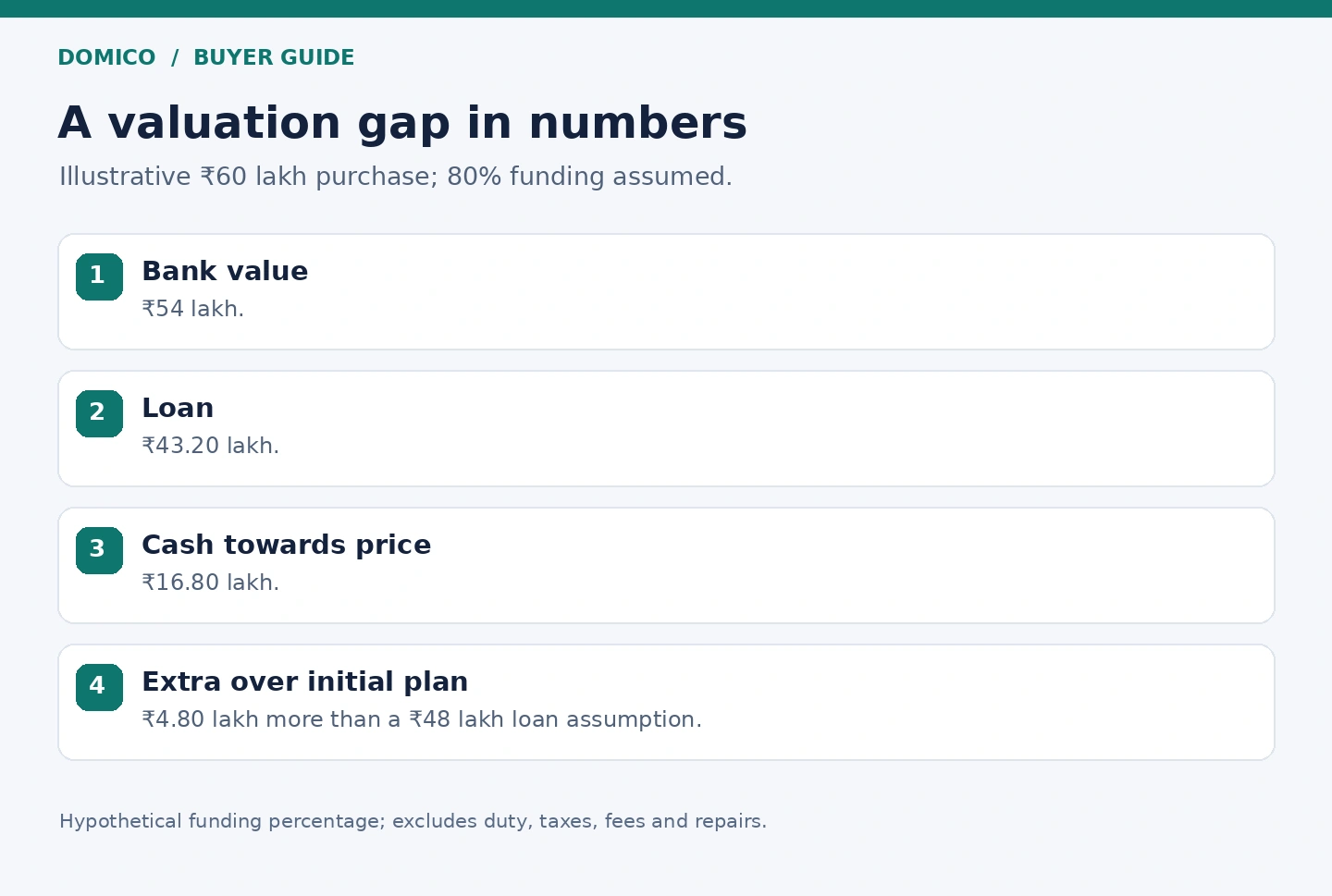
Consider an illustrative transaction price of ₹60 lakh. Suppose a lender accepts ₹54 lakh as the funding value and, for this hypothetical offer, finances 80% of that accepted amount. The loan is ₹43.20 lakh, not ₹48 lakh.
Your price contribution becomes ₹60 lakh minus ₹43.20 lakh, or ₹16.80 lakh. If you originally expected a ₹48 lakh loan, you planned a ₹12 lakh contribution. The valuation difference therefore adds ₹4.80 lakh to the cash you need for the price itself.
| Illustrative calculation | Expected funding | Funding after assessment |
|---|---|---|
| Agreed price | ₹60 lakh | ₹60 lakh |
| Funding value used | ₹60 lakh assumed | ₹54 lakh accepted |
| Hypothetical funding percentage | 80% | 80% |
| Loan amount | ₹48 lakh | ₹43.20 lakh |
| Cash towards price | ₹12 lakh | ₹16.80 lakh |
The assumed 80% is only an example. Actual funding depends on the relevant lender, loan size, borrower, property and applicable rules. The example also excludes registration, taxes, legal costs, moving and repairs. Add those separately so you do not mistake the price gap for the complete purchase budget.
A sanction amount can still be conditional
A letter indicating eligibility for a loan up to a certain amount may depend on acceptable property documents, legal review and technical valuation. It does not necessarily mean the bank will release that amount for every property you choose.
Ask whether the figure is an income-based assessment, a final property-backed sanction or a disbursement approval. Find any conditions relating to the selected address, property type, construction stage and own contribution. A clear answer at this stage can prevent an expensive surprise close to registration.
Do not pay a seller on the assumption that the bank will later fill the gap. Your sale agreement should deal sensibly with financing, review periods and consequences if the approved loan is lower than expected. Have those terms reviewed before relying on them.
Find out why the valuation is lower
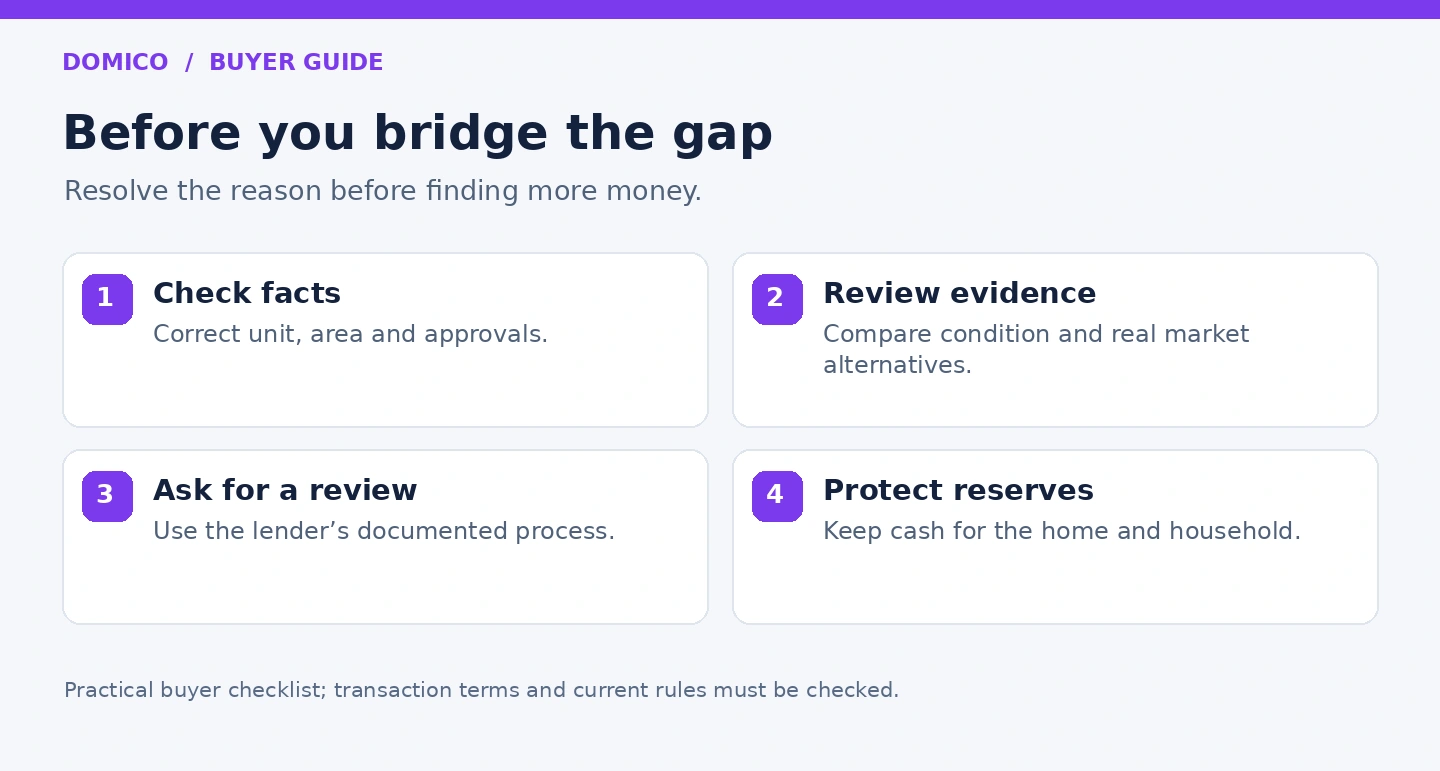
Start with factual inputs. Is the area correct? Does the report cover the right unit, floor, plot and parking arrangement? Has the valuer included only approved construction? Does the condition described match the property you inspected?
Then consider market evidence. Asking prices in advertisements are not the same as completed transactions. A seller's preferred comparable may have a different access road, building age, usable layout or title position. Differences that look small in a brochure can affect lending value.
Furniture and expensive interiors deserve separate treatment. They may improve your enjoyment of the home without increasing the bank's accepted collateral value by the amount the seller spent. Ask what portion of the price relates to the immovable property and what is being charged for movable items, without creating artificial allocations to reduce tax or duty.
When to request a review
If there is a factual error, provide evidence through the lender's formal process. Use the approved plan, measurement record, correct unit details and other relevant documents. A review request is stronger when it identifies a precise mistake rather than merely stating that the seller wants more money.
Ask whether the bank can explain the broad basis of the funding value and whether a reassessment is available. Some reports or internal details may not be shared in full. Even so, you need enough written clarity to understand the loan amount on offer and the conditions for release.
Never alter documents, exaggerate dimensions or arrange a false transaction value to obtain a larger loan. The correct goal is an accurate assessment and an affordable purchase. A mismatch that cannot be explained is a reason to investigate, not a reason to manufacture evidence.
Compare the practical options
You can ask the seller to reconsider the price, contribute more genuine savings, compare another lender's properly documented offer or choose a different property. Each option has a cost and a limit.
Adding savings may be reasonable if independent market evidence supports the price and your emergency reserve remains intact. Taking a personal loan to hide the shortfall can worsen affordability and may affect mortgage approval. Disclose existing and new debt accurately to the lender.
A second lender may use a different assessment, but a higher valuation is not automatically proof of a better property. Compare the full interest cost, fees, funding conditions and legal findings. Do not shop only for the largest number while ignoring why the first lender was cautious.
Build a registration-ready cash plan
| Cash requirement | Amount to confirm | Evidence |
|---|---|---|
| Price balance | Agreed price less approved disbursement and payments already made | Sale agreement and lender calculation |
| Transaction charges | Official duty, fees and other applicable costs | Current calculation and itemised quotes |
| Essential work | Repairs and immediate habitability spending | Inspection and written estimates |
| Emergency reserve | Money preserved after purchase | Household cash-flow plan |
| Timing gap | Amount due before the bank releases funds | Payment schedule and disbursement conditions |
The timing line is easy to overlook. Even when the total loan is adequate, the bank may require your contribution first or documents that arrive only at a later stage. Confirm which payment happens when, who receives it and what proof the lender needs.
If the seller will not wait for the assessment
A short payment deadline can put pressure on a buyer to accept an unknown funding gap. Ask for a written due-diligence and financing window before paying a substantial amount. Where a deadline is already contracted, obtain advice on the options rather than assuming the bank's delay automatically extends it.
Keep the seller informed with a factual update: the property assessment is pending, the requested release date is a particular day, and the final loan amount is not yet confirmed. Do not promise a disbursement that the bank has not approved. Clear communication can support an extension, but only the actual agreement establishes what the parties have accepted.
If you need to renegotiate the price, use evidence about the property and funding rather than presenting the bank's figure as an order the seller must follow. The seller can decline. Your decision then returns to whether the real price, cash gap and remaining reserves make sense.
A smaller home that preserves liquidity may be a better fit than a larger property funded through several improvised debts. Compare the alternatives before treating the shortfall as an amount that must be found at any cost.
Printable buyer worksheet
Download the topic-specific review checklist. Use it to record evidence, unanswered questions and follow-up actions for the exact property.
Frequently asked questions
Does a low bank valuation mean I am overpaying?
It is a useful warning to examine, but not a complete market verdict. Check factual inputs, comparable properties, condition and the funding policy. Obtain independent advice if the difference is substantial.
Will the bank finance a percentage of the seller’s price?
The accepted funding basis depends on the lender and product. Ask for the actual calculation using the selected property rather than assuming a percentage of the asking price.
Can registration charges be included in the home loan?
Treatment depends on applicable rules, loan conditions and the property. Plan conservatively and ask the lender to identify what is funded. Do not assume that every purchase expense is part of the collateral value.
Can I challenge an incorrect area in the report?
Submit the correct approved documents and request a formal review. The lender decides its process, but a specific evidence-backed error is more useful than an unsupported request for a higher value.
Should I use all my savings to cover the difference?
Only after testing the complete purchase and household budget. Keep room for essential work, emergencies and the EMI. A property that consumes every reserve can remain unaffordable even when the bank agrees to lend.
Sources and related reading
- buyer-guide-100
- homebuyers
- bank-valuation-shortfall
- indore
Planning to buy or rent in Indore? Browse verified properties in Indore or read more Indore guides.



