Buying Guide
Fake Property Listings: Verify the Seller Before Paying
Spot suspicious property listings and verify the exact asset, advertiser, seller authority and payment request before sending money.
8 min read

Buying Guide
Spot suspicious property listings and verify the exact asset, advertiser, seller authority and payment request before sending money.
Verify the person behind the listing before the listing becomes a payment request.
An attractive property advertisement can be genuine, inaccurate, outdated or deliberately fraudulent. Good photographs and a convincing conversation do not establish ownership or authority to collect money. A scam can begin with a fake home, but it can also use photographs and documents belonging to a real property.
Your first task is to establish the relationship between the advertiser, the actual seller and the exact unit or plot. Keep that investigation separate from whether the price looks attractive. A bargain that requires you to skip verification is a reason to slow down.
Not every inaccurate advertisement is a criminal scam. A broker may have old availability, a wrong photograph or incomplete instructions. Those problems still need correction before a buyer relies on the listing. Fraud involves a different concern, such as impersonation or a deliberate attempt to obtain money through false claims.
Avoid making public accusations based on one inconsistency. Ask for clarification, preserve the advertisement and verify independently. If there is evidence of suspected wrongdoing, use the platform's reporting process and appropriate official channels.
| Listing concern | What it can look like | Initial buyer response |
|---|---|---|
| Stale advertisement | Property already sold or withdrawn | Confirm current availability in writing |
| Misdescribed unit | Photos or area differ from the offered home | Identify the exact unit and inspect |
| Unauthorised intermediary | Advertiser cannot establish instructions | Contact the owner through a verified route |
| Impersonation | A person claims another owner's identity | Stop payment and obtain independent verification |
| Advance-fee attempt | Money demanded before basic access or checks | Decline pressure and preserve the request |
For an apartment, record the project, phase, building, floor, unit and usable-area description. For a plot, identify the location, layout number, underlying land references and boundaries as relevant. A vague map pin or colony name is insufficient for a purchase decision.
Ask which photographs show the actual property and which are common areas, sample flats or illustrations. Inspect the offered property through an authorised arrangement. Seeing an entrance or a key does not prove the person showing it has authority to sell.
If an address changes repeatedly or the advertiser refuses to identify the unit until payment, pause. There may be a legitimate privacy reason for withholding some information publicly, but a serious transaction needs a safe process for providing enough detail to verify the asset.
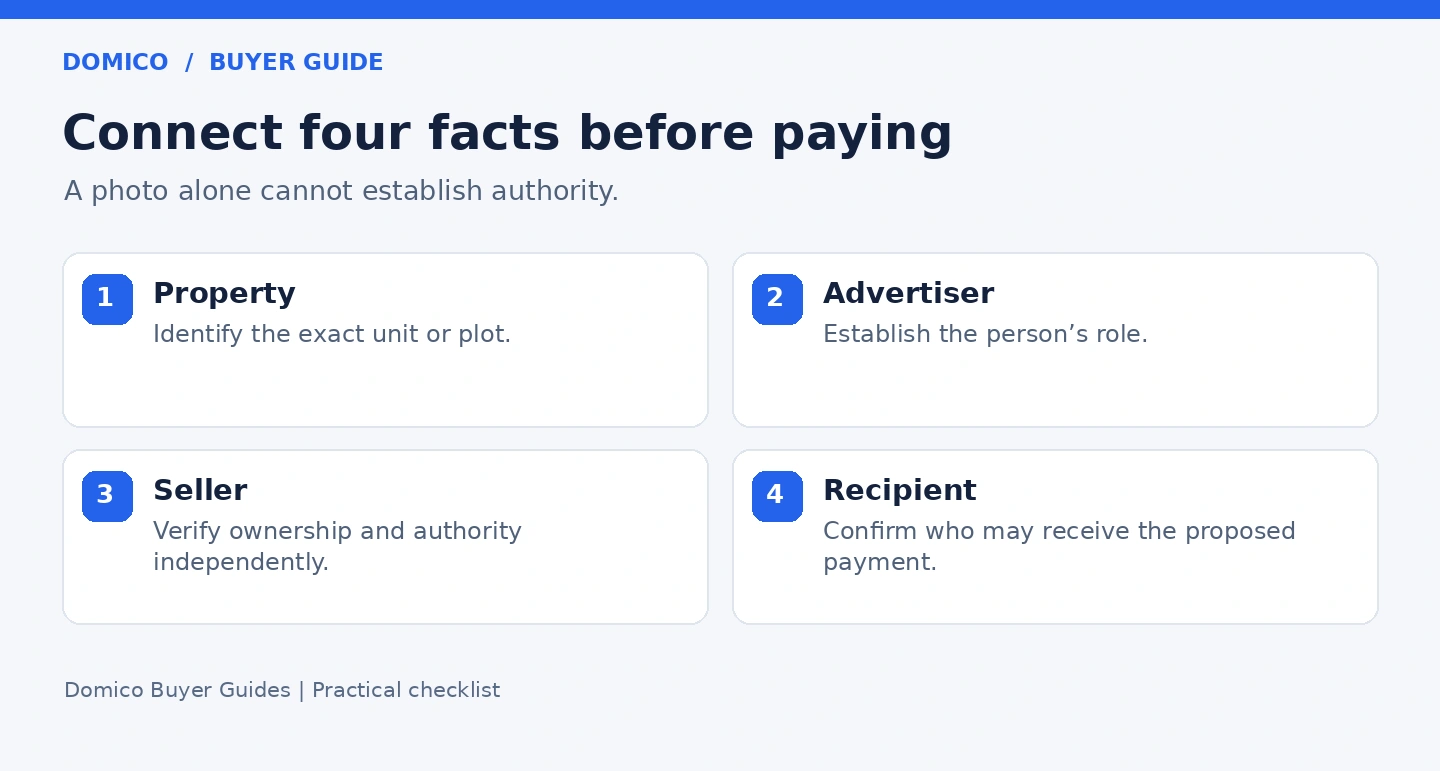
Ask whether you are dealing with the owner, an employee, an authorised agent or another intermediary. Obtain the relevant business details and a clear explanation of who instructed the sale. Where RERA agent registration applies, check the relevant official record; registration does not itself establish authority for this specific listing.
If a company or partnership is involved, ask how the person is authorised to act. If a representative relies on a power of attorney, have the authority examined independently. A visiting card, messaging-app business profile or identity document alone cannot answer those questions.
Keep identity verification proportionate and secure. Do not ask strangers to send unlimited personal records through an informal chat, and do not upload your own sensitive documents merely to demonstrate that you are a serious buyer. Use appropriate professional and official processes.
The advertiser's own phone number cannot independently confirm the advertiser's story. Obtain a reliable contact route through the relevant records, a known office or an authorised process, and confirm the seller's instructions. Do not let the person under review control every verification channel.
An independent property lawyer can examine title, seller authority and relevant searches. Confirm documents through the issuing authority or appropriate certified-record process where needed. A scan can be genuine, altered or unrelated; the presence of a stamp or QR-looking image does not settle authenticity.
For land in MP, official land records are one useful input. They should be reconciled with the title chain, registration records, approvals and ground identity. An online name match is not a complete title clearance.
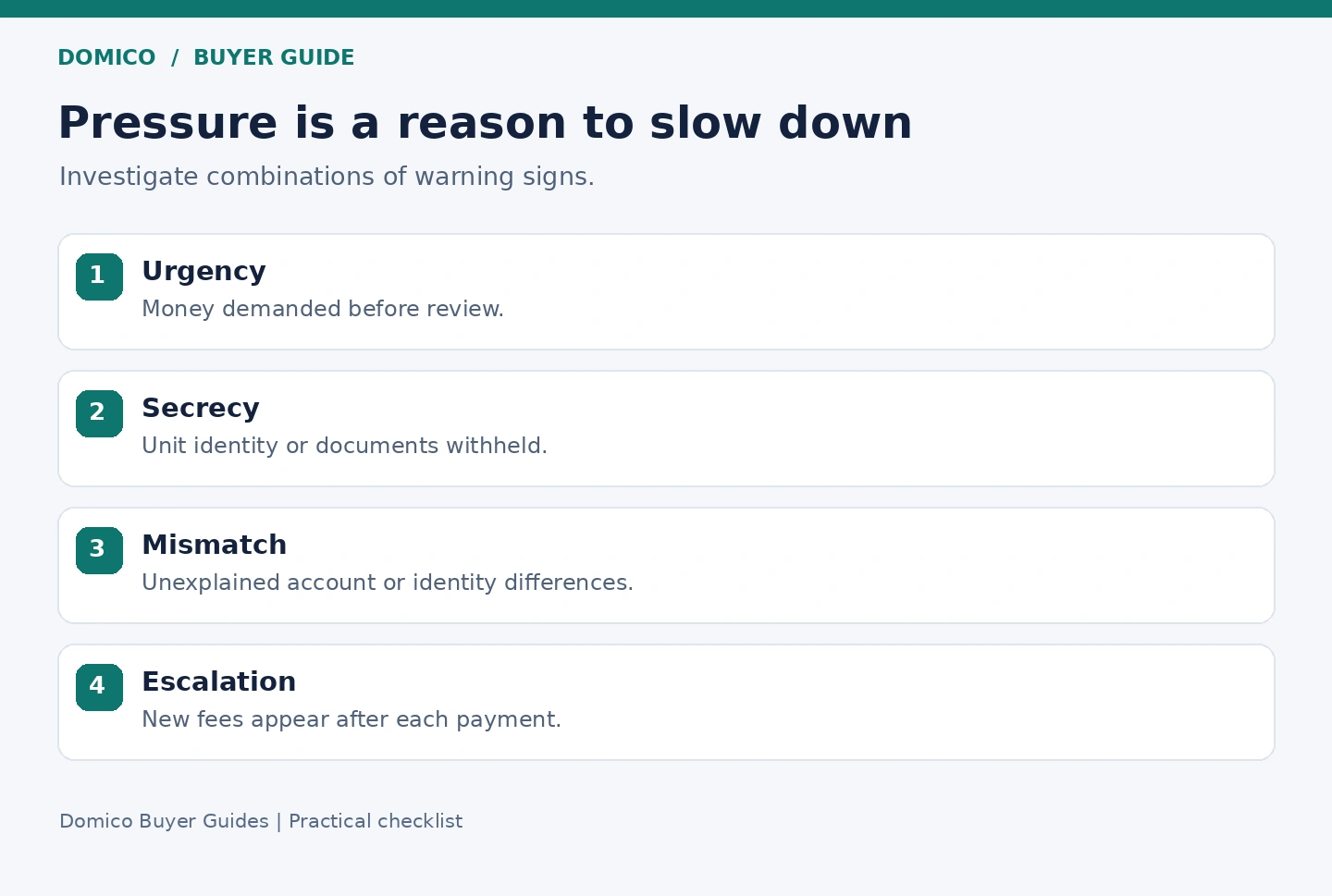
A low price can have a legitimate explanation. It becomes more concerning when paired with refusal of inspection, urgent transfer demands, unexplained recipient changes or a story that makes normal verification impossible.
Watch for requests to pay a “viewing pass”, refundable access charge or booking amount to a person who has not established authority. A claim that several other buyers are ready does not change what you need to verify. A legitimate seller can still impose a deadline, but you can decline a deadline that prevents responsible checks.
| Pattern | Why it needs clarification | Better response |
|---|---|---|
| Payment before identifying the unit | You cannot know what is being reserved | Request a documented verification process |
| Account name differs from seller | Authority to receive is unclear | Obtain verified written instructions and advice |
| Refusal of independent review | Important facts cannot be checked | Do not proceed on reassurance alone |
| Constant urgency | Can discourage scrutiny | Set your own verification requirements |
| New fees after each transfer | The transaction basis keeps changing | Stop and investigate before further payment |
Read what a platform's badge or check actually covers. A phone check, identity review, document collection and full legal investigation are different activities. Do not infer a legal guarantee from an unspecified “verified” label.
Keep the original listing link, date, photographs, claimed price and conversation. If the platform offers reporting, submit factual evidence rather than speculation. Continue independent purchase checks even when an advertisement appears on a familiar service.
Be cautious with links sent outside the platform. Open official services through a known address or app where possible. Do not install unfamiliar remote-access software or share your screen to complete a property enquiry.
Imagine an advertisement for a genuine apartment using photographs copied from an earlier listing. The caller says the owner is travelling and requests Rs 25,000 to reserve a viewing slot. They supply an identity scan and ask for payment to a differently named account.
The correct response is not to decide that the photograph looks convincing. The unresolved points are the caller's authority, the seller's instructions, the exact purpose of the payment and the recipient's entitlement. No transfer should be justified by the image alone.
If an independent contact confirms that the owner never instructed this person, preserve that evidence and report the listing appropriately. Do not confront a suspected fraudster in person or publish private identity documents that may belong to another victim.
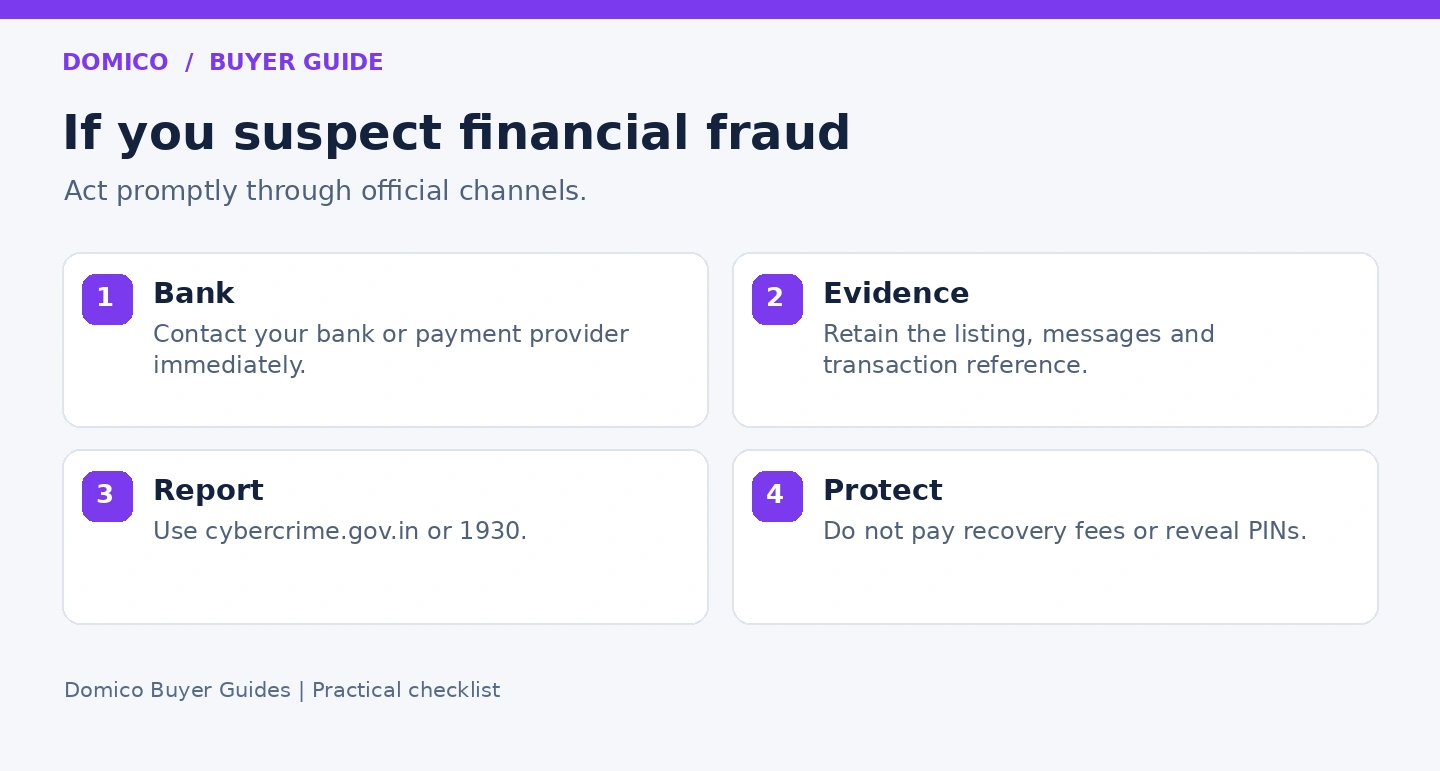
Contact your bank or payment provider immediately through its official channel, explain the suspected fraud and request the appropriate action. Preserve transaction references, recipient information, the listing and messages. Report financial cyber fraud promptly through the National Cybercrime Reporting Portal or the official 1930 helpline.
Reporting does not guarantee recovery. Do not pay a second person who promises a refund in exchange for another fee, PIN or remote access. Follow the instructions of the bank and authorities, and obtain legal advice where the matter also concerns the property transaction.
Download the topic-specific review checklist. Use it to record evidence, unanswered questions and follow-up actions for the exact property.
No. Meeting establishes that a person exists, not that they own the property or can sell it. Verify identity, role, seller instructions and the documents for the exact asset.
Yes. It may belong to someone else or be unrelated to the authority claimed. Do not treat an identity image as proof of ownership or permission to receive a property payment.
Only after the recipient, purpose, property and terms have been properly verified. A small amount can still be lost and may lead to larger demands. Seriousness can be demonstrated through an organised review and a documented transaction process.
Read the service's stated scope. Different checks cover different facts, and none should be assumed from the word alone. Ask what was checked, when and with what limitations.
Share only what is necessary, through an appropriate process and with a verified recipient. Protect personal and financial information. A request for excessive records or remote account access is not a normal substitute for property verification.
A trustworthy-looking advertisement is the beginning of an enquiry. Authority, identity and the exact asset must be established before money becomes part of the conversation.
Planning to buy or rent in Indore? Browse verified properties in Indore or read more Indore guides.
Compare property payment triggers, complete prices, lender disbursement conditions and funding risks before choosing a builder payment plan.