Buying Guide
How to Check a Builder’s Track Record
Review a developer’s identity, completed projects, delivery history, complaints and service quality using evidence rather than claims.

Table of contents
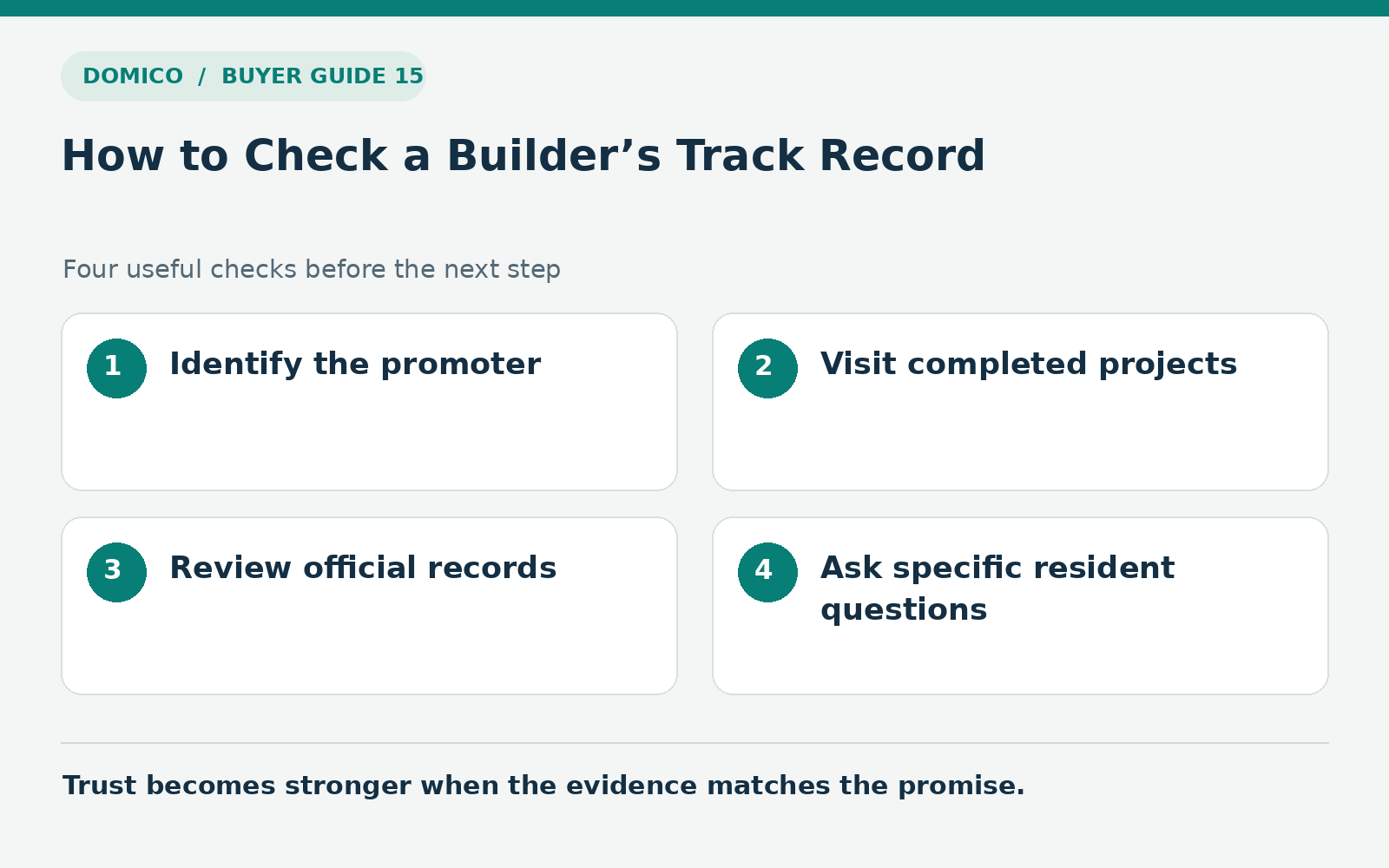
Trust becomes stronger when the evidence matches the promise.
To check a builder's track record, identify the exact promoter behind the proposed sale, examine relevant official records and compare earlier commitments with completed outcomes. Then ask focused questions about delivery, quality, maintenance and how problems were handled. A familiar brand name or a large advertising campaign cannot do that work for you.
This guide provides a practical research method for buyers considering a developer property in Indore or elsewhere in India. It does not rate or make claims about any named builder. The aim is to help you gather reliable evidence for the particular promoter, project and phase you are considering.
Start with the legal entity, not only the brand
Ask for the promoter's full legal name, project registration details where applicable and the identity of the entity that will sign the agreement. A brand may be associated with several entities or joint arrangements. Understand the relationship relevant to your transaction.
Compare these details across the booking form, agreement, relevant MP RERA record and payment instructions. If the names differ, ask for a documented explanation and have the authority reviewed. Do not assume every company using a similar brand has identical obligations or the same completed-project history.
Also identify the landowner or development arrangement where relevant. The question is not whether complex structures are automatically bad; it is whether you understand who has authority, who is making each commitment and which entity you would rely on if a problem arose.
| Evidence area | What to collect | Why it matters |
|---|---|---|
| Promoter identity | Exact legal name and project relationship | Keeps research tied to the correct entity |
| Relevant project history | Identifiable earlier developments and phases | Enables a fair comparison with actual outcomes |
| Delivery evidence | Agreed dates and relevant completion records | Separates promises from documented delivery |
| Operating experience | Specific resident questions and supporting records | Shows how the home works after handover |
| Official proceedings | Relevant complete orders and current status | Avoids conclusions from cropped or unrelated results |
Ask for a history you can actually investigate
Request a list of completed and ongoing projects, with exact names, locations and the promoter's role. “Many years of experience” is difficult to test without identifiable work behind it. Ask which projects are most comparable to the one being sold.
Comparable does not always mean the newest or most expensive project. An occupied development of similar scale and construction type may tell you more about ongoing quality and management than a showcase property with a different operating model.
Keep the list manageable. Choose a few relevant examples and investigate them properly. A long spreadsheet containing only project names and photographs can create an impression of diligence while answering very little about actual delivery or buyer experience.
Compare promised dates with documented outcomes
For a relevant project, review available official disclosures and agreements or completion evidence that you can legitimately obtain. Ask what the original commitment was, whether it changed and what the final handover involved. Different dates can refer to different phases or steps, so establish what each date means.
If an extension or revised timeline exists, read the relevant record for its scope. Do not reduce every changed date to a simple accusation, but do not ignore a material pattern without explanation. Ask how the promoter communicated and managed the change.
The outcome includes more than keys. Were the relevant services operational? Were promised facilities delivered in the applicable phase? Were important documents available? Use specific questions and supporting records rather than a broad statement that a project was “delivered.”
Visit an occupied project with a purpose
Visit lawfully and respect residents' privacy. Observe accessible common areas, maintenance, lifts, parking and visible building condition. Do not enter restricted spaces or photograph people and private interiors without permission.
Ask residents concise questions about their own experience. For example: “How were defects reported?” “Did you receive a written response?” “What does maintenance include?” “Were there major issues at handover?” These questions are more useful than asking whether they like the builder.
Treat individual comments as evidence of that person's experience, not proof of every unit or the current project. Where an issue could affect your decision, seek documents or an appropriate technical review. A few enthusiastic or unhappy comments should not become an unsupported universal verdict.
| Question to ask | Useful detail to seek | Avoid assuming |
|---|---|---|
| How was handover handled? | Inspection, documents and open-work process | Every unit had the same experience |
| How were defects addressed? | Reporting channel, response and actual repair | A verbal promise proves a completed repair |
| How does maintenance operate? | Services, collections and decision process | A low quoted charge covers everything |
| Were facilities delivered as agreed? | Relevant phase, specification and records | Every marketing image was a contractual promise |
| How were changes communicated? | Dated notices and explanations | An online review contains the full sequence |
Read official records with the correct identifiers
For relevant Madhya Pradesh projects, use MP RERA's current public services to locate the exact project and promoter. Review available disclosures, updates and relevant orders. A number belonging to another phase or a similarly named entity should not become the basis of your assessment.
Where you find proceedings, distinguish a complaint, an interim direction, a final order and an appeal or later development. Read the actual document, date and scope. A complaint is not automatically a final finding, and a later record may change the position.
Ask a lawyer to explain material issues that could affect your proposed transaction. Avoid creating or sharing accusations from incomplete search results. The purpose of the research is to make a better buying decision, supported by records you understand.
Use online reviews as leads, not a rating system
Online reviews can point to useful questions, but star ratings alone are weak evidence. The review may relate to a different project, a sales interaction rather than ownership or an experience that has since changed. Some comments contain little verifiable detail.
Look for specific recurring themes and investigate them. If several reviews mention water issues, ask about the actual supply arrangement at the project you are considering. If they mention delays, check the relevant dates and phase rather than assuming the same position everywhere.
Do not contact people in a way that invades privacy or pressures them to disclose personal documents. A respectful request for general experience is enough to generate questions. Obtain the formal answers through the legitimate project and authority records.

Check the quality promised for your exact home
Track record can inform the decision, but it does not replace the current project's specification. Compare the unit plan, materials, fixtures, common facilities and written inclusions. Ask which sample-flat elements are optional or decorative.
For an unfinished property, inspect progress safely within permitted areas and consider independent professional help for material technical concerns. For a completed unit, inspect the actual home. A builder's successful previous project does not certify the condition of the unit being offered today.
Ask how quality issues are recorded and resolved at handover. A clear inspection and defect-reporting process is valuable. Read the relevant agreement and applicable legal framework with an adviser rather than relying on a broad verbal statement that “everything is covered.”
Examine the sales process itself
The promoter's response to reasonable document requests can provide practical information about how the transaction is being managed. Are complete documents supplied? Are questions answered consistently? Do the price sheet, contract and payment instructions agree?
A slow response to one query is not proof of wrongdoing, but unresolved material questions should remain visible. Keep a short written list and ask for the document that answers each item. Do not allow a friendly conversation to replace the missing evidence.
Pay particular attention to pressure for immediate payment before terms are available. A time-limited offer should still be evaluated against the complete budget, legal review and financing. The ability to move quickly is useful only after the important conditions are understood.
Understand the financial questions you can reasonably ask
You may not have access to every internal financial detail, but you can ask about the payment schedule, financing arrangements relevant to the purchase, disclosed project information and any conditions affecting the property. Use a qualified adviser for records that require specialist interpretation.
Do not infer financial strength solely from a large office, a bank tie-up or a high number of advertisements. Equally, do not turn one isolated public figure into a prediction of failure without context. Research should stay proportionate and tied to the actual transaction.
For your own plan, test whether you can handle the agreed payment sequence and a less favourable timing scenario. A favourable view of the promoter's history should not justify an unaffordable commitment or an unexamined cash gap.
Build an evidence log instead of a vague score
Record each material claim, its source, the document reviewed and the remaining question. Mark whether it is confirmed, partly supported or unresolved. The log should help an adviser understand the file without repeating every sales conversation.
| Claim or question | Evidence status | Next action |
|---|---|---|
| Exact contracting entity | Record documents reviewed | Resolve any unexplained name difference |
| Comparable delivery history | Note projects and relevant dates | Request missing records or explanation |
| Current unit specification | Match plan, schedule and agreement | Clarify excluded or optional items |
| Relevant proceeding | Retain complete dated record | Obtain advice on scope and current status |
| Defect and maintenance process | Record written policy and experience | Ask how it applies to this project |
Avoid a numerical score that hides a serious unanswered issue. Clear title and authority are conditions to resolve, not points that can be offset by better landscaping. Treat material uncertainty as a question requiring a decision, with professional help where needed.
When the research produces mixed evidence
Most real comparisons are less tidy than a simple good-or-bad label. One project may have strong resident feedback but a different promoter entity. Another may have a clear record and a layout that does not suit your needs. Keep the categories separate.
Ask what the evidence actually supports. A pattern of well-handled defects may be relevant to service expectations; it does not prove future returns. A completed earlier phase can show an outcome; it does not guarantee the next phase's delivery.
You can decide that the remaining uncertainty is acceptable, seek a different property or wait for more information. What matters is that the decision is deliberate and based on documented facts rather than a reputation slogan.
Keep dates beside conclusions
Write when you reviewed each record and what period it describes. A project update, resident experience and authority order may concern different dates. Keeping that context prevents an older issue from being presented as the current position or a recent response from being used to erase the earlier sequence. Update material conclusions when reliable new evidence becomes available.
Frequently asked questions
Is a well-known builder automatically a safe choice?
Brand recognition is one piece of context. Verify the exact promoter, project, phase, legal file, contract and unit. A familiar name does not answer every ownership, quality, timing or affordability question.
How many previous projects should I inspect?
Choose a manageable number of relevant comparable projects and examine them properly. Exact outcomes and resident questions are more useful than a long list of developments you have not investigated.
Does a complaint prove the builder is at fault?
No. Understand the allegation, procedural stage, relevant order and any later developments. Ask a lawyer about material records and avoid conclusions based only on a headline or an unrelated name match.
Can I rely on online ratings?
Use them to identify questions, then verify important claims through records and appropriate enquiries. Ratings may cover different projects, dates or types of interaction and do not certify the current property.
What should I ask before booking?
Ask for the contracting entity, exact project and phase details, complete documents, written specification and cost sheet. Clarify payment, cancellation and handover terms before relying on a sales promise.
Let the evidence guide the shortlist
When comparing Indore projects, keep the promoter research beside the property's legal file, visit notes and budget. A useful track-record check leaves you with specific supported conclusions and a clear list of any questions still open.
Official resources and scope
- MP RERA — relevant project and authority records.
- Ministry of Housing and Urban Affairs: RERA — regulatory framework and authority links.
- MP IGR — applicable registration-related services.
Prepared on 18 October 2026. This is a general research method and contains no rating or factual allegation about a named promoter. Obtain case-specific legal and technical advice where needed. Images illustrate the topic.
Continue reading
- homebuyers
- buying-guide
- builder-track-record
- indore
Planning to buy or rent in Indore? Browse verified properties in Indore or read more Indore guides.