Buying Guide
How to Negotiate Property Prices Before Booking
Prepare a property negotiation using comparable homes, an itemised cost sheet, documented defects and clear payment terms.

Table of contents
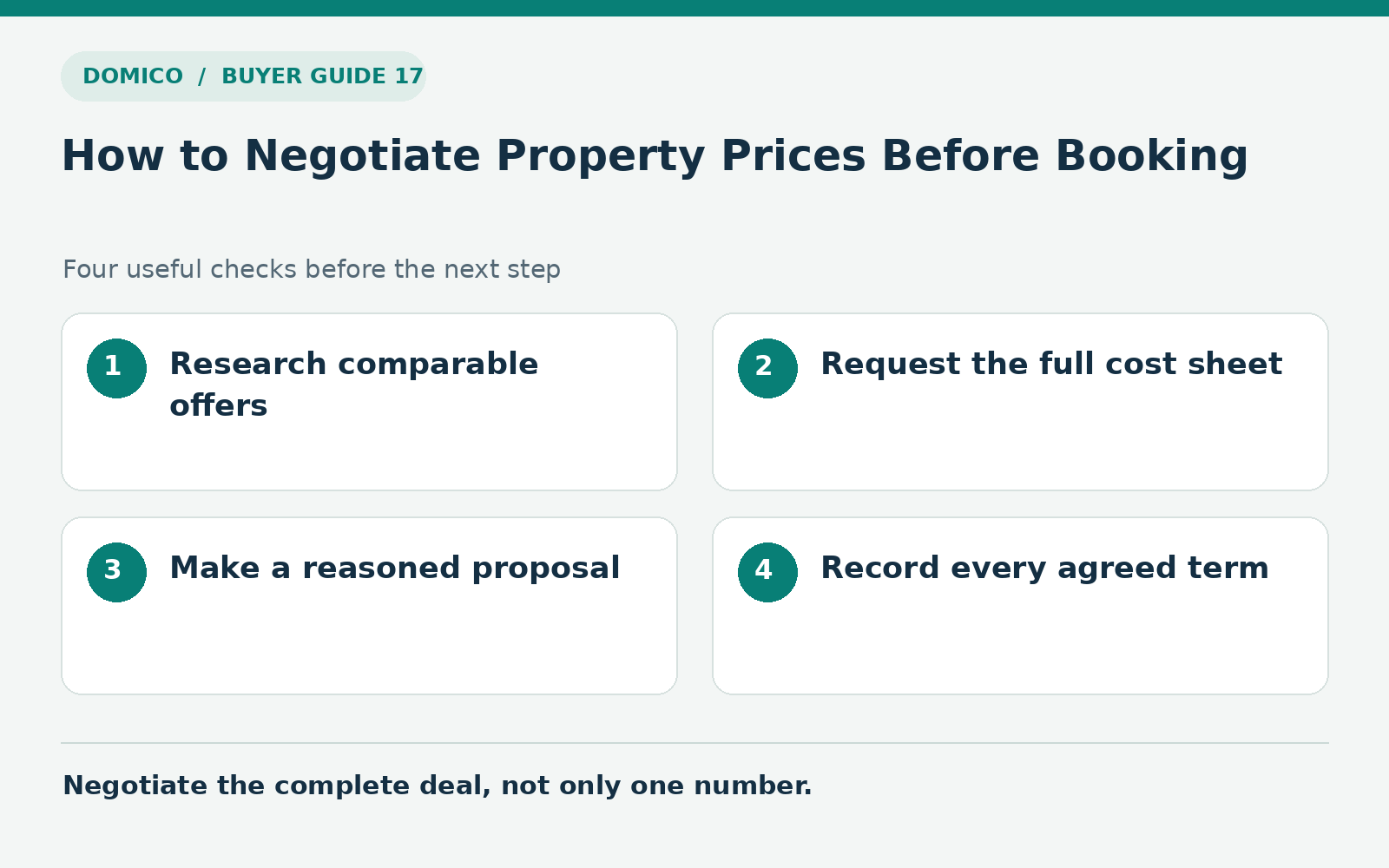
Negotiate the complete deal, not only one number.
To negotiate a property price well, arrive with comparable evidence, a complete cost sheet and a clear personal limit. Explain a reasoned proposal for the exact home or plot, then record the agreed price, inclusions, conditions and payment schedule. A successful negotiation should improve the purchase without making it harder to fund or verify.
There is no universal discount that every seller will accept. The outcome depends on the actual property, seller, competing alternatives and transaction terms. This guide explains a practical approach for buyers in Indore, with hypothetical examples and a simple offer format you can adapt.
Know your maximum before asking for a reduction
Set a limit using the complete purchase budget. Include the price contribution, applicable government charges, financing expenses, essential work and moving costs. Keep a suitable household reserve separate. A lender's highest possible sanction should not quietly become your target price.
Also establish the payment dates you can actually meet. A seller may value a reliable closing timetable, but a promise of quick payment is only useful when the funds and necessary checks are ready. Do not trade a modest concession for deadlines that depend on uncertain financing.
Write your preferred price, acceptable range and walk-away point in private notes. This helps you recognise when a discussion is still within your plan and when enthusiasm is beginning to change the budget without a clear reason.
| Preparation item | What to collect | How it helps |
|---|---|---|
| Complete budget | Price, separate costs and available funds | Establishes a personal ceiling |
| Comparable offers | Similar actual properties on the same basis | Supports a reasoned proposal |
| Condition evidence | Inspection notes and repair quotations | Connects an adjustment to a real cost |
| Seller's written terms | Inclusions, exclusions and timetable | Shows what is actually being negotiated |
| Financing readiness | Current assessment and remaining conditions | Makes payment commitments credible |
Compare genuinely similar properties
Use comparable homes or plots with relevant similarities in location, usable area, condition, legal position and possession. A nearby listing with a different area basis or major repairs may not support the simple price comparison it first appears to offer.
Distinguish an asking price from a completed transaction. An advertisement shows what a seller is seeking, not necessarily what a buyer paid. If you use a claimed sale as evidence, understand the source, date and property differences rather than presenting it as an unquestionable valuation.
For flats, compare equivalent price components and carpet-area information where relevant. For plots, compare lawful access, layout, use and development readiness as well as size. A cheaper parcel with an unresolved issue should not be used as if it were an identical alternative.
Request the full cost sheet first
Ask what the quoted amount includes and excludes. Identify applicable government charges, parking treatment, maintenance provisions, professional fees and other relevant components. Clarify which amounts are fixed and which may change under the agreement.
For a developer sale, obtain the current cost sheet and specification schedule. For resale, agree the treatment of fixtures, movable items, repairs and outstanding amounts. A headline reduction can disappear when the final inclusions are different.
Keep versions of the quotation so you can compare changes. If a price is reduced, ask for the revised complete sheet rather than relying on a message containing only the new headline number. The document should still identify the exact property and conditions.
Use condition and timing as evidence
An appropriate repair quote can support a discussion about the price or the seller completing work. Be specific: identify the defect, scope and likely cost. Avoid exaggerating problems or using a vague estimate simply to pressure the seller.
If you propose an earlier closing, confirm that legal review, funds and participation can be arranged. If you need a later possession date, state it clearly. The seller may value some terms differently from you, creating room for an agreement without pretending every concession must be a cash discount.
Never use an unresolved title or approval issue merely as a bargaining tool. Some matters need to be resolved before purchase, regardless of the price. A large reduction does not make an unsuitable or unverified property a sound personal decision.
A complete-deal comparison
Suppose a hypothetical seller quotes ₹55 lakh. A revised offer shows ₹53 lakh, but some items are removed and the buyer takes on additional work. Compare the total effect instead of celebrating the ₹2 lakh headline reduction.
| Hypothetical component | Initial package | Revised package |
|---|---|---|
| Property price | ₹55,00,000 | ₹53,00,000 |
| Separately payable extras in this example | ₹1,00,000 | ₹2,00,000 |
| Buyer-funded essential work | ₹40,000 | ₹60,000 |
| Comparable subtotal | ₹56,40,000 | ₹55,60,000 |
| Effective reduction in this subtotal | — | ₹80,000 |
Government charges and other common costs are excluded from this simplified example and must be added appropriately in a real budget. The table does not establish a market price. It shows how a ₹2 lakh headline change can produce a smaller improvement once the package changes.
Ask the same question about a “free” item: what is its usable value to you and what conditions come with it? An upgrade you would not otherwise buy may be less valuable than a smaller cash adjustment or more practical payment terms.

Make one clear, reasoned proposal
Identify the property, proposed consideration, included items, material conditions and a realistic timetable. Explain the evidence briefly. A long list of unrelated complaints can make the discussion less productive than two or three specific reasons for the offer.
For example: “For this exact unit, we propose the stated total consideration with the listed fixtures included, subject to satisfactory legal review and confirmed financing. Our offer reflects the comparable homes reviewed and the documented repair scope. Please confirm the complete cost sheet and proposed closing schedule.”
Adapt that structure with an adviser where necessary. It is a discussion format, not a binding legal template. Be careful about language that could create obligations before you intend them, and do not send a payment simply to make an informal proposal appear more serious.
Handle a counteroffer methodically
When the seller counters, compare it with your maximum and the complete package. Ask what changed: price, inclusions, payment timing, possession or conditions. If several people are involved, confirm who has authority to approve the final terms.
Respond with the same clear structure. Avoid making several small concessions without updating the budget. A sequence of apparently modest increases can move the final amount beyond your original limit before you notice the cumulative effect.
You do not need to respond instantly to every message. Take time to check figures and discuss with co-buyers. A calm pause is useful when it serves the decision; it should not be used to create fake competition or misleading pressure.
Negotiate terms that matter to your household
Price is central, but other terms can affect practical value. Depending on the transaction, these may include a realistic closing date, clearly listed fixtures, completion of agreed repairs, the handover condition and a documented process for settling relevant outstanding amounts.
For a developer property, clarify specifications and payment triggers. For resale, clarify vacant possession and what remains in the home. For a plot, establish the exact parcel, agreed boundary or development work and handover obligations.
Do not assume every requested term is legally available or appropriate. Have the final arrangement reviewed. The aim is an understandable, workable contract rather than an informal collection of concessions that later conflict with the signed documents.
Keep financing conditions honest
If the purchase depends on a loan, state that clearly in the appropriate documents and understand the agreed consequences if financing is unavailable. Ask the lender what remains to be assessed. A generic salary estimate should not be presented as unconditional approval.
Likewise, do not claim to be a cash buyer if the funds depend on selling another property or borrowing elsewhere. A credible funding plan helps both sides coordinate the transaction and reduces pressure for last-minute changes.
Compare any payment-linked concession with the cost and risk of accelerating funds. If paying earlier requires another loan, breaks a deposit or reduces your reserve, include that effect. A concession should improve the complete plan, not only the seller's quotation.
Record the final agreement properly
Request a revised written quotation and the appropriate agreement reflecting the negotiated terms. Check the exact property, consideration, inclusions, charge allocation, payment schedule and possession. Make sure referenced plans and annexures are present.
Compare the final documents with the negotiation record before signing. If a clause conflicts with a promise, ask for the inconsistency to be resolved in the proper document. Do not rely on an assurance that the wording is standard and therefore does not matter.
| Final check | What should be clear | Evidence to retain |
|---|---|---|
| Property and price | Exact unit or parcel and agreed consideration | Final quotation and agreement |
| Included items | Fixtures, specifications and relevant extras | Clear schedules or annexures |
| Payment sequence | Amounts, triggers and authorised recipients | Funding calendar and payment records |
| Possession | Date, condition and relevant open work | Written handover terms |
| Material conditions | Review, financing and other agreed requirements | Properly drafted applicable clauses |
Mistakes that weaken a buyer's position
The first is negotiating before understanding the total budget. The second is using non-comparable listings as if they prove the property's value. The third is revealing a higher limit simply because the seller asks whether you can stretch “a little more.”
Another mistake is focusing only on percentage discounts. A small reduction on an inflated quotation can still leave a poor deal; a firm price on a suitable property may be reasonable against actual alternatives. Evaluate the result rather than the drama of the negotiation.
Avoid false claims about competing offers or invented repair defects. Clear evidence is a stronger foundation for a transaction. Also avoid unusual or undocumented payment arrangements presented as a way to reduce the price; have the lawful structure and consequences reviewed properly.
Know when to walk away
Walk away when the complete cost exceeds your sustainable limit, essential conditions cannot be met or material questions remain unresolved. The right to stop looking at one property is part of maintaining a useful search, not a failure to negotiate.
Before leaving, distinguish a solvable question from a fundamental mismatch. A missing quotation may be obtained; an unsuitable layout may not change. A legal issue needs appropriate resolution, while a price gap may simply mean the parties cannot agree.
Keep your notes for future comparisons, but avoid becoming attached to the effort already spent. Previous visits and discussions do not make an unaffordable or unsuitable purchase better. Choose based on the position you would accept today.
Frequently asked questions
How much discount should I ask for?
There is no universal percentage. Base the proposal on comparable evidence, condition, the complete package and your budget. Ask for terms you can explain and complete rather than choosing an arbitrary reduction.
Is month-end or a festival always the best time?
Timing claims do not guarantee a better deal. Evaluate the actual written offer, conditions and alternatives available. A temporary promotion should still pass the same budget and verification checks.
Should I pay a token to negotiate seriously?
Read and understand the terms before any payment. Confirm the recipient, adjustment and cancellation treatment. A discussion can be clear and credible without paying under unclear conditions.
Can repairs be included instead of a price cut?
They can be discussed, but specify the work, standard, responsibility and completion evidence. Use professional advice where needed. A vague promise to repair may be less useful than a properly documented arrangement.
What if the seller will not reduce the price?
Compare the final complete offer with your limit and alternatives. You may accept a suitable deal, discuss other meaningful terms or leave. The aim is a sound purchase, not winning a discount argument.
Negotiate with a clear alternative
Keep a short list of comparable Indore properties and use the same cost and verification checks. A well-prepared buyer can make a fair proposal and recognise when the resulting agreement works.
Resources and scope
- MP IGR — applicable valuation and registration information.
- MP RERA — relevant project disclosures and records.
- HDFC Bank home loans — confirm actual financing conditions with the chosen lender.
Prepared on 18 October 2026. Examples and discussion wording are illustrative, not valuations or legal contract templates. Obtain transaction-specific advice before accepting binding terms. Images illustrate the topic.
Continue reading
- homebuyers
- buying-guide
- property-price-negotiation
- indore
Planning to buy or rent in Indore? Browse verified properties in Indore or read more Indore guides.