Buying Guide
Booking Amount and Property Cancellation Terms
Understand what to review before paying a property token, including recipient details, conditions, cancellation wording and refund procedure.

Table of contents
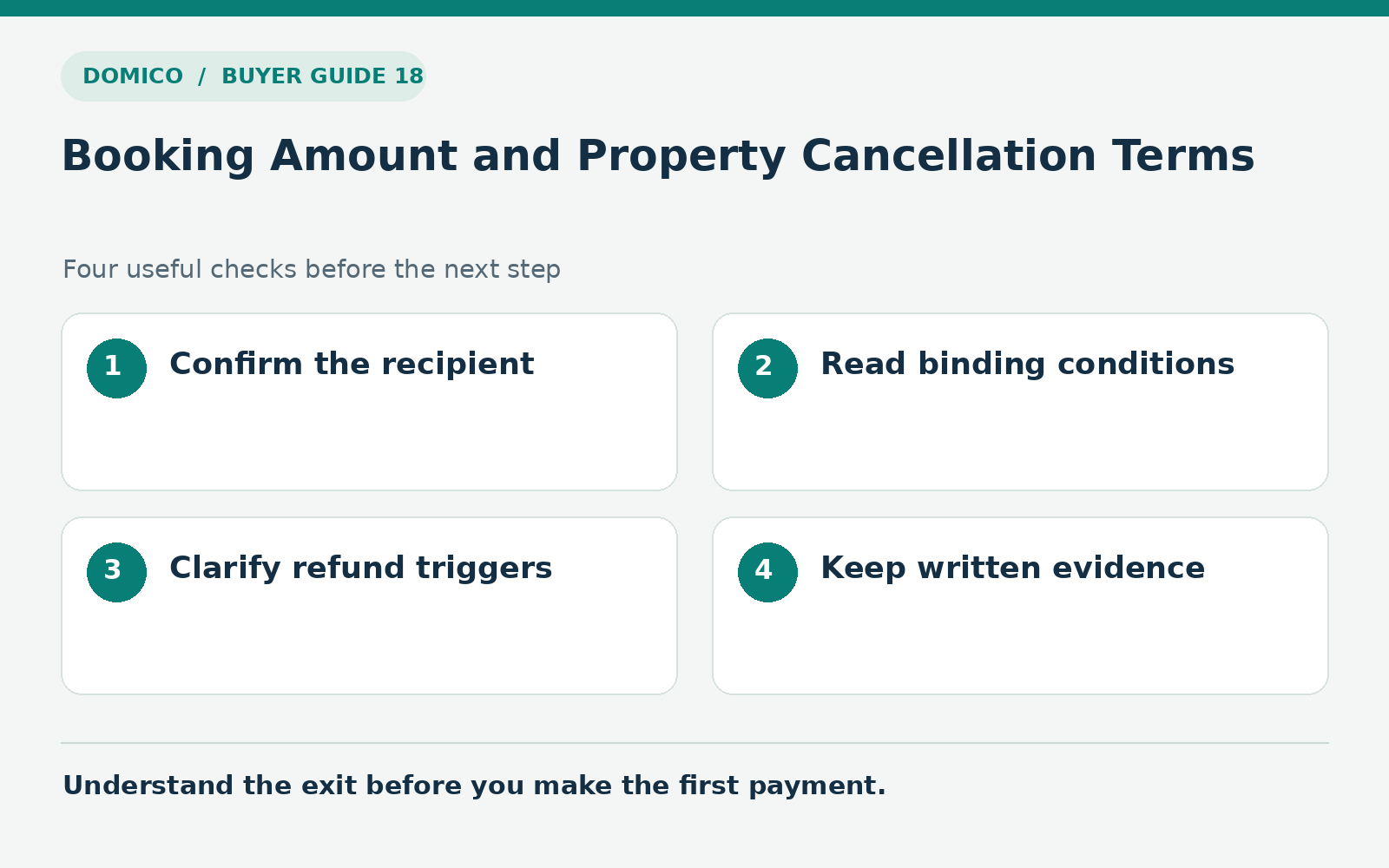
Understand the exit before you make the first payment.
A property booking amount can feel small compared with the total price, but its terms deserve careful reading. Before paying, establish who is receiving the money, which property it reserves, how it is adjusted and what happens if the transaction does not proceed. A verbal assurance that the amount is refundable should be reflected clearly in the relevant documents.
Cancellation and refund questions depend on the transaction, reason for withdrawal, contract, applicable law and facts. This guide explains how to examine the terms and preserve a clear record. It does not promise that every booking amount is refundable or that every deduction described in a form is automatically valid.
What is the payment actually for?
Ask whether the payment is an expression-of-interest amount, application fee, reservation, advance towards consideration or another defined payment. Labels can vary, so read the operative terms rather than relying only on the heading.
Confirm the exact project, phase, unit or plot and the proposed contracting party. If an intermediary collects money, verify the authority and authorised recipient. An agent's involvement does not remove the need to understand who owes the relevant obligations.
Ask for the complete form before payment and retain the accepted version. A receipt proves that money was received, but it may not explain all the conditions governing cancellation. Read the receipt, booking form, cost sheet and any agreement together.
| Before paying | What should be clear | Useful evidence |
|---|---|---|
| Property identity | Exact unit or plot and relevant phase | Written property reference |
| Recipient | Authorised person or entity and role | Verified payment instructions and authority |
| Adjustment | How the amount counts towards the price | Clear contractual wording |
| Cancellation | Reasons, deductions, process and timing | Complete applicable terms |
| Financing or review condition | What happens if an agreed condition fails | Properly documented condition |
The RERA advance rule is not a refund formula
For promoter transactions to which the provision applies, section 13(1) of the Real Estate Act restricts accepting advances or application fees above 10% of the property's cost before a written, registered agreement for sale. Have an adviser apply the provision to your case.
That advance threshold does not mean a promoter may automatically retain 10% on every cancellation. It also does not create a universal 10% refundable booking policy. Collection requirements and the legal treatment of a cancellation are different questions.
A resale token between private parties may involve a different contractual and legal analysis from a promoter booking. Identify the transaction first. Do not copy a rule from a developer-sale article into every property reservation without checking applicability.
Separate the reasons a transaction may stop
A buyer changing personal plans is different from a lender declining finance, an unresolved title concern, a seller failing an agreed condition or a promoter missing a material obligation. The reason matters, as do the terms and evidence supporting it.
If financing is essential, ask how the booking will be treated if the loan is not approved or the eligible amount is lower. The answer should not be left to an informal assumption. A general statement that loans are available does not necessarily make approval a condition of your booking.
If the purchase depends on satisfactory legal review, define the relevant process with professional help. Avoid vague wording that leaves everyone with different expectations about what qualifies as a concern or how it must be raised.
| Possible reason | Question to resolve before booking | Evidence to preserve if it occurs |
|---|---|---|
| Personal withdrawal | What contractual cancellation treatment applies? | Accepted terms and dated request |
| Financing unavailable | Is approval an agreed condition, and on what terms? | Relevant lender response and condition |
| Legal review concern | What review and response process was agreed? | Adviser's concern and supporting records |
| Seller or promoter issue | Which obligation or representation is involved? | Contract, disclosures and communications |
| Change in unit or terms | Did you agree to the change and its consequences? | Original and proposed revised documents |
Read deductions and timelines precisely
If the form mentions a deduction, identify its amount or formula, the event triggering it and the base on which it is calculated. A percentage of the booking amount is different from a percentage of the total price. Do not accept an ambiguous explanation when the difference is material.
Ask when a refund becomes due, what documents are required and whether any stated condition affects processing. A clause that refers to resale of the unit or another uncertain event deserves careful review before you rely on a quick return of funds.
Read the terms with an adviser where needed. A printed clause is not the end of every legal question; its applicability and enforceability may need examination. Equally, a buyer should not assume a disliked term can simply be ignored after accepting it.
A numerical example of why the base matters
Imagine a hypothetical booking payment of ₹1 lakh on a ₹50 lakh property. A discussion about “10% deduction” could mean ₹10,000 if applied to the booking amount or ₹5 lakh if applied to the full property price. These are very different figures.
This example is arithmetic only. It does not say either deduction is lawful, agreed or applicable. It shows why the written base, trigger and relevant legal position must be understood rather than reduced to a casual percentage.
| Hypothetical wording being discussed | Arithmetic result | What still needs review |
|---|---|---|
| 10% of a ₹1 lakh booking amount | ₹10,000 | Actual term, trigger and legal validity |
| 10% of a ₹50 lakh total price | ₹5,00,000 | Actual term, trigger and legal validity |
| No deduction under an agreed condition | Full payment in this arithmetic example | Whether that condition is met and applies |
Ask for a clear amount in a proposed cancellation statement, along with the clause and reasoning relied on. That makes the discussion concrete and gives your adviser something specific to assess.

Keep an organised payment and communication file
Retain the quotation, booking form, agreement, payment proof, receipt and relevant sales representations. Keep the version and date clear. If important terms were discussed by message, preserve the complete relevant exchange rather than a cropped sentence without context.
Record the authorised recipient and transaction reference. If the payment was adjusted, transferred to another unit or partly refunded, reconcile the amounts. A simple ledger can prevent confusion about what remains outstanding.
Protect sensitive information. Share personal identity and banking records only where needed for the legitimate process. Keep originals secure and use copies for ordinary enquiries unless the applicable procedure requires otherwise.
How to raise a cancellation or refund request
Use the notice method required by the applicable documents and seek advice if rights or deadlines are material. State the property reference, payment details, reason, relevant condition or obligation and the outcome requested. Attach appropriate evidence and retain proof of delivery.
Keep the tone factual. Identify the issue without exaggeration or unsupported allegations. Ask for a written response, itemised calculation of any proposed deduction and the stated basis for the timeline.
A useful request structure is: identify the booking, list payments, explain the reason, refer to the relevant documented position and request confirmation of the treatment and next steps. This is an organising method, not a legal notice template or a guarantee of entitlement.
If the response does not match your understanding
Compare the response with the actual contract and facts. Is the disagreement about the reason for cancellation, the applicable clause, the deduction base or the timing? Narrowing the issue helps an adviser assess the next step.
Ask a qualified lawyer about the appropriate process and forum. Depending on the case, the applicable legal framework may provide different options. Do not assume the same authority or remedy applies to every private resale, promoter sale or intermediary payment.
Preserve the file while seeking advice and be mindful of applicable time limits. Avoid relying on a broad internet statement that all refunds must arrive within one fixed period. The actual provision, order or contract needs to be identified.
Be careful with settlement documents
If a refund or adjustment is proposed, read any cancellation, release or settlement document before signing. Understand the amount, payment timing, remaining claims and effect of an acknowledgment. Do not treat a document as a mere formality because it accompanies a payment discussion.
Check whether the payment has actually been received and reconciled before acknowledging facts that are not yet true. If a partial payment is made, record whether it is accepted as partial or as a final settlement under the agreed terms.
Get advice before accepting a revised arrangement that you do not understand. A clear settlement can resolve a dispute, but broad language may have consequences beyond the amount immediately being discussed.
Changing to another unit is a new decision
A promoter or seller may offer an adjustment to a different unit or property instead of a refund. Compare the new property's identity, price, specification, timeline and legal position. Do not assume the original checks automatically cover it.
Ask how the original payment is credited, whether new charges apply and what happens to the earlier terms. Retain a clear written reconciliation. An internal transfer should not leave uncertainty about the amount paid or the property reserved.
Decide whether the alternative genuinely suits your needs. Accepting an unsuitable property only to avoid a refund discussion can create a much larger commitment than the original problem. Review it with the same budget and verification discipline as any new shortlist.
Questions worth asking before the first transfer
Ask: who receives this payment; which exact property does it relate to; where is it adjusted; what happens if financing fails; what happens if legal review raises a material issue; what deductions are proposed; and what process and timeline apply?
Request answers in the appropriate written documents, not only in a voice call. If the person cannot explain a clause, obtain clarification before paying. A short delay to understand the terms can prevent a long disagreement later.
Also check the next payment trigger. Sometimes the most important consequence of a booking is the obligation to pay more soon afterwards. The initial amount may fit your cash balance while the following deadline does not fit the financing plan.
Separate third-party expenses from the refund request
The seller's treatment of a booking amount and a lender's treatment of an application fee can be different questions. Keep each payment, recipient and applicable term distinct. If professional work was commissioned separately, review that engagement too. An expected refund from one party should not be used as an assumption that every other cost will also return. Reconcile the complete position before deciding what funds remain available for another property.
Frequently asked questions
Is a booking amount always refundable?
No universal answer applies. The transaction, reason for withdrawal, accepted terms, applicable law and facts matter. Obtain case-specific advice rather than relying on a verbal promise or a generic refund claim.
Does loan rejection automatically mean a full refund?
Do not assume so. Check whether financing approval was an agreed condition and how the documents address the situation. Preserve the lender's relevant response and seek advice on the actual terms and facts.
Is the RERA 10% advance rule a cancellation deduction rule?
No. It concerns collection before a written, registered agreement for sale in the relevant promoter transaction. It should not be treated as an automatic percentage that may be retained or refunded on cancellation.
What if the receipt says non-refundable?
Have the complete terms and circumstances reviewed. The label alone does not answer every question about applicability or enforceability, but it should be understood before payment. Do not assume either automatic forfeiture or automatic recovery.
Should I accept a verbal refund promise?
Ask for clear written terms and keep proof of the payment and request. Confirm the amount, deductions if any, conditions and timeline. Important commitments should be recorded in a form you can rely on and review.
Make booking a documented decision
When shortlisting properties in Indore, ask for the booking terms alongside the price sheet. The first payment should follow a clear understanding of the transaction, including what happens if it cannot continue.
Primary references and scope
- Real Estate Act, India Code — section 13 and other applicable provisions.
- Haryana RERA: central Act text — official reproduction of the central statutory text; MP-specific application and rules need separate review.
- MP RERA — relevant state authority records and current procedures.
Prepared on 18 October 2026. This educational guide is not legal advice or a finding that a particular refund or deduction is due. Seek advice on the actual contract, facts and applicable law. Images illustrate the topic.
Continue reading
- homebuyers
- buying-guide
- booking-cancellation-refund
- indore
Planning to buy or rent in Indore? Browse verified properties in Indore or read more Indore guides.