Buying Guide
New Flat vs Resale Flat: A Buyer’s Comparison
Compare new and resale flats using total price, actual condition, ownership papers, society records and possession readiness.
11 min read

Buying Guide
Compare new and resale flats using total price, actual condition, ownership papers, society records and possession readiness.
Buy the condition, records and layout you can verify.
A new flat and a resale flat can both provide a good home. The better choice depends on the exact unit, complete cost, possession needs, documentation and work required. “New” describes one part of the story; “resale” describes a transaction route. Neither word is a complete quality rating.
This guide compares a developer sale with a home sold by an existing owner. It focuses on the practical differences in evidence, condition, negotiation and transfer. A separate timing question—ready-to-move versus under-construction—can apply to the shortlist too, so establish the actual status of every option rather than assuming all new flats are unfinished.
Choose comparable properties with similar usable space, important routes and intended occupation dates. A new apartment outside your preferred daily area and a resale apartment beside your workplace offer different lifestyles as well as different transaction types.
Record the exact unit, carpet area where relevant, floor, parking arrangement, quoted price and condition. Ask what is included. A resale home's furniture may be negotiable, while a new sample flat may contain upgrades excluded from the offered specification.
Write the essential work needed before either home is usable. A new unit may need basic fittings, storage and other setup. A resale unit may need repairs or replacement of services. Neither should be assumed ready for your household merely because it looks attractive during a viewing.
| Comparison area | New flat from developer | Resale flat from owner |
|---|---|---|
| Main counterparty | Relevant developer or authorised entity | Existing owner or properly authorised seller |
| Condition evidence | Actual unit or specified future delivery | Existing unit and building condition |
| Price documents | Developer cost sheet and agreement | Negotiated consideration and written inclusions |
| Legal focus | Project, phase, permissions and contract | Ownership chain, authority and transfer position |
| Ongoing building evidence | May be estimated if operations are new | May include operating history and association records |
A resale viewing lets you inspect the actual layout and observe some aspects of the operating building. You can assess light, ventilation, visible wear, common-area condition and the route from parking to the front door. This can reduce uncertainty about how the space feels in use.
However, occupation does not prove that the records or alterations are in order. Ask about changes to the original plan, enclosed spaces or moved services. Have an appropriate adviser assess permissions and implications where a change matters to the purchase.
Visible condition also has limits. Paint can hide a history of damp, and a working tap does not certify the full plumbing system. Use a technical inspection for significant concerns and obtain repair quotations against a clear scope.
Match the exact unit and phase across the plan, cost sheet, booking form and agreement. For relevant projects, check MP RERA disclosures and current records. Confirm the promoter's legal identity and the authority of the person arranging the transaction.
Read the specification schedule carefully. Ask which sample-flat features are included, optional or decorative. Establish the relevant area basis and the written treatment of balconies, parking and amenities. A wide development illustration should not replace a precise description of what your purchase includes.
For a completed unit, inspect the actual home and relevant completion or occupancy records where applicable. For an unfinished unit, examine the delivery timeline, payment schedule and remaining work. A new sale still requires property-specific legal and technical review.
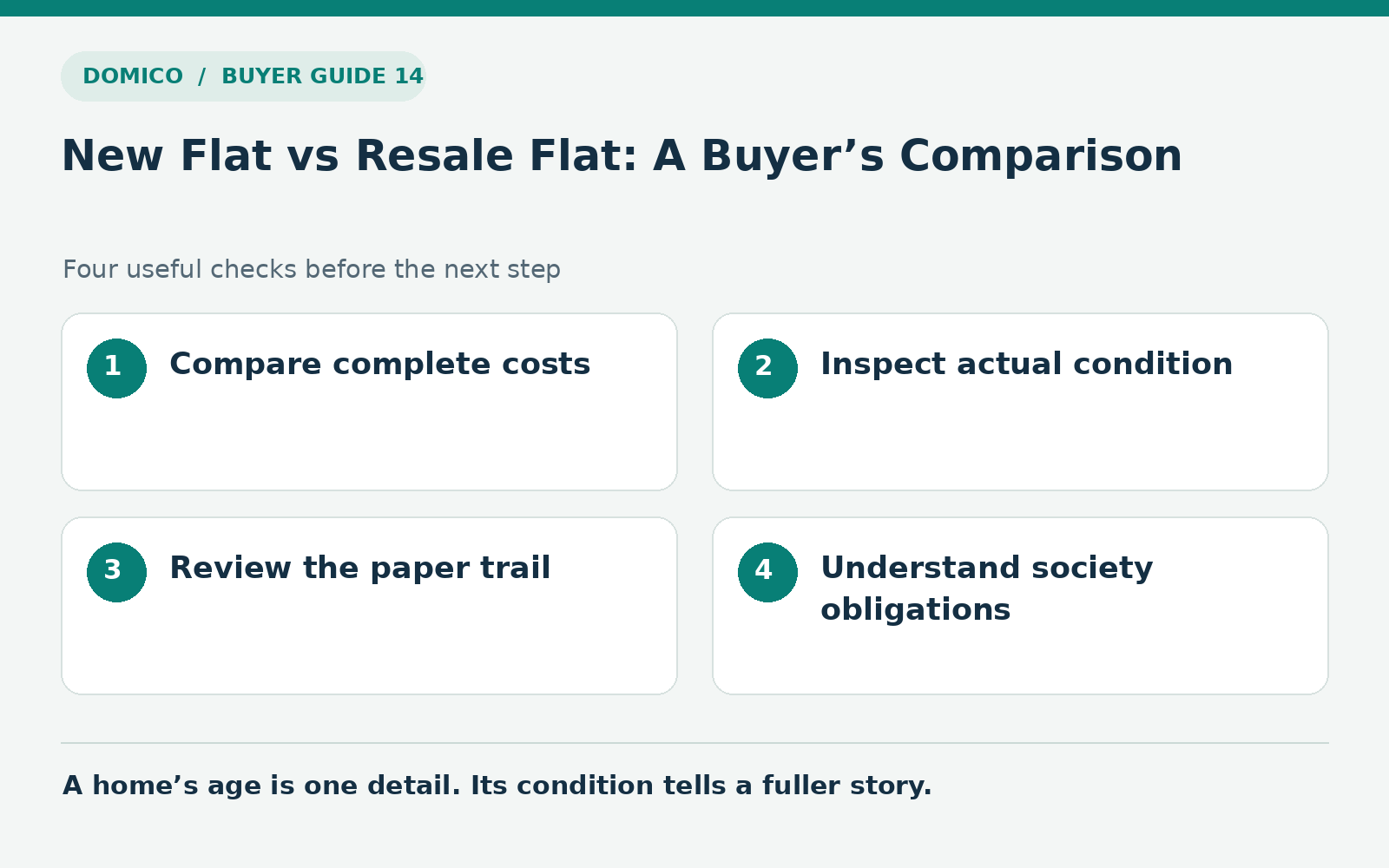
Use a complete budget rather than a price-per-square-foot headline. Add applicable transaction costs, loan expenses, essential repairs or fit-out and rent until the intended move. Obtain current tax advice for the actual transaction rather than applying one assumption to every new or resale sale.
The example below is hypothetical and does not represent market prices or official charges. It shows how repair and setup allowances can change a starting-price comparison. Every allowance needs a current assessment or quotation before a real decision.
| Illustrative cost | New flat | Resale flat |
|---|---|---|
| Agreed property price | ₹55,00,000 | ₹50,00,000 |
| Assumed transaction and finance allowance | ₹6,00,000 | ₹5,50,000 |
| Assumed essential fit-out or repairs | ₹2,50,000 | ₹5,00,000 |
| Assumed moving and rent overlap | ₹50,000 | ₹70,000 |
| Illustrative total | ₹64,00,000 | ₹61,20,000 |
The resale option remains cheaper in this example, but the difference is ₹2.80 lakh rather than the ₹5 lakh starting-price gap. A different repair assessment or specification can change the result. Do not choose from the table without the actual property's evidence.
Ask an independent property lawyer to examine the ownership chain, seller's authority and the property's legal position. Match the unit description and identifiers throughout the documents. If there are co-owners, inheritance issues or an attorney, clarify the required participation and authority early.
Check whether a mortgage or other liability must be addressed. If a loan is outstanding, the settlement and original-document release process should be coordinated with the relevant lenders and advisers. A promise to “clear it after the token” is not a complete closing plan.
Review applicable association or society records and the allocation of outstanding amounts. Ask what documents and steps apply to the transfer in that building. The precise requirements vary; do not accept a generic checklist as proof that the file is complete.
Look at common areas, lifts, staircases, parking access and visible signs of water or maintenance problems. Ask about the maintenance system and major upcoming works. A unit can look excellent while the building needs substantial expenditure.
For a new building, ask which shared systems are operational and how management will be arranged. For an older building, ask about actual maintenance collections, significant repairs and unresolved service issues. Treat personal comments as leads to verify rather than evidence of an entire building's condition.
Check whether the building supports the occupants' needs. An elderly parent, a wheelchair user or someone returning late from work may experience the same property very differently. Walk the actual access route and test practical arrangements where permitted.

For resale, separate necessary repairs from optional redesign. Investigate leakage, electrical concerns, plumbing and worn fixtures before pricing cosmetic improvements. A contractor's estimate should specify scope, materials, labour and exclusions so that competing quotes can be compared.
For a new unit, obtain the delivered specification and identify what you must add. Do not assume wardrobes, kitchen equipment, lights or other sample-home details are included unless the documents say so. A bare but well-finished unit still needs a realistic move-in plan.
Check whether proposed work is permitted by the relevant rules and building arrangements. Removing walls, moving wet areas or enclosing open space can involve more than a renovation quote. Seek qualified advice before treating a desired change as straightforward.
The lender will assess your application and the chosen property. A salary-based estimate does not guarantee the same financing for every new or resale flat. Accepted valuation, documents, condition and product requirements can affect the result.
Ask what contribution you must make, which costs are financed and when funds can be released. For a resale home with an existing mortgage, understand the closure sequence. For a developer sale, understand the agreement's demands and lender conditions, particularly if disbursement is staged.
Do not promise the seller a rapid closing solely because a loan officer gave an informal initial response. Align the written transaction timetable with the confirmed process and allow time for material questions to be resolved.
In a resale deal, the discussion may include price, repair responsibility, movable items, vacating date and settlement of agreed dues. List these clearly. A lower price accompanied by costly unaddressed repairs may not be the improvement it first appears to be.
In a developer sale, ask for a revised written cost sheet showing any concession and its conditions. Confirm whether an incentive changes payment timing, specification or other terms. A headline benefit should be translated into the complete amount and obligations you accept.
For both routes, maintain a personal maximum based on the full budget. Avoid making a larger payment to secure a small concession before the legal review and financing are ready. The best negotiation still needs a property you can safely and comfortably complete.
Write down the documents, payments and physical items required to complete the deal. Include the exact property, final consideration, relevant charge allocations, possession date, keys and access devices. Identify who will supply each item and when.
For resale, clarify vacant possession and the treatment of belongings or agreed fixtures. For a developer handover, compare the unit with the contractual specification and record defects. Have the final documents reviewed before signing broad acknowledgments or revised terms.
| Before completion | Evidence or agreement needed | Why it matters |
|---|---|---|
| Final price | Written consideration and complete component list | Prevents a last-minute mismatch |
| Legal readiness | Reviewed title and relevant permissions | Establishes what is actually being transferred |
| Funding | Confirmed lender release and buyer contribution | Makes payment dates realistic |
| Condition | Inspection notes and agreed open work | Records the state of the exact unit |
| Handover | Keys, meter details, records and possession terms | Makes the home practically usable |
A buyer who values an operating neighbourhood and wants to inspect an established building may find a suitable resale home attractive. That preference still needs a clean legal file, realistic repair allowance and a clear transfer process.
A buyer who prefers a particular new layout or specification may favour a developer sale. The decision still depends on written inclusions, actual readiness or future delivery, complete costs and the quality of the specific project evidence.
Someone with a fixed move-in deadline should evaluate actual usable possession rather than the age of the property. Someone with a limited cash reserve should pay close attention to setup costs and financing gaps under both routes. The right answer depends on the household and the exact homes.
If a resale flat is occupied by a tenant or another person, ask your lawyer to review the arrangement and proposed delivery of possession. Do not assume the seller's preferred date automatically ends another person's rights or produces a vacant home. Understand the applicable documents, obligations and practical sequence before relying on the move-in date. Your financing, agreement and household plan should reflect the position that can actually be completed.
Age alone cannot establish construction quality or daily usability. Inspect the actual unit where possible, review the specification and use qualified help for significant concerns. Building management and ongoing maintenance matter as well.
Compare current equivalent offers and the complete cost of occupation. Repairs, transaction arrangements, location and condition can change the result. A lower starting price is useful only when the total plan remains suitable.
Suitable lending products may be available, subject to the lender's assessment of the applicant and property. Obtain a property-specific review and understand the accepted value, documents, conditions and contribution required.
Ask for a professionally coordinated settlement and document-release process involving the relevant lenders. Understand the required evidence and sequence before committing to payment dates. Do not rely on a vague promise to clear the liability later.
Agree what stays and list the items and their condition in the appropriate documents. Distinguish movable belongings from property fixtures and seek tax or legal advice if the structure requires it. Avoid an unclear verbal package.
Review Indore flat options using the same area basis, complete price and intended move-in date. A well-chosen home should provide a usable layout, understandable obligations and a documented transfer, whether it is new or resale.
Prepared on 18 October 2026. All sample figures are hypothetical. This comparison does not certify a property or replace transaction-specific legal, technical, tax or financial advice. Images illustrate the topic.
Planning to buy or rent in Indore? Browse verified properties in Indore or read more Indore guides.
Review a developer’s identity, completed projects, delivery history, complaints and service quality using evidence rather than claims.