Buying Guide
Rent vs Buy: Compare the Real Cost of a Home
Use a transparent household example to compare rent, loan interest, ownership costs, flexibility and the cash tied up in a purchase.
11 min read

Buying Guide
Use a transparent household example to compare rent, loan interest, ownership costs, flexibility and the cash tied up in a purchase.
Compare the life and the numbers over the same years.
Rent versus buy is not answered by comparing one month's rent with one month's EMI. Buying uses upfront money, creates ownership responsibilities and can build equity through principal repayment. Renting pays for the use of a home while usually offering more flexibility. Both choices have costs, benefits and risks.
A useful comparison looks at equivalent homes, the same time horizon and the money left available under each route. It also considers how long you expect to stay, how stable your income is and how strongly you value control over the home. This guide explains the comparison without assuming that property prices or investment returns will follow a guaranteed path.
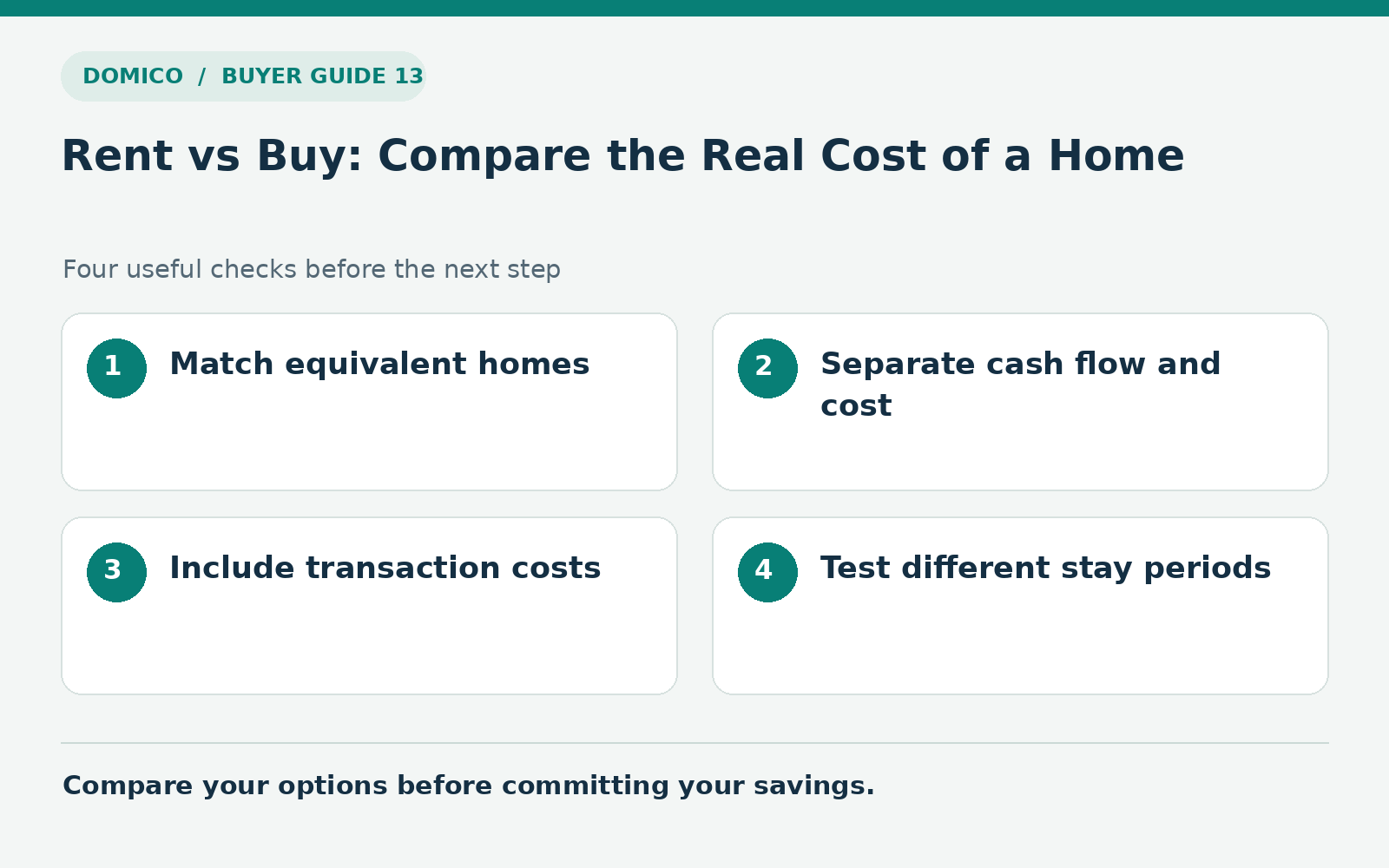
Compare a home you would realistically rent with a home you would realistically buy. If the purchase option is larger, newer or in a different location, part of the cost difference is a lifestyle change rather than a pure renting-versus-owning decision.
Use the same household needs: usable rooms, important journeys, access requirements and expected occupation date. Record the condition and essential work required. A rental ready for immediate use and a purchased home needing major repairs should not be compared as if both offer the same starting point.
Then choose a time horizon based on your plans. A possible transfer in two years changes the decision from a plan to remain for ten years. You cannot predict every life event, but a known possibility deserves a place in the comparison.
| Comparison area | Renting | Buying |
|---|---|---|
| Upfront money | Deposit, moving and applicable initial costs | Price contribution, transaction costs and setup |
| Monthly cash flow | Rent and agreed occupier expenses | EMI plus ownership and occupier expenses |
| Flexibility | Depends on lease terms and available alternatives | Sale or letting requires a separate process |
| Control | Changes depend on the lease and owner's consent | Changes still depend on applicable rules and building restrictions |
| End position | Deposit recovery and any savings or investments | Property value less outstanding loan and exit costs |
An EMI contains interest and principal. Interest is a borrowing cost; principal repayment reduces the loan balance and builds your equity, assuming the underlying asset value is considered separately. Treating the entire EMI as an unrecoverable expense can distort the comparison.
But principal repayment still uses cash every month. A household cannot spend that same money on groceries simply because it creates equity. That is why you need two views: monthly affordability and the longer-term financial position.
Rent is also paying for a real service: a place to live during the lease. Calling all rent “wasted” does not help compare the flexibility and capital retained under that route. Evaluate what each payment provides and what remains at the end.
Assume a hypothetical ₹50 lakh home, a ₹40 lakh loan, an 8.5% annual interest rate and a 20-year reducing-balance schedule. The monthly EMI is about ₹34,713. Assume the rate stays unchanged and no fees or prepayments affect the schedule.
During the first twelve payments, the total EMI outflow is about ₹4,16,555. Approximately ₹3,36,946 is interest and ₹79,609 is principal repayment. The outstanding loan after those payments is about ₹39,20,391. These are calculations using stated assumptions, not a lender offer.
| Illustrative first-year item | Buying route | Renting route |
|---|---|---|
| Housing payment | EMI about ₹34,713 monthly | Assumed rent ₹18,000 monthly |
| Annual housing payment | About ₹4,16,555 | ₹2,16,000 |
| Principal within annual EMI | About ₹79,609 | Not applicable |
| Interest within annual EMI | About ₹3,36,946 | Not applicable |
| Other costs still to add | Transaction, ownership and setup costs | Deposit funding, moving and agreed expenses |
The rent is hypothetical and does not estimate a current Indore rental yield. The table also does not establish the final cheaper option. Upfront costs, investment of retained money, rent changes, property value and the eventual exit all remain to be considered.
In the example, the price contribution is ₹10 lakh before transaction and setup costs. Buying commits that money to the home. Renting may leave some capital available after the deposit and initial expenses. What happens to the retained money matters to the long-term comparison.
If a model assumes the renter invests the difference, use a clearly stated return assumption and consider risk, tax and actual saving behaviour. A projected investment return is not guaranteed, and money that is spent rather than saved will not produce the modelled end balance.
Apply the same discipline to the buying route. Do not insert a confident appreciation rate merely because a property is in a developing area. Test more than one property-value scenario, including a flat-price scenario and a less favourable exit.
Ownership may involve applicable taxes, maintenance, insurance, repairs and periodic major work. Some expenses would also exist for a tenant, while others belong to the owner under the relevant arrangements. Avoid counting a shared expense on one side only.
Transaction and exit costs can be particularly important over a short holding period. Buying and selling involve time as well as money, and a sale may not complete on the date you prefer. A model that assumes an instant sale at an advertised price can overstate the ease of changing plans.
If you might let the home instead of selling, model that as a separate scenario. Allow for vacancy, management, repairs and any financing or association conditions. Expected gross rent is different from reliable net cash available every month.

A longer stay can spread one-time transaction costs over more years, but it does not automatically make any purchase attractive. Price, financing, property condition and future alternatives still matter. A short stay can make flexibility more valuable when a move is likely.
Ask what would happen if you needed to relocate sooner than planned. Could you carry the loan while selling? Would another move require a deposit and rent elsewhere? These practical questions can reveal a cash-pressure risk that an annual return estimate misses.
Also consider whether the property will remain suitable. Buying a home you expect to outgrow very quickly can create another transaction and another set of costs. A modestly different rental may be easier to change while plans become clearer.
Build a base case from current quotes, then change the assumptions that most affect your decision. Keep the same method on both sides. If the conclusion reverses when one optimistic assumption is removed, understand that sensitivity before committing.
| Scenario to test | What changes | What you learn |
|---|---|---|
| Shorter stay | Earlier sale or move | Effect of transaction costs and flexibility |
| Higher financing cost | Increased repayment or borrowing expense | Pressure on buying cash flow |
| Slower property growth | Lower eventual value than hoped | Dependence on appreciation |
| Higher rent | Larger future rental outflow | Pressure on the renting plan |
| Lower investment outcome | Smaller return on retained capital | Dependence on investment assumptions |
Do not compare an optimistic property scenario with a pessimistic investment scenario just to justify a preferred answer. The point is to understand how your decision behaves under plausible alternatives, not force a spreadsheet to endorse it.
For buying, list the initial outlay, monthly loan schedule, ownership costs and expected exit date. At the end, estimate a property value under each scenario, subtract the outstanding loan and relevant selling costs, and consider applicable tax with professional advice.
For renting, list the initial deposit and expenses, rent schedule and other relevant costs. Track retained capital and any monthly savings that would actually be invested under the chosen assumptions. Include deposit recovery on the assumed terms and investment-related costs or taxes where relevant.
Keep all cash flows on a consistent timing basis. A more formal comparison may use discounted cash flows, but the model is only as useful as its inputs. Avoid counting the same down payment as both retained cash and invested money, or subtracting principal twice from the buying outcome.
Owning can provide a sense of stability and control, subject to financial and legal responsibilities. A family may value staying in one home, arranging it for long-term needs and reducing uncertainty about a landlord's future plans. Those preferences can be legitimate even when a model is close.
Renting can suit a changing job, a new city or uncertainty about household needs. It may allow someone to live closer to work without making a large immediate purchase. The value depends on the actual lease, property and alternatives available.
Discuss these priorities openly with co-decision-makers. One person may value flexibility while another values permanence. A clear conversation is more productive than debating whether rent is always bad or ownership is always financially superior.
If the price contribution uses nearly every accessible rupee, the EMI depends on uncertain income or the property has unresolved material questions, pause the commitment and improve the plan. Continuing to rent while preparing is a valid outcome, not a failure to progress.
A pending job change, major family expense or unclear location preference may also favour more time. Use that period actively: review borrowing readiness, build savings and learn the market through comparable properties and visits.
Do not buy only because of a claim that prices will never be affordable again. Future prices are uncertain, while a signed payment obligation is concrete. Choose a commitment that remains manageable under more than the best expected circumstances.
Can we afford the monthly outflow after including ownership expenses? How much accessible money remains after purchase? How long are we likely to use this home? What would we do if a move became necessary? Which assumptions drive the financial comparison?
Write the answers in one place. If the household disagrees, identify the specific fact or preference behind the difference. Sometimes the next useful action is a lender assessment or a trial commute; sometimes it is a clearer savings target.
The decision does not need to be permanent for every stage of life. Renting now and buying later, or buying a smaller suitable home rather than stretching, can both be rational plans when they fit the actual circumstances.
A recoverable deposit ties up cash but is different from rent paid for use of the home. Model its payment and recovery on the expected lease terms, including any genuine deductions or uncertainty. If you include an opportunity cost, avoid also treating the entire recoverable principal as a permanent expense. Consistent treatment of deposits and upfront purchase money makes the comparison clearer.
Rent pays for the use of housing and may provide flexibility. The relevant comparison includes the cost of ownership, capital committed and end position under both routes. A slogan cannot answer a household's financial and practical needs.
Compare the complete outlay first. Include the price contribution, transaction costs, ownership expenses and liquidity remaining. Also check that the two homes are equivalent and that the EMI assumption is a real lender assessment.
It is a cash outflow, but it includes principal and interest. Principal reduces the loan balance; interest is a financing cost. Keep the cash-flow and long-term wealth views separate to avoid double counting.
There is no universal break-even period. It depends on prices, rents, financing, transaction costs, investment assumptions and future property value. Model your intended period and test an earlier move.
A calculator can organise the arithmetic, but it cannot guarantee returns or choose your priorities. Check assumptions, current quotes and practical constraints. Use the output as one part of a broader decision.
Use actual Indore property options, current rental alternatives and a realistic household budget. The right choice should make sense both on paper and on the ordinary month after you move.
Prepared on 18 October 2026. All numerical examples are hypothetical and exclude unspecified fees and taxes. No property appreciation, investment return or future rent is guaranteed. This is educational, not personalised financial advice. Images illustrate the topic.
Planning to buy or rent in Indore? Browse verified properties in Indore or read more Indore guides.
Review a developer’s identity, completed projects, delivery history, complaints and service quality using evidence rather than claims.