Buying Guide
No EMI Until Possession: Costs, Liability and Buyer Risks
Check who owes the lender, how builder-paid interest works, when support ends and whether you can carry the loan if payments stop.
8 min read

Buying Guide
Check who owes the lender, how builder-paid interest works, when support ends and whether you can carry the loan if payments stop.
Someone may promise to pay the interest, but first check who owes the bank.
“No EMI until possession” can make an under-construction home appear easier to afford. The phrase may refer to a promoter paying interest for a period, a reimbursement arrangement, a deferred payment structure or another product. Those arrangements are not interchangeable, and the headline does not establish that the buyer has no loan obligation.
Before evaluating the offer, obtain every linked document: the sale agreement, lender's sanction and loan terms, the scheme terms and any tripartite agreement. Identify who pays, when payments begin and end, and what happens if construction or the subsidy payment is delayed.
Ask the salesperson to explain the money trail without slogans. Will the lender disburse in stages? Does the developer pay the lender directly or reimburse the buyer? Is the promise limited to interest, a full instalment or a fixed amount? Does the support end on a calendar date even if possession is late?
Write those answers into a timeline and compare them with the documents. A verbal promise of support “until possession” may differ from an agreement promising support for twenty-four months or until an earlier defined event.
| Offer description | What it may involve | What to verify |
|---|---|---|
| Promoter-paid pre-EMI | Promoter services interest on disbursed loan | Payment dates, amount and borrower liability |
| Buyer reimbursed later | Buyer pays first and claims reimbursement | Proof, timing and conditions for repayment |
| Deferred developer balance | Part of price is payable later | Complete price and final payment trigger |
| Fixed support period | Benefit ends after specified months | What happens during a longer delay |
The table describes possible structures, not an approval of any scheme. The applicable lender rules, product terms and transaction require individual review.
The RBI's housing-loan guidance discusses builder-linked products involving upfront disbursal and promoter servicing of interest or EMI. It identifies risks from delays, disputes and promoter payment defaults, including potential effects on the borrower's credit record.
Ask the lender directly how the proposed arrangement complies with current requirements and how construction-linked disbursement will work. Do not rely only on a promoter's claim that a bank is associated with the project. A bank logo does not explain your repayment responsibilities.
Read the loan agreement to establish who is the borrower and what the lender can demand. A promoter's separate promise may create a claim against that promoter without preventing the lender from enforcing the buyer's loan obligations.
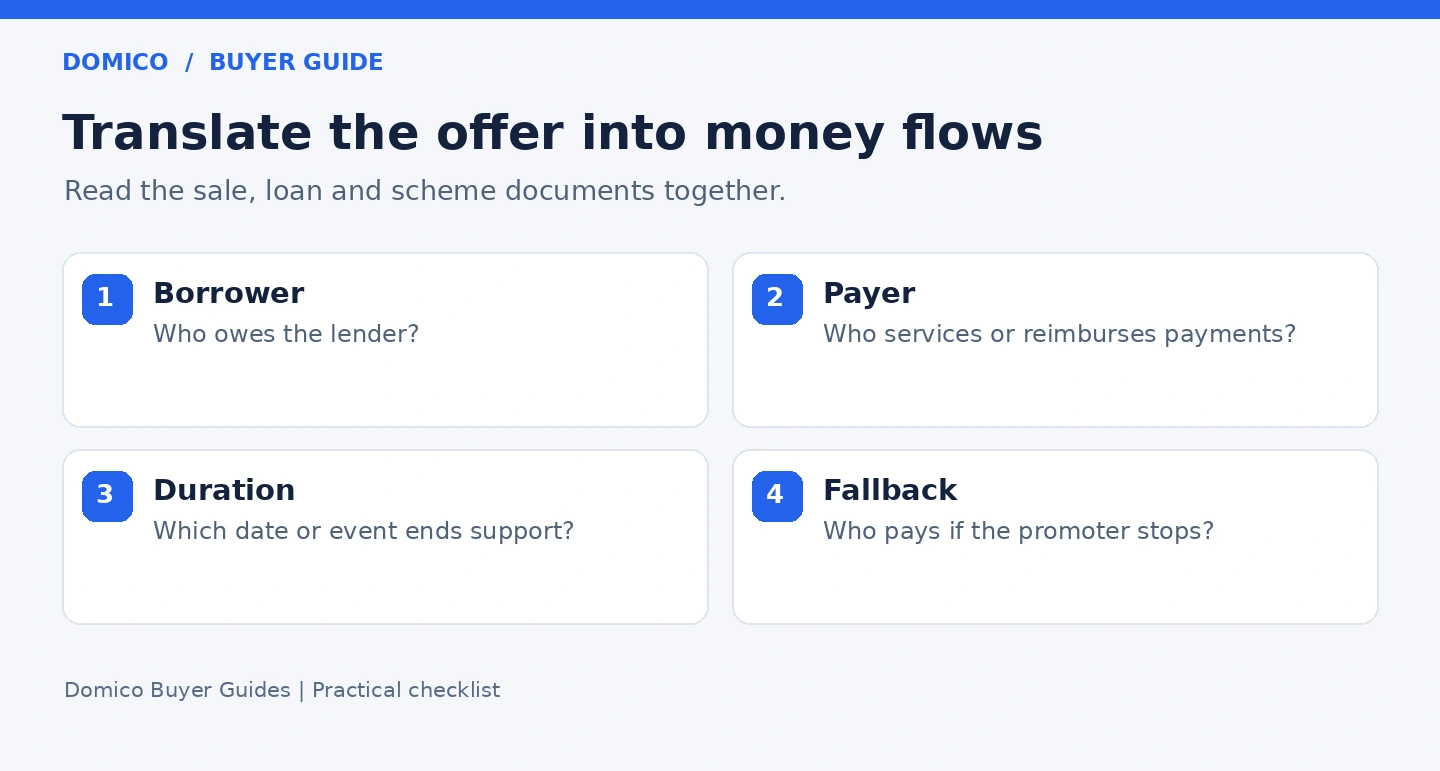
Use the actual disbursement pattern and rate, not the full sanctioned amount by default. Interest on a partially disbursed loan differs from interest after the entire amount is released. A lender's written schedule can help establish the expected amounts.
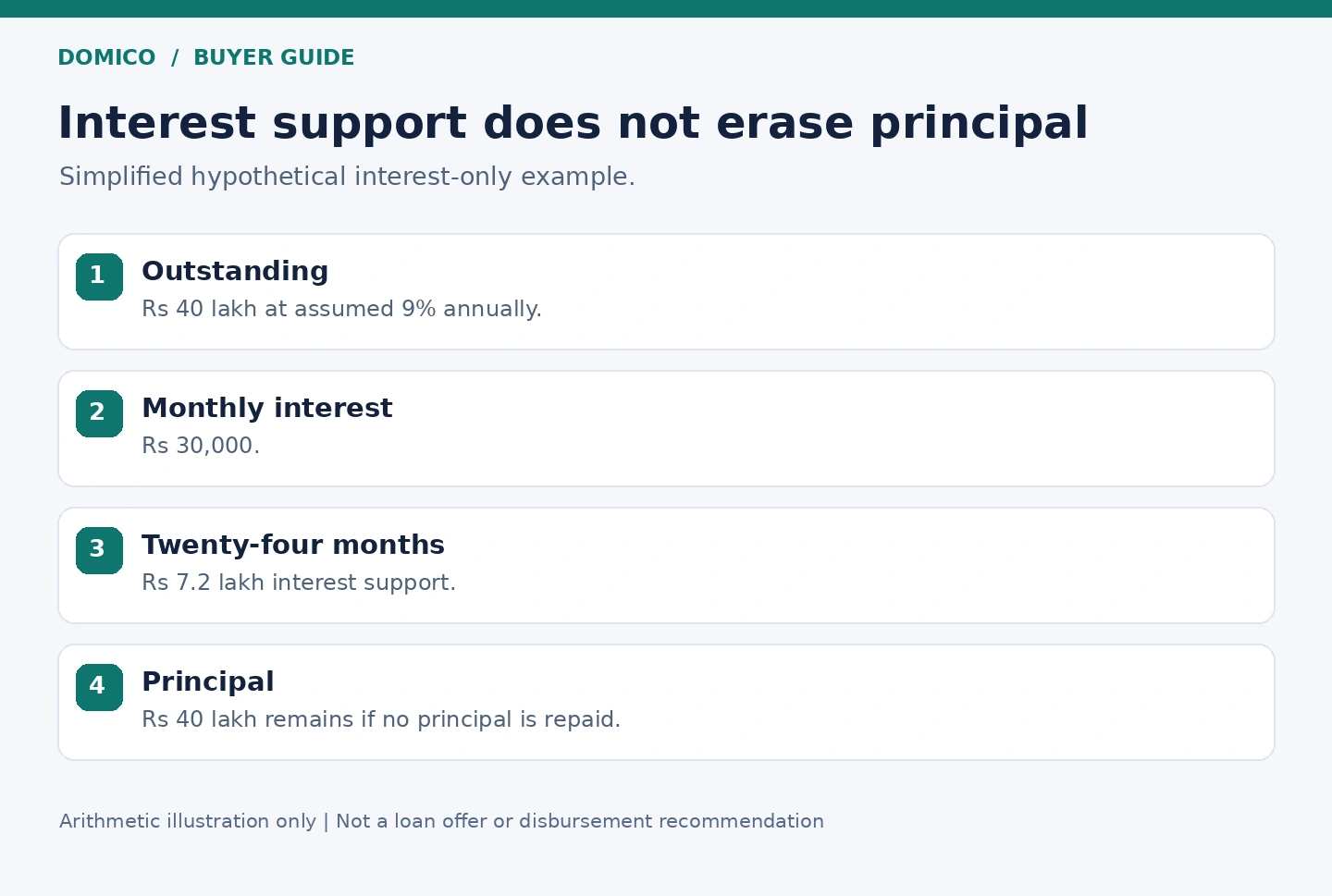
For a deliberately simplified illustration, assume Rs 40 lakh is outstanding throughout a period at 9% annual interest, with interest paid monthly and no principal reduction. Monthly interest is Rs 30,000. Twenty-four months of that interest totals Rs 7.2 lakh.
| Simplified illustration | Calculation | Amount |
|---|---|---|
| Monthly interest | Rs 40 lakh × 9% ÷ 12 | Rs 30,000 |
| Support for 24 months | Rs 30,000 × 24 | Rs 7,20,000 |
| Additional 6 months if buyer must pay | Rs 30,000 × 6 | Rs 1,80,000 |
| Principal after interest-only payments | No principal repaid in this example | Rs 40 lakh remains |
This is not a permissible disbursement model or a loan quotation. It isolates the arithmetic. Actual stage disbursement, rates, instalment structure, fees and treatment of unpaid amounts can change the result.
Request a complete price for the scheme and a comparable offer without it, where available. Separate base price, mandatory charges, taxes and conditions. A subsidy can be funded partly through a higher property price, different discounts or restrictions; only the actual quotations can establish that.
Suppose a hypothetical scheme price is Rs 3 lakh higher than an otherwise comparable offer. That difference is part of the purchase cost. It should be considered alongside the support actually expected, its timing and the risk that it ends early or is not paid.
Do not subtract the full advertised support from the property price and call the remainder the true cost without checking financing, fees and the buyer's obligations. If the support is uncertain, model a case in which the household receives less or none of the expected benefit.
Read every stopping condition. Support might end on a fixed date, a possession offer, cancellation, loan conversion, a missed buyer payment or another event. Ask how a delayed completion or a disputed possession offer affects the scheme.
The buyer should understand the funding requirement on the first day after support ends. Is the loan interest-only until then, or is a normal EMI already being serviced? What outstanding balance remains? Could the rate or tenure have changed? Ask the lender for the relevant amortisation schedule and current Key Facts Statement.
Do not assume that “no EMI” means principal has reduced. In the illustration above, paying interest alone leaves the entire Rs 40 lakh principal outstanding. A large repayment obligation can remain when the promotional period ends.
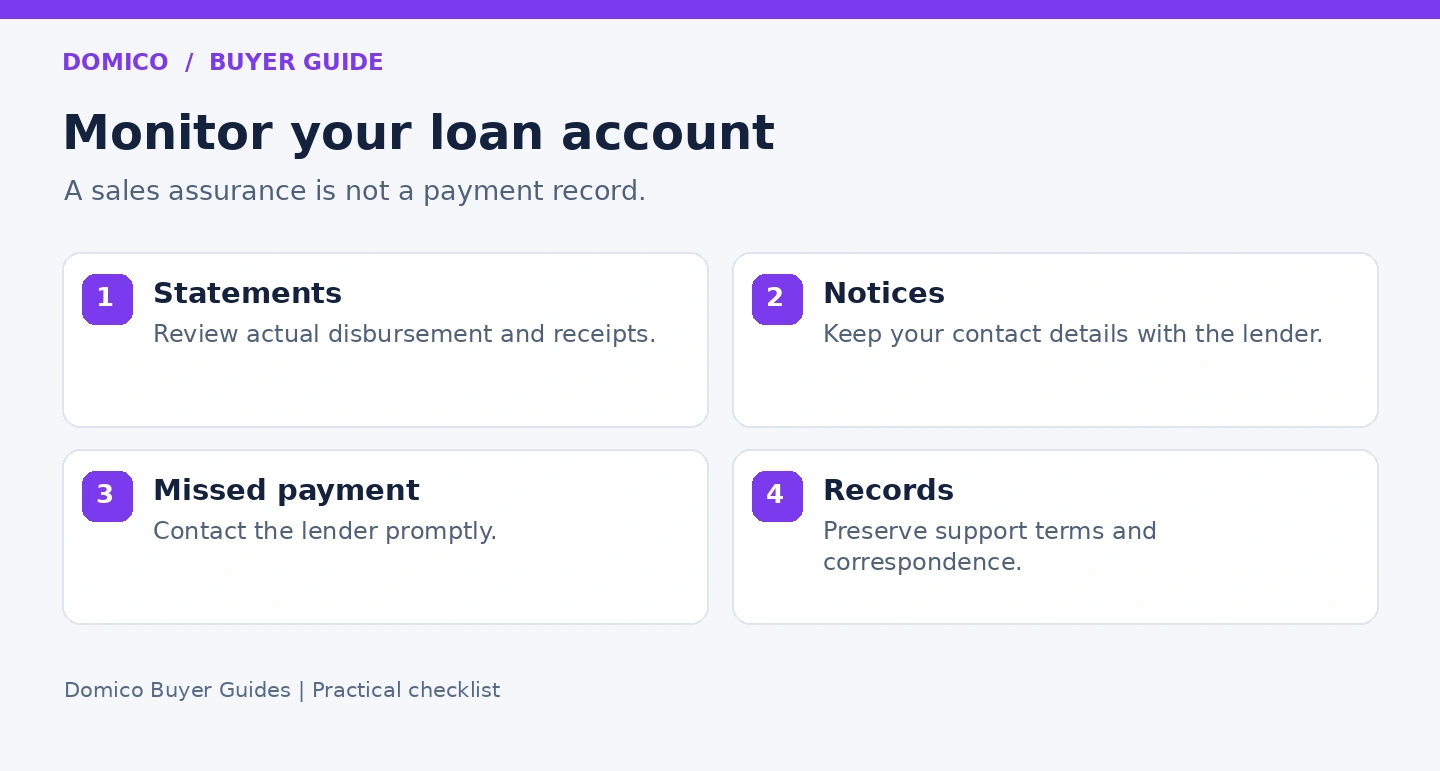
Obtain legitimate access to your loan statements and review whether payments arrive on time. Keep your own contact details registered with the lender so notices reach you. Do not allow a third party to control the only channel through which you learn about the account.
If a payment is missing, contact the lender promptly through an official channel and seek advice about the promoter's obligations. Preserve the statements and correspondence. Avoid waiting for a sales representative's informal reassurance while the account remains overdue.
| Item to monitor | What to retain | Why it matters |
|---|---|---|
| Loan disbursement | Lender statement and stage details | Establishes the amount actually borrowed |
| Promoter payment | Credit entry or reimbursement evidence | Shows whether support arrived |
| Rate or instalment change | Official lender communication | Updates the household's future obligation |
| Construction progress | Dated project information and records | Tests the possession assumptions |
| Dispute correspondence | Written queries and replies | Preserves evidence of the issue |
Ask whether you could fund rent, the loan obligation and ordinary living costs if the promoter stopped paying for several months. Then test a longer delay in moving into the home. Choose the period according to your circumstances and get financial advice where needed.
If the purchase is affordable only while a financially separate party services the loan, recognise that dependency before signing. A support promise is a counterparty exposure, not a substitute for household repayment capacity.
Have a lawyer review the consistency of the sale, loan and scheme documents. Ask what remedies exist if support is withheld, whether recovery could take time and what obligations continue meanwhile. The practical ability to fund the gap matters even when a legal claim may be available.
Ask what happens if the purchase is cancelled or a refund is ordered while a loan remains outstanding. The sale account and loan account may need separate settlement steps. Obtain advice on who receives refund proceeds, how the lender is repaid and whether any support already provided is adjusted under the documents. Do not assume cancelling the booking automatically closes the loan or removes interest already accrued.
Not necessarily. Read the lender's documents. You may remain responsible for the loan while the promoter agrees separately to service or reimburse payments. Confirm liability directly with the lender and obtain legal advice on the linked contracts.
No single label explains every structure. Applicable rules and lender policies must be checked for the actual product. Ask for a clear documented explanation rather than assuming a familiar marketing name establishes legality or suitability.
Contact the lender promptly, inspect the account and preserve evidence. Seek advice on the support agreement and how to keep the loan position properly addressed. Do not assume the lender must wait for the promoter to resolve a separate dispute.
Only the documents and applicable law can answer that. A fixed support period may end before the home is ready. Read the exact duration, definition of possession and termination conditions before purchase.
Use complete prices, actual disbursement timing, expected support, fees and adverse scenarios. Include the household's ability to carry payments without support. A headline saving alone is not a full comparison.
An offer becomes understandable when the borrower, payer, dates and fallback funding are explicit. Check those details before allowing a temporary benefit to determine a long-term purchase.
Download the topic-specific review checklist. Use it to record evidence, unanswered questions and follow-up actions for the exact property.
Planning to buy or rent in Indore? Browse verified properties in Indore or read more Indore guides.
Compare property payment triggers, complete prices, lender disbursement conditions and funding risks before choosing a builder payment plan.