Buying Guide
Construction-Linked vs Possession-Linked Payment Plans
Compare property payment triggers, complete prices, lender disbursement conditions and funding risks before choosing a builder payment plan.
8 min read

Buying Guide
Compare property payment triggers, complete prices, lender disbursement conditions and funding risks before choosing a builder payment plan.
A payment plan is useful only when its triggers and your funding are clear.
“Pay as construction progresses” and “pay most of the price at possession” can describe very different cash-flow commitments. The headline percentage does not tell you what counts as a completed stage, which charges sit outside the plan or whether your lender will release money when the developer demands it.
Compare the signed schedules, complete price and funding conditions for the same property. A payment plan changes when cash is required; it does not remove the need to check title, approvals, construction quality and the promoter's obligations.
A construction-linked plan ties instalments to specified stages, such as foundation, structure or finishing. A possession-linked plan leaves a larger balance until a defined possession-related trigger. Labels vary, and some offers combine calendar dates with construction stages.
Read each trigger as a sentence. “On completion of structure of your tower” is different from “on commencement of construction in the project”. “On offer of possession” may not mean the same thing as lawful, usable handover after all required conditions are met. Ask a lawyer to review the actual wording and applicable law.
| Plan feature | Construction-linked | Possession-linked |
|---|---|---|
| Main payment trigger | Defined construction milestones | A larger final possession-related event |
| Buyer cash pattern | Several demands during construction | Smaller initial share and larger later balance |
| Main funding question | Can each stage be financed on time? | Will the large balance be available when due? |
| Key contract risk | Ambiguous or premature milestones | Unclear possession trigger or excluded charges |
Neither structure guarantees timely completion. A favourable payment schedule cannot compensate for unresolved legal or project issues.
Section 13 of the RERA Act restricts a promoter from accepting more than 10% of the property cost as an advance or application fee before entering into and registering the agreement for sale as required. The agreement should specify payment and possession terms.
Do not treat an attractive 20:80 label as permission to pay the first 20% without examining the agreement and legal requirements. Have the transaction reviewed before crossing the applicable advance threshold. Keep the cumulative amount paid visible; several small transfers can together exceed a limit.
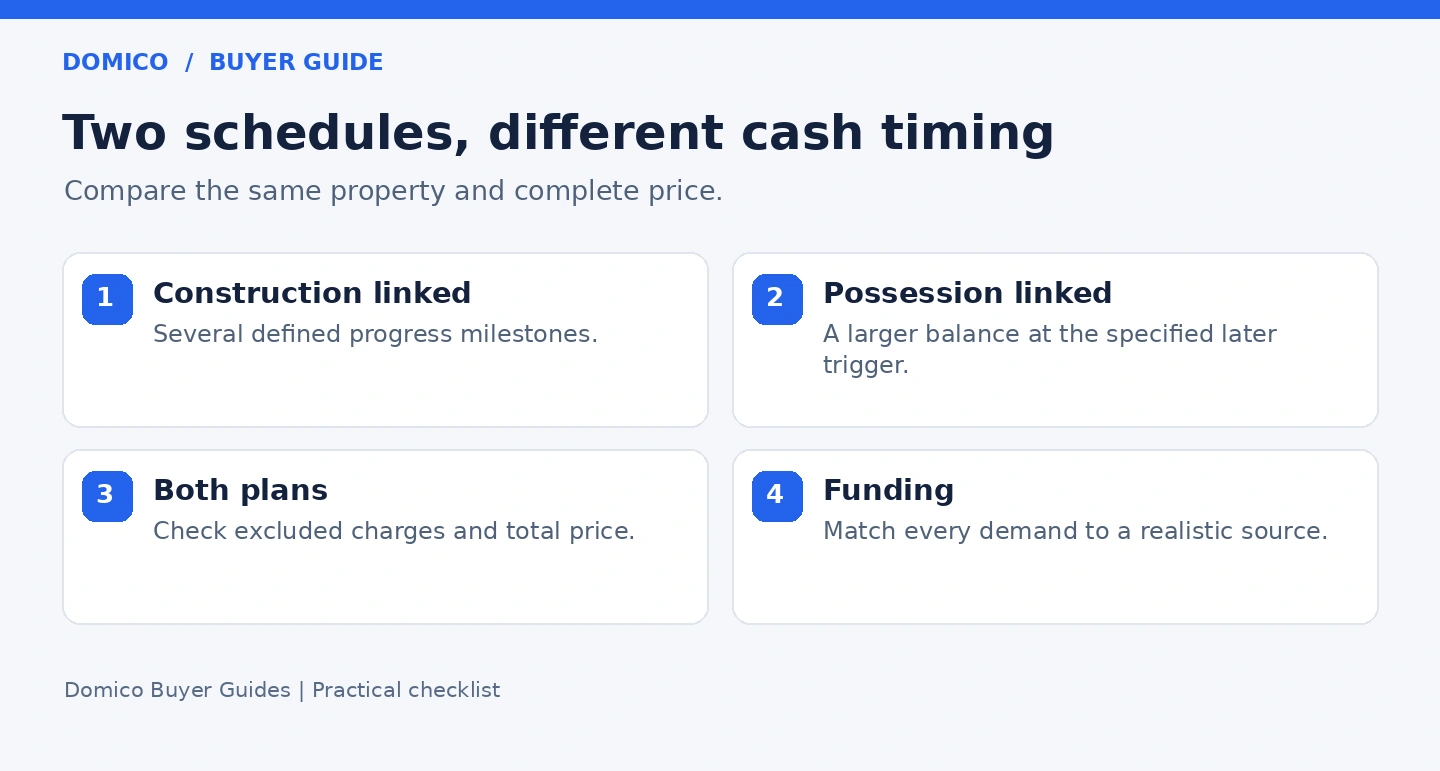
Assume a property price of Rs 60 lakh before charges expressly excluded from the example. The following schedules are hypothetical and are not a recommendation or a statement of standard market terms.
| Example construction-linked stage | Share of price | Amount |
|---|---|---|
| Initial payment, subject to legal requirements | 10% | Rs 6 lakh |
| Defined foundation stage | 20% | Rs 12 lakh |
| Defined structure stage | 40% | Rs 24 lakh |
| Defined finishing stage | 20% | Rs 12 lakh |
| Defined possession stage | 10% | Rs 6 lakh |
| Total | 100% | Rs 60 lakh |
A hypothetical 20:80 possession-linked plan would require Rs 12 lakh initially and Rs 48 lakh at the specified later trigger, with agreement requirements addressed before any amount beyond the lawful advance threshold. The Rs 48 lakh balance still needs a dependable funding plan.
Compare total price as well. If one schedule costs more, quantify that premium before judging the deferred payment attractive. Obtain an itemised list of taxes, registration, maintenance, utility, parking and other applicable amounts rather than assuming the advertised split covers every payment.
Loan sanction does not mean every demand will be paid automatically. Ask the lender which conditions, inspections, borrower contributions and documents are required before each disbursement. Clarify whether the bank and developer use the same stage descriptions.
RBI's housing-finance guidance addresses linking individual housing-loan disbursal to construction progress and the risks of upfront disbursal for incomplete projects, with specified treatment for certain government or statutory-authority projects. Ask your lender how the current rules and its policy apply to the actual purchase.
Do not assume a promoter's demand letter overrides the lender's conditions. If the lender releases less or later than expected, the agreement may still create a payment dispute. Resolve the mismatch before signing rather than waiting until a demand deadline.
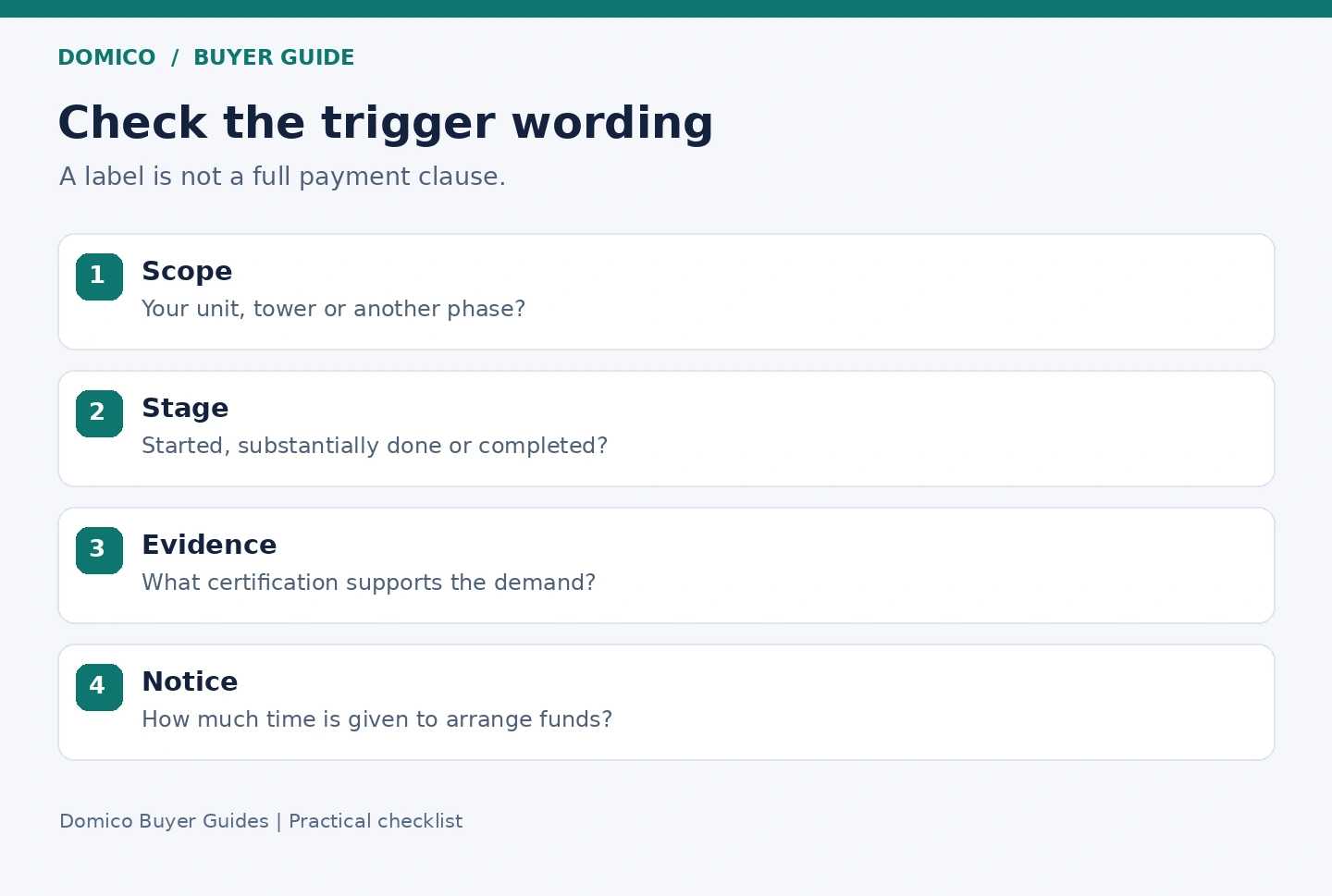
Ask what evidence accompanies a demand: the relevant certification, progress details and identification of the block or unit. Request access to inspect through the appropriate process and consider independent technical help. Do not enter an active construction area without permission and proper safety arrangements.
Check whether a milestone can be called repeatedly for different portions of the project. Does “structure complete” refer to your tower or another phase? Does a finishing-stage demand require the listed work to be complete, or merely started? These details affect when substantial money leaves your account.
Keep a dated record of the demand, supporting evidence, your queries and the reply. If you dispute a demand, seek timely advice about the proper response and payment obligations rather than simply ignoring it.
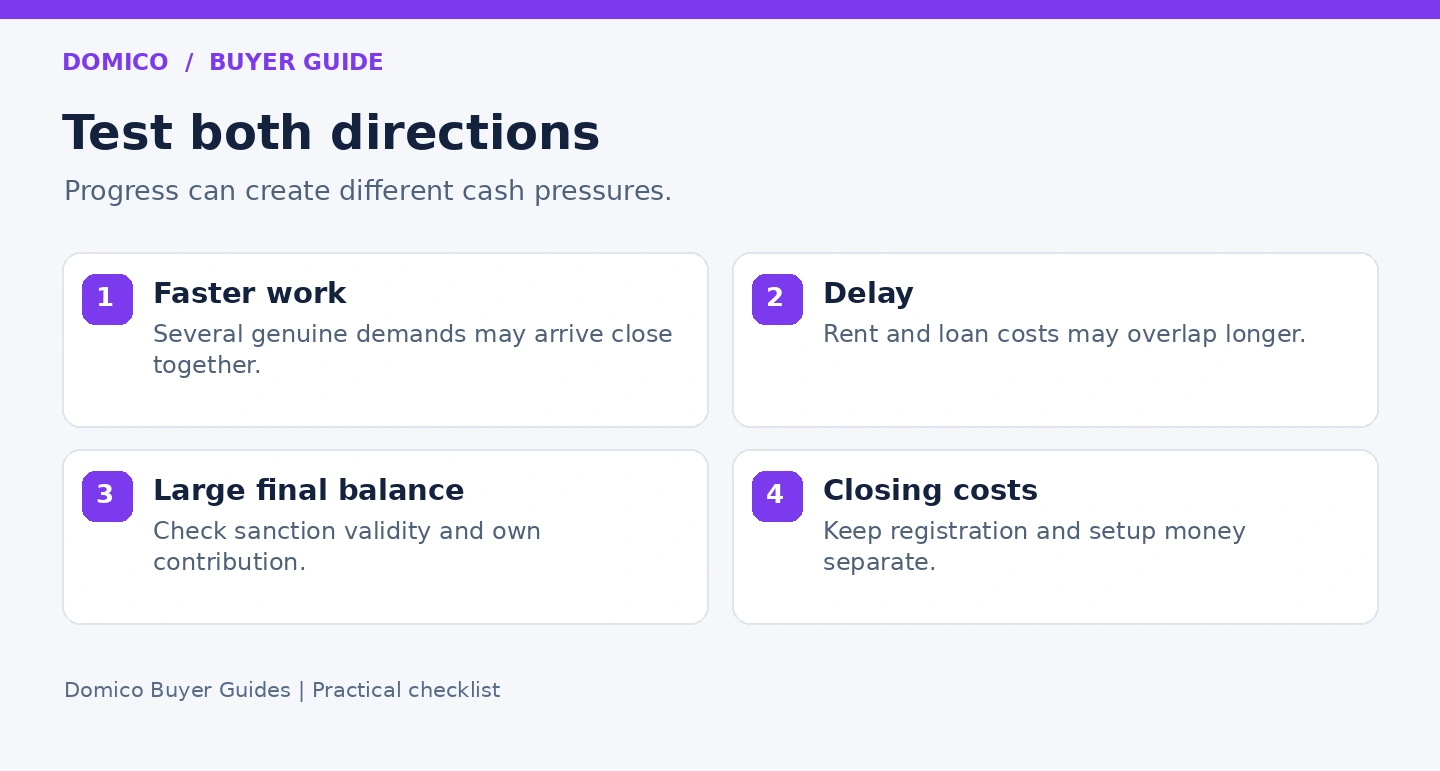
Buyers often prepare only for delay. A construction-linked plan can also create cash pressure if several genuine milestones occur close together. Ask how much notice is provided and whether your funds can be accessed within that period without selling another asset urgently.
For a possession-linked plan, test whether the loan sanction will still be valid and whether the household's income and credit position might be reassessed. A large balance due later can coincide with fit-out, registration and moving expenses.
| Funding situation | Question to resolve before signing |
|---|---|
| Savings mature after a milestone | Can you fund an earlier genuine demand? |
| Loan sanction expires before possession | What reassessment or renewal is needed? |
| Bank valuation is below price | How will the extra own contribution be funded? |
| Construction delays handover | Can rent and loan-related costs overlap longer? |
| Possession brings several extra bills | Is a separate closing and setup allowance retained? |
Read the treatment of late payments, disputed milestones, changed completion dates and cancellation. Ask whether any discount is lost if a payment is delayed and how adjustments are calculated. A small headline discount can have important conditions in the agreement.
The promoter's obligations and the buyer's obligations need to be considered together. Do not assume a project delay automatically permits stopping every payment; obtain advice on the contract, facts and available legal remedies. Similarly, a demand marked urgent does not resolve a genuine question about its basis.
Where a scheme includes a lender, promoter and buyer, review all related documents together. A promise in sales material may not alter the lender's independent rights under the loan agreement.
Create a timeline showing payments, expected disbursements, available savings and overlapping living costs. Add a separate column for the evidence that triggers each amount. Use a weaker scenario and a faster-demand scenario.
If two plans have different prices, compare the present timing and complete outlays rather than simply adding percentages. A financial adviser can help assess the time value of deferred payments using explicit assumptions. The most useful plan is one the buyer can fund and understand.
After each payment, obtain a proper receipt and reconcile the cumulative amount with the agreed schedule. Identify whether the money was applied to base price, taxes, interest or another charge. Keep lender disbursement entries alongside your own contributions so a later demand does not count an amount twice. If the developer changes the statement, request an explanation and retain the earlier version. A clean running account helps both the buyer and the professionals reviewing a future dispute.
It can reduce cash paid early, but it may carry a premium, a large final funding requirement or unclear triggers. Review the complete agreement and project. Deferred payment alone does not establish legal or construction safety.
Disbursement depends on the loan terms, applicable rules, progress and required documents. Ask the lender in advance how demands will be examined. A sanctioned limit is not an unconditional promise to pay every invoice.
Request a written explanation and compare the agreement, plan and certification. Seek professional advice if the trigger does not clearly relate to your commitment. Preserve the demand and respond within the appropriate process.
Only after checking the total price, later balance, extra charges and funding risk. A lower initial contribution may postpone rather than reduce the household's obligation.
Ask for any agreed change to be properly recorded in the applicable documents. The enforceability and required form should be reviewed by a lawyer. Sales conversations should not replace clear contractual payment terms.
Read the payment plan as a sequence of evidence and obligations. A clear trigger and a workable funding source are more valuable than an attractive percentage split.
Download the topic-specific review checklist. Use it to record evidence, unanswered questions and follow-up actions for the exact property.
Planning to buy or rent in Indore? Browse verified properties in Indore or read more Indore guides.
Check who owes the lender, how builder-paid interest works, when support ends and whether you can carry the loan if payments stop.