Buying Guide
Property vs Mutual Funds: Costs, Liquidity and Risk
Compare direct property and mutual funds through goals, liquidity, concentration, complete costs, borrowing and management effort.
8 min read

Buying Guide
Compare direct property and mutual funds through goals, liquidity, concentration, complete costs, borrowing and management effort.
The better investment is the one that fits the goal, the risks and the cash you may need.
Property and mutual funds are often compared through a single claim: one supposedly doubles faster, feels safer or produces better returns. That comparison misses their different uses. A home can provide a place to live. A rental property is a managed physical asset. A mutual fund is an investment vehicle whose risks depend on the securities and strategy it holds.
Start by deciding whether you are buying housing for your own use or allocating investment capital. Then compare liquidity, concentration, costs, financing and effort. This guide is an educational framework, not a recommendation to buy a particular property or fund.
A self-occupied home provides accommodation, control over the space and a particular location. Those benefits cannot be reduced to a fund return. If you buy an investment property while renting your own home, the housing and investment decisions remain separate cash flows.
For an investment comparison, use money available after essential reserves and near-term obligations. Do not compare a property requiring a large loan with an unleveraged fund investment without explicitly accounting for the debt and monthly payments.
SEBI's asset-class guidance explains that investments have different risk and return characteristics. Choosing between categories requires your purpose and horizon, not an assumption that every property or every mutual fund behaves alike.
A direct property purchase concentrates ownership in a particular parcel or unit. Its outcome depends on title, approvals, location, condition, services, tenant demand and the terms of eventual sale. A problem affecting that one asset can have a large effect on the owner's position.
A mutual fund pools investors' money under a stated investment objective. An equity fund, debt fund, hybrid fund and sector-focused fund can have very different risk exposures. Diversification depends on the actual portfolio; the words “mutual fund” do not mean the investment cannot lose value.
| Decision factor | Direct property | Mutual fund |
|---|---|---|
| What drives results | Specific asset, location and transaction | Underlying holdings and scheme strategy |
| Typical unit of investment | A whole property or lawful ownership share | Units, subject to scheme terms |
| Control | Owner manages the physical asset and contracts | Fund manager follows the scheme mandate |
| Investigation | Title, approvals, condition and local market | Scheme documents, risks, costs and suitability |
| Personal use | May provide accommodation | Does not provide a home to occupy |
Neither column removes the need for due diligence. The work is different.
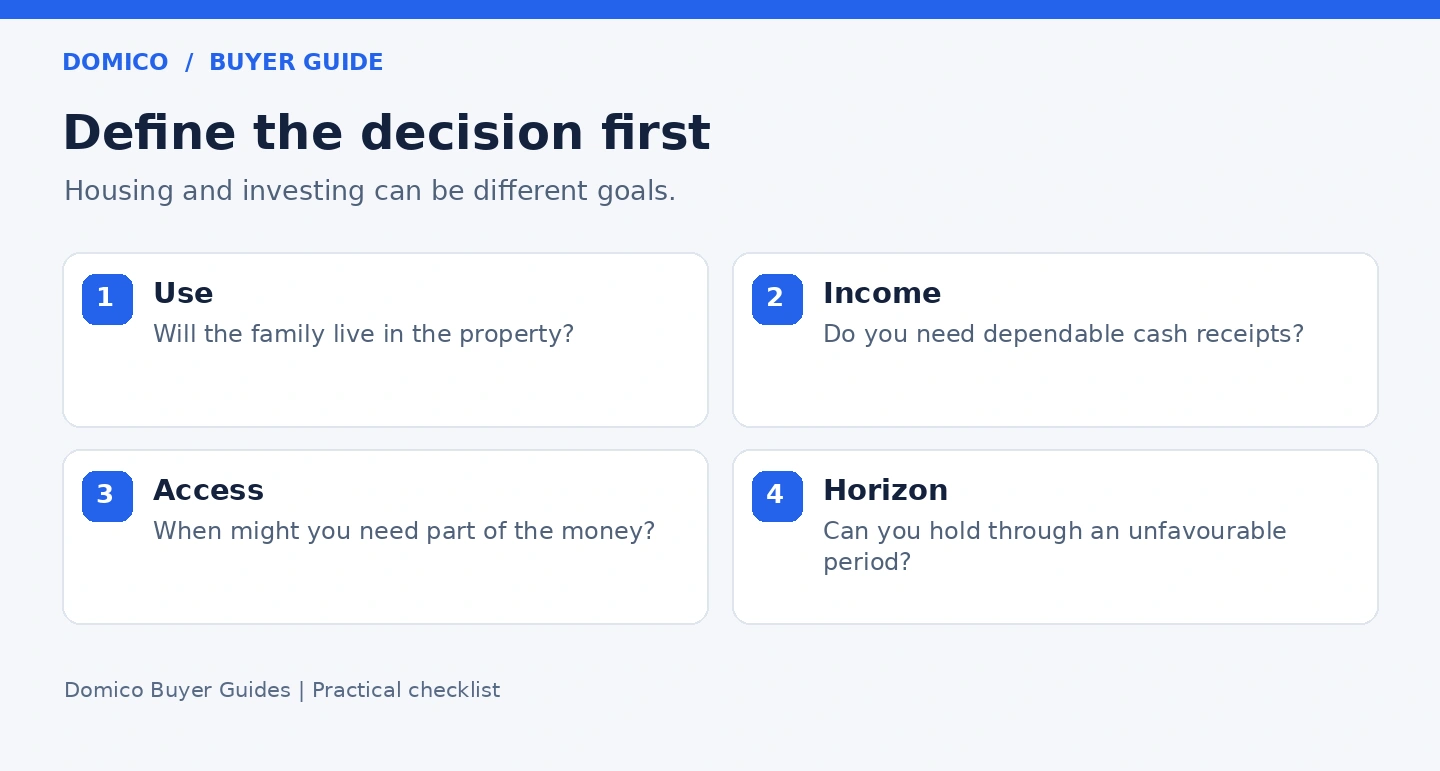
Selling a property requires a buyer, agreed terms, verification, funding and transfer. You may be unable to sell only a small part when you need cash. Even a valuable property can take longer than expected to convert into cleared proceeds.
SEBI's explanation of open-ended funds describes ongoing purchase and redemption at applicable NAV. Actual redemption timing, exit loads, lock-ins, settlement rules and restrictions must be checked in the scheme documents. An investment that can be redeemed is still exposed to its current value; liquidity is not capital protection.
Match the asset to the date you need money. A near-term school payment, emergency requirement or fixed business obligation should not rely on an optimistic property sale or an assumption that a volatile investment will be favourable on one exact day.
List existing property, business interests, investments and debt. A person who already owns a home and earns from local real estate may add substantial concentration by buying another nearby plot. A mutual fund portfolio concentrated in one sector can also create overlapping risk.
Consider whether an economic slowdown could affect both income and investments. Diversification aims to reduce reliance on one outcome; it does not eliminate losses. SEBI's planning guidance treats diversification and asset allocation as part of goal-based investing.
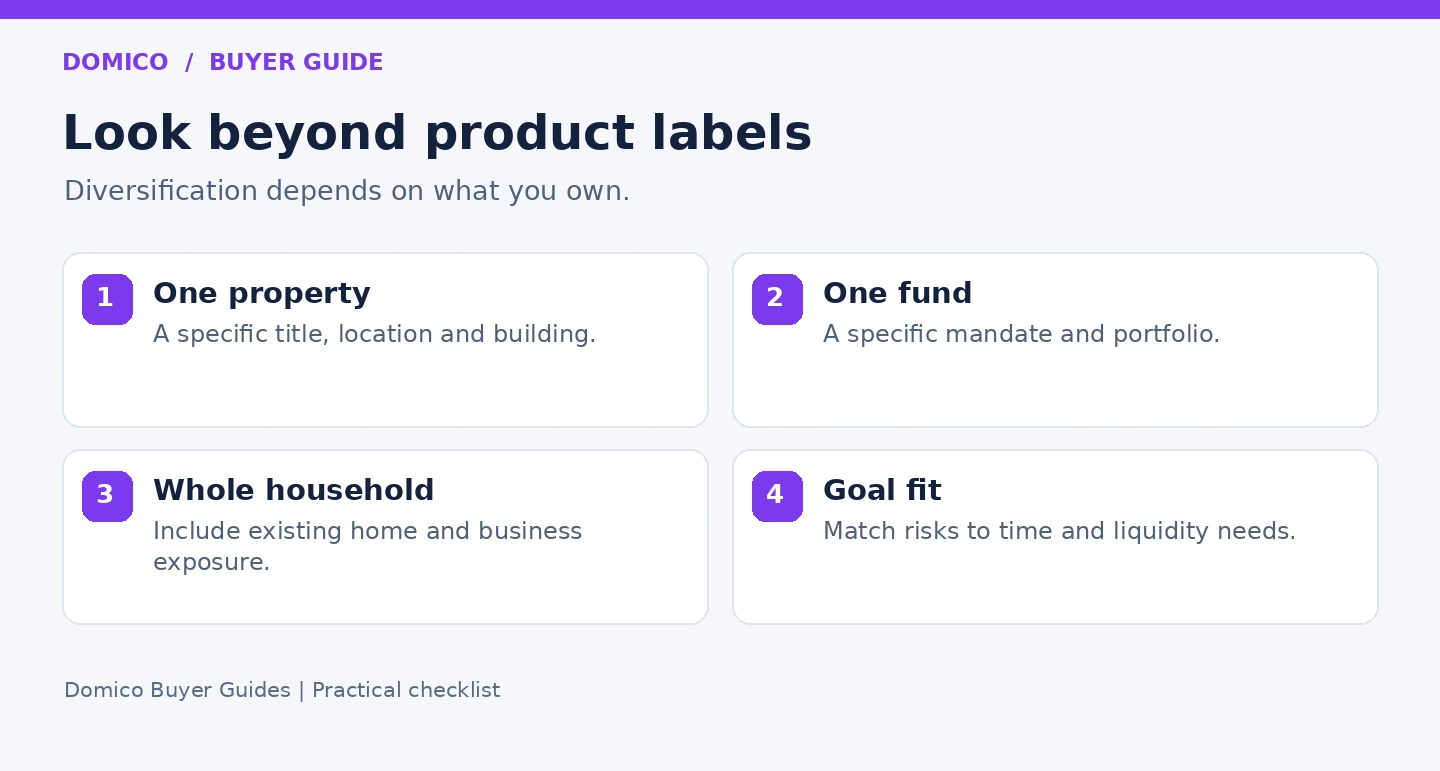
Look through product labels. Holding three similar funds may not provide three independent exposures. Holding three plots in the same project may leave the owner dependent on the same approvals, access and local demand.
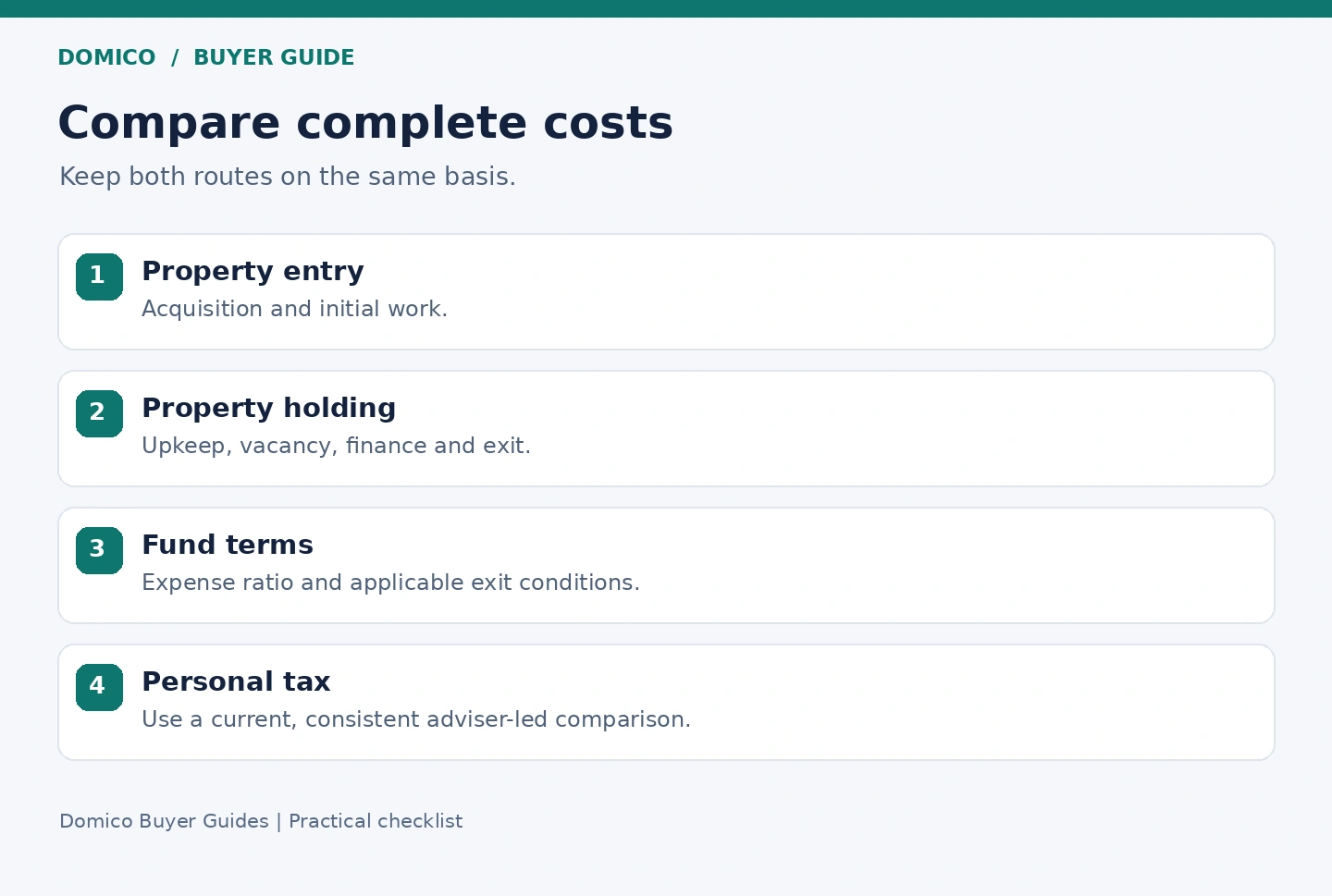
For property, investigate acquisition charges, legal review, brokerage, repairs, furnishing, owner-paid running costs, vacancy and selling expenses. Add borrowing costs if relevant. Use the actual property's documents and current official calculations.
For a fund, examine the expense ratio, direct or regular plan, applicable exit load, transaction conditions and tax treatment. The SEBI explanation of direct and regular plans shows why cost structure matters. Check the current scheme documents rather than assuming a general example is the charge for your chosen fund.
| Cost stage | Property questions | Fund questions |
|---|---|---|
| Entry | What is the total acquisition and setup outlay? | What terms apply to purchase and allocation? |
| Holding | Who pays maintenance, repairs, taxes and vacancy? | What ongoing expenses affect NAV? |
| Exit | What remains after sale costs and loan settlement? | What exit load, settlement and tax rules apply? |
| Advice | What legal, technical and financial help is needed? | What advice or distribution arrangements apply? |
Taxes differ by asset, ownership, transaction, holding period and current law. Obtain a current personalised calculation. Do not compare one asset before tax with another after tax.
Suppose an investor has Rs 60 lakh available for investment after keeping a separate emergency reserve. A property costs Rs 55 lakh, with Rs 5 lakh of assumed purchase and initial work costs. The full Rs 60 lakh is committed.
For a fund comparison, use Rs 60 lakh as the initial amount too. Then record each route's future cash flows at their actual dates. The property may produce net rent or require extra cash. The fund may have distributions or redemptions depending on the option selected. Do not invent a guaranteed annual growth rate for either route.
Test alternative outcomes instead of choosing one favourable forecast. For property, vary rent, vacancy, repairs, sale price and sale timing. For the fund, examine losses, volatility and the consequences of redeeming at an unfavourable time. The purpose is to identify whether the investor can remain committed through the chosen horizon.
A rental home may require tenant selection, agreements, repairs, collection, inspections and turnover management. A remote plot may need oversight and periodic physical checks. Delegating these tasks can cost money and still requires supervision.
A fund reduces direct physical management but does not remove financial responsibility. The investor still needs suitable allocation, scheme understanding, secure account practices and periodic review. Frequent switching based on recent performance can introduce costs and poor timing.
Ask which responsibilities you can handle well and which you would need to outsource. Time is relevant even when it does not appear in a return spreadsheet.
| Your question | What to examine first |
|---|---|
| “I need a home for my family” | Housing suitability, affordability and tenure |
| “I need income from capital” | Reliable net cash flow, risk and tax |
| “I may need part of the money soon” | Liquidity, value risk and access conditions |
| “Most of my wealth is already local property” | Concentration and diversification |
| “I cannot manage a physical asset” | Outsourcing cost and suitable alternatives |
There is no obligation to choose only one category. An allocation can include housing, accessible reserves and diversified investments if that fits the household's resources and goals. A qualified adviser can help compare the complete plan without turning a product preference into a universal rule.
No. Risk depends on the fund's holdings and the property's characteristics. Equity, debt, credit, interest-rate and concentration risks differ. A property also carries legal, physical, market and liquidity risks. Compare the actual assets.
An infrequently observed price does not prove stable value. A sale can reveal changes that were not visible in the owner's estimates. Listed investment values are observed more frequently, which can make fluctuations more noticeable.
Rental yield usually measures operating income against property value or cost. A fund's total return measures a different set of value changes and distributions. Use consistent dated cash flows and include relevant costs before comparing investment outcomes.
No. Borrowing can amplify gains and losses and creates repayment obligations. Include interest, fees, contributions and loan settlement. A return calculation that uses only the down payment and ignores later EMIs is incomplete.
First define how quickly money must be accessible and how much value fluctuation is acceptable. A property sale and a volatile investment may both be unsuitable for an immediate obligation. Choose appropriate reserve arrangements within a personalised plan.
Compare the job each asset must do, the money it can require and the risks you can carry. A useful decision is broader than a contest between two headline returns.
Download the topic-specific review checklist. Use it to record evidence, unanswered questions and follow-up actions for the exact property.
Planning to buy or rent in Indore? Browse verified properties in Indore or read more Indore guides.
Check who owes the lender, how builder-paid interest works, when support ends and whether you can carry the loan if payments stop.



