Buying Guide
Buying a Home With Cash vs a Loan: Compare the Impact
Compare a cash home purchase with borrowing using reserves, EMI, APR, investment risk, tax and a fair cash-flow model.
Updated 8 min read

Buying Guide
Compare a cash home purchase with borrowing using reserves, EMI, APR, investment risk, tax and a fair cash-flow model.
Keeping cash and avoiding debt are both useful; the right balance needs a complete calculation.
Paying the full price of a home can remove a long-term loan obligation. Taking a loan can preserve cash for other needs. Neither choice is automatically superior. The decision depends on available reserves, loan terms, household income, investment risk and how the retained money would actually be used.
Compare two complete financial plans for the same property. Do not compare the emotional comfort of being debt-free with an assumed investment return that may never occur. Equally, do not assume paying cash is prudent if it leaves the household unable to meet essential expenses.
List liquid resources, near-term obligations and an appropriate emergency reserve. Exclude money earmarked for essential goals unless you deliberately reassess those goals. Consider the costs and tax effects of selling investments to fund the purchase.
Then calculate the property's complete cash requirement: agreed price, applicable transaction charges, professional work and essential setup. Obtain current quotations and official calculations. A cash purchase still has acquisition costs and ongoing owner expenses.
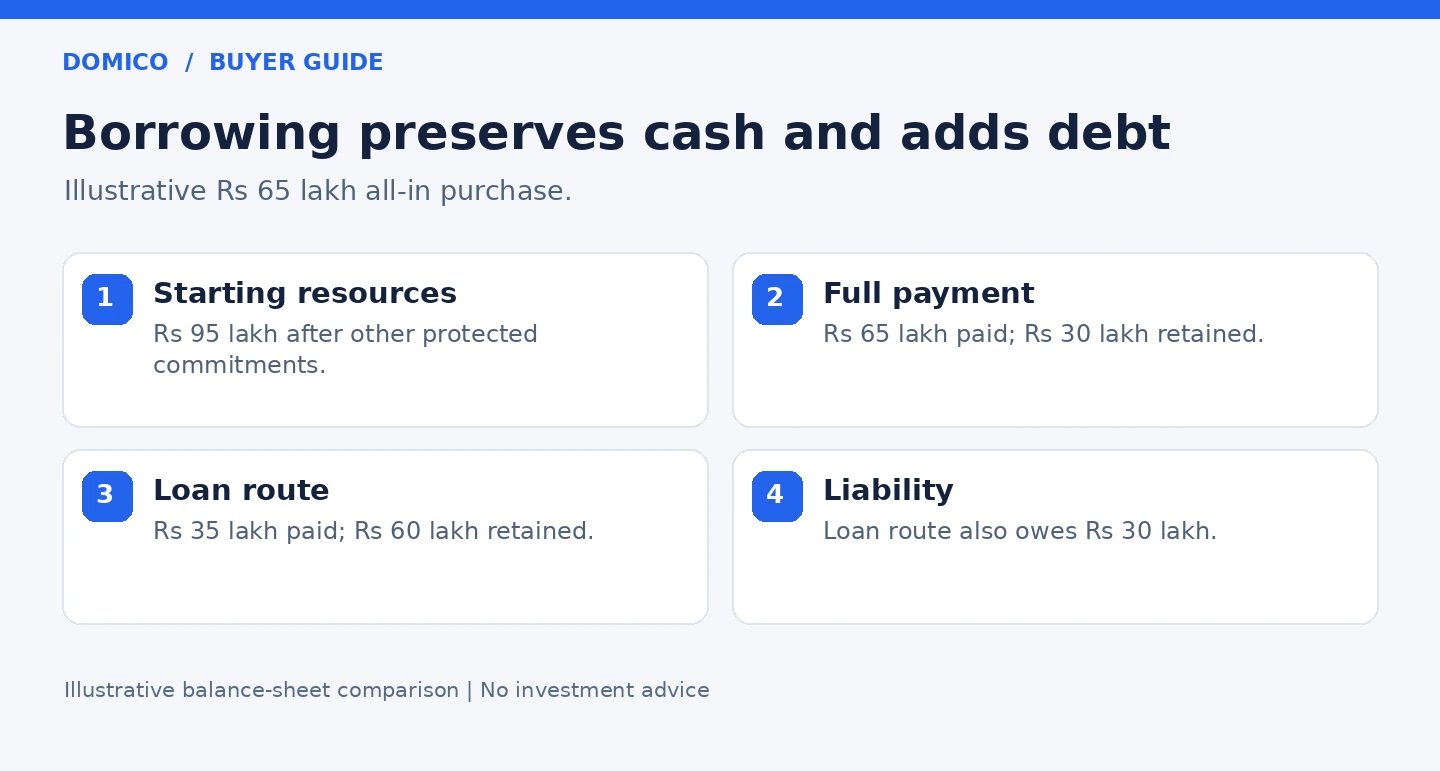
Suppose a household has Rs 95 lakh of available resources after separately protecting other commitments, and the all-in purchase requirement is Rs 65 lakh. Paying the full amount leaves Rs 30 lakh accessible. Borrowing Rs 30 lakh and contributing Rs 35 lakh leaves Rs 60 lakh accessible, alongside a Rs 30 lakh debt. These are hypothetical amounts.
| At purchase | Full payment | Rs 30 lakh loan |
|---|---|---|
| All-in property requirement | Rs 65 lakh | Rs 65 lakh |
| Household contribution | Rs 65 lakh | Rs 35 lakh |
| New loan | Rs 0 | Rs 30 lakh |
| Resources retained from Rs 95 lakh | Rs 30 lakh | Rs 60 lakh |
The loan route does not create Rs 30 lakh of extra wealth. It retains assets and creates an offsetting liability. The practical benefit is access to cash; the cost is the loan and its conditions.
Ask for the lender's Key Facts Statement, APR, amortisation schedule and relevant agreement terms. Compare the rate type, benchmark, spread, reset conditions, fees, insurance arrangements and prepayment provisions applicable to your loan.
RBI's KFS directions require a standardised explanation of key loan facts for covered loans. Use the documents supplied by the lender rather than a headline interest rate alone. APR and the repayment schedule help reveal costs and timing that a promotional rate can hide.
Do not assume a fixed or floating label answers every question. Confirm when a rate can change, how that affects EMI or tenure and what options are available. Ask for a written illustration of a higher-rate scenario.
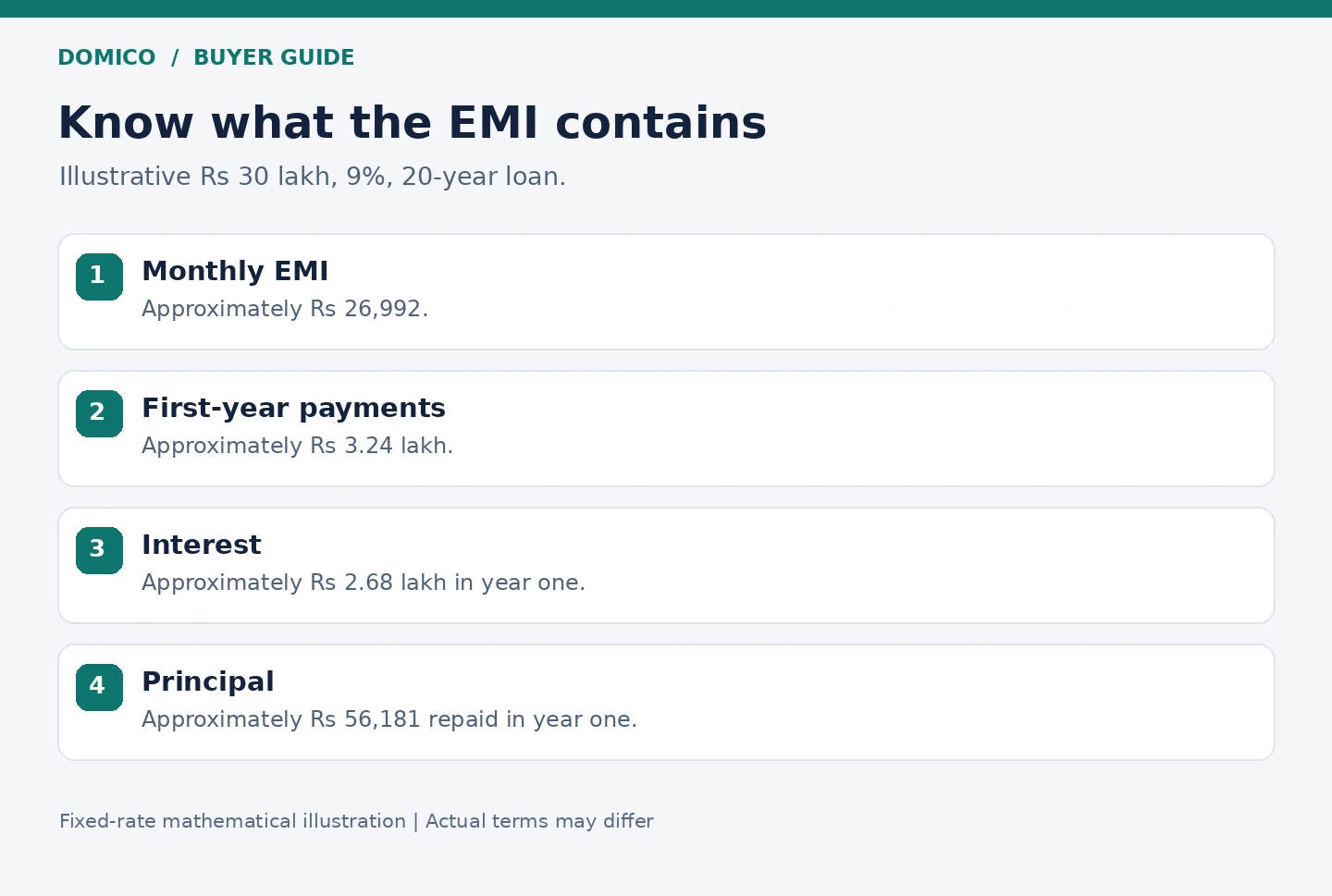
For a Rs 30 lakh loan at an assumed annual rate of 9%, repaid over 20 years with monthly reducing-balance instalments and no rate change, EMI is approximately Rs 26,992. This is a mathematical illustration, not a lender quotation.
During the first twelve payments, total instalments are approximately Rs 3,23,901. Of that, about Rs 2,67,720 is interest and Rs 56,181 is principal repayment. Rounding can create small differences. The principal outstanding after twelve payments is approximately Rs 29,43,819.
| First-year illustration | Approximate amount |
|---|---|
| Monthly EMI | Rs 26,992 |
| Twelve payments | Rs 3,23,901 |
| Interest within those payments | Rs 2,67,720 |
| Principal repaid | Rs 56,181 |
| Loan balance after twelve payments | Rs 29,43,819 |
The split matters. The household must fund the entire EMI, but only the interest is the borrowing charge within that instalment. Principal repayment reduces the liability. Include fees and other actual costs separately when comparing complete plans.
Use reliable take-home income and existing obligations. If a household receives Rs 1.4 lakh monthly, spends Rs 70,000 on essential living costs and contributes Rs 20,000 towards other goals, the illustrative EMI leaves about Rs 23,008 monthly before any other unlisted expenses.
Now test lower income and higher property costs. A loan can preserve a reserve at purchase while still creating monthly stress. The household needs both an initial balance sheet and a sustainable cash-flow plan.
RBI's financial awareness material explains budgeting and responsible borrowing. Apply those principles to your actual commitments rather than adopting a universal EMI-to-income rule as proof of comfort.
The case for borrowing is often that investments might earn more than the loan costs. That is an uncertain comparison. Identify the actual investment, its risk, fees, tax, liquidity and the possibility of losses. A guaranteed loan payment should not be justified using an optimistic return assumption alone.
If retained money will fund business working capital, explain the business risk and cash cycle too. If it will remain in low-return cash, include that actual plan rather than a hypothetical high-return alternative. The decision should reflect likely behaviour, not a spreadsheet strategy the household will not follow.
Keep emergency reserves suited to emergencies. Borrowing to preserve cash does not help if all that cash is then placed in investments that may fall or be difficult to access when needed.
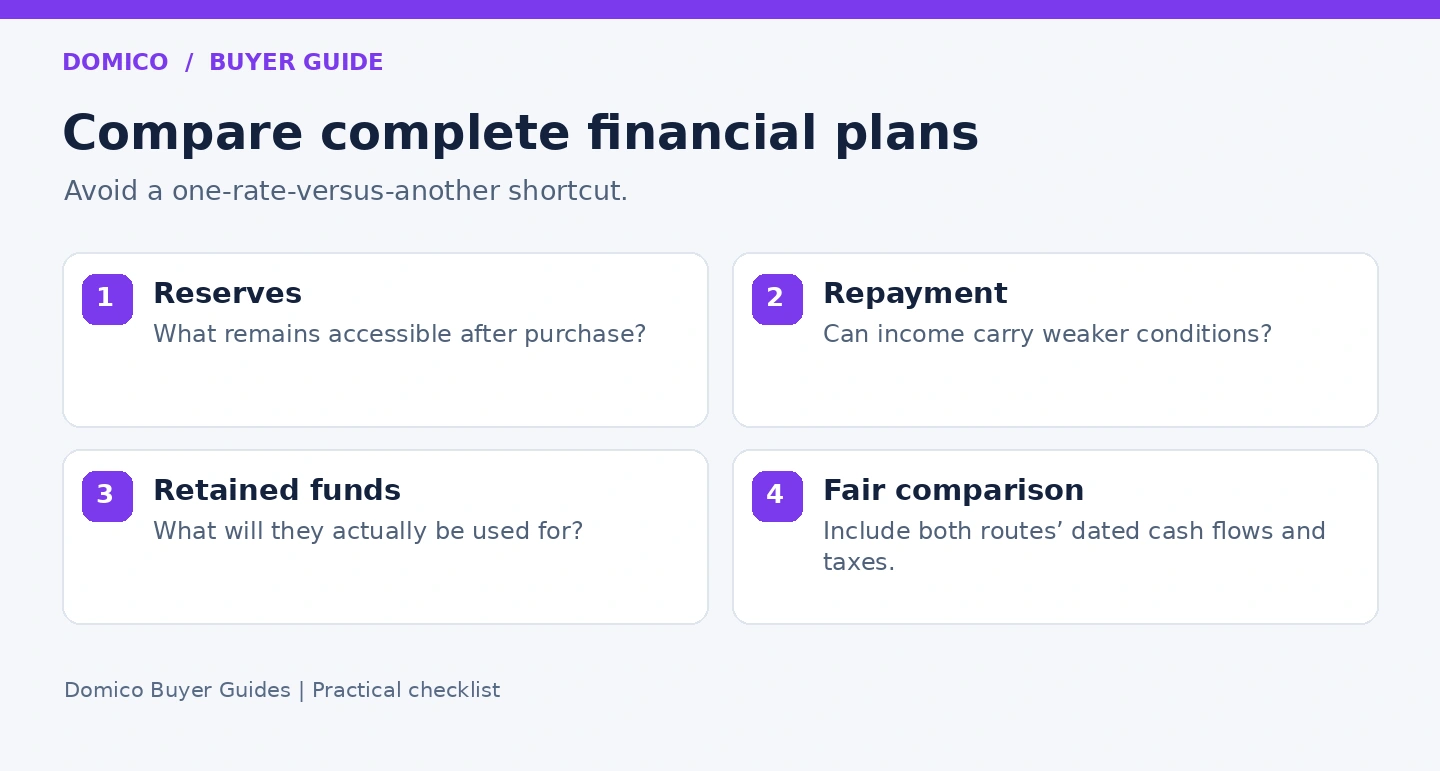
The cash buyer has no EMI and may be able to invest the monthly amount that the borrower pays to the bank. The borrower retains more initial capital but must service debt. A fair comparison should account for both paths across the same dates and horizon.
Record all contributions, investment withdrawals, fees, taxes and loan payments. If the property is the same in both routes, its uncertain future value may cancel out in part of the comparison, but differences in liquidity and funding risk remain.
Use a range of investment outcomes and borrowing scenarios. Ask an adviser to check the model. Avoid declaring a winner by comparing one assumed annual return with one nominal loan rate while ignoring timing and costs.
Whether a loan creates a tax benefit depends on the applicable law, tax regime, ownership, use of the property, repayment and other facts. A deduction is not the same as reimbursement of the interest paid. Do not take a loan solely because someone says the government “returns the EMI”.
Obtain a current calculation from a qualified tax adviser for the planned transaction. Include only benefits you are eligible to claim and likely to use. The tax comparison should also consider any investment liquidation required for the cash route.
A smaller loan may preserve a necessary reserve without creating the largest possible EMI. A larger contribution may reduce borrowing while leaving enough liquidity for known needs. Ask about actual prepayment conditions before assuming you can freely restructure later.
| Decision point | Full payment may help when | A loan may help when |
|---|---|---|
| Monthly obligations | Avoiding repayment pressure is a priority | EMI fits a tested household budget |
| Available cash | Adequate reserves remain after purchase | Paying fully would exhaust needed liquidity |
| Retained-capital use | No compelling need for additional capital | A specific, understood use justifies its risk |
| Personal comfort | Debt would impair financial peace | Debt and investment uncertainty are manageable |
These are considerations, not a recommendation for every buyer. The best balance is the one supported by resources, documents and a plan the household can maintain.
It avoids loan interest and related borrowing charges, but the full comparison includes lost liquidity, investment-sale costs and the use of capital. Separate the known loan cost from uncertain alternatives.
Consider risk, tax, costs and timing, not only the average return assumption. The loan payment remains due even if the investment falls. Use a personalised model and a downside case.
No. Eligibility and actual savings vary, and a deduction does not refund the entire interest payment. Ask for a current calculation rather than using a promotional tax-saving claim.
Check the applicable lender terms and current rules for that loan, including rate type and purpose. Obtain written information on prepayment and other charges before relying on that flexibility.
Start with the complete purchase cost, reserves to retain and a stress-tested monthly budget. Then compare feasible loan sizes. The maximum sanction should be one option, not the starting requirement.
Paying cash and borrowing are tools. Choose the combination that leaves the household able to own the home comfortably and meet its other commitments.
Download the topic-specific review checklist. Use it to record evidence, unanswered questions and follow-up actions for the exact property.
Planning to buy or rent in Indore? Browse verified properties in Indore or read more Indore guides.
Check who owes the lender, how builder-paid interest works, when support ends and whether you can carry the loan if payments stop.