Buying Guide
Why a Bank Rejects Property Despite Income Approval
Learn why legal, technical, valuation or lender-policy issues can block a home loan after income approval, and what evidence buyers should request.

Table of contents
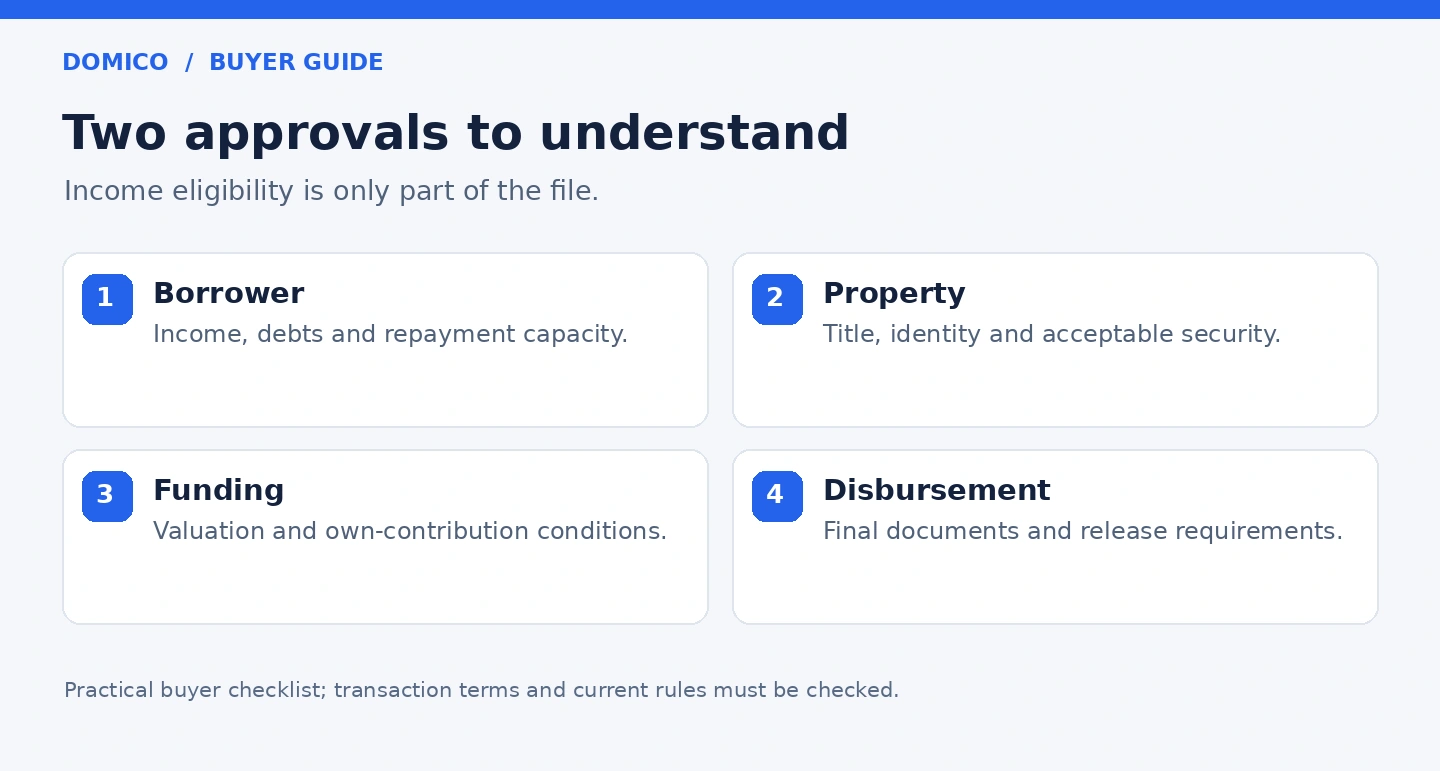
The bank approves the borrower and the property separately.
A strong salary, a good repayment history and an encouraging eligibility letter do not guarantee a loan for the home you select. The lender still needs to assess whether that particular property is acceptable security and whether its conditions for release have been met.
This is why a buyer can be financially qualified but still face a property-related rejection. Understanding the difference helps you ask better questions, avoid paying a large token too early and distinguish a missing document from a deeper problem.
What income approval actually means
The lender's first assessment may focus on income, existing debt, credit history and repayment capacity. Property review asks different questions: who owns the asset, can the proposed mortgage be created, does the description match and is the development supported by relevant permissions?
A pre-approved figure may therefore remain conditional. Read the sanction letter for the selected address and any legal, technical, valuation or disbursement requirements. Ask the bank to identify what has been completed and what remains pending.
Do not describe a project as fully safe merely because one buyer obtained a loan there. A bank's review serves its lending purpose and may cover specific units, phases and documents. It is useful evidence, but it does not replace independent legal and physical checks for your purchase.
Common property-related reasons for a hold or rejection
| Review area | Possible issue | What the buyer should ask for |
|---|---|---|
| Ownership | Missing link in title or unclear seller authority | A written list of unresolved documents or questions |
| Approvals | Unverified land use, layout or building permission | Exact approval reference and property match |
| Identity | Unit, area, survey number or boundary mismatch | Reconciled description and supporting records |
| Construction | Deviation or unsupported additional area | Approved plan and competent technical assessment |
| Valuation | Accepted value below required funding | The approved loan calculation |
| Transfer conditions | Existing lender, lease or authority restrictions | Required release, consent or transfer process |
These are examples of questions, not a diagnosis of every rejected property. The lender's actual reason should guide the next step. A delay caused by an unreadable scan needs a different response from a court dispute or a construction deviation.
Ask whether the problem is a document gap or a defect
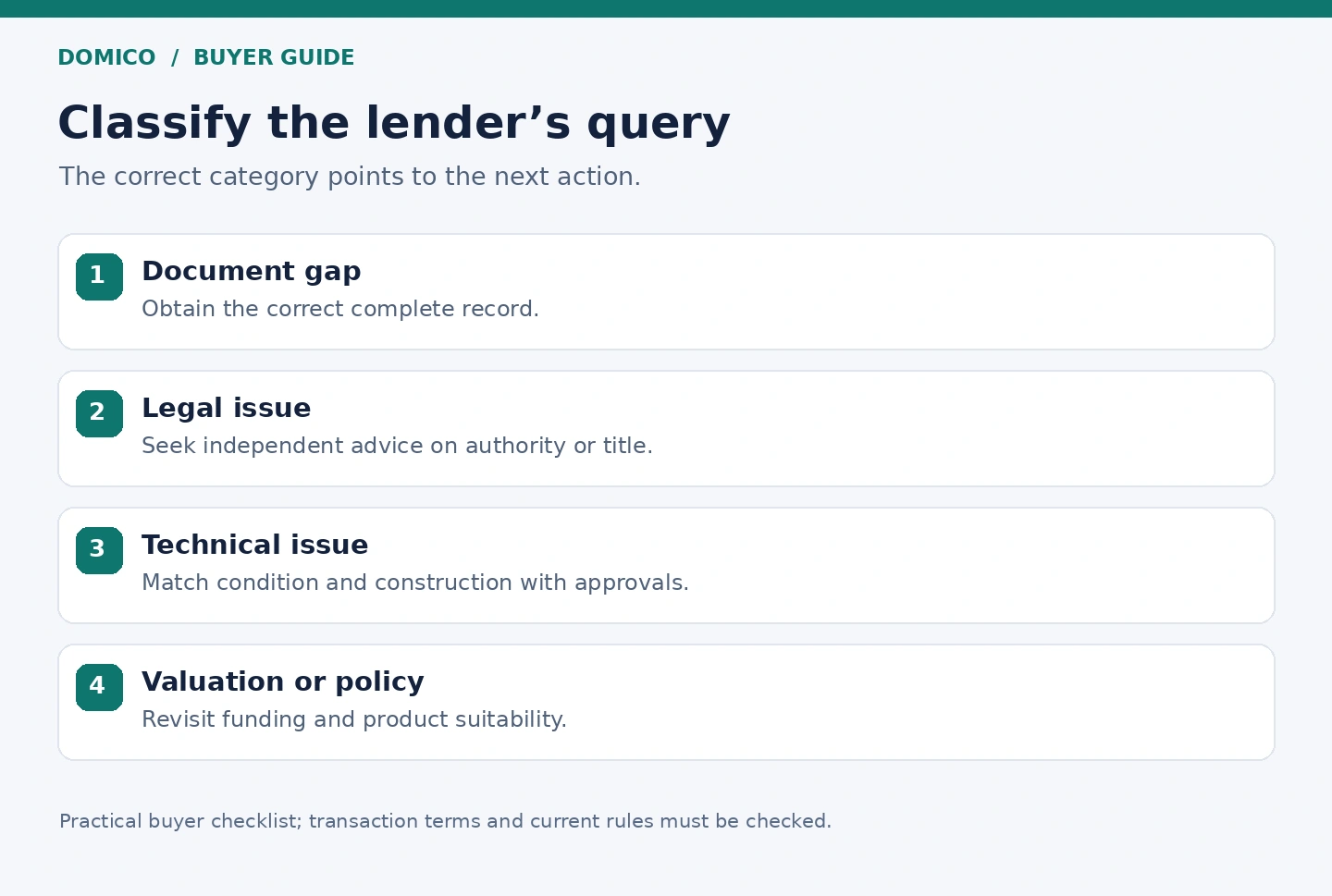
A missing document may exist and be obtainable from the proper authority. A defect may require a legal remedy, additional consent, correction or a decision not to proceed. Ask the lender to state whether the file is pending, conditionally acceptable or rejected.
For example, the seller may have provided only one page of a registered deed. Supplying a complete authorised copy can answer a specific review question. By contrast, a seller claiming exclusive ownership while the record shows multiple owners may need more than another photocopy. The issue is authority to transfer.
Keep a tracker with the query, person responsible, evidence requested and date resolved. It makes follow-up practical and prevents the same missing item from being described differently by the broker, seller and bank.
Why approval labels need to be matched
A project can have several regulatory and contractual documents, each addressing a different subject. A planning approval does not answer every title question. A RERA registration does not remove the need to check the unit's phase, agreement and approvals. A bank's project tie-up does not automatically approve every alteration or resale transaction.
Start with the exact plot or unit. Match the legal project name, registration details, underlying land references and sanctioned plans. If the marketing name differs, ask for a documented connection. This is particularly useful in large townships where separate phases may have different records.
For Madhya Pradesh, use the relevant official systems and obtain professional help interpreting the records. A seller's screenshot can help identify a reference, but it should not be treated as the final answer without checking the current official record.
Technical review is about more than a photograph
The bank may assess construction stage, age, condition, access and whether the area being funded is supported. An attractive interior does not resolve an unauthorised extension or a discrepancy between the plan and the actual building.
A resale flat with a closed balcony may look larger than the sanctioned configuration. A plot may have a clear road on site but an unresolved legal access position. A building may be occupied while completion-related documents remain unclear. Ask a qualified professional to explain the exact issue and what evidence would address it.
Do not promise yourself that registration will cure every concern. A registered transaction and a compliant, mortgageable property are related but different questions. The legal effect of a particular defect needs proper advice.
A practical example: approved income, lower acceptable funding
Consider an illustrative buyer eligible for a ₹45 lakh loan based on income. They select a home for ₹60 lakh. The lender then accepts a funding value and conditions that support only ₹40 lakh for this transaction. Even without a complete rejection, the buyer now needs ₹5 lakh more than expected towards the price.
If the property is instead held because a required seller consent is missing, arranging another ₹5 lakh does not solve that consent problem. This distinction matters: some issues are financial, some documentary and some substantive. Identify which one you are facing before changing the budget.
| Situation | What it means | Sensible next action |
|---|---|---|
| Lower loan after valuation | Funding gap | Recalculate cash and reconsider price |
| Missing complete document | Review cannot finish | Obtain the correct record through a legitimate route |
| Unclear co-owner consent | Seller authority question | Independent legal review and proper participation |
| Construction deviation | Technical and approval question | Competent assessment of legality and remedy |
| Lender policy restriction | Product does not accept this asset | Understand the restriction before comparing another lender |
Avoid the “another bank will do it” shortcut
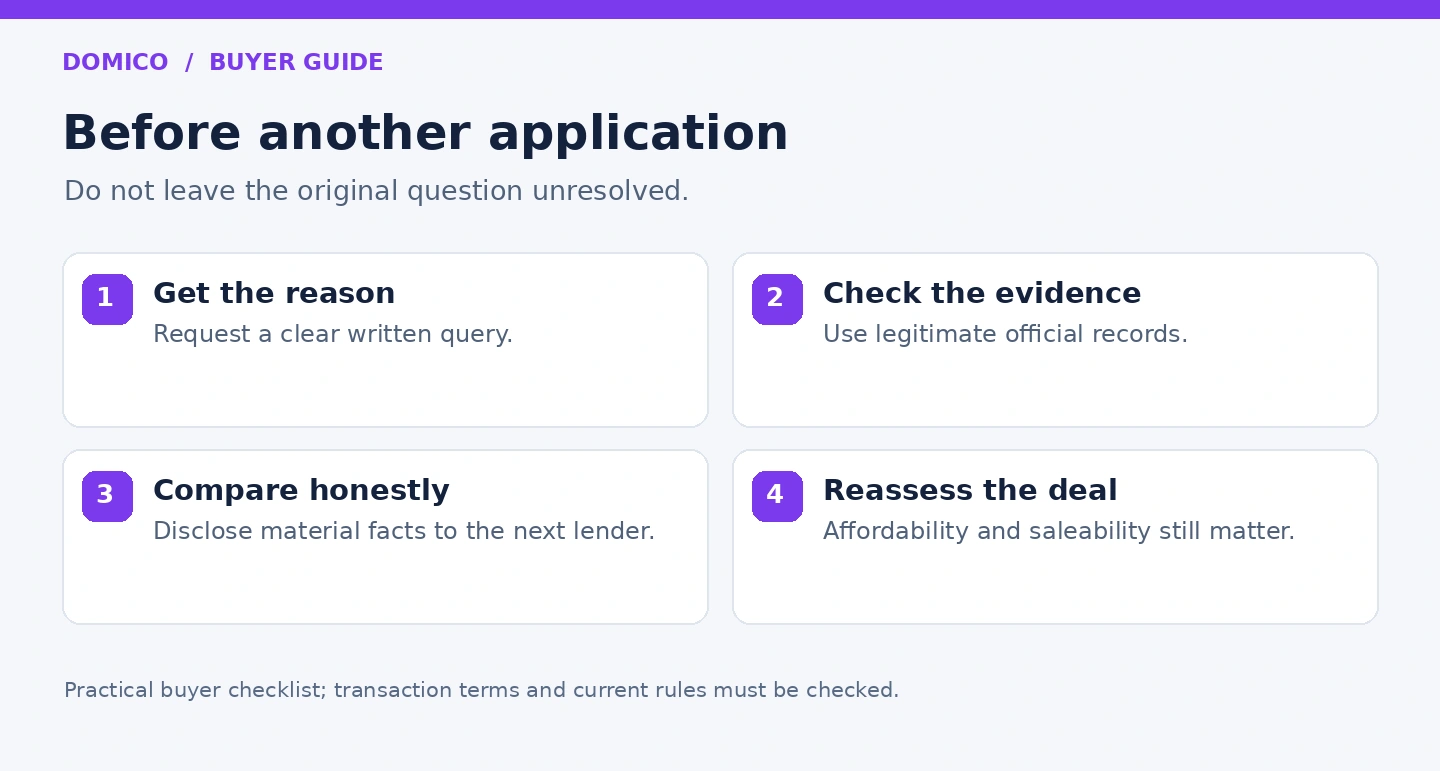
A second lender can have a different risk policy or product. Comparing is reasonable. Ignoring an unresolved title or approval issue because another person promises a loan is not.
Ask the second lender the same question and disclose the relevant facts accurately. Do not omit an existing mortgage, alter a plan or submit inconsistent property information to make the application look easier. A successful disbursement does not guarantee that a hidden problem will disappear when you try to sell later.
Your independent lawyer works for your purchase decision. The bank's advocate works within the lender's review process. The two reviews can support each other, but their scope and responsibilities may differ. Ask your lawyer to explain what was examined and what was outside the assignment.
Protect yourself before paying a token
Use a reasonable due-diligence period and financing provisions appropriate to the deal. Clarify which records the seller must provide, what happens if a material legal issue is found and how any refund conditions operate. Do not rely on a generic phrase such as loan subject to approval without understanding its contractual effect.
Keep payment receipts, the written offer and the agreed property description. If a broker says a token is refundable, ensure the actual recipient and written terms support that promise. Recovering money can be harder than avoiding a premature commitment.
Also ask the bank which processing, legal or valuation charges are refundable if the selected property is rejected. Those costs should be understood before you authorise multiple applications.
A clear escalation and decision process
| Step | Question | Record to keep |
|---|---|---|
| Identify | What exactly is pending or rejected? | Written lender query |
| Classify | Documentary, legal, technical, valuation or policy? | Issue tracker |
| Investigate | Who can legitimately resolve it? | Professional opinion and official evidence |
| Reassess | Does the purchase still fit risk and budget? | Revised decision note |
| Close or exit | Are contract conditions satisfied? | Final approvals or documented cancellation process |
Keep a clean version of every document
When a bank raises a query, ask the seller for a complete, legible version of the relevant record. Save it with its date and description so a corrected document is not confused with an earlier incomplete copy. Avoid forwarding several unnamed screenshots that make the review harder to follow.
If a document is amended or replaced, ask what changed and retain the legitimate supporting trail. A replacement should resolve the query, not merely make the file look different. Where a correction requires an authority's order or a registered instrument, an edited scan is not a substitute.
Send the lender a short index identifying the query and the evidence supplied. This reduces avoidable follow-up and helps you distinguish a file that is waiting for review from one still missing essential information. It also creates a useful record for your own lawyer and purchase decision.
Printable buyer worksheet
Download the topic-specific review checklist. Use it to record evidence, unanswered questions and follow-up actions for the exact property.
Frequently asked questions
Does a bank rejection prove the property is illegal?
No. It may relate to policy, valuation, missing records or a substantive issue. Obtain the actual reason and have it examined. Avoid both dismissing the warning and making an unsupported legal accusation.
Is a bank-approved project enough for a buyer?
It is useful to understand what the approval covers, but your exact unit, phase, seller and transaction still require checks. A project-level relationship does not replace independent due diligence.
Can I obtain the bank lawyer’s report?
Disclosure depends on the lender's process. Ask for the outstanding queries and conditions even if the full internal report is not supplied. Commission your own review when you need advice for your purchase.
Should I apply to another bank immediately?
First understand the reason. A different product may solve a policy limitation, but another application does not cure a genuine defect in ownership, permissions or the property description.
What if I already paid a booking amount?
Review the agreement, refund provisions and lender's written reason. Preserve evidence and obtain advice on the appropriate contractual next step. Avoid assuming that every loan rejection automatically creates a refund right.
Sources and related reading
- buyer-guide-100
- homebuyers
- property-loan-rejection
- indore
Planning to buy or rent in Indore? Browse verified properties in Indore or read more Indore guides.



