Buying Guide
GST on Property: Flats, Plots and Construction Explained
Understand GST differences between under-construction apartments, completed homes, developed plots and separate construction services before paying.

Table of contents
Ask what is being supplied and when the money is paid before asking the GST rate.
A buyer hears that GST on property is 5%. Another person says ready homes have no GST. A plot seller says development changes the answer. These statements can sound contradictory because they describe different transactions.
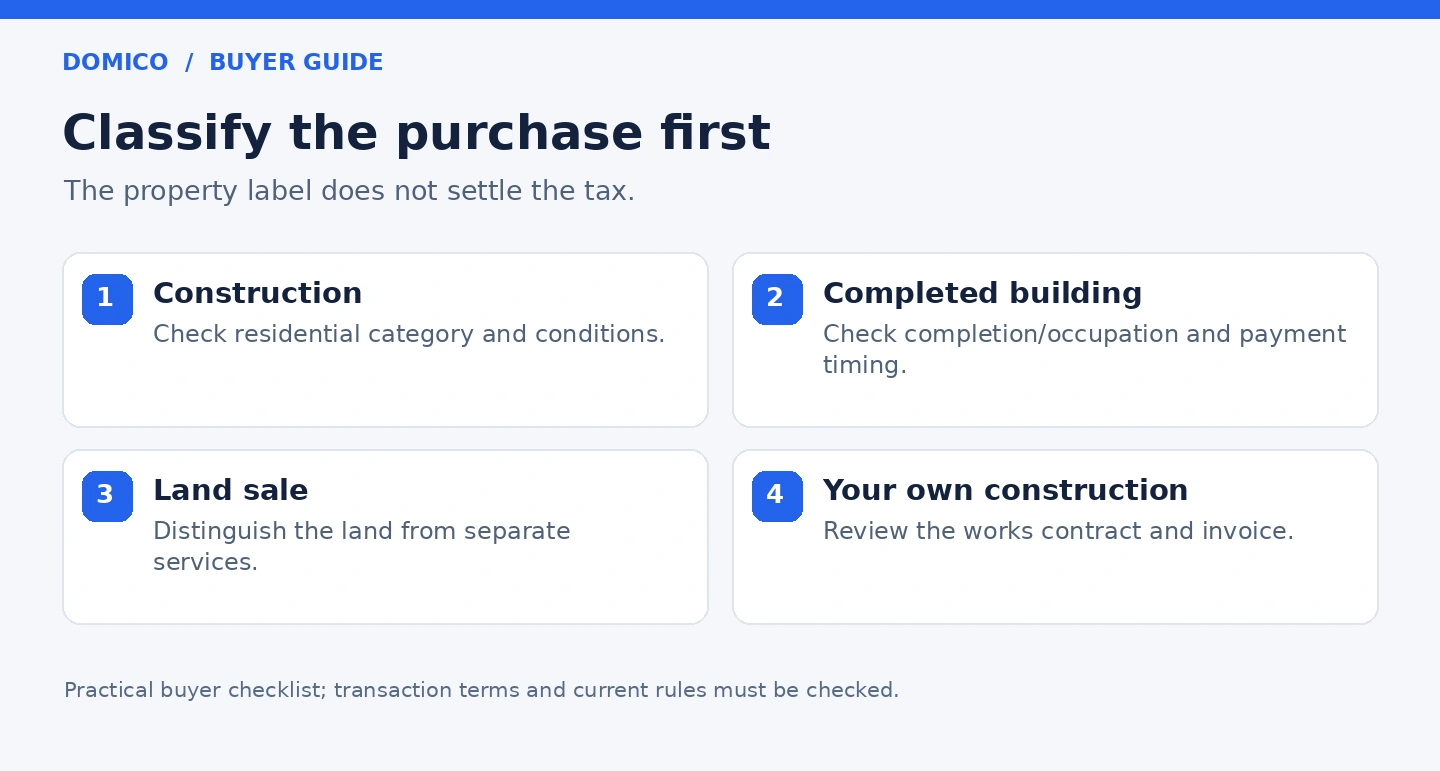
The practical approach is to classify your purchase first: land, construction service, a completed building, a resale transaction or separately supplied work. Then check the relevant dates, agreements and invoice. This avoids both paying an unsupported tax demand and assuming that every property-related payment is outside GST.
Why the property label is not enough
A home advertised as ready may still need its completion-related status and payment history checked. A plot in a developed colony may be a sale of land, while a separate contract for construction or development can be a taxable service. The name on a brochure does not determine the legal classification.
Ask the seller for an itemised statement showing the property consideration, separately charged services, taxes and the basis for each. Where the position is unclear, have a GST professional review the documents before payment rather than arguing from a general internet summary.
| Purchase situation | Main GST question | Evidence to obtain |
|---|---|---|
| Under-construction residential apartment | Which construction-rate category and conditions apply? | Agreement, project details and tax invoice |
| Completed building | Does the statutory completion/first-occupation exception apply? | Relevant certificate, occupation and consideration dates |
| Sale of land | Is the transaction actually land or a separate service arrangement? | Sale contract and itemised demands |
| Separate construction on your plot | What service is supplied and at what applicable rate? | Works agreement and supplier invoice |
| Resale home | Is it a completed immovable-property sale or an assignment involving construction? | Title, stage and transaction structure |
Under-construction residential apartments
The official real-estate GST FAQs explain the post-April 2019 residential framework, including effective rates of 1% for qualifying affordable apartments and 5% for other residential apartments without input tax credit under that framework. Older ongoing projects and specialised transactions can require separate analysis.
Affordable is a defined category, not simply a seller's opinion that the flat is inexpensive. Applicable area, value, location and notification conditions must be checked. A property should not be assigned a lower rate just because its price happens to suit your budget.
Ask the promoter to state the applicable notification and category in the invoice or written tax explanation. If the project has a special or historic treatment, obtain the supporting basis. Do not compare two quoted rates without checking whether the transactions fall under the same rules.
Completed homes: timing matters
The GST law's construction-service entry contains an exception where the entire consideration is received after the completion certificate, where required, or first occupation, whichever is earlier. The key is the statutory condition and the relevant events, not merely the fact that you can walk through the apartment.
A token, advance or instalment paid before the relevant event can change the analysis. A possession letter issued by the builder is not automatically the same evidence as a completion certificate from the competent authority. Have the transaction's payment history and supporting documents examined together.
Do not use absence of GST as proof that a flat is legally fit for occupation. Planning, completion and occupancy compliance require their own checks. Tax classification does not cure a missing approval.
Developed plots and separate services
CBIC's Circular 177/09/2022 clarifies that sale of land remains outside GST even after basic development such as levelling and laying drainage, water or electricity lines. It also distinguishes taxable development services supplied separately.
This distinction is important for plotted colonies around Indore. Ask whether the demand is part of the actual land-sale consideration or relates to a separate service contract. Do not accept a blanket statement that every developed plot attracts GST or that every service attached to a plot is automatically tax-free.
A building contract on land you already own is another situation. Buying the land and commissioning construction are not automatically taxed like buying a completed building. Obtain separate, accurate agreements and invoices that reflect the real arrangement.
Use an itemised price comparison
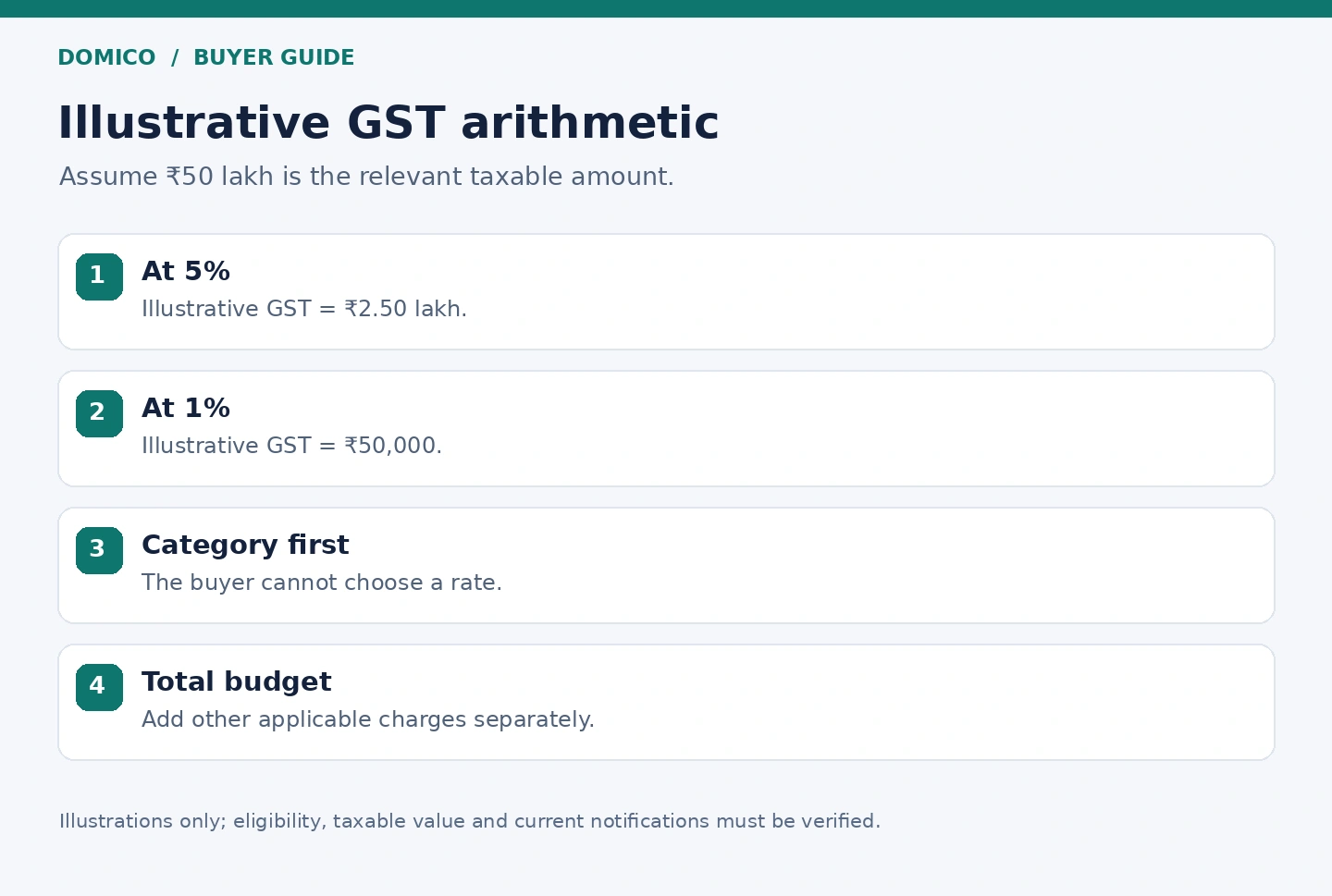
Suppose an illustrative under-construction apartment has a taxable amount of ₹50 lakh under an applicable 5% effective-rate treatment. The GST amount in that simplified example is ₹2.50 lakh. At an applicable 1% treatment on the same illustrative amount, it would be ₹50,000. These calculations show the cash difference; they do not establish which category a real flat qualifies for.
| Hypothetical taxable amount | Assumed applicable effective rate | GST in the illustration |
|---|---|---|
| ₹50 lakh | 5% | ₹2.50 lakh |
| ₹50 lakh | 1% | ₹50,000 |
| Actual purchase | Must be verified | Use the proper taxable value and category |
Ask whether the quoted price is inclusive or exclusive of tax. A ₹50 lakh tax-exclusive quotation is not the same cash commitment as ₹50 lakh all-inclusive. Also check the treatment of parking, preferential-location charges, maintenance deposits and other items rather than assuming the headline apartment rate answers every line.
Stamp duty and registration charges are separate from GST. A statement that GST is not chargeable does not mean the purchase has no transaction taxes or fees. Keep the total-cost worksheet broad enough to capture all applicable payments.
Read the tax invoice before transferring money
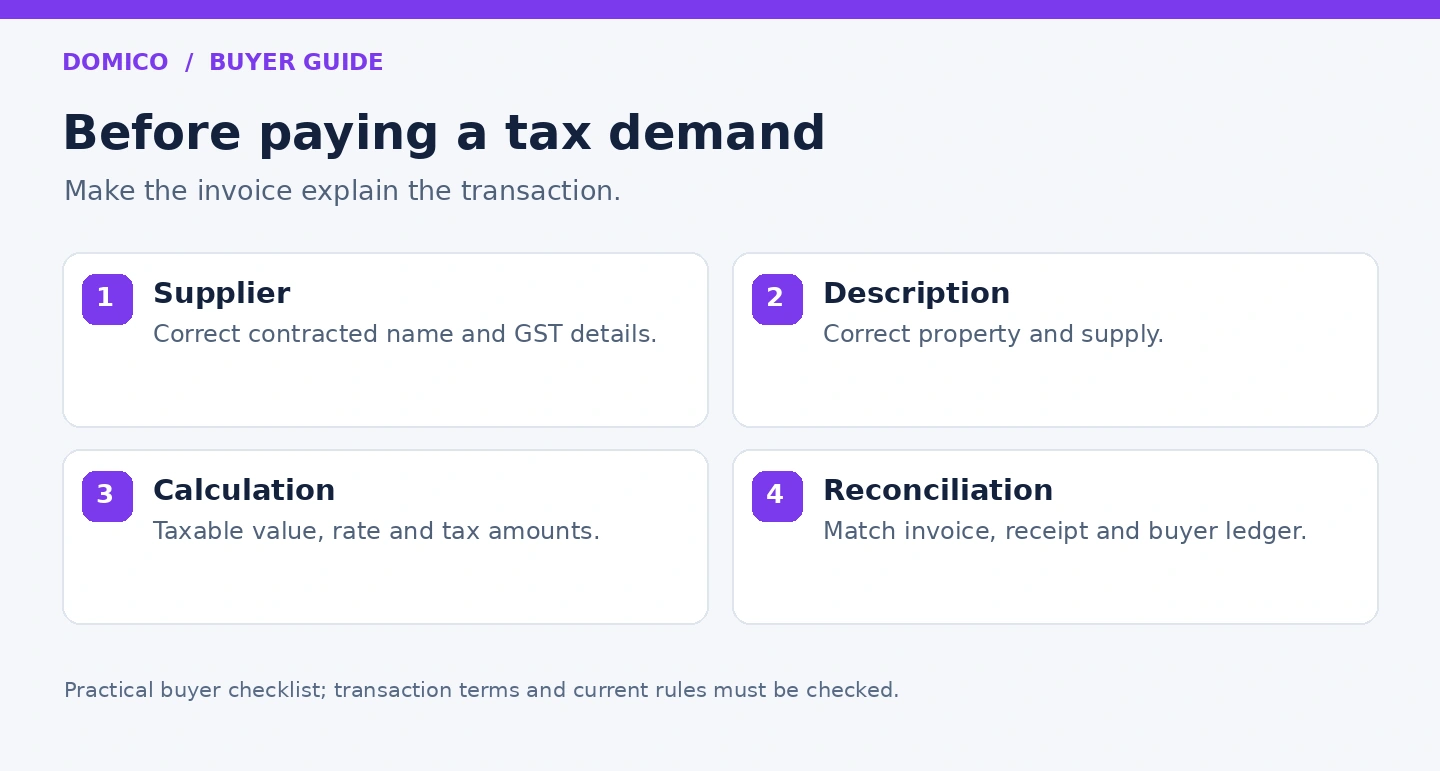
Match the supplier's name and GST details with the contracted party. Check the property reference, taxable value, rate, tax amounts, invoice date and description. Confirm whether the demand is for an advance, a construction milestone or another supply.
Where a seller collects a sum described as GST, request a proper invoice or the relevant document for that payment. A handwritten total stating tax extra is not a satisfactory explanation of a substantial demand. Keep receipts and reconcile each payment with the buyer ledger.
If the seller changes the tax demand, ask for the reason in writing. It may relate to a corrected classification, a changed transaction or an error. Do not silently pay twice for a liability already included in the agreed price.
Cancellation, resale and assignments need their own review
Cancelling a booking can involve credit notes, contractual deductions and tax adjustments. A refund calculation should distinguish the promoter's cancellation charge from the treatment of tax already collected. Ask for the breakup and the documents supporting the adjustment.
Likewise, purchasing an under-construction allotment from an earlier buyer is not always equivalent to buying a completed resale flat. Assignment, promoter consent and continuing construction payments can create additional questions. The contracts and stage of the property matter more than the word resale.
Avoid assuming that the entire amount collected by an earlier allottee has one tax character. Have a professional examine the rights transferred, payments to the promoter and applicable tax obligations before settling the deal.
A simple GST verification workflow
| Step | Action | What it prevents |
|---|---|---|
| Identify | Classify land, building, construction or separate service | Applying a generic rate to the wrong transaction |
| Date | Match advances with completion/occupation events | Ignoring a payment that affects treatment |
| Verify | Check category, notification and taxable value | Unsupported reduced or increased rate |
| Document | Obtain itemised invoice and payment receipt | Unexplained tax collection |
| Reconcile | Match agreement, invoices and ledger | Duplicate or inconsistent charges |
Compare two payment timelines before relying on a tax claim
Suppose one buyer signs and pays the entire genuine consideration only after the relevant completion or first-occupation event, while another buyer paid an advance during construction. Those timelines may require different GST analysis even if both buyers collect keys on the same day. Ask the adviser to examine the actual sequence rather than only the handover date.
Prepare a short chronology showing agreement, each payment, relevant completion evidence, first occupation where relevant and final settlement. Attach invoices and receipts. This makes it easier to identify which statutory condition needs examination and prevents a sales description from replacing the facts.
Do not manufacture a later payment date or rename an earlier advance to obtain a preferred outcome. If a demand seems inconsistent, request a corrected explanation and the proper tax document. The right answer comes from the real transaction and current law.
For a comparison between projects, use the final all-in cash requirement after the classification is verified. A lower base price with an additional lawful tax demand can still cost more than a higher all-inclusive quote. Keep the figures on the same basis.
Printable buyer worksheet
Download the topic-specific review checklist. Use it to record evidence, unanswered questions and follow-up actions for the exact property.
Frequently asked questions
Is every ready-to-move flat free of GST?
The statutory condition and consideration timing must be checked. Physical readiness or a marketing label alone is insufficient. Obtain the relevant completion/occupation evidence and review the payment history.
Does every affordable-looking flat attract 1% GST?
No. The affordable residential apartment category has defined conditions. The promoter should identify why the actual unit qualifies under the applicable framework.
Is GST payable on a developed plot?
CBIC distinguishes sale of land, including land after specified basic development, from separately supplied development services. Review the actual agreements and demands rather than applying one answer to every plotted transaction.
Does paying GST replace stamp duty?
No. They address different liabilities. Check state registration charges and other transaction costs separately when preparing your total budget.
What if the seller cannot explain the GST calculation?
Request an itemised tax invoice and written basis before paying the disputed amount. Have a qualified professional examine the documents and preserve the communication, especially when the amount is material.
Sources and related reading
- buyer-guide-100
- homebuyers
- property-gst
- indore
Planning to buy or rent in Indore? Browse verified properties in Indore or read more Indore guides.



