Buying Guide
Sale Deed vs Agreement to Sell vs Mutation
Understand the different purposes of a sale agreement, registered sale deed and mutation entry in a property purchase.

Table of contents
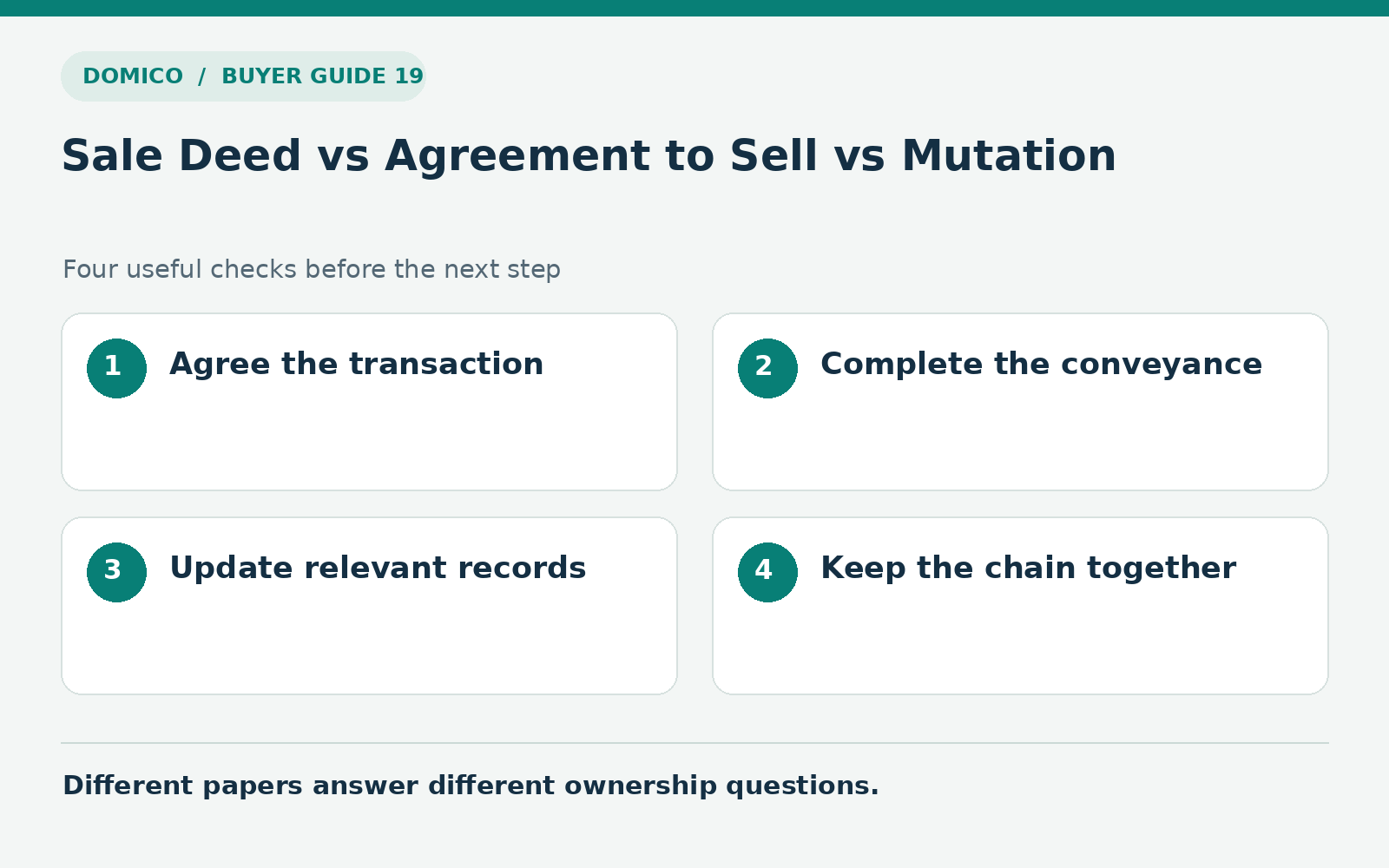
Different papers answer different ownership questions.
A sale deed, an agreement to sell and a mutation entry have different roles. An agreement records the terms on which a proposed sale will take place. A properly executed and registered sale deed is the conveyancing instrument for a conventional property sale of the kind discussed here. Mutation updates the relevant administrative record; it does not itself create title.
Understanding those differences helps a buyer ask better questions before paying, signing or relying on a seller's papers. This guide explains the sequence in ordinary language, with practical checks for a plot or home purchase in Madhya Pradesh. Special transactions can require different instruments and advice, so do not apply the sequence mechanically to every case.
The three documents at a glance
The easiest approach is to ask what each record is intended to do. Is it setting future obligations, completing a conveyance or updating a government record after a relevant event? A document can be important without performing all three functions.
The Transfer of Property Act distinguishes a sale from a contract for sale. Section 54 explains that a contract for sale does not, by itself, create an interest in or charge on the property. The actual legal structure and registration requirements should be reviewed for the particular transaction.
| Record | Main role | What a buyer should not assume |
|---|---|---|
| Agreement to sell | Records the proposed transaction and obligations | That signing it alone completes ownership transfer |
| Sale deed | Conveys the relevant interest through the proper legal process | That registration cures every earlier title defect |
| Mutation entry | Updates the relevant administrative or revenue record | That the entry itself creates or proves title conclusively |
| Tax or utility record | Serves the relevant service or assessment purpose | That the payer is automatically the legal owner |
What an agreement to sell should help you understand
An agreement identifies the parties, property, consideration, payment schedule, conditions and intended completion. Depending on the transaction, it may also cover specifications, possession, liabilities and consequences if obligations are not met. Read the complete document and annexures before relying on it.
Ask whether the property description is precise enough to identify the unit or parcel. Confirm names, capacity, ownership shares and the seller's authority. A clear future promise is difficult to use if it does not match the actual property or the person who can sell it.
Have material conditions drafted appropriately. If financing, legal review, mortgage closure or another event matters, understand how it is addressed. A condition discussed informally may not have the same treatment as one properly recorded in the governing documents.
Registration and an agreement are separate questions
Do not assume every agreement can remain unregistered or that a notarised document automatically satisfies registration requirements. The instrument, applicable law and transaction matter. Obtain advice on the required stamping and registration for the actual document.
For promoter transactions covered by the relevant RERA provision, the law also addresses accepting advances above the specified threshold before a written, registered agreement for sale. This is one reason a booking form should not be treated casually as a substitute for the next required legal step.
Keep the purpose clear: even where an agreement is properly registered, its role is not automatically identical to a sale deed. Ask the adviser what rights and obligations it creates and what still needs to happen to complete the intended conveyance.
What the sale deed does in a conventional purchase
The sale deed is the instrument through which the relevant property interest is conveyed in the normal registered-sale structure discussed here. Its wording, execution, registration and the seller's capacity all matter. Review the final draft against the title file and agreed transaction.
Check the exact property description, consideration, payment details, parties and ownership shares. For a flat, identify the unit and relevant rights accurately. For a plot, match the parcel and description with the appropriate records and layout.
Do not treat a registered deed as proof that every earlier legal concern has vanished. The seller can only convey the interest legally available to be transferred. Independent title review before completion remains important, including authority, restrictions and relevant liabilities.
Why mutation does not replace the sale deed
Mutation generally records a change in the relevant revenue or administrative record following a transaction or event. The Supreme Court has repeatedly explained that mutation entries do not confer title. A person's name appearing in such a record should be read in its proper role alongside the complete legal file.
That does not make mutation unimportant. Updating the applicable record can be necessary for administration and future dealings. The mistake is treating it as the instrument that independently creates ownership or resolves a disputed title.
Ask which revenue, municipal or other records apply to your property and what the current update process requires. Different records serve different functions. Keep the acknowledgment and final update, but preserve the underlying conveyance and supporting title documents too.
| Buyer question | Record or review that helps | Important distinction |
|---|---|---|
| What terms were agreed? | Agreement and complete annexures | A promise and its conditions |
| What was conveyed? | Registered deed and legal review | The actual instrument and available interest |
| Was an administrative record updated? | Relevant mutation or record update | An entry serving its defined purpose |
| Who can sell? | Title chain and authority review | Capacity is not established by one label |
| Are services and dues addressed? | Applicable statements and settlement records | Service records are separate from title |
A simple purchase sequence
Imagine a buyer considering a resale flat. First, an independent lawyer reviews the seller's title and authority, relevant building records and any liabilities. The buyer and seller agree the price and conditions, with an agreement structured appropriately for the transaction.
The parties then coordinate financing, settlement of an existing mortgage where relevant and the final deed. The deed is reviewed, executed and registered through the applicable process. Payment and possession are handled under the agreed and legally reviewed sequence.
After the transfer, the buyer completes applicable record updates and practical service changes. The agreement, deed and later entries remain in one file, each serving its own purpose. This is an illustration of the roles, not a universal order for every property transaction.

Names and property details must match
Compare the parties' names and capacity throughout the file. A spelling variation may have an explanation, but it should not be ignored when identity matters. If a seller acts through an attorney, entity or succession arrangement, have the authority reviewed properly.
For the property, compare numbers, location, area, boundaries or unit details as relevant. A familiar address is not always a sufficient legal description. A plot number in a private layout may need to be connected with the underlying land records.
If the agreement and deed differ, establish whether the change is intended and properly documented. Do not sign an unexplained revised description because the registration appointment is approaching. Correct identification is central to understanding what you are buying.
Understand the payment record too
Keep the agreed consideration and actual payment trail consistent with the transaction documents. Record the booking adjustment, subsequent transfers and relevant lender payments. Reconcile totals before signing a final acknowledgment.
If an existing mortgage must be closed, use a coordinated process with the relevant lenders and advisers. Confirm how original documents, discharge evidence and remaining funds will be handled. A seller's assurance that the loan will be cleared later does not answer the sequence.
Avoid signing statements that a payment has been received or a condition completed when that is not true. Ask the adviser to document the actual arrangement accurately. The paperwork should describe the transaction you are completing, not a convenient fiction.
Possession is another important record
Physical possession and legal conveyance should be understood together but are not interchangeable labels. A person occupying a property is not automatically its legal owner. Equally, a buyer needs a clear practical handover even when the conveyancing documents are ready.
Record the agreed possession date, condition, keys and access arrangements. For a flat, include relevant meter readings, fixtures and open work. For a plot, identify the exact parcel, boundaries and access at handover.
Have the transaction adviser explain how possession is coordinated with the deed and payments in your case. Do not assume every deal follows the same timing. A written plan helps the parties complete the transfer without an avoidable gap between documents and actual use.
Common shortcuts that deserve closer review
An agreement, receipt, power of attorney, tax entry or mutation record should not be described casually as “the same as a sale deed.” Each needs to be understood in its actual legal role. Some transactions have special structures, which makes proper advice more important rather than less.
Do not assume notarisation replaces registration where registration is required. Do not assume a revenue entry conclusively settles a title dispute. Do not assume payment of property tax proves that the payer can transfer the property.
If someone proposes an unusual shortcut to reduce time or charges, ask for its lawful basis and consequences. The cost of correcting an incomplete transfer can be much more significant than the convenience promised at the beginning.
Build a permanent ownership file
Keep a clear index of the documents, their dates and the property they concern. Preserve the title-chain records supplied, legal review, agreement, registered deed, relevant payment evidence, possession record and applicable administrative updates.
If a lender holds original documents, retain its acknowledgment and inventory. Keep secure digital copies for reference and avoid sharing unrestricted folders containing personal identity or banking information. Future refinancing or sale becomes easier when the file is organised.
| File section | What to retain | Check after completion |
|---|---|---|
| Title and authority | Relevant prior instruments and supporting records | Documents relate to the same property and seller |
| Transaction terms | Accepted agreement and annexures | Final agreed version is complete |
| Conveyance | Registered deed and acknowledgment | Names, description and shares are correct |
| Money and possession | Receipts, lender records and handover evidence | Totals and actual handover reconcile |
| Later updates | Applicable revenue, municipal and service records | Updates are completed and retained |
What if a record is missing or wrong?
Identify which record is affected and what the error changes. A utility name update, a deed description error and a disputed ownership claim require different responses. Do not try to solve every problem by obtaining a mutation entry.
Ask the relevant authority or professional for the proper correction process. Some matters may involve additional documents, participation or legal proceedings. The right route depends on the facts and applicable requirements.
Keep the original record, evidence of the issue and correspondence about the correction. Avoid creating inconsistent replacement documents informally. A clear audit trail helps explain the position to authorities, lenders and future buyers.
Frequently asked questions
Does an agreement to sell make me the owner?
An agreement records the proposed sale and obligations; it does not by itself perform the same role as the completed conveyance. Have an adviser explain the actual rights created and steps required for your transaction.
Is mutation proof of ownership?
Mutation entries do not themselves confer title. Read them alongside the underlying legal instruments and complete title review. They still have an administrative role and should be updated where applicable.
Is a registered sale deed enough to skip title checks?
No. Review the seller's title, capacity, restrictions and relevant liabilities before completion. Registration of an instrument should not be treated as curing every possible earlier defect in the seller's interest.
Can notarisation replace registration?
Do not assume that it can. Applicable stamping and registration requirements depend on the instrument and law. Obtain transaction-specific advice before relying on a notarised document as a completed transfer.
What should I do after registration?
Retain the deed and payment records, complete the agreed possession process and check applicable administrative and service updates. Keep each record in its proper role within a secure permanent file.
Follow the whole chain
When examining a property in Indore, ask how the seller acquired the interest, what agreement is proposed, how the conveyance will be completed and which records must then be updated. Clear answers are more useful than treating one paper as the answer to every ownership question.
Primary references and scope
- Transfer of Property Act, 1882, India Code — section 54 on sale and contract for sale.
- Supreme Court judgment, 20 November 2023 — discussion of the settled distinction between mutation entries and title.
- MP IGR and MP Bhulekh — relevant official transaction and land-record services.
Prepared on 18 October 2026. This explains general document roles, not the validity of a particular title or instrument. Obtain a legal opinion for the actual property and transaction. Images illustrate the topic.
Continue reading
- homebuyers
- buying-guide
- sale-deed-agreement-mutation
- indore
Planning to buy or rent in Indore? Browse verified properties in Indore or read more Indore guides.