Buying Guide
Vacant Plot Holding Costs: Build an Annual Budget
Budget vacant-plot upkeep, applicable dues, inspections, security, borrowing and a longer holding period before investing in land.
Updated 8 min read
Buying Guide
Budget vacant-plot upkeep, applicable dues, inspections, security, borrowing and a longer holding period before investing in land.
An empty plot can still send you bills.
Buying vacant land does not end the spending. Depending on the property, location and ownership terms, you may face upkeep, security, local dues, inspections and occasional repairs. If the plot is financed, borrowing creates another carrying obligation. These costs matter especially when the land produces no current income.
A holding-cost budget helps you decide whether you can retain the plot until your intended use or a realistic sale. It also makes small recurring obligations visible before neglected land becomes a larger problem. Use actual quotations and applicable official demands; the examples below are illustrations, not Indore market rates.
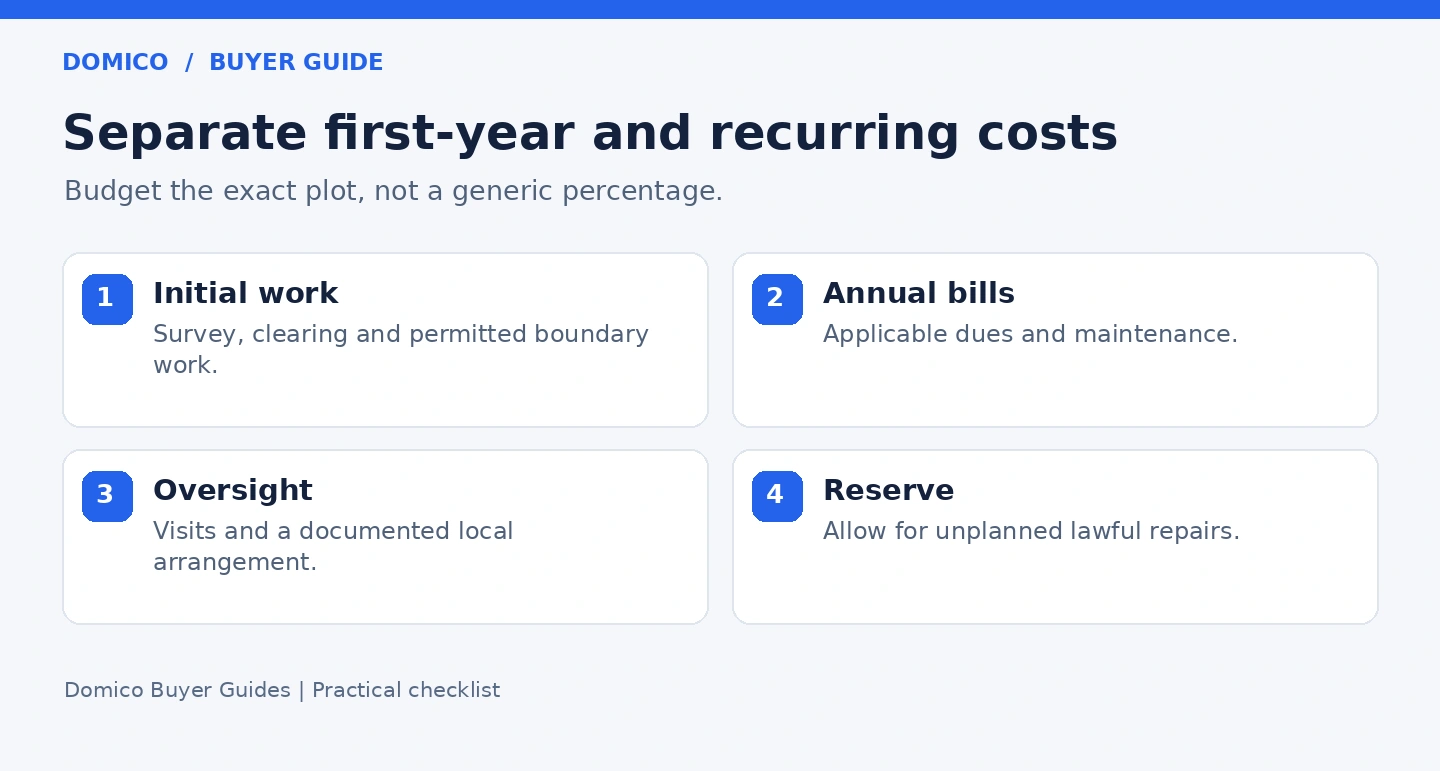
Some costs occur once when you take ownership: legal review, an initial survey or demarcation, clearing existing debris and any permitted boundary work. Others recur, such as periodic cleaning, applicable dues and inspection travel. Mixing them makes the first year look like a normal year or understates the capital needed at purchase.
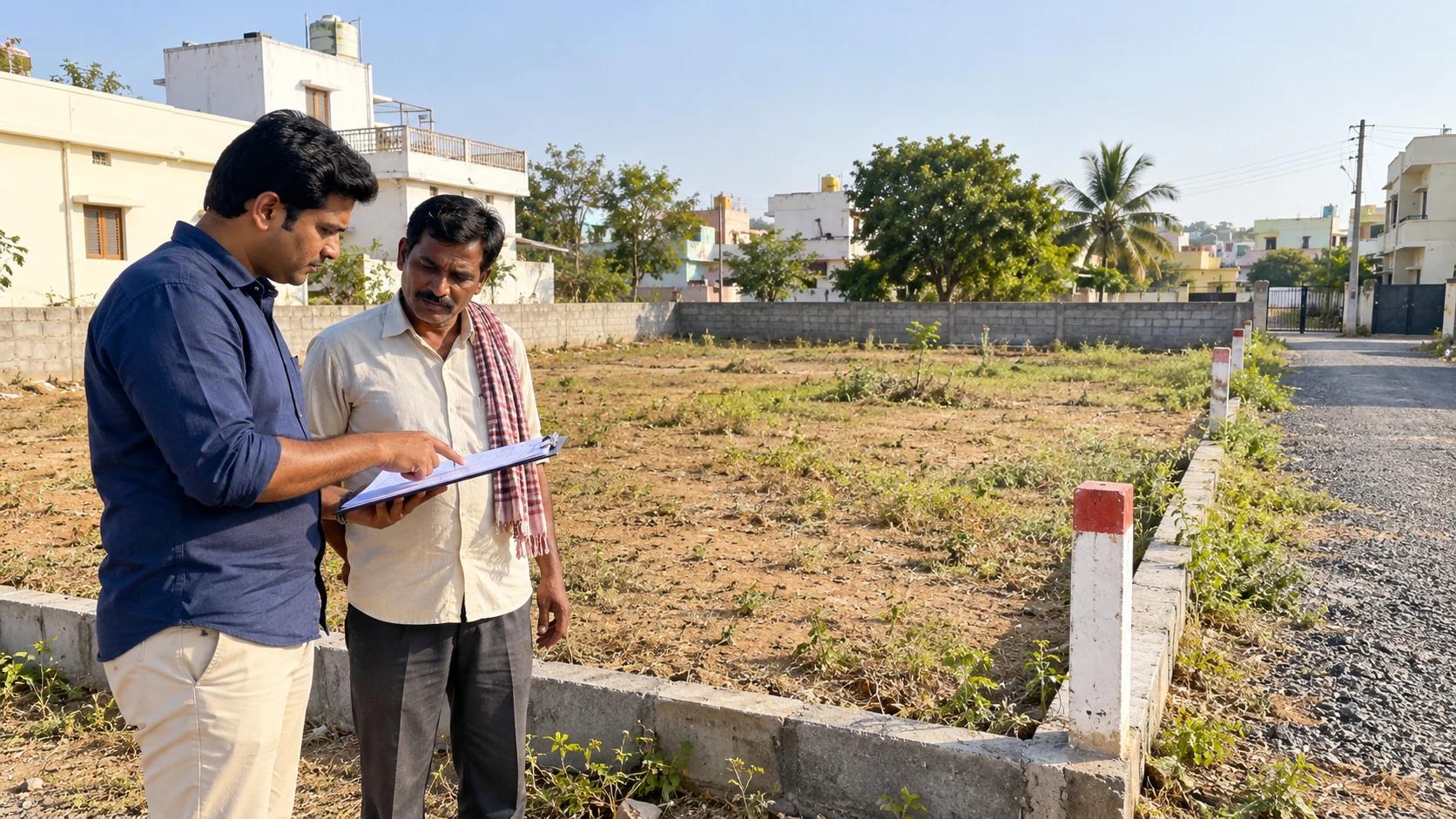
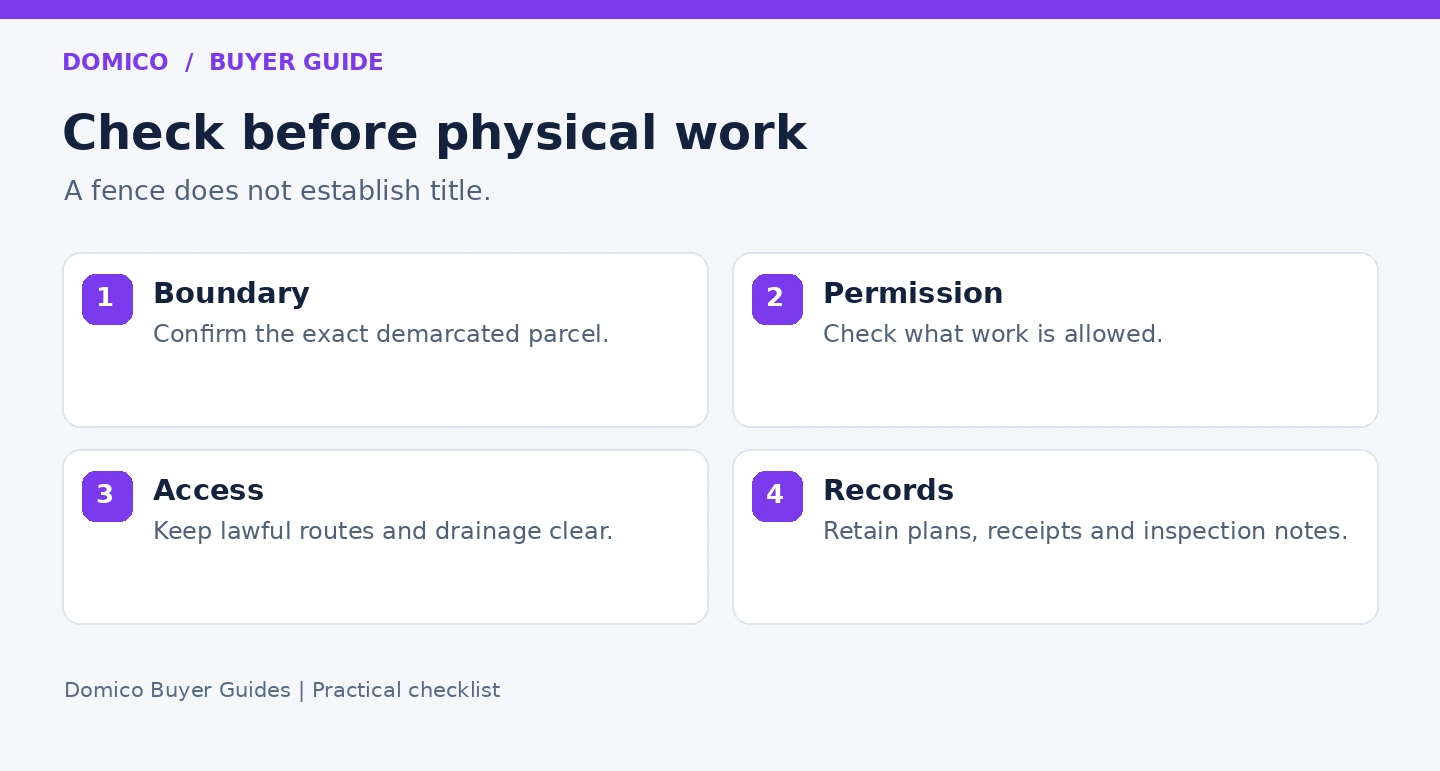
Before authorising a fence or boundary wall, confirm the plot position, permissions and access. Do not obstruct a public route, drainage channel or another person's land. A contractor's willingness to build does not establish the legal boundary or permission to do so.
Use the official MP Bhulekh portal for relevant land-record information and obtain professional help for the broader legal and physical review. Online records and a visible fence answer different questions.
Begin with ownership and local obligations. Check the applicable municipal or revenue demands, development-authority dues, lease rent, project maintenance or association charges. Not every item applies to every plot. Ask for a current statement rather than assuming vacant land has no charges.
Review allotment, lease and purchase terms for any development obligations or deadlines. Have a lawyer explain the actual consequences and available process where conditions exist. Do not accept a universal claim that all plots must be built on within a particular number of years.
| Cost category | What to investigate | Useful evidence |
|---|---|---|
| Local and authority dues | Applicable tax, lease or other demands | Current official statements and receipts |
| Project maintenance | What services are provided and how charged | Agreement, budget and invoices |
| Physical upkeep | Vegetation, litter and minor boundary repairs | Inspection and itemised quotations |
| Oversight | Visits, caretaker or security arrangements | Written scope and actual travel cost |
| Documentation | Professional review when records change | Specific advice and quotations |
For property within the relevant municipal jurisdiction, Indore Municipal Corporation's services provide an official starting point for applicable local bills. Confirm the authority responsible for the actual parcel, especially outside municipal limits.
Decide who will inspect the land, how often and what they will record. A dated photograph from a permitted location can help track dumping, damaged boundaries or a blocked approach. The inspection should also identify notices or new activity that needs professional attention.
Do not rely solely on a neighbour's informal promise to watch the plot. If a caretaker is engaged, agree what the person is authorised to do, what they must report and how payment is documented. Avoid giving broad authority or possession rights without appropriate legal advice.
Remote ownership can add cost. Include travel, time away from work and arranging a trustworthy local contact. A low annual maintenance invoice does not capture those practical burdens.
An empty plot can collect litter, overgrown vegetation or standing water. Ask a suitable contractor for an itemised maintenance plan, and check local requirements for disposal and work. Do not burn waste, dump material elsewhere or redirect water onto a neighbouring property.
Inspect drainage before monsoon conditions and after significant problems are reported. Where a drainage or boundary issue needs engineering work, obtain a proper assessment. Repeatedly paying for cleaning may not solve the underlying cause.
Spend in line with the ownership plan. A costly wall or decorative gate may not be necessary if you intend to build soon, while a basic permitted boundary and clear identification may be useful for oversight. Confirm the purpose and feasibility before treating construction as automatic “value addition”.
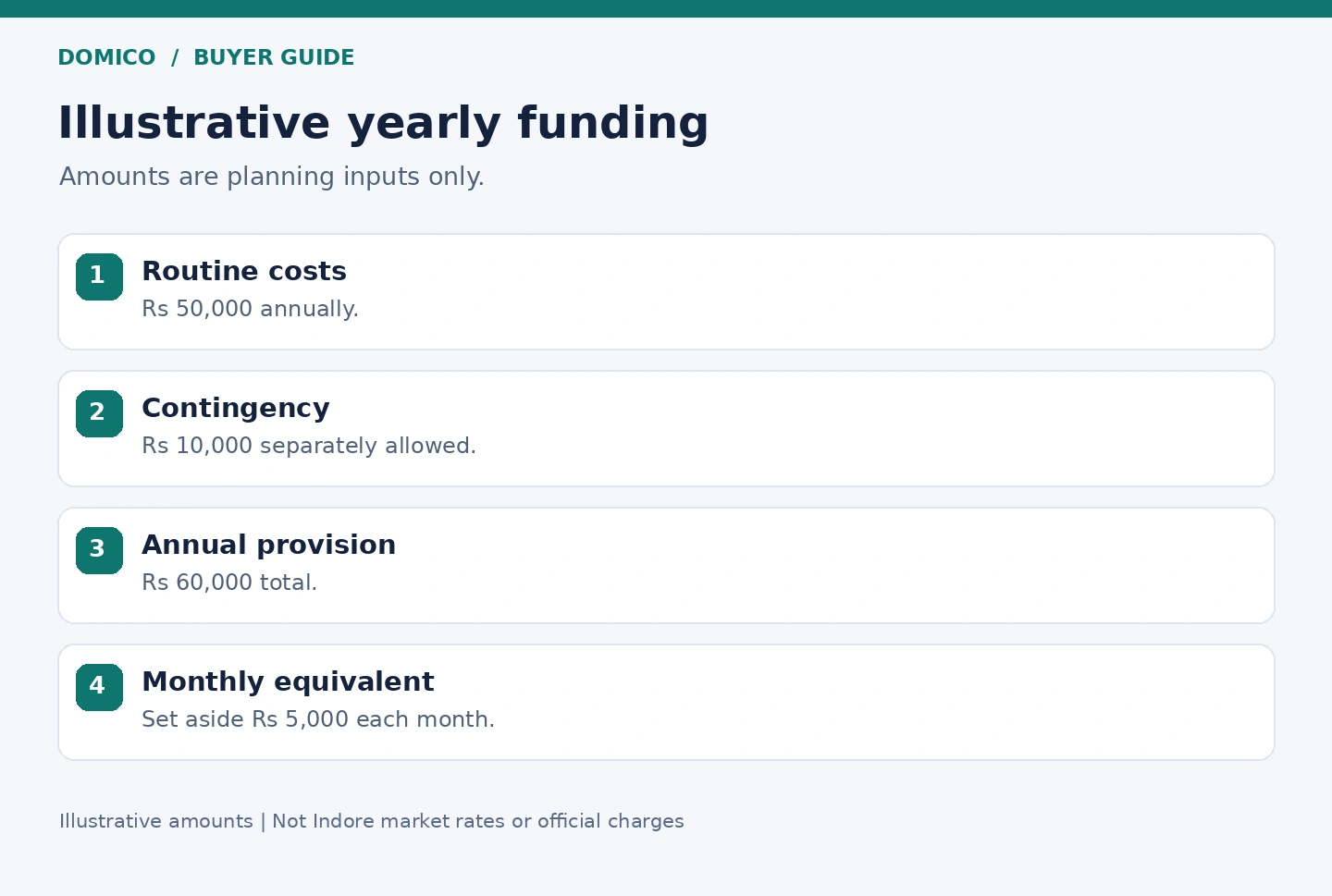
Suppose an owner obtains the following estimates. They are hypothetical inputs selected to demonstrate the method, not typical charges or a quotation for any locality.
| Annual item | Illustrative allowance |
|---|---|
| Cleaning and vegetation control | Rs 24,000 |
| Applicable local dues | Rs 5,000 |
| Project maintenance | Rs 12,000 |
| Inspection and security arrangement | Rs 6,000 |
| Documentation or professional allowance | Rs 3,000 |
| Routine annual total | Rs 50,000 |
| Separate contingency allowance | Rs 10,000 |
| Planned annual funding | Rs 60,000 |
Rs 60,000 per year is equivalent to putting aside Rs 5,000 per month. If the owner also spends Rs 1 lakh on initial permitted boundary work, the first-year cash provision becomes Rs 1.6 lakh. The following year's starting budget should separate recurring items from that one-time work.
This approach is more useful than assuming that a higher purchase price automatically requires a higher upkeep percentage. The condition, local obligations, distance and services determine the actual items.
If a loan financed the plot, include its full required payment in the household cash-flow plan. For measuring the investment's economic cost, distinguish interest from principal repayment. Principal reduces debt, but it still requires cash when the instalment falls due.
Do not assume future appreciation can service the loan before a sale. If the plot earns no income, the household must fund both debt payments and upkeep from other resources. Test whether those obligations remain manageable if business income slows or a sale takes longer.
RBI's financial awareness guidance supports budgeting and responsible borrowing. A plot should have its own carrying-cost line within that household budget rather than disappearing after the initial down payment.
Take the illustrative Rs 60,000 annual provision and hold it constant simply to see scale. Three years requires Rs 1.8 lakh and five years Rs 3 lakh. Actual bills may rise, a contingency may remain unused or a larger repair may occur; the flat assumption is not a forecast.
If your sale plan assumes two years, also examine four or five years. The exercise reveals whether the investment horizon is supported by the household's cash. A plot bought for a future home needs the same test if construction is postponed.
| Holding period | Illustrative funding at Rs 60,000 yearly | What is excluded |
|---|---|---|
| 1 year | Rs 60,000 | Purchase costs and debt payments |
| 3 years | Rs 1,80,000 | Cost increases and major unexpected work |
| 5 years | Rs 3,00,000 | Tax on eventual sale and selling expenses |
Also recognise opportunity cost: money committed to land is unavailable for another use. Keep any assumed alternative return clearly labelled and separate from the cash bills you must actually pay.
Keep the deed and title review, relevant approvals, survey information, receipts, current demands and inspection log together. Record notices and follow-up dates. Store sensitive documents securely and share them only with appropriate people for a defined purpose.
When a bill is unexpected, establish its authority, period and basis before paying. When an inspection reveals encroachment, a disputed boundary or official action, obtain timely legal help rather than attempting self-help measures that could worsen the situation.
No. The applicable items vary, but oversight, upkeep and local or contractual dues may remain. Ask for the exact property's records and quotations instead of assuming a zero-cost holding period.
That depends on the plot, permissions, agreements and practical needs. Confirm demarcation and applicable rules before work. A wall should not be used to settle an unresolved ownership or boundary dispute.
Review the relevant agreement, governing arrangements and services with a lawyer if disputed. Ask for an itemised basis and current demand. Avoid assuming every demand is valid or every vacant plot is exempt.
Count the full payment when testing household cash needs. For an investment-return calculation, separate interest and principal and include the outstanding loan settlement at sale. Mixing the two can confuse cost with debt reduction.
Add actual travel and an appropriately documented local oversight arrangement. Decide what inspections cover and how issues are reported. Keep enough accessible funds to respond to urgent lawful work without depending on an immediate sale.
An empty plot is an ongoing ownership responsibility. Price the purchase together with the years of care and funding needed to keep it usable and sale-ready.
Download the topic-specific review checklist. Use it to record evidence, unanswered questions and follow-up actions for the exact property.
Planning to buy or rent in Indore? Browse verified properties in Indore or read more Indore guides.
Check who owes the lender, how builder-paid interest works, when support ends and whether you can carry the loan if payments stop.



