Buying Guide
Plot Resale Liquidity: Check Your Exit Before Investing
Assess a plot’s future buyer, ticket size, financeability, comparable sales, transfer conditions and holding costs before investing.
8 min read
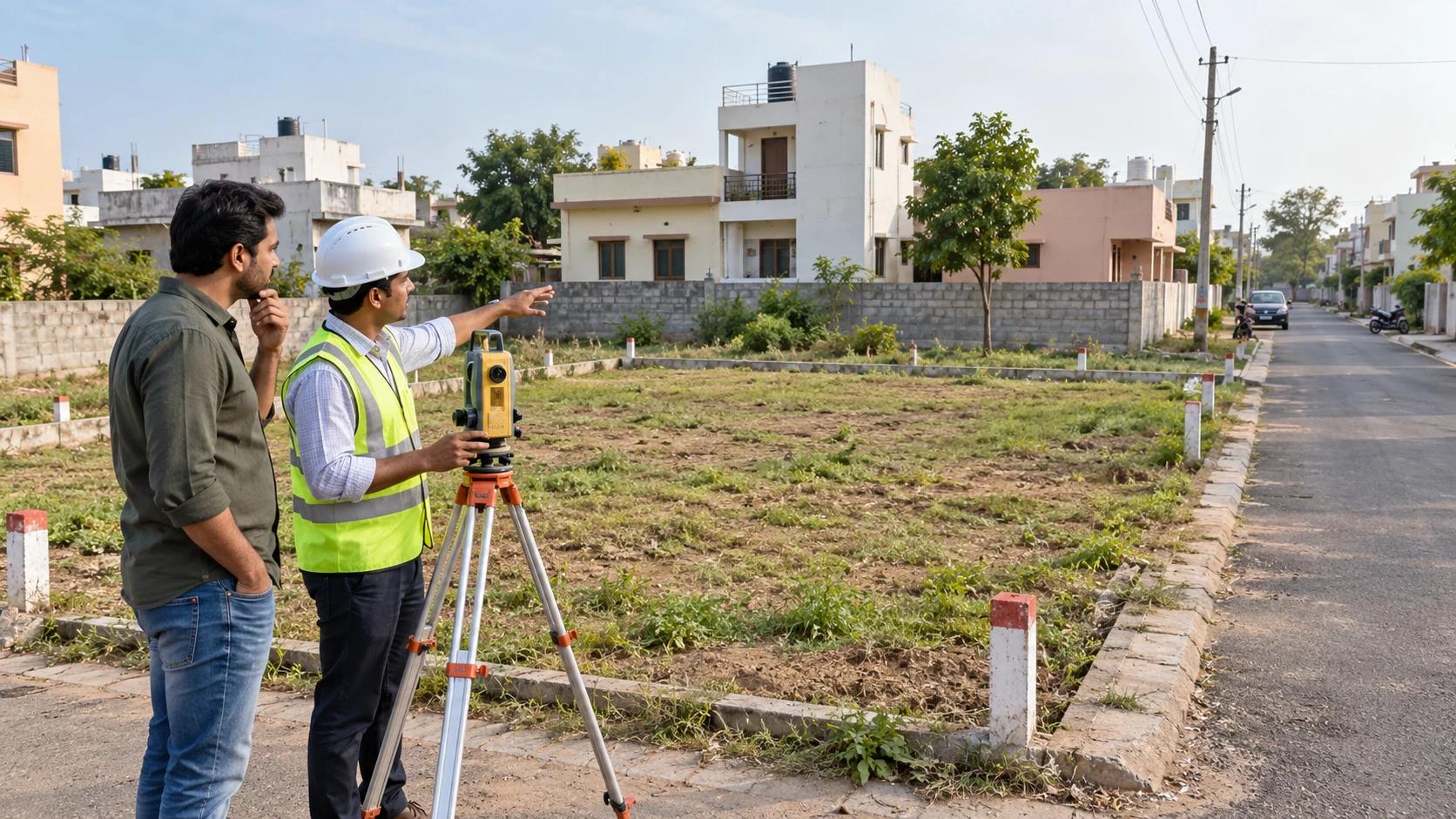
Buying Guide
Assess a plot’s future buyer, ticket size, financeability, comparable sales, transfer conditions and holding costs before investing.
Before buying a plot, ask who would buy it from you.
A plot can have an attractive location story and still take time to sell. Resale liquidity means how readily you can convert the asset into cash, within a realistic period and without accepting an unexpectedly large price reduction. It depends on more than a rising rate quoted by a broker.
Investigate the future buyer's budget, financing options, intended use and alternatives. Then check whether this exact plot meets those needs. A marketing promise that “investors are buying here” is weaker than evidence of completed comparable sales to people able to use or finance the land.
Record the plot's dimensions, area, frontage, access, orientation, tenure, approved use and development status. Add the seller's legal authority, applicable approvals and restrictions. A buyer who wants to build a home may reject a plot that an investor considers acceptable on paper.
Check whether the advertised area and number can be reconciled with the title documents, approved layout and ground position. If a basic identification issue remains unresolved, future buyers and their lenders may face the same problem. A purchase discount does not automatically compensate for a defect that prevents transfer or construction.
Use the official MP land-records portal as one part of an appropriate records review. Revenue information does not replace a complete legal title investigation, approval check and physical demarcation.
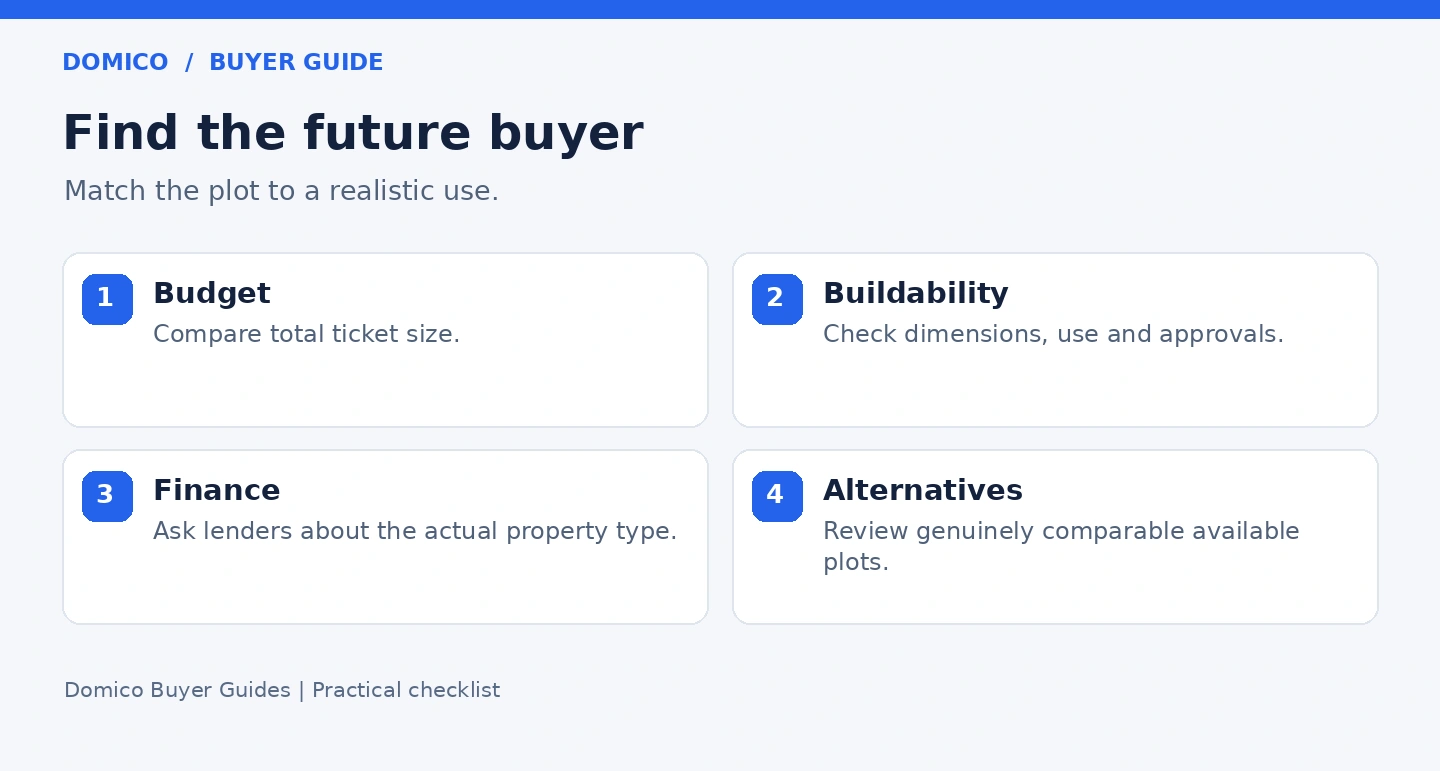
Ask whether the plot is likely to appeal to an end-user, a small developer, an adjacent owner or another investor. Each audience has different reasons to purchase and different limits. An oversized plot may have a small buyer pool even when its per-square-foot rate looks competitive.
Think in ticket size. A rate of Rs 4,000 per square foot means Rs 32 lakh for an 800-square-foot plot and Rs 80 lakh for a 2,000-square-foot plot, before other costs. These are illustrative calculations, not local market quotations. The larger plot requires a very different budget despite the identical rate.
| Possible buyer | What may drive the decision | What can narrow demand |
|---|---|---|
| Homebuilding household | Buildable size, services and everyday access | Unclear approvals or high complete budget |
| Small developer | Permitted use, dimensions and project economics | Restrictions or unsuitable frontage |
| Adjacent owner | Ability to combine land for a lawful purpose | Only one interested neighbour |
| Investor | Price, horizon and credible exit demand | Dependence on another speculative buyer |
Avoid assuming a particular buyer must eventually appear. A resale plan should remain plausible if the adjacent owner declines or speculative demand weakens.
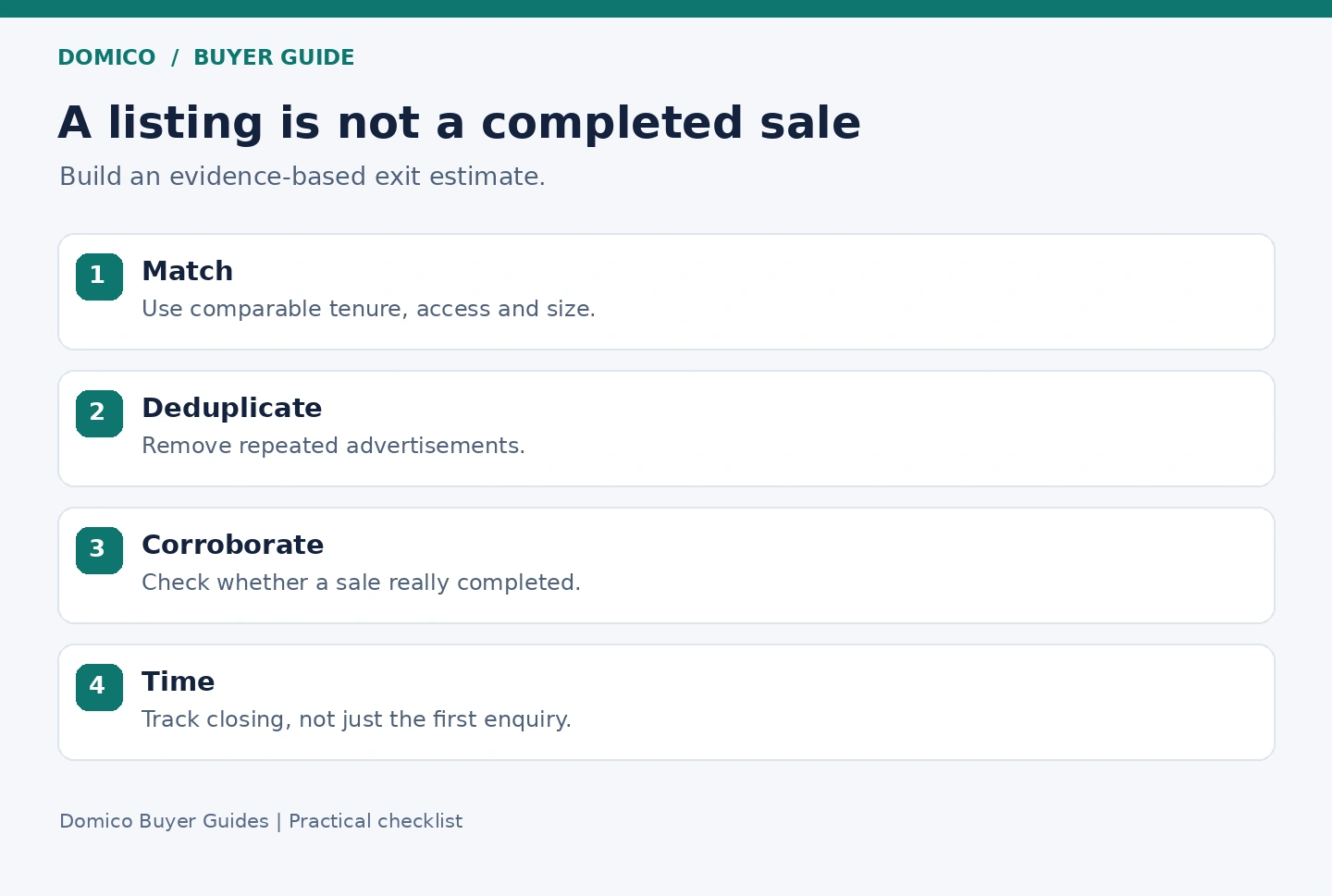
Ask several sources about recent comparable sales, how long they were marketed and what changed before closing. Were the properties genuinely similar? Did the seller reduce the price, clear a title issue or offer unusual payment terms? Protect private information when examining evidence.
Listings measure visible asking supply. They do not establish how quickly transactions complete. Track comparable plots and remove duplicates. A listing that disappears may have been withdrawn rather than sold. Ask for corroboration before using it as proof of liquidity.
Separate the time to receive an enquiry from the time to receive cleared sale proceeds. Site visits, due diligence, financing and registration all take time. If you need money for a fixed deadline, an expected enquiry is not an available bank balance.
Ask lenders about the kind of plot, location, approvals and transaction they are willing to examine. A general statement that a colony is “bank approved” does not guarantee a future buyer's loan. Lenders review the borrower and the property according to their current policies.
If mainstream financing is difficult, the potential buyer may need more cash. That can narrow the audience or affect negotiations. Obtain clear current information rather than treating the seller's old loan sanction as evidence that every future transaction will be financeable.
Also consider the complete building budget for an end-user. A plot can be inexpensive relative to nearby land but unaffordable once construction, services and transaction costs are added. Investigate the use the buyer is actually trying to achieve.
Visit using the route an ordinary buyer would take. Check lawful access, usable road condition, drainage and the services represented in the offer. Proposed connectivity should be separated from completed, usable access.
Ask how the plot could be built on under applicable permissions and restrictions. Some buyers care more about usable frontage and layout than a corner premium. Others need immediate services because they plan to construct soon. Match the asset to a realistic use instead of relying on a general locality story.
Where infrastructure is central to the investment argument, verify the responsible authority, official status and alignment. A proposed road may affect parcels differently. It can also introduce access changes or acquisition questions rather than simply increasing every nearby price.
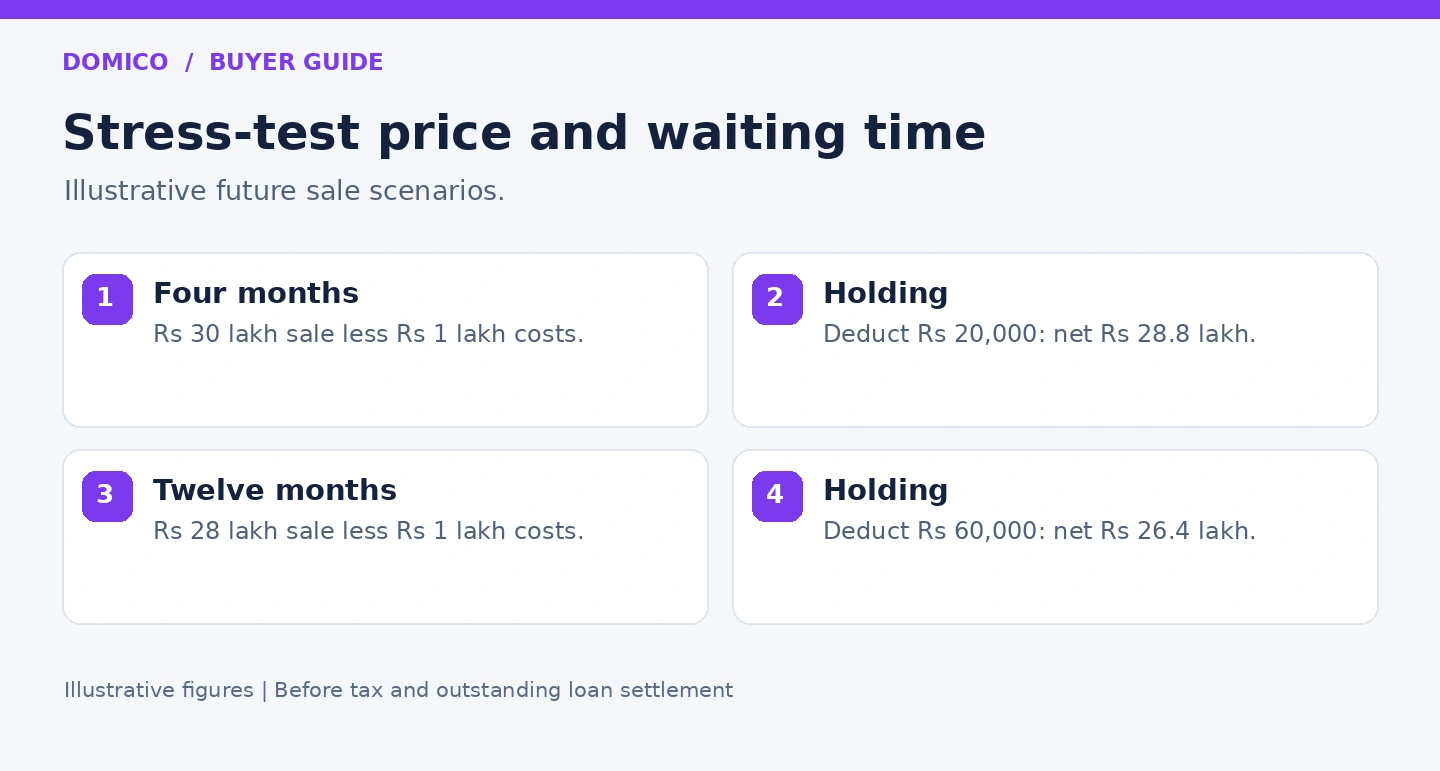
Imagine a buyer considering a future sale at Rs 30 lakh. Assume selling expenses of Rs 1 lakh and holding costs of Rs 5,000 per month. If the sale completes after four months at that price, net proceeds after these assumed items are Rs 28.8 lakh.
Now consider a weaker case: sale at Rs 28 lakh after twelve months, with the same Rs 1 lakh selling costs and Rs 60,000 holding costs. Net proceeds become Rs 26.4 lakh. The difference is Rs 2.4 lakh, created by both a lower price and a longer waiting period.
| Illustrative exit | Gross sale | Selling cost | Holding cost | Net before tax and loan settlement |
|---|---|---|---|---|
| Four-month sale | Rs 30 lakh | Rs 1 lakh | Rs 20,000 | Rs 28.8 lakh |
| Twelve-month sale | Rs 28 lakh | Rs 1 lakh | Rs 60,000 | Rs 26.4 lakh |
Neither scenario is a forecast. The exercise shows why a higher expected rate should not be assessed without time and cost. Include outstanding debt and current tax advice when evaluating the actual cash available to you.
Lease conditions, development obligations, authority transfer processes or specific allotment terms may affect a sale. Have a lawyer identify which apply to this plot and whether consents, dues or restrictions need attention. Do not assume conditions are identical across all projects or ownership types.
Check whether the plot can lawfully be subdivided before imagining several smaller exits. A large parcel's price should not be justified by a subdivision plan that has not been assessed or approved as required.
Ask for a written schedule of known dues and transfer steps. Unknown obligations discovered during a future sale can delay the transaction or reduce the net amount received.
Organise title records, approvals, relevant receipts, plans, demarcation information and a record of enquiries. Update the file when a new order, charge or condition arises. Good records cannot guarantee a buyer, but they can reduce avoidable delay when genuine interest appears.
| Evidence | Stronger position | Weak assumption |
|---|---|---|
| Comparable sales | Similar plots with corroborated closing details | Only current asking rates |
| Buyer audience | Identifiable use and feasible budget | “Anyone can buy later” |
| Transfer readiness | Known documents, dues and permissions | Problems postponed until resale |
| Holding capacity | Costs fit the owner's available cash | Sale required on one exact date |
SEBI's liquidity-risk explanation describes the difficulty of promptly buying or selling an investment. A plot should be evaluated with that possibility in mind, even when the owner expects long-term growth.
No. Ticket size, exact location, title, approvals, access and competition still matter. Demand for one plot type does not establish demand for every parcel in the locality.
It may fit more budgets, but usability and legal status remain important. An awkward or non-buildable small plot can have limited demand. Compare actual buyer needs rather than using size alone.
Review the written contract, conditions, funding and counterparty's ability to perform with professional advice. A verbal buyback assurance is not available cash or proof of market liquidity.
It can take time to sell and the achievable price may change. Keep emergency planning centred on resources that can be accessed when needed. Decide how long you can hold the plot without a forced sale.
Ask: “What evidence shows a suitable buyer could purchase this exact plot at this complete price?” The answer should address use, finance, documents and alternatives, rather than only future infrastructure.
Buy with the future buyer in mind. A credible exit needs usable land, clear records, an attainable ticket size and enough time to complete the transaction.
Download the topic-specific review checklist. Use it to record evidence, unanswered questions and follow-up actions for the exact property.
Planning to buy or rent in Indore? Browse verified properties in Indore or read more Indore guides.
Check who owes the lender, how builder-paid interest works, when support ends and whether you can carry the loan if payments stop.



