Buying Guide
Property Purchase TDS: Form 141 and Buyer Checklist
Understand property purchase TDS, resident and NRI seller distinctions, Form 141 schedules, joint-party checks and a practical payment ledger.

Table of contents
Property TDS is a buyer’s payment responsibility, not a task to remember after registration.
A property deal involves large transfers, deadlines and several people handling paperwork. In that rush, a buyer can assume the seller, bank or deed writer has taken care of tax deducted at source. That assumption can leave the buyer with an avoidable compliance problem.
This guide explains the purchase-side workflow in simple terms. It uses the Income-tax Act, 2025 framework relevant to tax years beginning from April 2026 and the official filing guidance available in October 2026. Earlier payment events can fall under the previous law and forms, so a transaction spanning the change needs date-wise review.
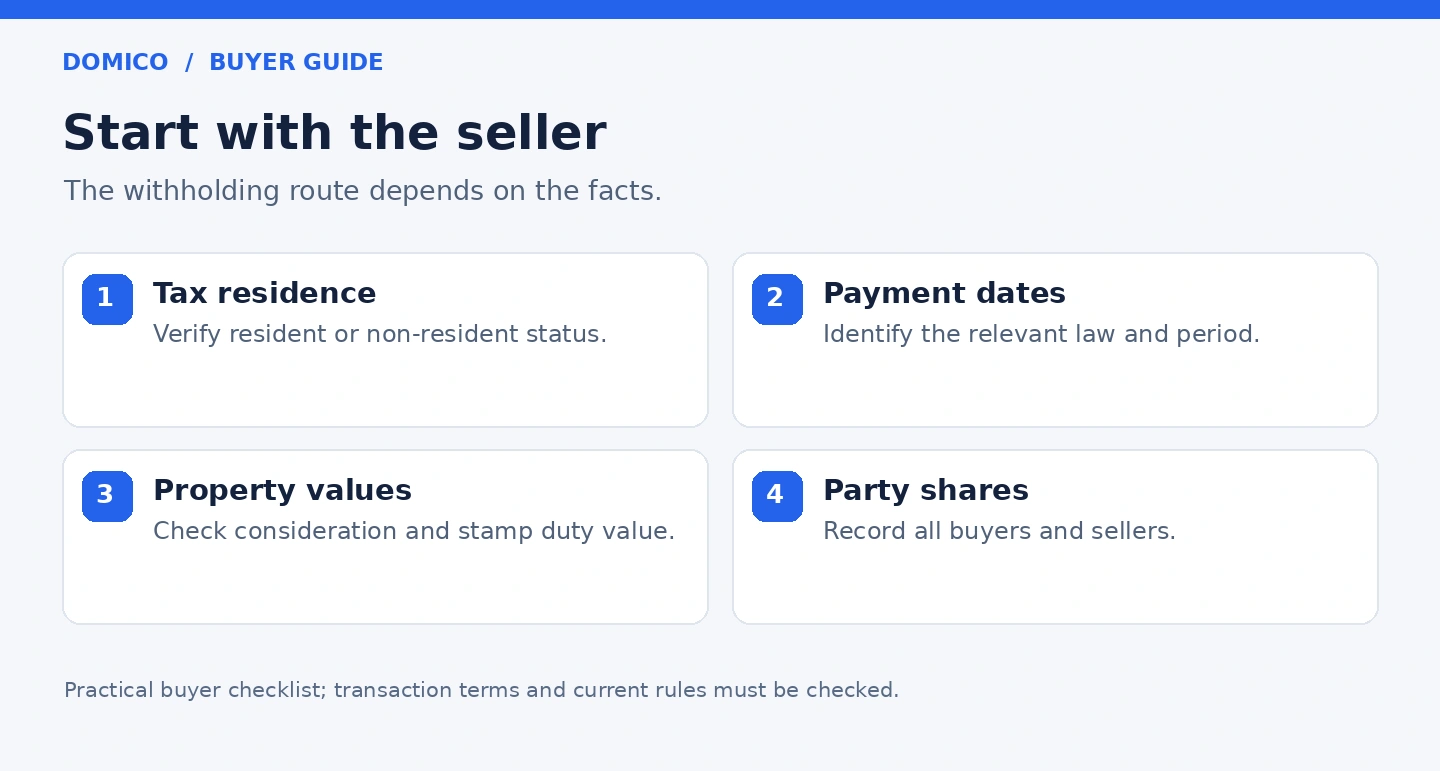
First identify the seller’s tax residence
An Indian passport, an Indian bank account or a local address does not by itself settle income-tax residential status. Ask for the seller's declaration and have a tax professional verify the treatment where residence is uncertain. Resident and non-resident seller transactions must not be processed as though they have identical withholding rules.
For a qualifying purchase from a resident seller, the official TDS guidance describes the property-purchase provision under section 393(1), Table serial number 3(i). The ordinary rate is 1% of the higher of consideration and stamp duty value when the applicable ₹50 lakh threshold is met. Agricultural-land exclusions and special cases require the statutory definition, not only the land's marketing description.
Do not apply that 1% rule automatically to an NRI seller. Withholding can depend on a different provision, rates and any valid lower-deduction certificate. Obtain the computation before making payments.
A current form update buyers should know
Under the new framework, Form 141 consolidates several earlier PAN-based challan-cum-statements, including the earlier property Form 26 QB. The official Form 141 FAQ identifies Schedule B for resident-seller property transfers.
From 1 October 2026, Schedule E also covers eligible property purchases from non-resident sellers by resident individual or HUF buyers. Other buyer categories can require the appropriate TAN-based route. This reporting change does not make the resident-seller 1% rate applicable to every non-resident transaction.
| Transaction question | Why it matters | Action before payment |
|---|---|---|
| Resident or non-resident seller? | Determines the withholding route | Verify tax residence |
| Which payment date? | Determines old/new framework and period | Make a date-wise ledger |
| Which property values? | Affects threshold and calculation | Obtain price and stamp assessment |
| Multiple parties? | Reporting and allocations need accuracy | Record every buyer and seller share |
| Lower-deduction certificate? | May affect a qualifying case | Validate scope and period professionally |
Understand the threshold without splitting the deal
For the resident-seller provision, check both the genuine consideration and stamp duty value. Do not assume that a price below ₹50 lakh settles the question if the stamp duty value reaches the threshold.
The current statutory table also addresses aggregation across multiple buyers and sellers. Dividing a property between spouses does not automatically split one transaction into separate sub-threshold purchases. Ask the professional preparing the filing to document the total and the party-wise allocation.
Include relevant incidental consideration as required by the applicable definition. A basic price shown separately from certain property-related charges should not be used casually to understate the taxable base. Obtain an itemised seller demand and a written calculation.
An illustrative resident-seller transaction
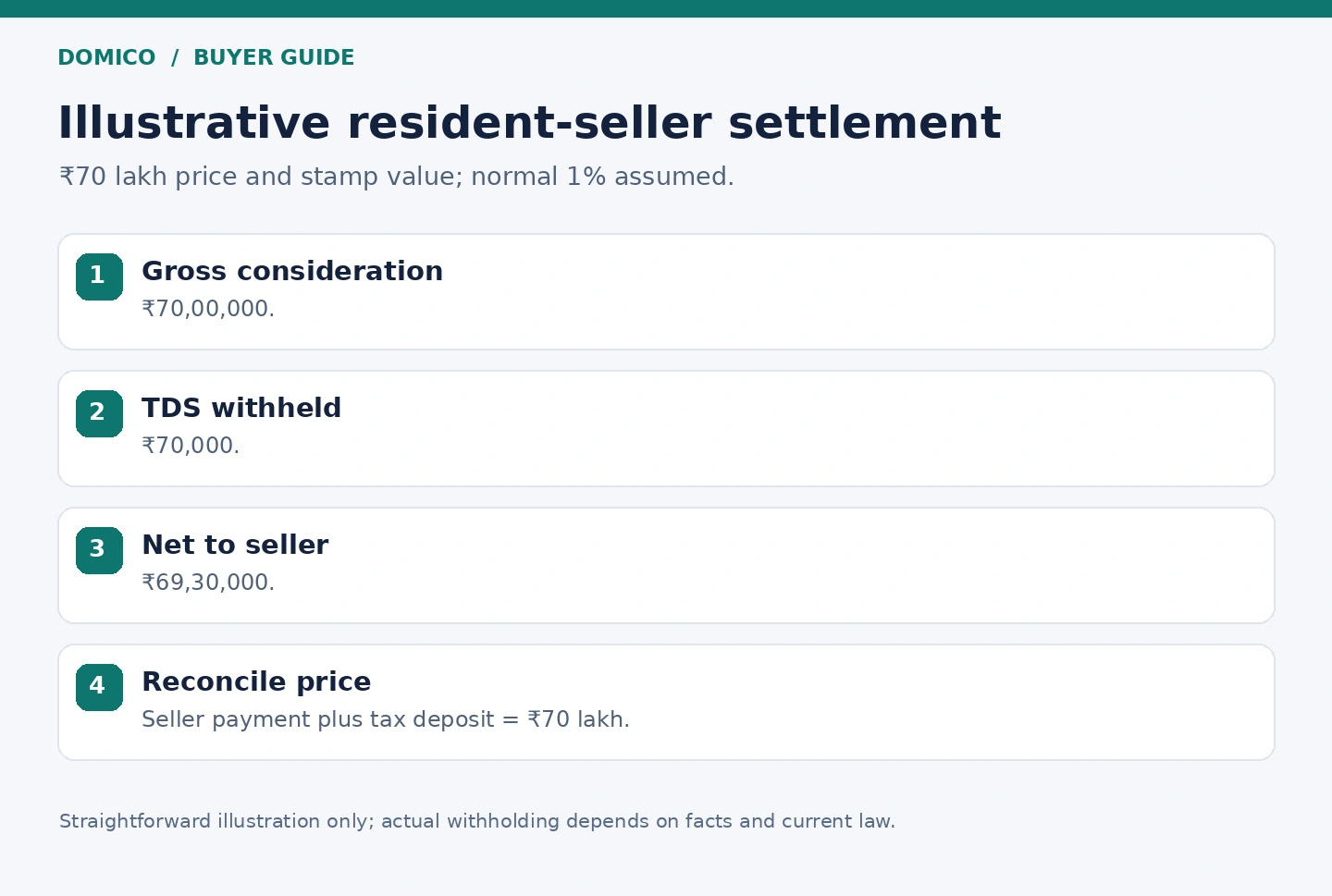
Assume a qualifying property is bought from a resident seller for ₹70 lakh, with stamp duty value also ₹70 lakh, and the normal 1% rate applies. TDS is ₹70,000. The price is generally settled through ₹69.30 lakh to the seller and ₹70,000 deposited as the seller's tax credit, subject to the transaction's lawful payment arrangements.
TDS is not an extra ₹70,000 automatically added on top of the agreed ₹70 lakh price. It is tax withheld from the relevant payment. Make the agreement and receipts clear so the seller's ledger credits the full amount appropriately.
| Illustrative price settlement | Amount | Record |
|---|---|---|
| Agreed consideration | ₹70,00,000 | Sale agreement and deed |
| TDS at assumed applicable 1% | ₹70,000 | Government deposit and filed statement |
| Net amount to seller | ₹69,30,000 | Bank transfer receipts |
| Total accounted towards price | ₹70,00,000 | Reconciled transaction ledger |
This example assumes a straightforward full-price settlement. Instalments, differing stamp value, joint ownership, earlier payments or a non-resident seller need their own computation. Do not copy the arithmetic into a different fact pattern without checking.
Build the ledger before the first instalment
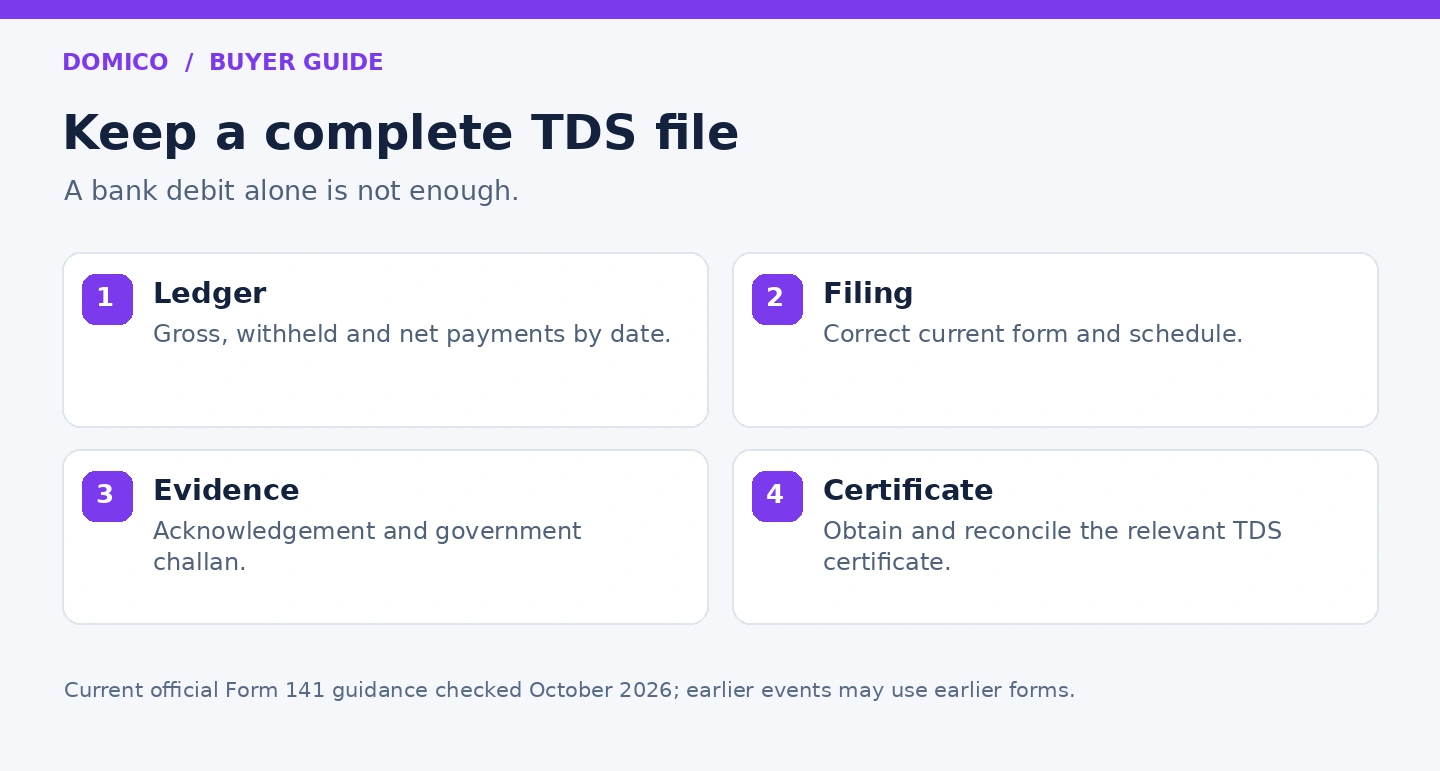
List each payment or credit event, its date, gross amount, withholding, net transfer, recipient and filing acknowledgement. Share the required withholding plan with the lender if loan disbursements are involved. The buyer should know whether the lender will deduct from a release or expects the buyer to arrange it separately.
Do not wait until the registration appointment to discover that all money has already been paid to the seller. Recovering withheld tax afterward can become a contractual and cash-flow problem. Agree the process beforehand and keep the seller informed.
For a deal that began before April 2026 and continues afterward, ask the tax professional to identify which event belongs to which framework. A new registration date does not automatically rewrite the treatment of an earlier payment.
Filing and payment: keep completion evidence
Use the current official portal guidance for the applicable form and schedule. Prepare accurate PAN details, party information, property address, agreement and payment dates, values and instalment information. Verify every digit against the source document before submission.
The Form 141 guidance states a payment deadline of thirty days from the end of the deduction month and a filing deadline described as one month from that month-end. Treat the payment and statement requirements separately and confirm the precise calendar deadline, especially around February or a short month. Do not substitute thirty days from registration.
After filing, retain the acknowledgement and challan, obtain the applicable TDS certificate through the official process and ensure the seller can reconcile the credit. A bank debit alone is not the complete compliance file.
Common mistakes and a better control
| Mistake | Why it causes trouble | Better control |
|---|---|---|
| Assuming the seller is resident | Wrong withholding treatment | Obtain residence information early |
| Paying the entire amount first | No withholding retained | Build deduction into each relevant event |
| Using an old form tutorial | Wrong year or filing route | Follow current official guidance |
| Ignoring joint-party details | Allocation or PAN mismatch | Prepare a party-wise worksheet |
| Treating a debit as final proof | Filing may remain incomplete | Save acknowledgement, challan and certificate |
If an error occurs, use the prescribed correction process rather than filing another unrelated payment blindly. The official FAQ directs Form 141 corrections through TDS-TRACES. Have the original acknowledgement, challan and correct supporting documents available for the correction request.
Reconcile one payment all the way through
For each relevant instalment, check four records together: the seller's gross demand, the deduction worksheet, the net bank transfer and the government payment acknowledgement. The seller's ledger should recognise how the gross demand was discharged, including the tax deposited on the seller's behalf where applicable.
For example, a receipt that acknowledges only the net transfer can leave the buyer appearing to owe the withheld portion even after tax has been deposited. Ask for the price ledger to distinguish net receipts and TDS credits rather than using one unexplained balance. This is an accounting control, not a change to the applicable withholding base.
At the end of the transaction, total the gross amounts accounted towards the price and compare them with the agreement. Separately total all tax deducted and deposited, then check the filed statements and certificates. Differences should be resolved while the parties and advisers still have the transaction records readily available.
Keep sensitive PAN and payment information in a secure file. Publicly sharing a challan screenshot is unnecessary for proving that the process was completed. The seller and authorised professionals need the relevant records through an appropriate private channel.
Printable buyer worksheet
Download the topic-specific review checklist. Use it to record evidence, unanswered questions and follow-up actions for the exact property.
Frequently asked questions
Is TDS the same as stamp duty?
No. Stamp duty is a state transaction levy, while TDS is income tax withheld and deposited under the applicable tax provision. Paying one does not discharge the other.
Does a joint purchase avoid the ₹50 lakh threshold?
Not automatically. The current provision addresses aggregate consideration across buyers and sellers. Have the complete transaction reviewed before applying the threshold to individual shares.
Is Form 26 QB still the form for every new purchase?
No. For the new Act framework, current official guidance uses Form 141 and relevant schedules. Earlier events under the previous law can still require the earlier route. Match the form to the event and tax period.
Can a resident individual buying from an NRI use Form 141?
The official guidance provides Schedule E for eligible cases from 1 October 2026. Verify buyer category, seller residence and withholding calculation. The filing facility does not make the resident-seller rate applicable.
Who should check the final calculation?
A qualified tax professional should examine the actual facts, especially instalments, joint parties, non-resident sellers or transactions spanning legal changes. The buyer should still retain the records and understand who is doing each step.
Sources and related reading
- buyer-guide-100
- homebuyers
- property-purchase-tds
- indore
Planning to buy or rent in Indore? Browse verified properties in Indore or read more Indore guides.



