Buying Guide
Check Property Court Cases: A Buyer’s Search Guide
Learn how to investigate relevant cases without mistaking a name match or a no-result search for the whole answer.

Table of contents
A seller says there is no case on the property. A quick search returns no result. That is encouraging, but it is not the same as a complete litigation investigation.
Search for the dispute, then understand what it actually affects. Property litigation can appear under a seller's name, a previous owner's name, a revenue proceeding, a project dispute or an appeal. The buyer needs a sensible search scope and a lawyer's interpretation of any relevant records.
Begin with the property and people involved
Collect the exact property schedule, survey or plot identifiers, village, seller's full legal name and names of relevant previous owners. For a developer project, identify the promoter's legal entity and exact project or phase.
Record spelling variations and old property numbers where relevant. A name written differently in an old deed can affect a party-name search. A project brand may not be the legal entity appearing in proceedings.
Ask the seller for a written disclosure of relevant disputes, notices and proceedings, including disposed matters that may still affect title or possession. The disclosure supports the investigation; it is not a replacement for independent checks.
Use official court sources
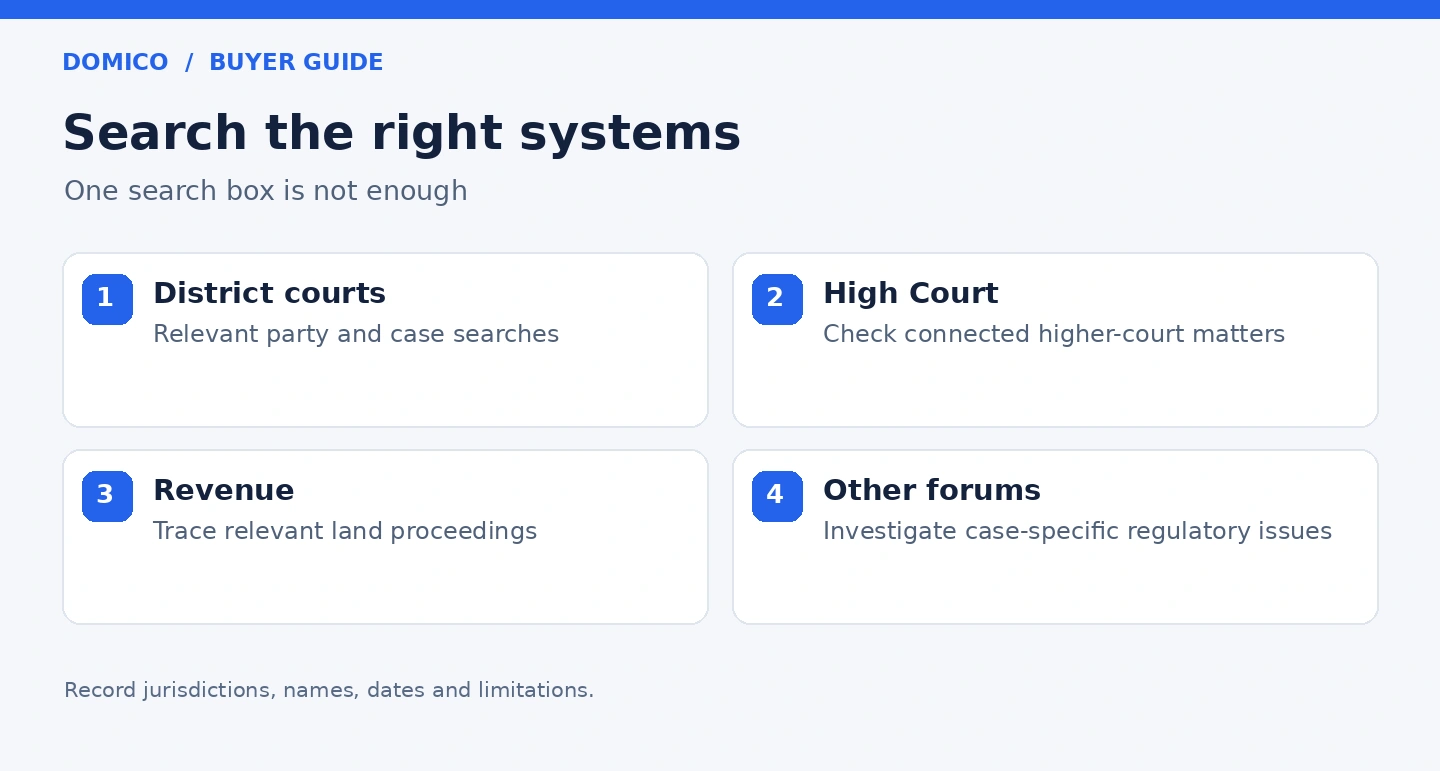
The official eCourts case-status service provides district and taluka court information. Depending on the available search, users can investigate known case details or party names and then view case history and available orders.
The Madhya Pradesh High Court case-status service is relevant for High Court matters. Use the appropriate court and bench context and examine the actual case rather than assuming every name match concerns your seller.
Portal fields, access and record availability can change. Follow current official instructions and use court support or a lawyer where a record cannot be located online. Do not treat a temporary portal error as a clean search result.
| Search route | What it can help reveal | Important limitation |
|---|---|---|
| District and taluka eCourts | Civil and other relevant listed cases | Scope depends on courts, names and available records |
| MP High Court | Appeals, writs and other relevant matters | A lower-court search alone may miss them |
| Revenue proceedings | Mutation, partition, boundaries and related matters | These may use a separate system |
| Regulatory or tribunal records | Relevant project or specialised disputes | Not every matter is indexed in ordinary court search |
| Seller and title-file disclosure | Known notices and case references | Needs independent examination |
Search revenue proceedings separately in MP
Land disputes do not all begin in an ordinary civil court. Mutation, partition, demarcation and other revenue matters can have their own records and appeals.
The official MP RCMS service information directs users to the state's Revenue Case Management System. The MP Bhulekh portal can also support relevant land-record investigation.
Ask the lawyer which revenue offices and identifiers are relevant to the property. A current Khasra remark or a mutation order can provide a reference worth tracing. If the seller supplies an order, check whether a later appeal, stay or revision affects it.
Avoid both false matches and false reassurance
A common name can produce cases involving entirely different people. Compare addresses, relatives' names where lawfully available, property references and case documents before connecting the result to the seller.
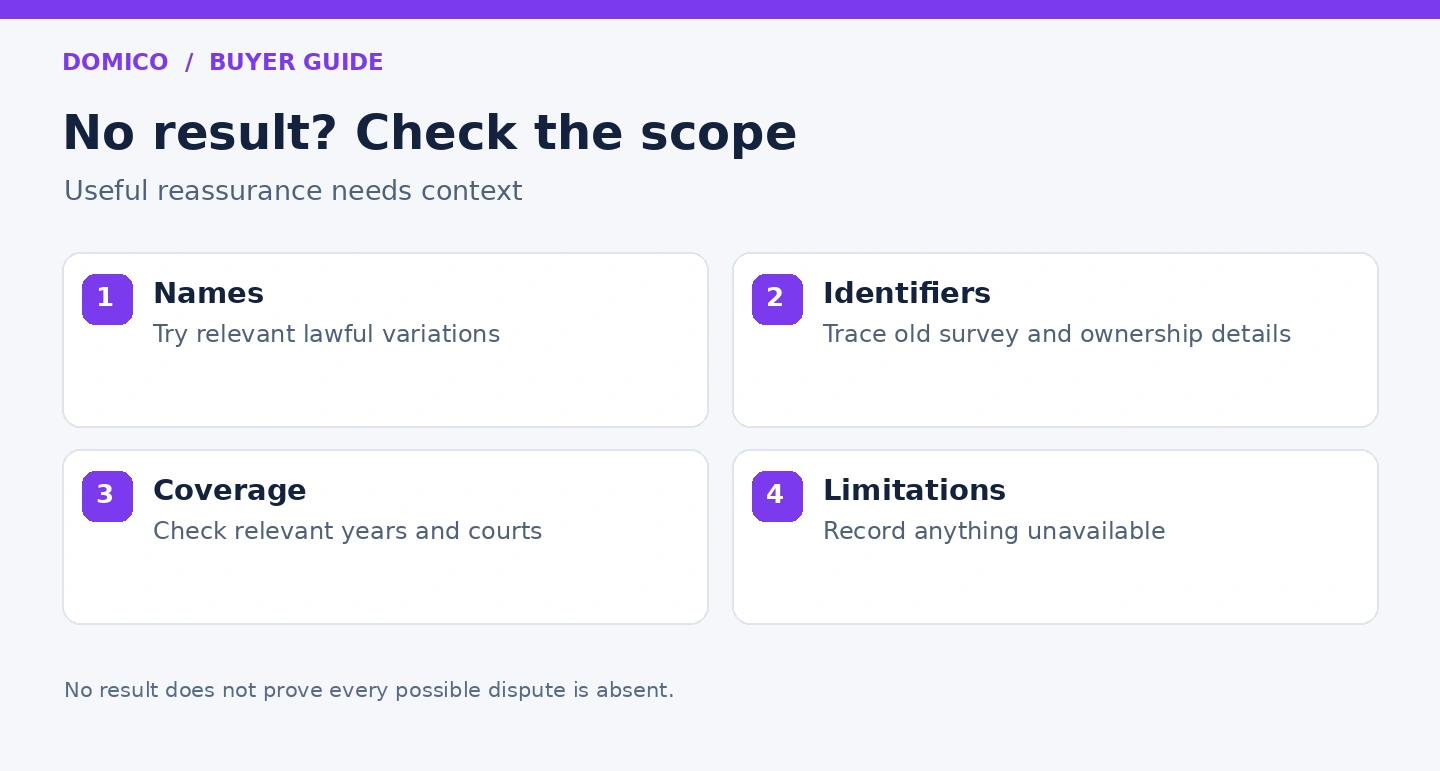
The reverse problem is a search that is too narrow. Searching one spelling in one year or one court may miss a relevant matter elsewhere. Older records may use a previous owner, partnership or property description.
Ask the professional conducting the search to record the names, jurisdictions, periods and sources used. A useful search note explains its limits. A screenshot of “no records found” without those details cannot establish much.
If a case appears, obtain the documents
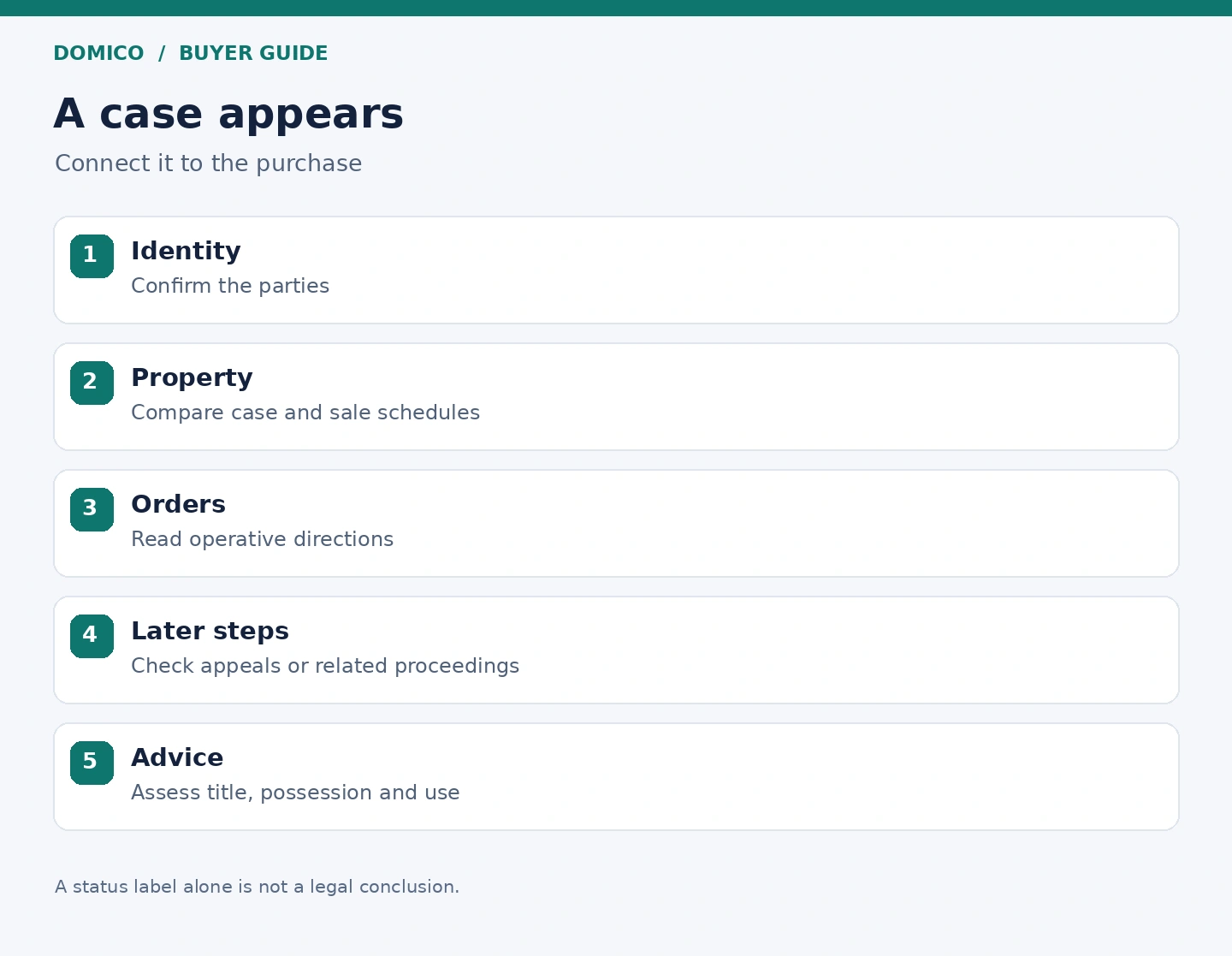
Start with the case number or CNR where available, court, parties, filing date and current status. Then retrieve relevant pleadings, interim orders, final orders and later proceedings as appropriate.
The case title alone rarely tells you whether the selected property is affected. A dispute may concern another parcel, part of a larger holding or a different contractual issue. Conversely, a case whose title does not mention the project name may still concern its parent land.
Ask the lawyer to identify the property in the case schedule and compare it with your purchase schedule. This connection is essential before deciding whether the matter is irrelevant, manageable or a reason to stop.
Read the operative order, not only the status label
“Pending,” “disposed,” “stayed” and “dismissed” are useful status descriptions, but they are not complete advice. A disposed case may have produced a decree affecting title or possession. An appeal may exist. An interim order may restrict transfer, construction or changes on the site.
Ask exactly what the current operative directions require and who is bound by them. Do not assume that “no stay” means the purchase is risk-free.
Section 52 of the Transfer of Property Act deals with transfers during specified pending litigation. Its application and consequences require legal analysis; a transaction is not made safe simply by registering it while a relevant dispute continues.
Worked example: a name match becomes a parcel question
An illustrative buyer considers a plot for ₹34 lakh. A party-name search reveals a pending partition case involving a person with the seller's name. The seller says it relates to a different family property.
The buyer should neither immediately accuse the seller nor dismiss the result. The lawyer obtains the case schedule and compares the village and survey numbers with the plot's parent land.
If the land is genuinely different, the file can record that conclusion and its basis. If the parent parcel overlaps, the lawyer must assess the claims, interests and operative orders before the buyer commits further funds.
Suppose the seller offers a ₹1 lakh reduction to close quickly. That reduction does not answer the legal question. The important work is establishing what rights and restrictions affect the exact purchase.
These amounts and circumstances are hypothetical. The example demonstrates an investigation method rather than a prediction about litigation outcomes.
| Finding | Question for the lawyer | Buyer action to consider |
|---|---|---|
| Similar name, different property | Is the match unrelated? | Preserve documented identification |
| Relevant pending claim | What rights and outcomes are at issue? | Assess whether to defer or decline |
| Transfer-related restriction | What does the operative order prohibit? | Do not proceed contrary to the order |
| Disposed case | What was decided and is there later litigation? | Obtain the necessary orders |
| Missing or unclear record | What remains unverified? | Treat the gap as unresolved |
Project complaints need proportionate interpretation
A consumer or RERA complaint against a developer can concern delay, refund, defects or another issue. It does not automatically establish that every unit has defective title. Equally, repeated or serious proceedings can be relevant to a buyer's risk assessment.
Identify the exact project, phase, issue and current order. Compare the complaint with the property being purchased and the promoter's disclosures. A headline count without context is a poor substitute for understanding the underlying matters.
For specialised land, company, insolvency or environmental issues, ask which additional authorities or tribunals should be checked. There is no single public search box that reliably proves the absence of every dispute in India.
Put the conclusion into payment and contract decisions
Ask the lawyer to produce a short litigation note: what was searched, what was found, whether it affects the property and what remains uncertain. If a case matters, request a plain-language explanation of consequences for title, possession, construction and resale.
A seller's indemnity can provide contractual recourse but does not erase a court order or bind a third-party claimant. Assess the actual risk before treating an indemnity as sufficient protection.
If closing is delayed, ask which searches should be refreshed. Preserve relevant orders and the reasoning used to connect or distinguish the property. The purchase file should show more than a confident sentence that “there is no issue.”
Printable buyer worksheet
Download the topic-specific review checklist. Use it to record evidence, unanswered questions and follow-up actions for the exact property.
Frequently asked questions
Can I search by the property's address alone?
Some systems are organised around cases and parties rather than a complete property-address index. Collect seller and prior-owner names, known case references and legal property identifiers. A lawyer can choose a scope appropriate to the title history.
Does no result on eCourts prove there is no dispute?
No. Search coverage, names, years, jurisdictions and digitisation can limit results. Revenue, tribunal or other proceedings may need separate investigation. Record the scope and limitations instead of treating one no-result screen as a guarantee.
Is a disposed case harmless?
Not necessarily. Read what was decided and check relevant later proceedings or appeals. The final order may establish rights or obligations affecting the property even though the case itself is no longer pending.
Can I buy if a case is pending but there is no stay?
Get case-specific legal advice. Pending litigation can affect a transfer even without the particular stay the seller mentions. The claims, property schedule, applicable law and operative orders all matter.
Should every case against a builder stop my purchase?
Assess the issue and its connection to the selected project and unit. A complaint about one service matter differs from a proceeding affecting the project land. Investigate proportionately and base the decision on records rather than a raw case count.
A good litigation check does not stop at finding a case. It establishes whether the case changes what you can safely acquire and use.
Related buyer guides
Property Documents Checklist Before Buying in India
How to Check a Builder’s Track Record
Booking Amount and Property Cancellation Terms
Sources and further checks
- buyer-guide-100
- homebuyers
- property-court-case
- indore
Planning to buy or rent in Indore? Browse verified properties in Indore or read more Indore guides.



