Buying Guide
Cash in Property Deals: Limits, Risks and Payment Records
Understand cash-payment risks in property deals, current tax-law receipt restrictions, truthful consideration and a complete buyer payment trail.
Updated 8 min read

Buying Guide
Understand cash-payment risks in property deals, current tax-law receipt restrictions, truthful consideration and a complete buyer payment trail.
A lower number in the deed does not lower the money you actually risk.
A seller asks for part of the property price in cash and says it is normal. A buyer worries about losing the deal and starts thinking only about the immediate registration cost. That is the moment to step back and separate a genuine price negotiation from an undocumented payment arrangement.
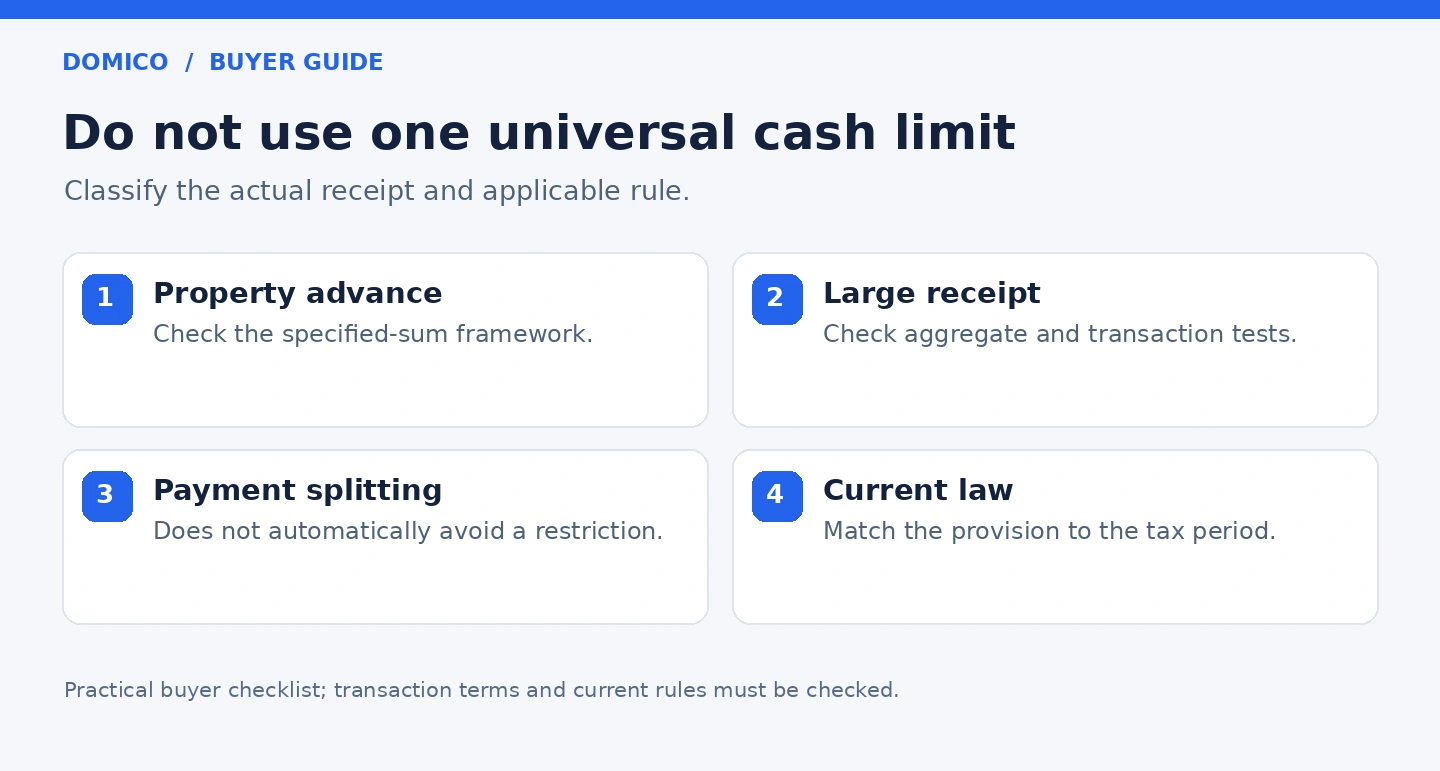
Cash in property transactions can raise tax-law restrictions, proof problems, financing issues and disputes about what was actually paid. The applicable rules can reach smaller property-related advances as well as large receipts. A receipt alone does not make a prohibited payment structure lawful.
Under the Income-tax Act, 2025, section 185 addresses specified loans, deposits and sums relating to immovable-property transfers, with a ₹20,000 framework and statutory conditions and exceptions. Section 186 separately restricts receipts of ₹2 lakh or more under its aggregation, single-transaction and event-based tests, except through the permitted modes and subject to exceptions.
These are not interchangeable rules. Do not conclude that every property cash advance below ₹2 lakh is safe. Nor should you apply both provisions mechanically without checking which one governs the receipt. Have a tax professional examine the actual payment and arrangement.
Older explanations often refer to sections 269 SS and 269 ST of the 1961 Act. The relevant tax period determines the applicable law. For a current transaction, use the 2025 Act and current rules rather than relying solely on familiar old section numbers.
| Question | Why it matters | Better approach |
|---|---|---|
| Advance, loan, deposit or price payment? | Different provisions can apply | Classify the real payment |
| One payment or related instalments? | Aggregation can matter | Review the whole arrangement |
| Who receives the money? | Recipient identity and authority matter | Pay the verified entitled party |
| Which payment mode? | Permitted modes are legally specified | Use an appropriate traceable channel |
| Is the deed truthful? | Hidden consideration creates separate risk | Record the genuine agreed price |
The law does not examine only the amount in one envelope. Relevant tests can aggregate receipts from a person, look at a single transaction or consider payments connected with an event. Dividing a substantial sum across days or recipients to avoid scrutiny is not a sound compliance strategy.
For example, a request for several smaller cash instalments towards one property should be reviewed as the underlying transaction, not treated as unrelated purchases. The fact that the seller issues several receipts does not by itself change the legal character.
Do not ask the broker to design a workaround. Ask the tax professional which permitted payment method and reporting process apply. It is easier to structure the payment correctly before money changes hands than to explain a questionable arrangement afterward.
If the deed records ₹40 lakh but the genuine price paid is ₹50 lakh, the buyer has a ₹10 lakh documentary gap. In a later cancellation, title dispute, family disagreement or resale, proving the additional payment can become difficult.
A private note, chat or cash receipt may be disputed, incomplete or inconsistent with the registered instrument. Legal consequences depend on the facts, but the buyer has already made the evidence problem harder. Paying the true price through traceable channels and recording it accurately avoids creating that gap in the first place.
This also affects negotiation. A seller who refuses to acknowledge the full consideration in the agreement is asking you to rely on a promise outside the main transaction record. Consider what happens if the relationship becomes hostile after payment.
Taking cash out of your account shows a withdrawal. It does not necessarily prove that the entitled seller received it for the specified property. Similarly, a cash deposit into another account may not by itself establish the contractual purpose or cure restrictions on the receipt.
A proper transfer trail should connect payer, recipient, amount, date and property purpose. Retain the corresponding receipt and ledger credit. Where a lender pays part of the price directly, reconcile that release with the seller's acknowledgement too.
Verify payment instructions independently before large transfers. A last-minute message asking you to pay a different account can be fraud even when the payment is digital. Traceability and recipient verification work together; neither replaces the other.
The current section 450 provides a penalty framework for contravention of section 185, and section 451 addresses section 186. The provisions can involve penalties equal to the relevant prohibited amount, subject to the law and facts.
Do not simplify this into an automatic identical penalty on both buyer and seller in every case. Different responsibilities and provisions may apply to different people. The buyer should still avoid participating in an unlawful or misleading arrangement merely because one receipt restriction is framed around the recipient.
A potential penalty is only one exposure. Tax assessment, unexplained-source questions, contractual disputes and loss of evidence can create further costs. Obtain proper advice if money has already been transferred in a questionable manner.
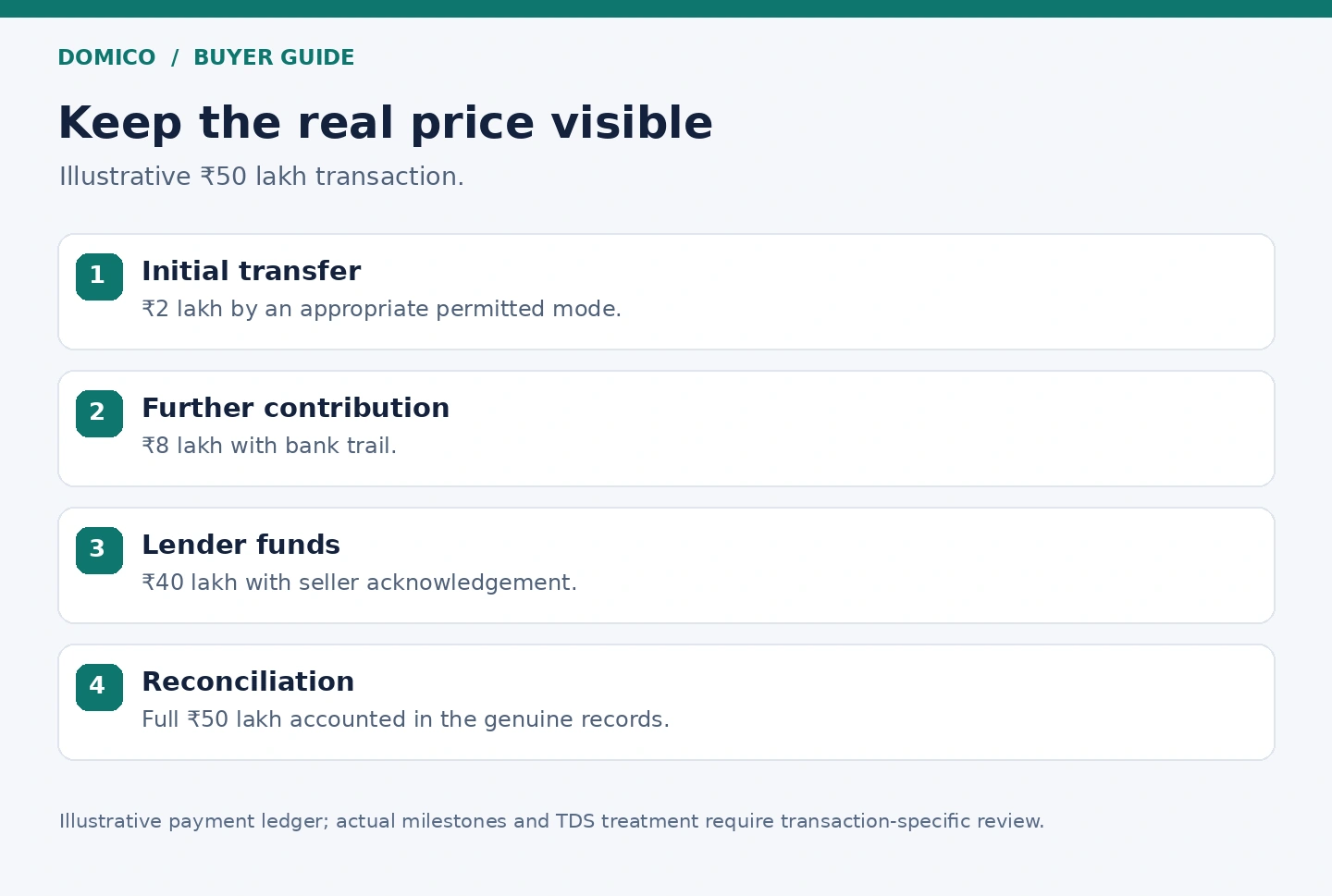
| Illustrative agreed price: ₹50 lakh | Amount | Supporting trail |
|---|---|---|
| Initial permitted-mode payment | ₹2 lakh | Verified account transfer and receipt |
| Further own contribution | ₹8 lakh | Bank transfer and seller ledger |
| Lender disbursement | ₹40 lakh | Lender release and seller acknowledgement |
| Total accounted consideration | ₹50 lakh | Agreement, deed and reconciled payments |
This is an illustration of complete accounting, not a recommendation for a particular token size or payment schedule. Applicable TDS can require part of a relevant payment to be withheld and deposited, so the final ledger should separately show gross, tax and net settlement where required.
Ask the seller to acknowledge the full credited amount after each stage. A bank release marked successful should be matched with the correct property ledger. Resolve discrepancies before the next transfer rather than collecting a bundle of unexplained receipts at registration.
Movable items can genuinely be part of a transaction, but artificial allocations used to conceal property consideration can create their own tax and legal problems. If furniture is sold, describe the real items and reasonable actual arrangement. Do not invent an invoice to explain money that was actually paid for the land or building.
Likewise, a payment to the broker, a relative or another entity needs a legitimate basis and proper authority. A seller's instruction does not automatically mean that any third-party account is appropriate. Have the agreement and payment directions reviewed when the structure is unusual.
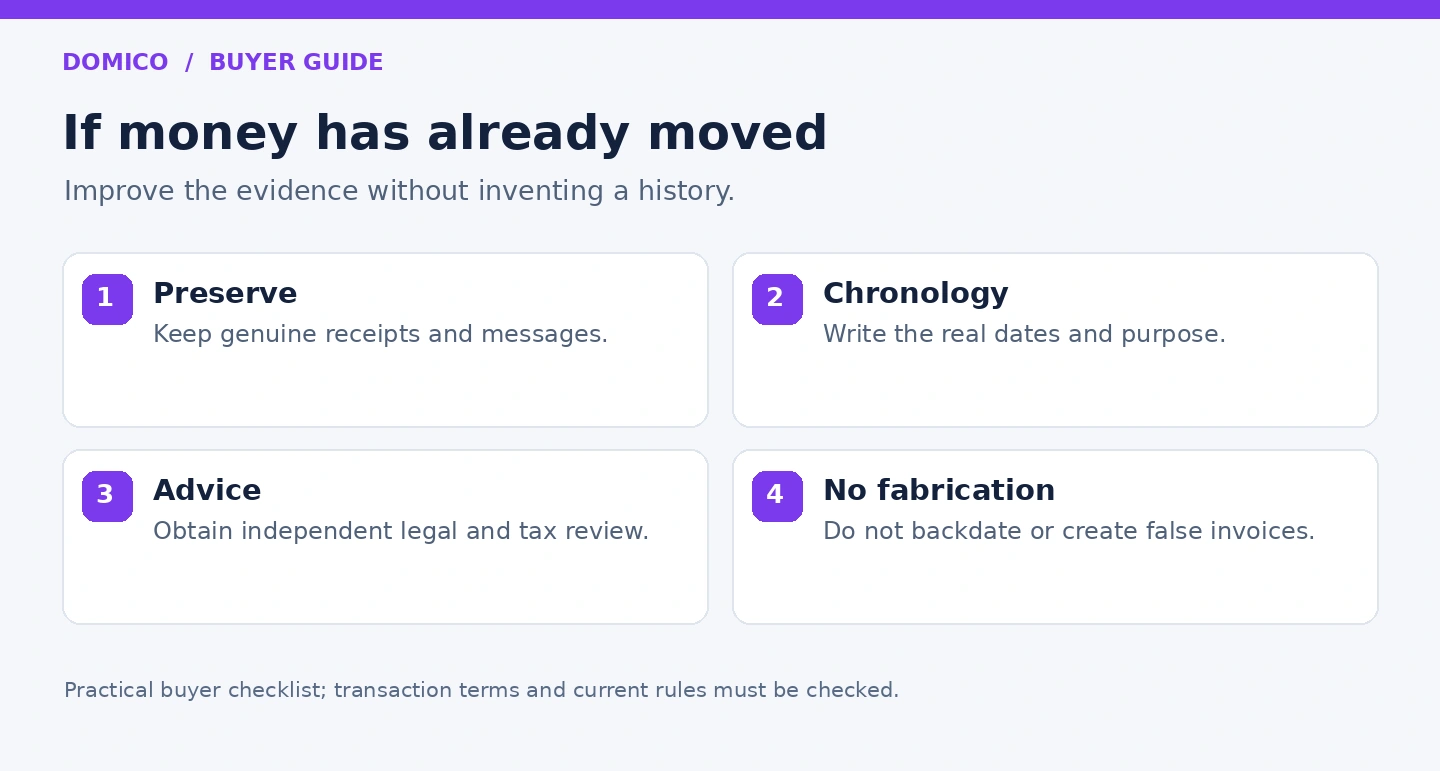
Preserve the genuine records: agreement, messages, receipts, bank withdrawals and the actual chronology. Do not backdate a document, generate a false invoice or invent a different payment purpose. Seek independent legal and tax advice on the correct disclosure and remedy.
If the seller refuses to acknowledge payment, act promptly on advice. Avoid sending more money in the hope that a bigger commitment will force cooperation. The next step should improve the evidence and legal position, not deepen an undocumented exposure.
| Before payment | At payment | After payment |
|---|---|---|
| Verify seller and authority | Use an appropriate permitted mode | Obtain a property-specific receipt |
| Agree truthful consideration | Match beneficiary details | Reconcile seller and bank ledgers |
| Check tax and TDS obligations | Retain reference and date | Complete required filings |
| Confirm contractual milestone | Avoid unexplained third parties | Preserve documents securely |
Before each substantial payment, obtain written instructions identifying the entitled recipient, verified account, gross amount, any withholding and the contractual milestone. Confirm changed account details using a trusted contact route rather than only replying to the message that announced the change.
After the transfer, save the bank reference and ask for a receipt linked to the exact property. Reconcile any tax deposited separately and retain the supporting acknowledgement. This is a simple way to make a lawful digital transaction provable as well as traceable.
If someone requests an unexplained third-party recipient, pause that payment until the authority and purpose are properly established. The pressure of a registration appointment is not a reason to abandon beneficiary verification. A documented delay can be easier to resolve than money sent to the wrong person.
Download the topic-specific review checklist. Use it to record evidence, unanswered questions and follow-up actions for the exact property.
No. Property-related advances and specified sums can engage the separate ₹20,000 framework and other conditions. Review the payment's actual nature rather than treating ₹2 lakh as a universal safe limit.
Relevant provisions include aggregation and single-transaction tests. Splitting payments should not be treated as a workaround. Use the proper permitted mode for the real arrangement.
A receipt can be evidence, but it does not override tax-law restrictions or make an understated deed accurate. Compliance and proof are separate questions.
It shows the money left your account, not necessarily who received it or why. A clear beneficiary transfer, receipt and transaction ledger provide a much stronger connection.
Ask for a truthful documented transaction through appropriate payment channels. Obtain independent advice and be prepared to reconsider the purchase if the seller refuses a lawful, provable arrangement.
Planning to buy or rent in Indore? Browse verified properties in Indore or read more Indore guides.
Check who owes the lender, how builder-paid interest works, when support ends and whether you can carry the loan if payments stop.



