Buying Guide
Buying Through a Power of Attorney: Verification Checks
Distinguish an authorised representative sale from treating a power of attorney as the ownership transfer itself.

Table of contents
“The owner is abroad, so their brother will sign.” That can describe a genuine representative arrangement. It can also leave the buyer with unanswered questions about authority, payment and the property being transferred.
A power of attorney can authorise a person to act; it is not itself a substitute for the required conveyance. The distinction matters whenever someone other than the owner negotiates or executes a property sale.
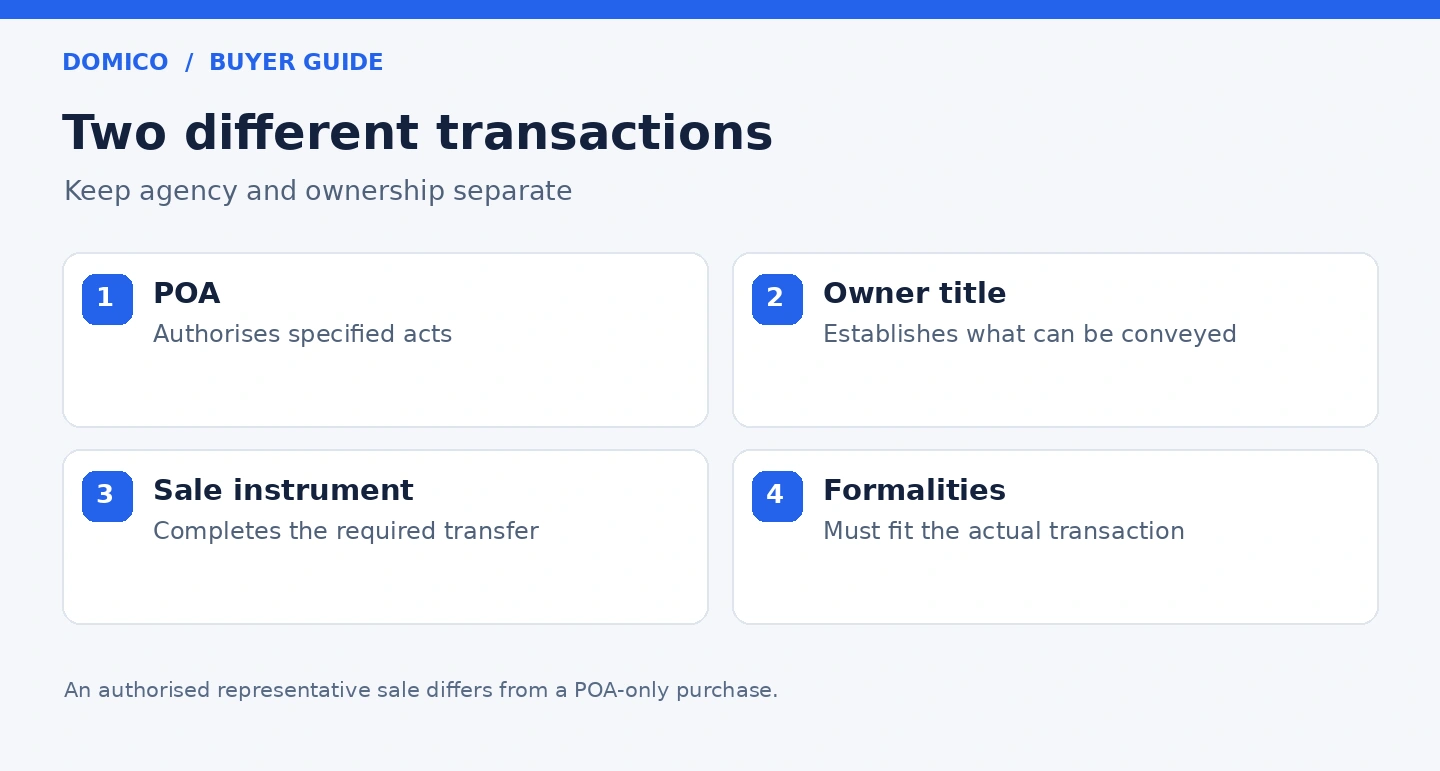
Understand the two different situations
In a legitimate representative sale, the owner grants appropriate authority and the authorised person executes the required sale instrument on the owner's behalf, following applicable legal formalities.
A different arrangement tries to treat a power of attorney, agreement or will as if it were the completed sale itself. Buyers should not confuse these. The Supreme Court's discussion of powers of attorney reiterates the distinction between agency and transfer of title.
The Powers-of-Attorney Act, Contract Act and registration requirements form part of the framework. Ask your lawyer to assess the actual instrument and proposed transaction rather than relying on the label “GPA” or “special POA.”
| Arrangement | What it may do | What the buyer must establish |
|---|---|---|
| Owner appoints a representative | Authorise specified acts on the owner's behalf | Scope, validity and execution requirements |
| Representative executes a sale deed | Carry out an authorised conveyance | Owner's title and effective authority |
| POA offered as the purchase itself | Creates claimed agency powers | Whether required title transfer is missing |
| Management POA | Permit administration or rental activity | Whether sale powers exist at all |
| “Irrevocable” POA | Raises specific legal questions | Actual legal effect, not the heading alone |
Verify the owner's title first
A representative cannot solve a defective ownership chain by presenting an impressive authority document. Establish what the principal owns and whether the proposed sale concerns the whole property or only an interest.
Obtain the owner's acquisition documents, relevant land or municipal records and appropriate encumbrance investigation. Identify co-owners or other persons whose participation is required.
If the authority was granted by one of several owners, ask whether it covers only that person's interest. Do not assume it authorises sale of the whole property because the representative is handling the entire negotiation.
Read the actual powers, not the document title
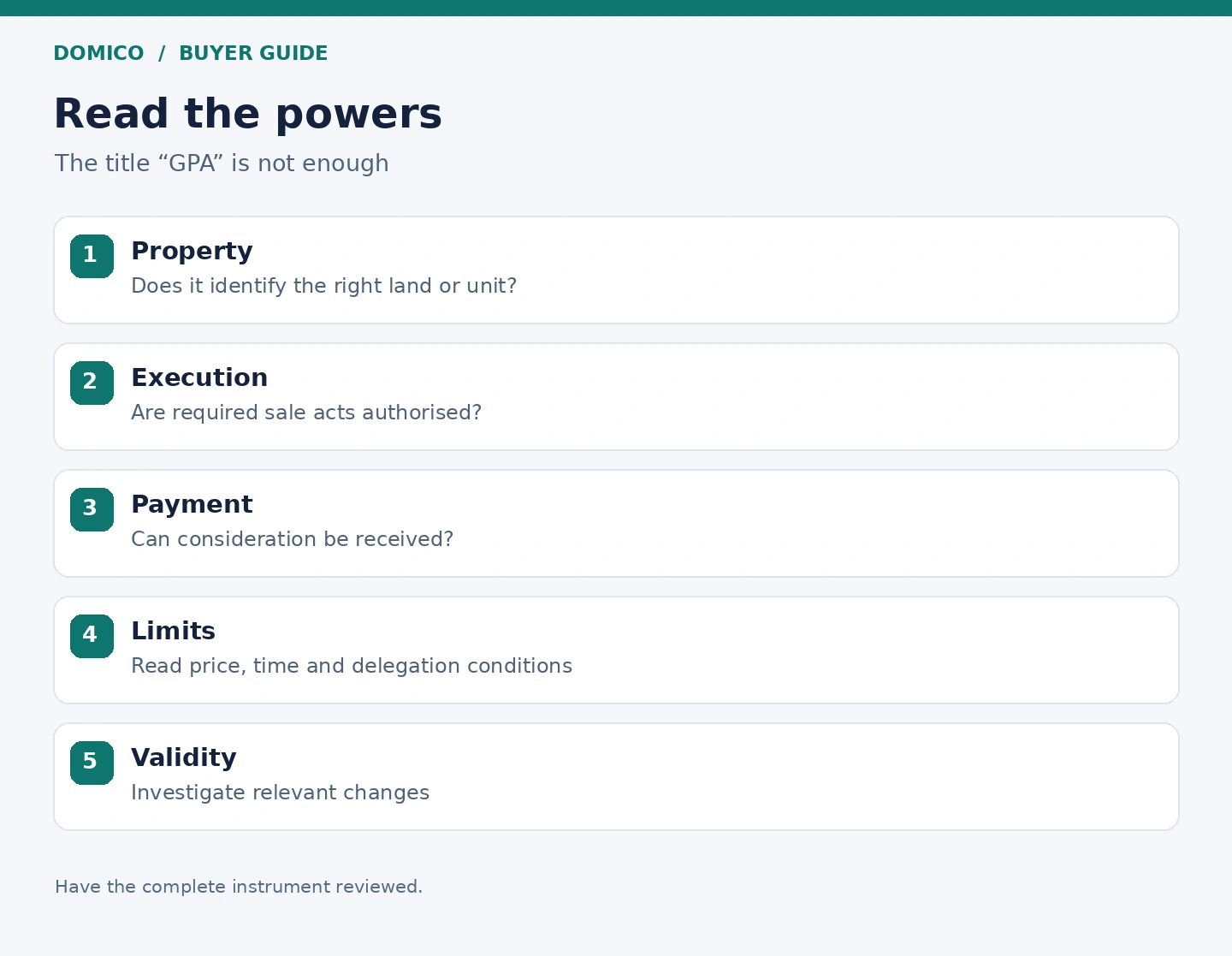
Obtain the complete instrument and any schedules or annexures. Check the principal, attorney holder, property identification, date, execution details and scope.
Ask whether it authorises negotiation, agreement execution, sale-deed execution, presentation for registration, receipt of consideration and delivery of possession as relevant. Authority to manage, rent or pay taxes is not automatically authority to sell.
Look for limits on price, buyer, time, delegation or other conditions. If another person is proposed to act under delegated authority, have the lawyer examine whether that is permitted and properly documented.
A broad phrase should be interpreted in the context of the whole instrument. The buyer should not select one reassuring sentence while ignoring an exclusion elsewhere.
Check continuing validity near the transaction date
An authority document can be genuine yet no longer operate as assumed. Ask the lawyer to examine revocation, expiry, completion of the purpose and relevant events affecting the principal or attorney.
Death, incapacity and an agency coupled with an interest can raise specific legal questions. Avoid universal claims that every POA survives or ends in exactly the same way. The Contract Act's agency framework needs to be applied to the facts.
Where practical, independently confirm the owner's identity, intention and awareness of the proposed transaction through a contact route established separately from the representative. That confirmation supports investigation; it does not replace the required legal authority or formalities.
Verify execution and registration-related formalities
Requirements can depend on where and how the power was executed and how it will be used. An instrument executed outside India may raise authentication, stamping and other questions different from a local instrument.
Ask the lawyer and concerned registration office what is required for this particular transaction. The Registration Act contains relevant provisions, while state law and practice can also matter.
Do not assume a notarised document is sufficient for every property transaction. Equally, avoid assuming that registration alone proves every necessary power or continuing validity. Formal authenticity and substantive authority are separate checks.
Worked example: authority to manage but not sell
An illustrative flat is offered for ₹65 lakh. The representative produces a genuine instrument authorising them to collect rent, maintain the property and pay charges. They ask for a ₹5 lakh token and say the same document permits the sale.
The buyer's lawyer reads the full instrument and finds no adequate sale authority for the proposed transaction. The next step is to obtain the necessary lawful participation or authority before treating the representative as able to execute the conveyance.
A receipt for ₹5 lakh from that person would not independently cure the authority problem. Nor would the fact that tenants have paid rent to them for years.
The example shows why the actual words and legal effect matter. It does not imply that every management instrument is inadequate in every circumstance; the professional must interpret the document presented.
| Verification point | Question before payment | Evidence to preserve |
|---|---|---|
| Principal | Is this the owner whose rights are being sold? | Identity and title documents |
| Attorney | Is the person acting the named authorised person? | Verified identity |
| Powers | Are the required sale acts covered? | Complete instrument and legal assessment |
| Validity | Has anything ended or limited the authority? | Relevant confirmations and record checks |
| Payment | Who can receive funds and acknowledge them? | Agreed instructions and receipts |
Make payment instructions part of the review
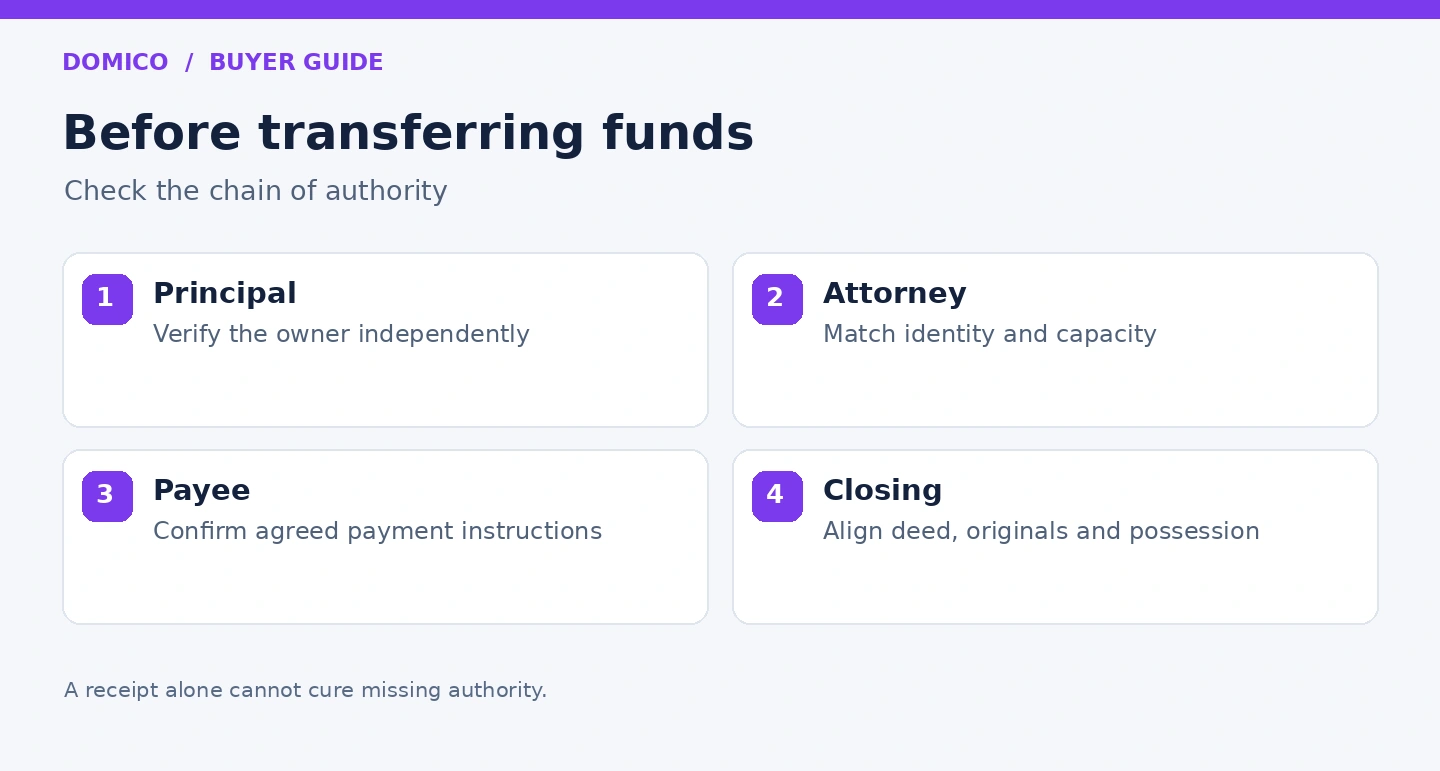
A person authorised to sign is not automatically authorised to receive every payment into any account they nominate. Ask the lawyer to review the instrument and transaction terms together.
Confirm the payee, account details, purpose and acknowledgement route through reliable channels. Be particularly careful if payment instructions change shortly before transfer. Independently verify a changed account rather than relying on a message forwarded by the person seeking funds.
Coordinate tax obligations with the relevant adviser, especially if the owner is non-resident. The owner's legal or tax position does not disappear because a local relative represents them.
Keep the conveyance and possession consistent
The final instrument should identify the owner, representative capacity, authority relied on and exact property as appropriate. Ask the lawyer to compare it with the reviewed POA and title file before execution.
Establish who holds the originals and who will deliver vacant possession, keys and necessary records. A representative may manage paperwork while another person occupies the property; both matters need resolution.
If several owners are involved, account for every interest. A representative's signature should not conceal that another owner's share has no valid transfer mechanism.
Warning signs worth investigating
Pause when the owner cannot be contacted through any independently verified route, the full authority document is withheld, pages are missing or the representative discourages legal review.
Also investigate a claimed “irrevocable” heading used to avoid questions, a request to buy through POA alone, or pressure to pay before authority is examined. None automatically proves fraud, but each is a reason to demand a clear documentary answer.
A genuine arrangement should become easier to understand as documents are supplied. If explanations become less precise with every question, reassess whether you have enough evidence to proceed.
Printable buyer worksheet
Download the topic-specific review checklist. Use it to record evidence, unanswered questions and follow-up actions for the exact property.
Frequently asked questions
Are all sales signed by a POA holder invalid?
No. A properly authorised representative can execute an appropriate transaction on the owner's behalf, subject to applicable requirements. The key distinction is between authorised execution of the required conveyance and treating the POA itself as ownership transfer.
Does a registered POA automatically include the power to sell?
Read its actual terms. Registration does not add a sale power that the instrument does not grant. Ask a lawyer to assess scope, property identification, restrictions and continuing validity.
Is a notarised foreign POA enough?
Do not assume so. The requirements depend on the place of execution, intended use, applicable law and registration process. Obtain advice from the lawyer and concerned office before planning the closing around a scanned or notarised copy.
Can I pay the attorney holder directly?
Only after establishing the relevant authority and agreed payment arrangement. Confirm whether receipt of consideration is authorised and how the owner will acknowledge the payment. Independent verification is especially important when account instructions change.
Does “irrevocable” mean there is nothing else to check?
No. Legal effect depends on the instrument, facts and applicable law. Have the lawyer examine the basis for that description and relevant events rather than accepting the heading as a complete answer.
A representative arrangement should make execution possible, not make the owner's title and authority harder to see.
Related buyer guides
Property Documents Checklist Before Buying in India
Booking Amount and Property Cancellation Terms
Sale Deed vs Agreement to Sell vs Mutation
Sources and further checks
- buyer-guide-100
- homebuyers
- power-of-attorney-purchase
- indore
Planning to buy or rent in Indore? Browse verified properties in Indore or read more Indore guides.