Buying Guide
Legal Road Access to a Plot: Buyer Verification Guide
Trace every segment from public road to plot and verify the documents behind your right to use it.
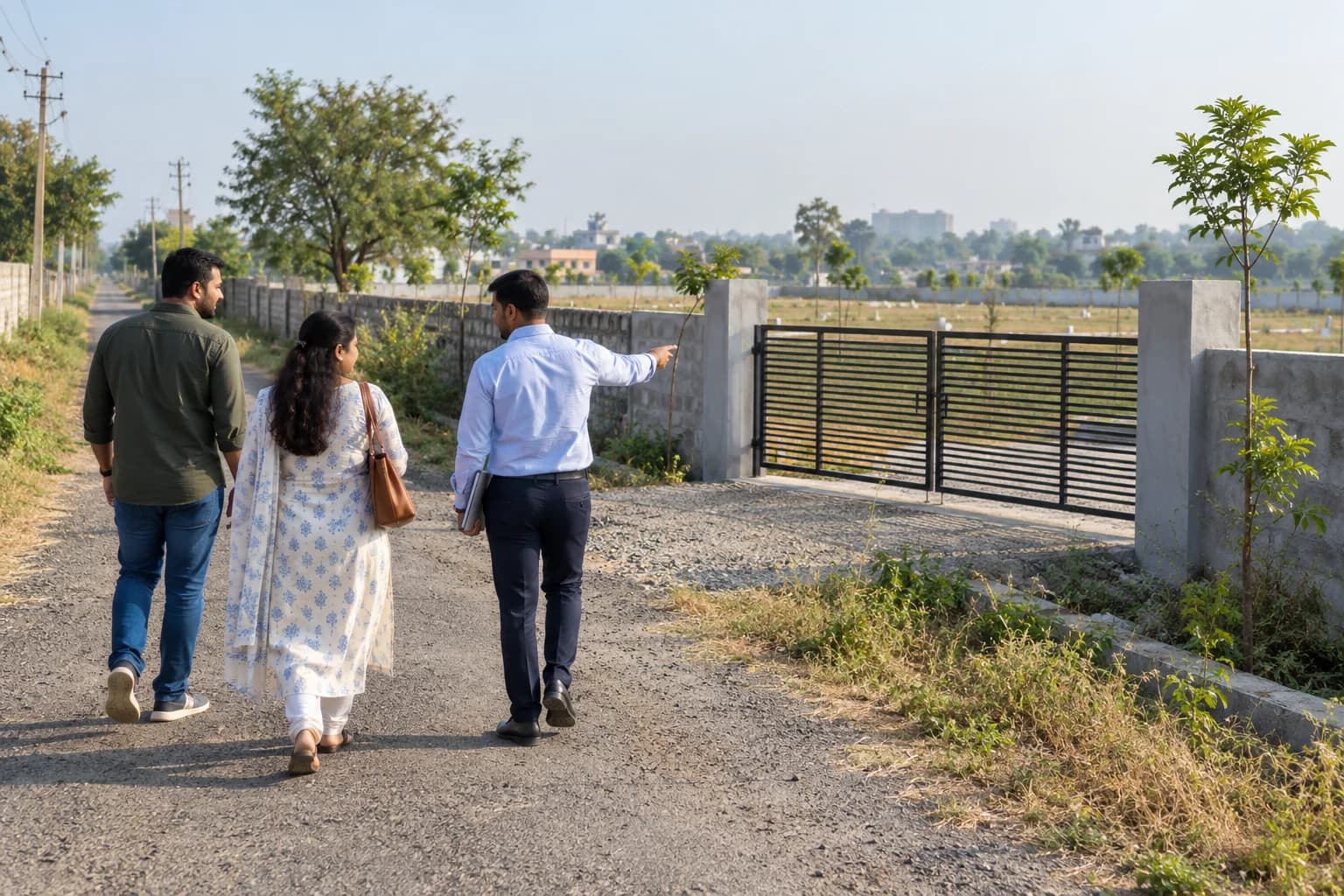
Table of contents
You drive comfortably to a plot, inspect it and leave convinced that access is settled. A month later, someone closes a gate on the approach. The route existed physically; the legal right to keep using it was never established.
A road you can drive on today is not automatically a road you have a right to use tomorrow. Before buying land, examine access as its own part of the purchase. It affects daily life, construction, finance and eventual resale.
Start with two separate access questions
First, is there a continuous physical route from a public road to the plot? Second, what legal basis allows the buyer and future owners to use every part of that route?
A visible track may cross private land. A colony's internal street may connect to an external strip whose ownership is unresolved. A route suitable for a motorbike may not support a family car or construction vehicle. These are different problems and need different evidence.
The Indian Easements Act provides a legal framework for easements and licences. Whether a right exists, its scope and how it can be enforced depend on the facts and applicable law. Do not buy on the assumption that a lawyer can obtain an access right later simply because the land would otherwise be inconvenient to use.
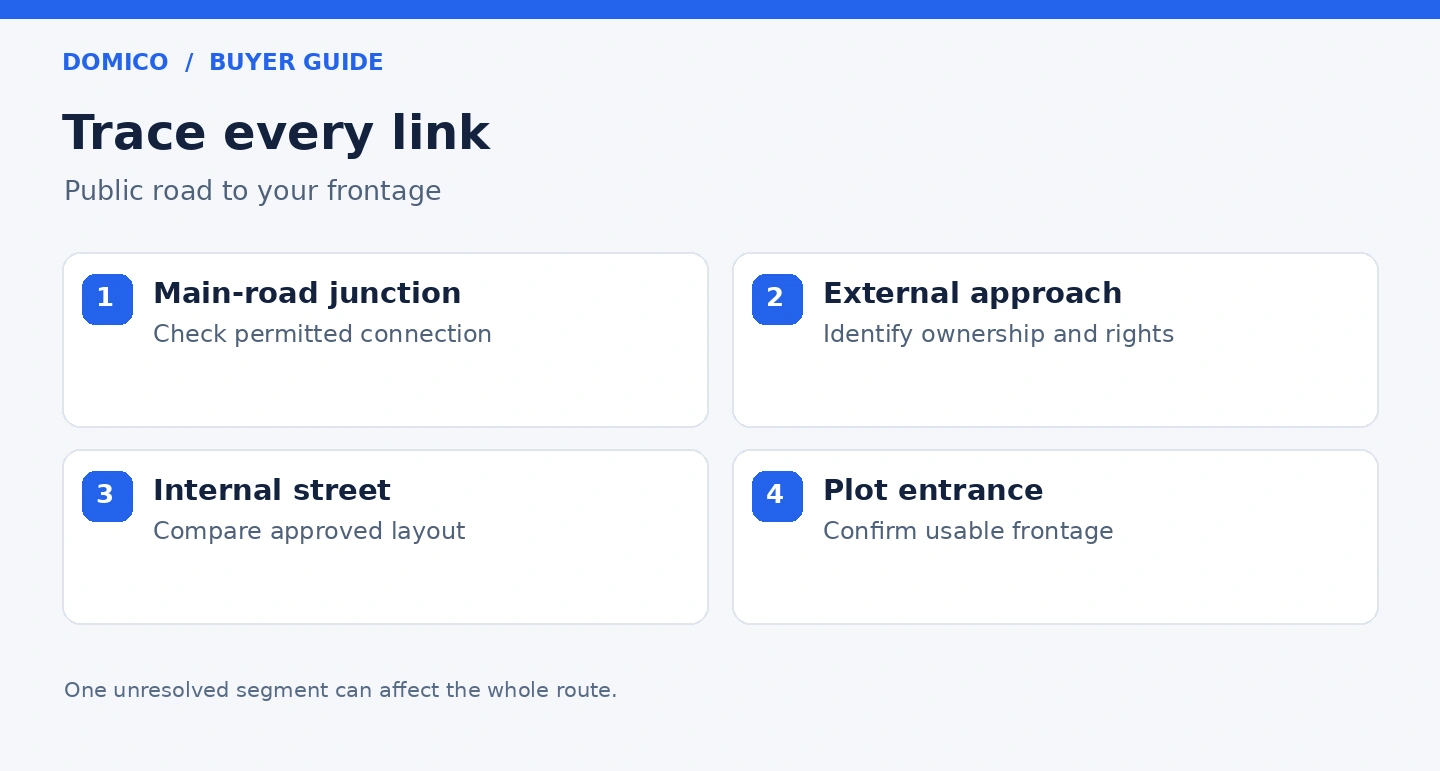
Trace the complete route
Walk or drive from the public road to the plot and mark the route on a plan. Divide it into segments when ownership, surface, width or control changes. Note gates, narrow corners, culverts, drainage crossings and sections used informally through neighbouring land.
Ask who owns or controls each segment and which record supports that answer. If the route runs through an approved development, inspect the approved layout and relevant handover or authority records. If it relies on private land, ask for the document creating the right and the title of the person who granted it.
A promise about one segment does not solve another. The last 50 metres can be as important as the first kilometre.
| Route segment | Physical check | Legal or documentary question |
|---|---|---|
| Public-road connection | Is the junction usable? | Is access at that point permitted? |
| External approach | Width, surface and obstructions | Who owns it and what right applies? |
| Internal colony street | Does it match the approved drawing? | What approved and ownership records apply? |
| Final frontage | Can vehicles enter the selected plot? | Does the sale schedule reach the lawful road? |
| Drain or water crossing | Culvert condition and seasonal access | Who approved and maintains the crossing? |
Distinguish ownership, easement and permission
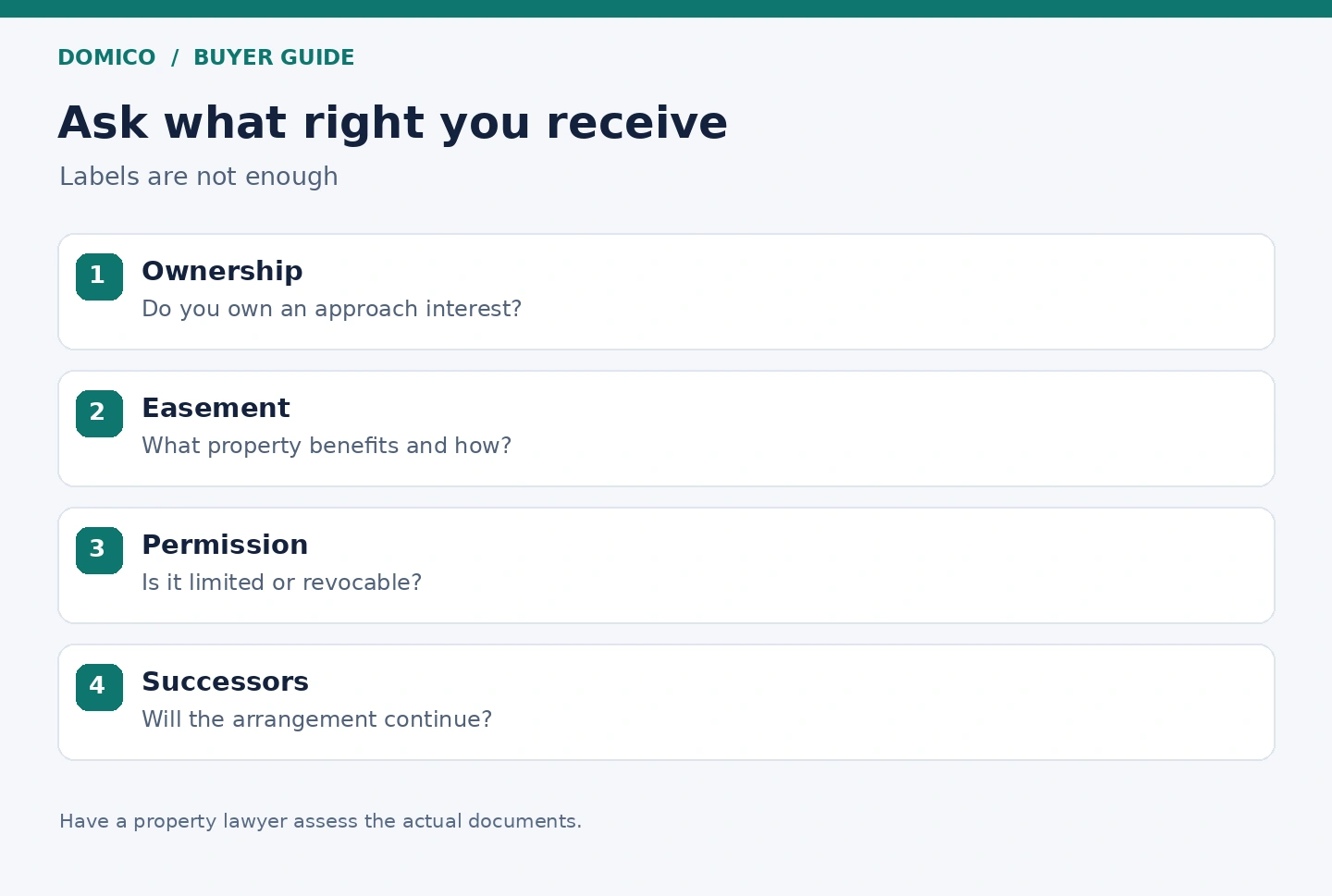
Owning the approach strip is different from having a right over someone else's strip. Both may support access, but the documents and responsibilities differ. A personal or revocable permission can create a less durable position than the buyer expects.
Ask your lawyer to explain whether the right benefits the property and can continue with successors, or whether it is linked to a particular person or arrangement. Read restrictions on route, width, vehicle type, time or purpose. A right associated with agricultural use should not be assumed to cover every intensity of future residential or commercial traffic.
Do not rely on the label “common road” without investigating what makes it common. Is it shown in an approved layout? Has it been transferred or vested as required? Who can authorise changes? What happens if the developer sells adjoining land?
Inspect the deed schedule and attached plan
Ask whether the seller's acquisition document and your proposed conveyance identify the access accurately. A schedule saying “road on the east” may require closer examination if the actual road lies on a separate private parcel.
Where a document creates an access right, check its parties, legal description, location, width and conditions. The person granting the right must have the relevant authority. A signature from a neighbour who does not own the affected land may not provide the protection the buyer expects.
Registered records, title investigation and a ground survey should support one consistent route. The Transfer of Property Act is part of the broader conveyancing framework; your lawyer should assess how the particular rights are created and transferred.
Measure usable access, not just advertised width
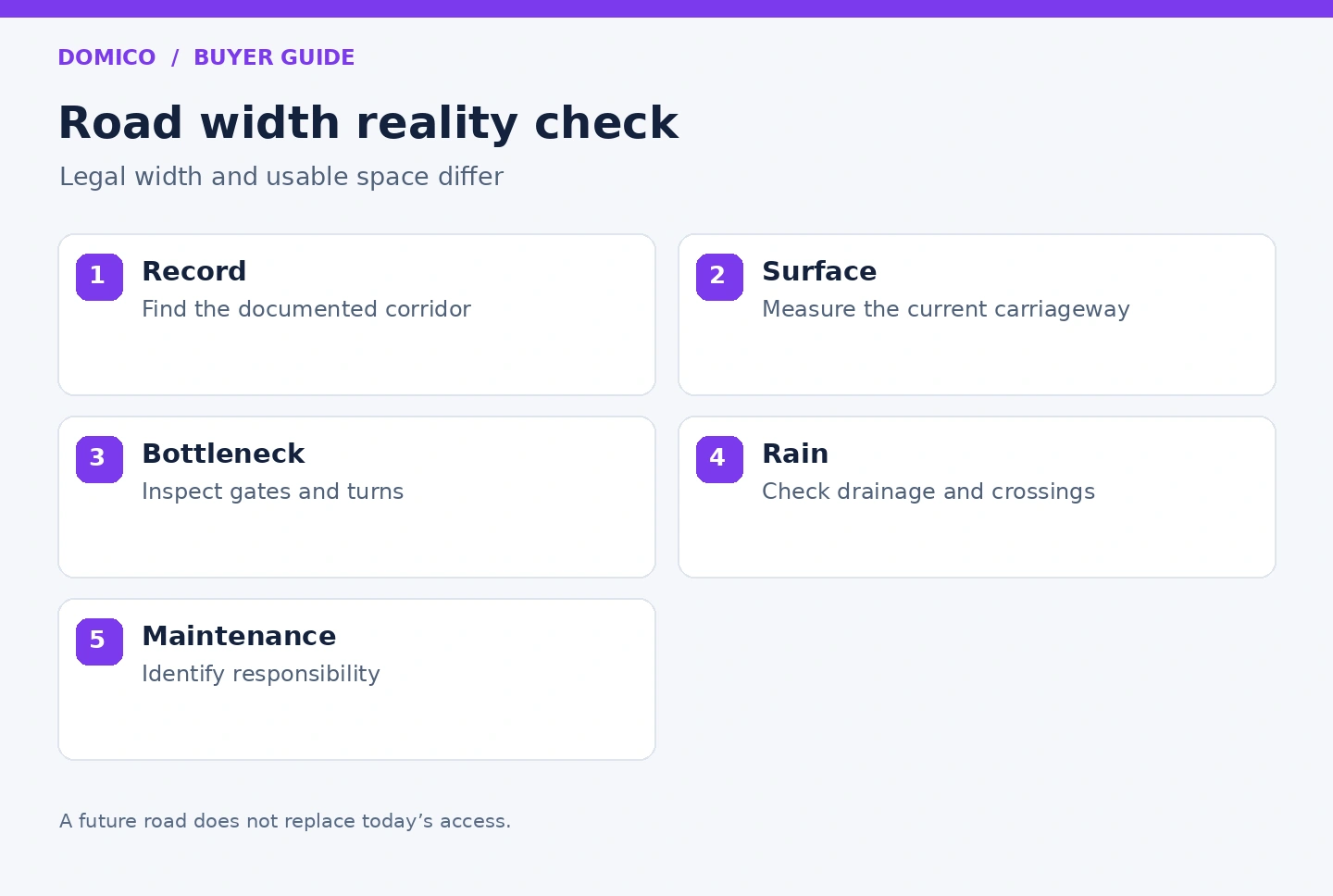
A nominally wide road can narrow at a gate, pole, sharp bend or parked vehicles. Check actual clear passage and vehicle turning needs. If you plan to build, discuss delivery of materials, concrete equipment and emergency access with your architect or engineer.
Distinguish the recorded road width from paved carriageway width. Both are useful, but they are not the same measurement. A wider recorded corridor with incomplete paving creates a different issue from a narrow legal strip marketed as a wide road.
Also test the route in poor conditions if possible. Low-lying stretches, loose soil and an undersized crossing can make a technically available route impractical during rain. Ask who pays for repairs and whether maintenance obligations are documented.
Worked example: the missing final link
Consider a 1,000-square-foot plot offered at an illustrative ₹28 lakh. The internal street is 30 feet wide on the approved plan. The approach from the main road, however, crosses a separate privately owned strip with a locked gate outside daytime visiting hours.
The buyer is told that the strip's owner is a friend of the developer. That relationship may explain current use; it does not establish the buyer's continuing right. The lawyer asks for the title and instrument supporting access over that exact strip.
If no adequate right is documented, the transaction has an unresolved access issue even though the internal layout is clear. A hypothetical ₹2 lakh price reduction cannot be compared sensibly with an undefined cost and uncertain ability to secure access later.
The buyer can request that the required right be properly established before a payment milestone, or decline the purchase. The example illustrates a missing legal link, not a conclusion about any actual property.
| Seller statement | Better follow-up question | Evidence to request |
|---|---|---|
| Everyone uses this road | On what legal basis? | Relevant public or private records |
| The owner is our relative | Who owns it and what is granted? | Title and effective access document |
| A wider road is coming | What is its official stage? | Agency record and alignment |
| We will open another entrance | Is that entrance approved and legally available? | Permission and land connection |
| You can resolve it after buying | What exactly remains unresolved? | Written professional assessment |
Access near highways and proposed roads
A plot beside a large road does not automatically have permission for direct entry at any point. Check whether access must use a service road, designated junction or another approved arrangement. Identify the responsible road authority and seek the current position for the property.
Likewise, a proposed road should not be counted as today's access. Investigate the existing route independently. Ask whether the purchase still works if the proposal is delayed, altered or never completed in its advertised form.
Avoid paying a road-front premium until both the legal boundary and permitted access arrangement are clear. Frontage is a physical relationship; usable access is a separate practical and regulatory question.
Resolve access before construction and closing
Record the verified route, supporting documents and responsibilities in the purchase file. Ask your lawyer to address any required access instrument and conditions before committing the balance payment.
If an obstruction already exists, do not remove it yourself or instruct workers to force a route. Establish the legal position and use the appropriate process. A purchase should not begin with a confrontation that proper investigation could have identified earlier.
After taking possession, preserve the records and avoid building beyond the verified boundary. Access rights can also carry obligations towards other users, drainage and maintenance. Understand them before treating the approach as exclusively yours.
Printable buyer worksheet
Download the topic-specific review checklist. Use it to record evidence, unanswered questions and follow-up actions for the exact property.
Frequently asked questions
Is a road shown in a layout always enough?
Check that the drawing is approved, covers the exact property and connects continuously to lawful external access. An internal road arrangement alone may not answer questions about a separate approach strip outside the project.
Can I rely on a neighbour's verbal permission?
It may explain current use, but you should not assume it creates a durable right for you and future buyers. Ask a lawyer to assess the arrangement and the documentation required for the property's intended use.
Does long use automatically establish an easement?
Do not assume so. Claims based on use involve specific legal requirements and evidence. Have a lawyer assess the actual history, nature of use and applicable law before treating an unconfirmed claim as secure access.
Is the road's paved width the legal width?
Not necessarily. Compare the recorded corridor, approved layout and physical measurements. Explain any difference and assess how much clear, usable passage exists for your vehicles and proposed construction.
What if a future road will solve the problem?
Verify its official stage and evaluate the property using current access as well. A future proposal can change or be delayed. Essential usability should not rest solely on a marketing promise about infrastructure.
The right address matters. So does the right to reach it, every day and after every change of owner.
Related buyer guides
Plot Buying Checklist: 20 Checks Before Booking
Property Site Visit Checklist Before Shortlisting
Booking Amount and Property Cancellation Terms
Sources and further checks
- buyer-guide-100
- homebuyers
- plot-legal-road-access
- indore
Planning to buy or rent in Indore? Browse verified properties in Indore or read more Indore guides.