Buying Guide
Buying Jointly Owned Property: Consent and Signatures
Know when one spokesperson represents several owners and what must be established before the whole property can be sold.

Table of contents
One person negotiates, one person sends the documents and one person asks for the booking amount. Then the deed reveals three owners. Before treating this as an administrative detail, establish exactly who can sell what.
One spokesperson does not automatically mean one seller. Jointly owned property can be bought through a clear transaction, but the ownership interests, required signatures and any representative authority must be identified early.
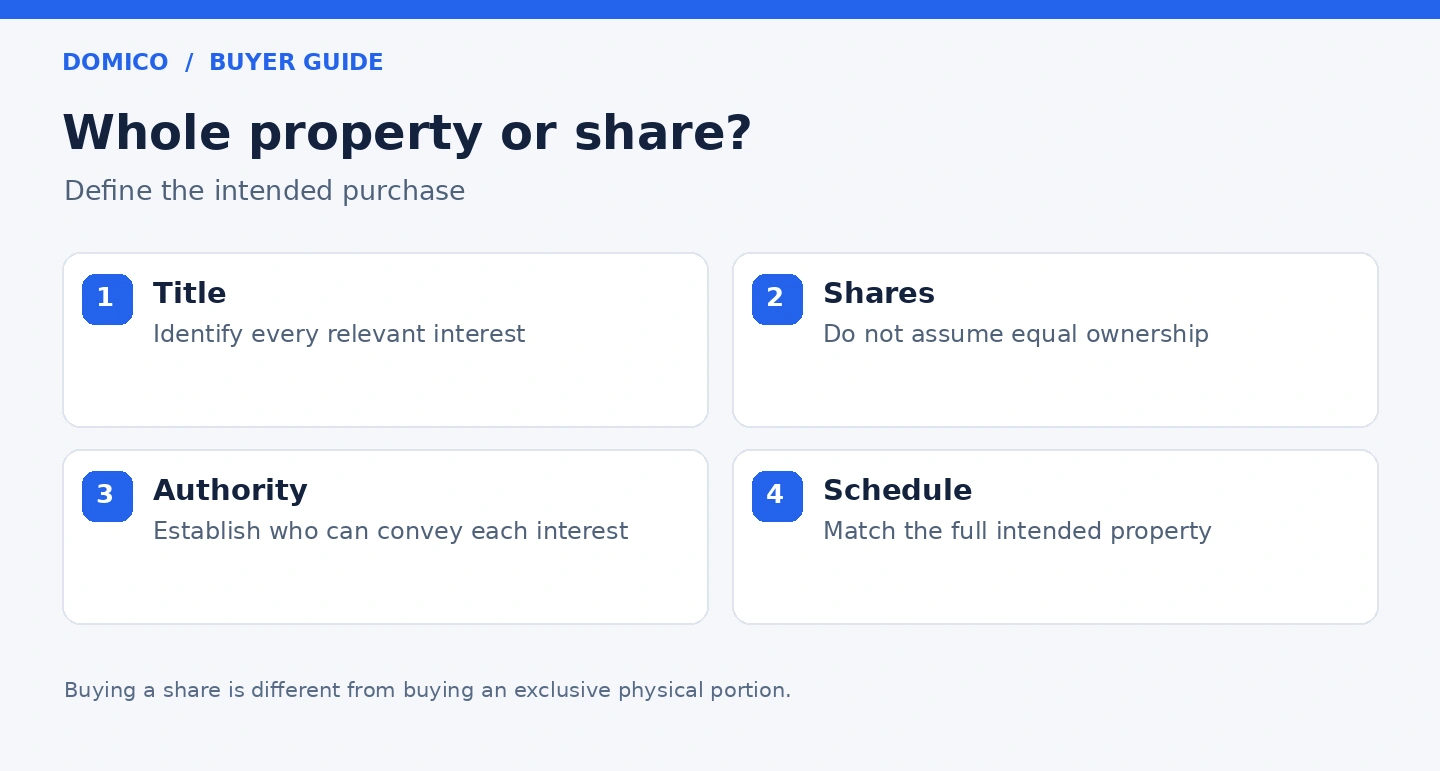
First decide whether you are buying the whole property or a share
Buying the whole flat or plot is different from acquiring one person's undivided interest. A seller may be able to deal with their own rights without being authorised to sell the interests of every other owner.
Section 44 of the Transfer of Property Act addresses transfers by co-owners and includes important qualifications. Have your lawyer apply the provision to the actual property and transaction; do not assume that purchasing a share gives exclusive ownership of the room or plot portion shown during a visit.
State the intended purchase clearly in writing. If the offer is for the whole property, the legal file must establish how the whole relevant interest will be conveyed.
Read the acquisition deed and ownership history
Obtain the complete document through which the current owners acquired their interests. Check all names, the property schedule, stated shares and any conditions. If shares are not clearly expressed, ask the lawyer how they are determined rather than assuming equal ownership.
Trace later events such as death, release, partition, gift or sale of a share. Today's rights may differ from the original purchase deed. Revenue or municipal records should be compared with the underlying instruments.
A person added to a tax account or utility bill is not automatically an additional legal owner. Conversely, a person absent from a convenient online summary may still hold a relevant interest. The title investigation must establish the position.
| Person involved | Question to answer | Evidence to examine |
|---|---|---|
| Owner named in deed | What interest is currently held? | Acquisition and later transfer documents |
| Family spokesperson | Are they an owner or representative? | Identity and authority records |
| Attorney holder | What acts are authorised? | Valid power and underlying ownership |
| Successor of deceased owner | How did the interest pass? | Succession-related evidence |
| Minor or represented person | What permissions and authority are needed? | Case-specific legal documents |
Identify the required executing parties
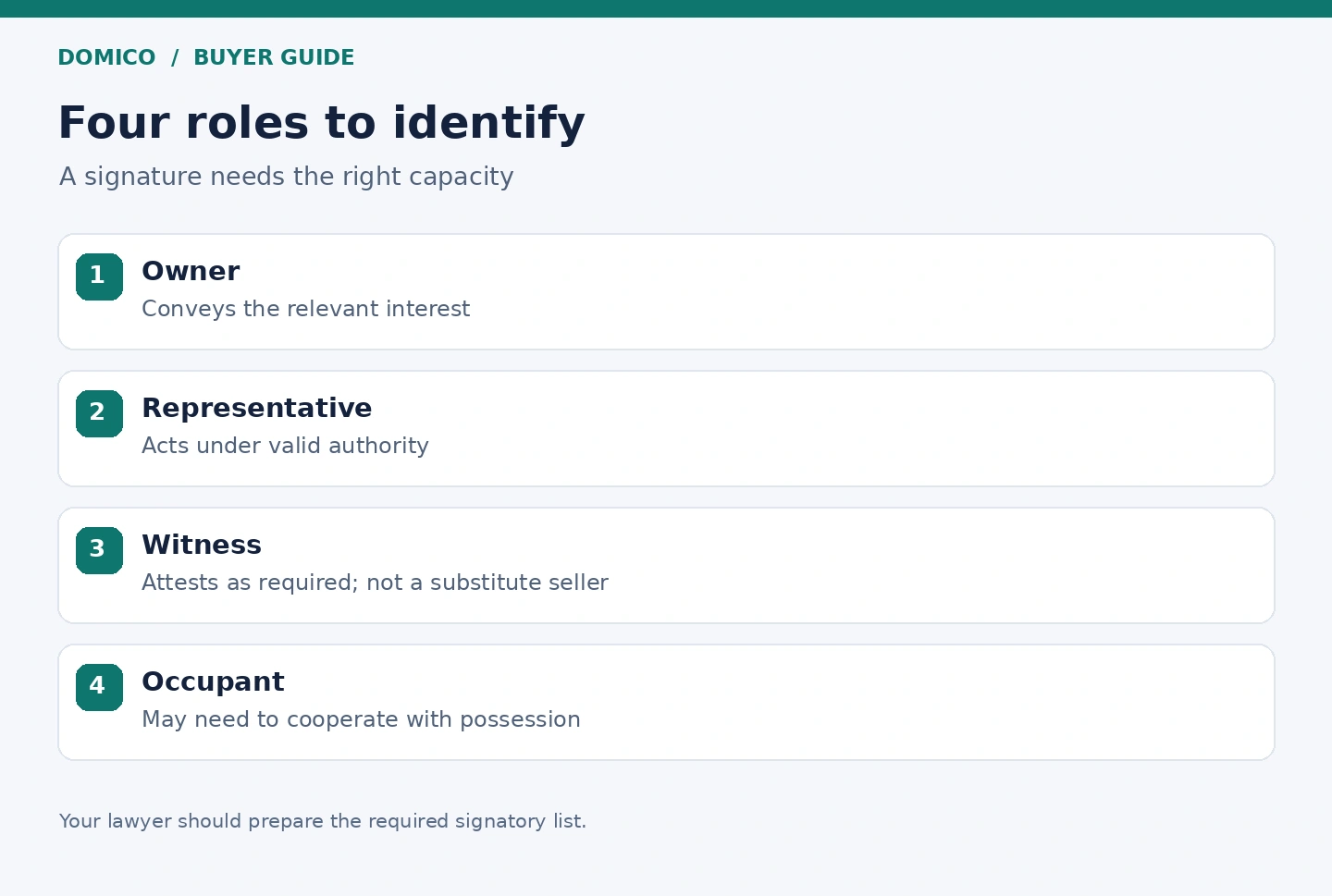
Ask the lawyer for a written signatory list. For each person, record the capacity in which they sign: owner, authorised representative, estate representative or another legally relevant role.
If the whole property is being transferred, establish how every required interest will be conveyed. A person should not be included merely to create reassurance if they have no relevant role, nor omitted because the family says their signature is inconvenient.
Some people may need to execute the instrument; others may provide a legally appropriate confirmation or supporting document. Let the legal analysis determine this. Avoid substituting a general “family NOC” for a necessary conveyance or authority.
When one owner is unavailable
An owner being abroad, elderly or unable to attend can create practical execution questions. It does not make their rights disappear. Plan the lawful representation and registration process early.
Ask the lawyer and registration office what authority, authentication, stamping or other formalities apply to the particular document and place of execution. Do not copy another state's checklist or assume a scan of a signed authorisation is enough.
If a power of attorney is proposed, verify its scope, continuing validity and connection to the exact property. A management authority is not automatically a sale authority. The Registration Act forms part of the framework for execution and presentation, subject to applicable provisions and state practice.
Do not confuse consent with transfer of rights
A relative may say they have no objection to the sale. That statement can be relevant, but its legal effect depends on the person's rights, the document and required formalities.
If a co-owner is giving up an interest, ask what instrument achieves that result. If they remain an owner, ask how their interest is conveyed to the buyer. A witness signature, an informal letter or a payment acknowledgement should not be assumed to do the work of a necessary transfer.
Keep the final transaction consistent with the intended outcome. A buyer paying for 100% of a property should not discover that the documents transfer only one seller's share.
Worked example: two owners and one collection account
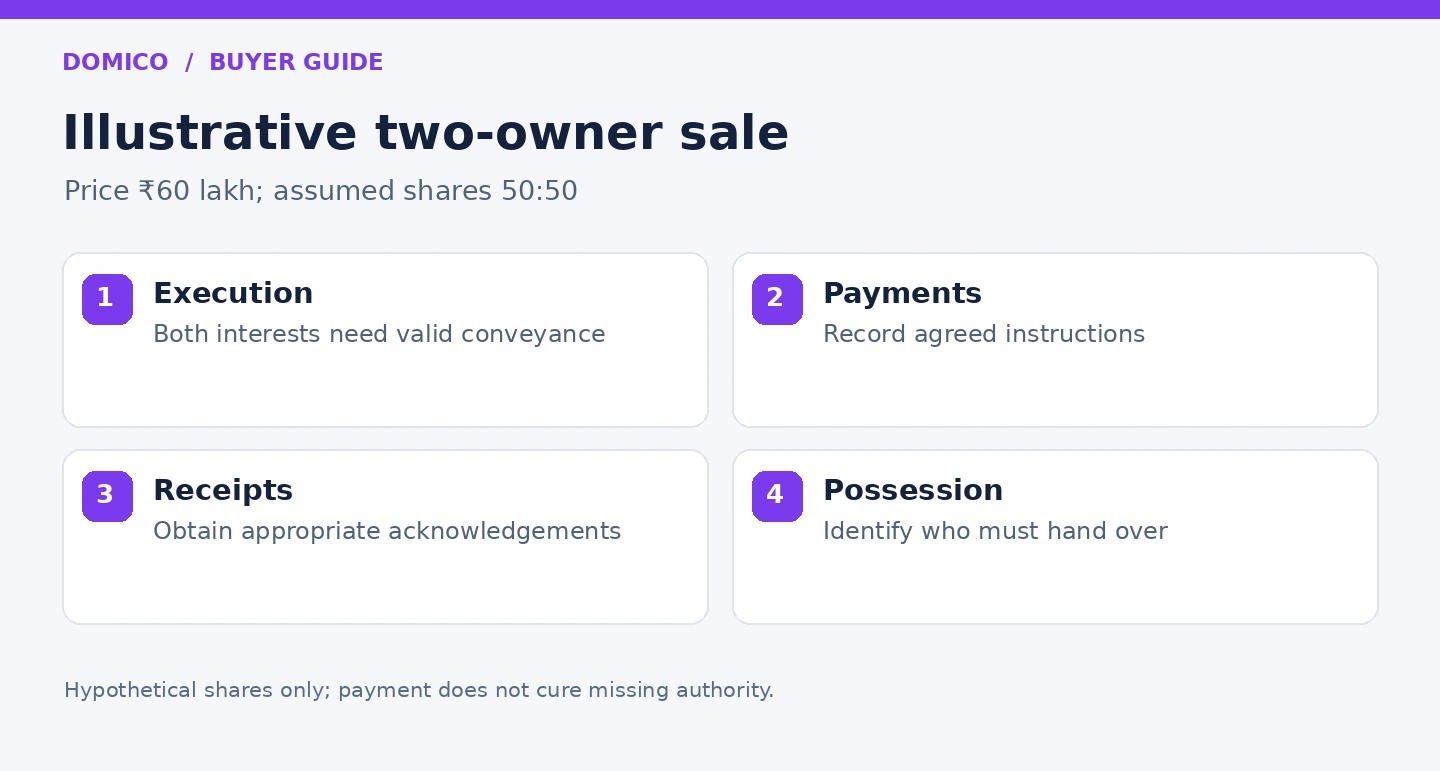
Suppose an illustrative flat is priced at ₹60 lakh and the ownership review establishes that two sellers each hold a 50% interest. One seller conducts negotiations and asks the buyer to transfer the entire price to their personal account.
The buyer needs two separate answers. First, how will both interests be conveyed through valid execution or authority? Second, what payment instructions and acknowledgements are agreed by the relevant parties and consistent with the transaction and tax requirements?
Payment to one person does not independently transfer the other person's property interest. Equally, sending half the money to each does not cure a missing signature or defective authority.
The lawyer should coordinate execution and payment terms, while the tax adviser checks relevant buyer obligations. The 50% shares here are an explicit hypothetical assumption, not a rule that two owners always own equally.
| Transaction question | Why it matters | Better practice to discuss |
|---|---|---|
| Who owns each interest? | Defines what can be sold | Written ownership analysis |
| Who executes for each interest? | Establishes valid transfer authority | Signatory and authority list |
| Who receives each payment? | Prevents later disagreement | Documented instructions and receipts |
| Who holds originals? | Helps identify lender or custody issues | Inspection and handover plan |
| Who gives possession? | Aligns paper rights and actual occupation | Clear possession obligations |
Check disputes among the owners
Ask whether partition proceedings, family disputes, sale objections or competing agreements exist. Obtain relevant case details and review actual orders, not merely an assurance that a matter is “personal.”
A disagreement does not always make every transaction impossible, but it may affect authority, possession, marketability or the buyer's ability to use the property. A lawyer needs the facts before advising whether to proceed.
Use the official eCourts service and relevant court sources as part of an appropriately scoped investigation. A no-result party-name search is not a guarantee that no dispute exists. Search terms, jurisdictions and record coverage matter.
Inspect possession and shared use
The person holding a key may not be the only person in possession. Ask who occupies the property, stores belongings there or claims a right to use a room, terrace, parking area or access strip.
For land, inspect whether separate co-owners have informally marked portions without an effective partition. For a house, check whether the sale includes the entire building or only a stated interest.
If vacant possession is promised, identify who must cooperate and what must happen before handover. A buyer should not be expected to negotiate family occupancy after paying for an empty property.
Set a closing checklist that covers every owner
Before a material payment, confirm identity documents, title interests, signatories, authority instruments, lender arrangements and the possession plan. Ask the lawyer to review the final deed against this checklist.
Where an important owner has not agreed or authority is incomplete, treat that as an unresolved condition. Do not let a closing date chosen for convenience turn into pressure to accept missing rights.
Preserve payment receipts, final signed instruments and evidence of possession. A clear file shows both what was conveyed and how the transaction was completed, which helps future finance and resale.
Printable buyer worksheet
Download the topic-specific review checklist. Use it to record evidence, unanswered questions and follow-up actions for the exact property.
Frequently asked questions
Must every family member sign the sale deed?
Not simply because they are related. The required parties depend on actual ownership, authority and the property's legal history. Ask the lawyer to identify each person's relevant role instead of collecting signatures without understanding their purpose.
Can one co-owner sell the whole property?
Only if the necessary legal authority and rights support that transaction. Ownership of a share does not automatically authorise sale of everyone else's interest. Examine the deed and any valid representation documents.
If one owner signs as a witness, is their share transferred?
Do not assume that a witness signature conveys ownership. Ask the lawyer whether the person must execute as a transferor or through an appropriate representative and how the instrument deals with their interest.
Can I buy only one owner's share?
That is a different purchase from buying the whole property. Understand the nature of the share, possession, any special legal limitations, potential partition issues and practical use before deciding. A low price does not remove those questions.
What if the owners disagree about payment distribution?
Resolve the relevant instructions before closing and obtain professional advice on execution, receipts and tax obligations. The buyer should not become the informal referee of a dispute after transferring the full price.
A smooth negotiation is helpful. A complete transfer requires every necessary right and authority to be accounted for.
Related buyer guides
Property Documents Checklist Before Buying in India
Booking Amount and Property Cancellation Terms
Sale Deed vs Agreement to Sell vs Mutation
Sources and further checks
- buyer-guide-100
- homebuyers
- joint-owner-seller
- indore
Planning to buy or rent in Indore? Browse verified properties in Indore or read more Indore guides.



