Buying Guide
Buying Inherited Property: Heirs and Seller Authority
Trace the rights from the deceased owner to today’s sellers instead of relying on possession, mutation or family assurances.

Table of contents
The seller lives in the house, pays its bills and says it belonged to their father. That may explain possession, but it does not establish that this person alone can transfer the whole property.
In inherited property, identify the rights before identifying the price. A sound purchase requires a clear link from the deceased owner's title to the people or representatives entitled to sell today.
Begin with the deceased owner's title
Obtain the document by which the deceased acquired the property and examine the earlier chain as appropriate. Confirm the exact property schedule, ownership share and any mortgage, lease, allotment condition or other restriction.
Inheritance can pass only the relevant interest that formed part of the deceased person's estate. If the deceased was a co-owner, do not assume the entire property passed through that estate. If the property was part of a different family or legal arrangement, the analysis may be more complex.
Ask the lawyer to identify what interest is being sold: the whole property, a share in it or an interest administered through an estate representative. The answer should appear clearly in the proposed conveyance.
Establish which succession rules apply
Inheritance rules are not identical for every person or family. They can depend on applicable personal law, whether there is a will, the nature of the property and other legally relevant facts.
The Hindu Succession Act and Indian Succession Act are important statutory sources, but a buyer should not select a family-tree formula from an internet article and apply it without advice.
Tell the lawyer about the date of death, family relationships, any later deaths, marriages and the claimed will or family arrangement. A sale can involve more than one succession event if an original heir has also died.
| Starting situation | Question to investigate | Documents that may be relevant |
|---|---|---|
| Owner died without a claimed will | Who inherited under the applicable law? | Death records, family evidence and title papers |
| Seller relies on a will | Is it valid and what authority is required? | Will, relevant proceedings and supporting evidence |
| Several successors exist | Who holds each interest? | Succession analysis and any effective transfers |
| One heir later died | How did that heir's interest pass? | Further death and succession documents |
| Estate representative sells | What power supports the sale? | Relevant appointment, grant or court documents |
The documents required depend on the facts. This table is an investigation guide, not a universal mandatory-document list.
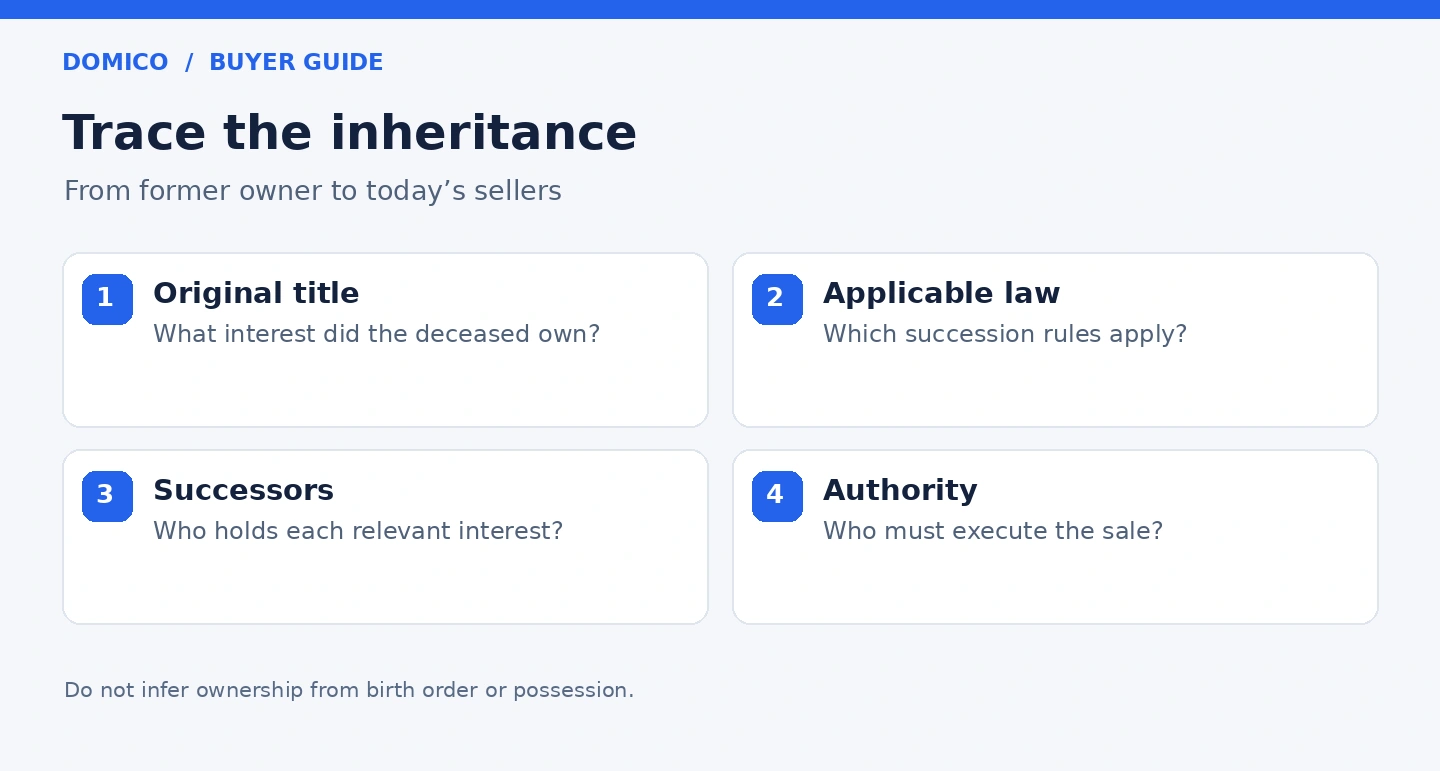
Verify the family and authority independently
Obtain a family tree with supporting identity and death records. Ask how the seller's claimed list of heirs was established and whether anyone has been omitted. Daughters, spouses, parents, descendants or other relatives may matter under the applicable rules; do not assume that the eldest son or person living in the property is the sole owner.
A legal-heir or similar administrative document can be useful evidence, but its scope and legal effect must be understood. Ask the lawyer whether it resolves the property question or needs other supporting documents.
Likewise, a succession certificate under the relevant statutory framework principally concerns specified debts and securities. Do not assume that a document called a “succession certificate” automatically transfers ownership of a house. Examine what it actually covers.
If the seller relies on a will
Read the full will and any later document claimed to change it. Establish the property described, beneficiaries, executor if any and relevant conditions. Ask how authenticity and the maker's authority are being investigated.
Whether probate, letters of administration or another court process is required or appropriate depends on current law and the case. Do not assume a blanket rule that every will must be probated, or that no court-related verification is ever needed. Obtain a current professional assessment.
If relatives challenge the will or a case has been filed, investigate the actual proceedings and orders. A registered will is not a complete answer to every possible validity challenge. The buyer needs to understand the dispute and its effect on the proposed sale.
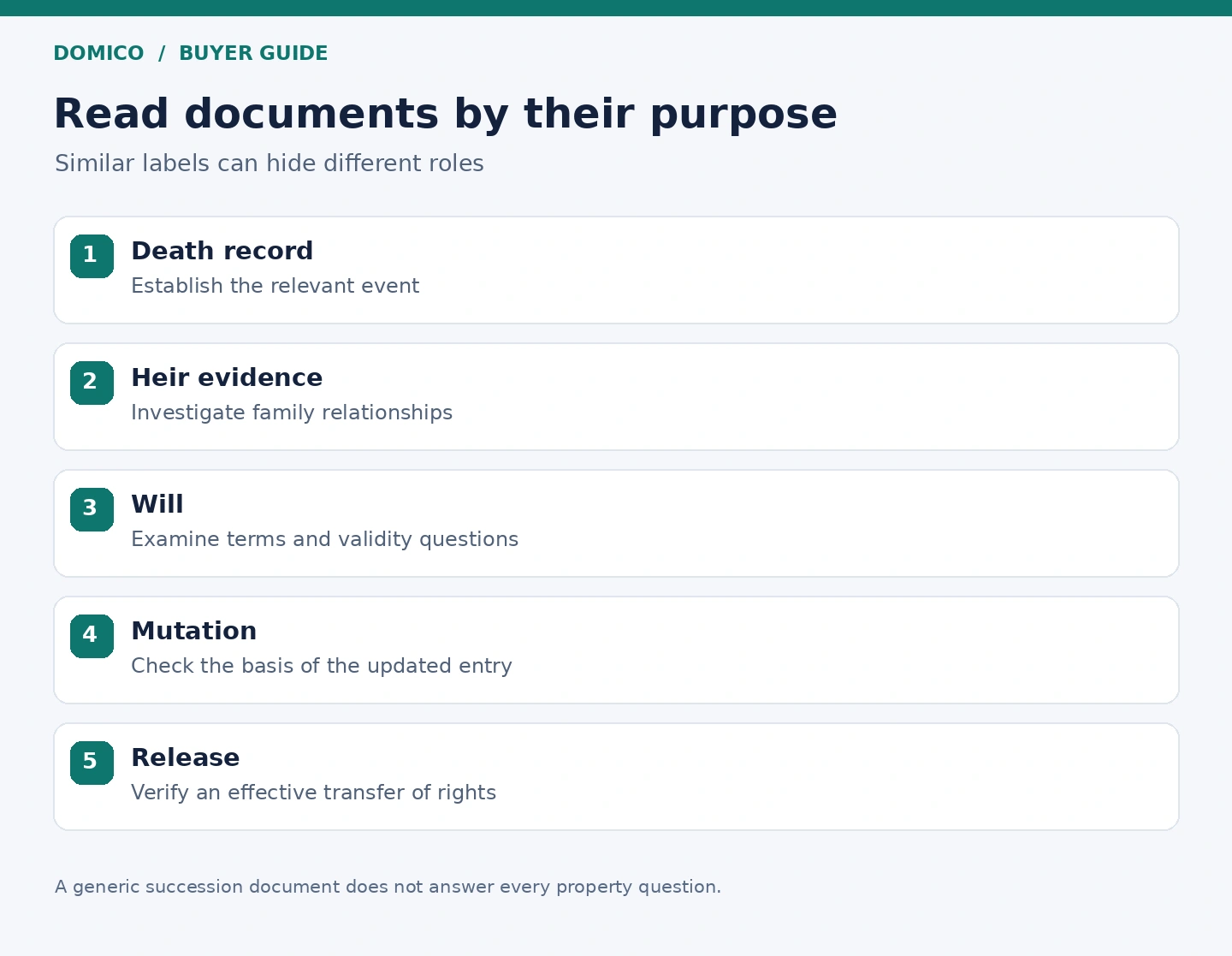
Mutation and utility bills do not replace the succession analysis
A mutation entry can show how the revenue or municipal record has been updated. It should be examined alongside the underlying basis for the change, not treated as the entire ownership story.
Use the official MP Bhulekh portal for relevant land-record checks. Obtain the mutation order and supporting records where appropriate. Ask whether objections, appeals or competing claims exist.
An electricity bill, property-tax payment or long residence may establish useful facts about possession and administration. None should be treated as a universal certificate that all other successors' rights have ended.
Releases and family arrangements need proper review
A seller may say siblings “gave up their share.” Ask what instrument or legal event supports that statement. A casual letter or oral assurance may not achieve what the buyer expects.
Have the lawyer examine any release, partition, settlement or transfer, including required formalities, parties, property schedule and legal effect. Check whether it deals with the entire relevant interest or only part of it.
Where a minor's interest is involved, obtain specific advice on authority and permissions. An adult relative's assurance that they will manage the matter is not a sufficient basis for a buyer to assume the minor's rights can be sold.
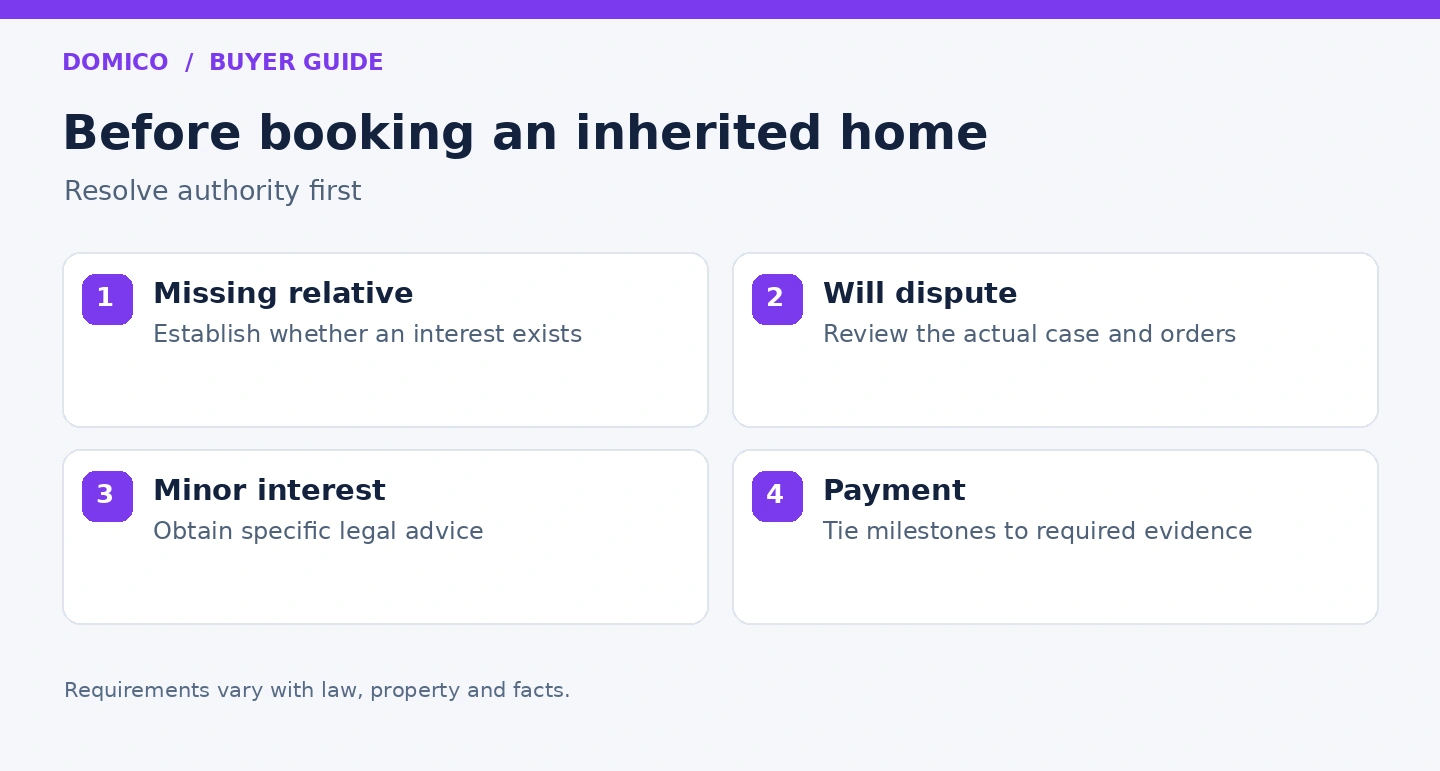
Worked example: possession is mistaken for exclusive ownership
Consider an illustrative house priced at ₹70 lakh. The person negotiating says the house was inherited and asks for a ₹5 lakh booking amount. A sibling lives elsewhere and is described as having “no objection.”
The buyer's lawyer first identifies the deceased owner's interest and applicable succession position. The file then needs evidence of who holds the rights and whether the seller can transfer the whole house alone.
If another person has an interest, the solution may involve that person joining the transaction or an effective prior transfer or authority, depending on the facts. The buyer should not pay on the assumption that a later family signature will be easy to obtain.
The example deliberately assigns no inheritance percentages. Shares cannot be calculated merely from the short family story in a sales conversation.
| Unresolved statement | Better buyer question | Evidence to seek |
|---|---|---|
| All heirs agreed | Who are they and how was agreement given legal effect? | Reviewed instruments and required participation |
| The will is registered | What does it say and is its authority established? | Full will and case-specific legal assessment |
| Mutation is complete | On what basis and with what objections, if any? | Relevant order and underlying documents |
| One relative is abroad | How will valid execution or authority be arranged? | Appropriate verified representation documents |
| A minor will sign later | What permissions are legally required now? | Specific legal advice and relevant orders |
Structure payments around established authority
Ask the lawyer to identify required signatories, acceptable authority documents and unresolved conditions before the booking payment becomes non-refundable. If time is needed to complete a legal process, record the timetable and consequences clearly.
Keep payment instructions consistent with the legal transaction and agreed allocation. Payment to one relative does not, by itself, extinguish another person's property rights. The conveyance and authority must support what the buyer intends to acquire.
Refresh litigation and encumbrance checks as appropriate near closing. Preserve the succession analysis and supporting evidence in your purchase file; they may be needed again when you seek a loan or sell.
Printable buyer worksheet
Download the topic-specific review checklist. Use it to record evidence, unanswered questions and follow-up actions for the exact property.
Frequently asked questions
Can the eldest child sell the inherited property alone?
Do not assume so. The lawyer must identify ownership and authority under the applicable law and documents. Birth order, possession or family responsibility does not automatically establish the right to convey everyone's interest.
Does a mutation entry prove that other heirs have no rights?
Treat mutation as part of the evidence, not a substitute for the underlying legal analysis. Examine the basis for the entry and the rights created by succession and any later valid transfers or arrangements.
Is a no-objection letter enough from other relatives?
Its effect depends on the rights involved, wording and legal formalities. Ask the lawyer whether the necessary interest has actually been released or transferred, or whether those people must join the sale. Do not rely on the label alone.
Does every will require probate before a sale?
Avoid a universal answer. Current law, the person's circumstances, property and disputes can affect what is required or advisable. Have the actual will and relevant legal position examined before relying on the seller's claim.
What happens if an heir has died after the original owner?
There may be another succession step to trace. The deceased heir's interest does not simply disappear. Obtain the relevant records and have the lawyer establish who now holds that interest and who must participate.
An inherited-property purchase becomes easier to assess when the family story is translated into a documented chain of rights and authority.
Related buyer guides
Property Documents Checklist Before Buying in India
Booking Amount and Property Cancellation Terms
Sale Deed vs Agreement to Sell vs Mutation
Sources and further checks
- buyer-guide-100
- homebuyers
- inherited-property
- indore
Planning to buy or rent in Indore? Browse verified properties in Indore or read more Indore guides.



