Buying Guide
Encumbrance Certificate: Meaning, Limits and Buyer Checks
Read an encumbrance search intelligently without mistaking a nil result for a complete title guarantee.

Table of contents
“The encumbrance certificate is clear” sounds like the end of a property investigation. It is better understood as one result within that investigation. To use it well, you need to know what was searched, for which period and under which property description.
A clean search result is useful evidence, not a complete ownership guarantee. This guide explains how buyers should interpret encumbrance records and the separate checks that remain necessary.
What an encumbrance search is trying to reveal
In property transactions, an encumbrance is a burden or interest that can affect the owner's rights or the buyer's proposed acquisition. A registration-record search can reveal transactions or entries indexed against the property within the scope of that search.
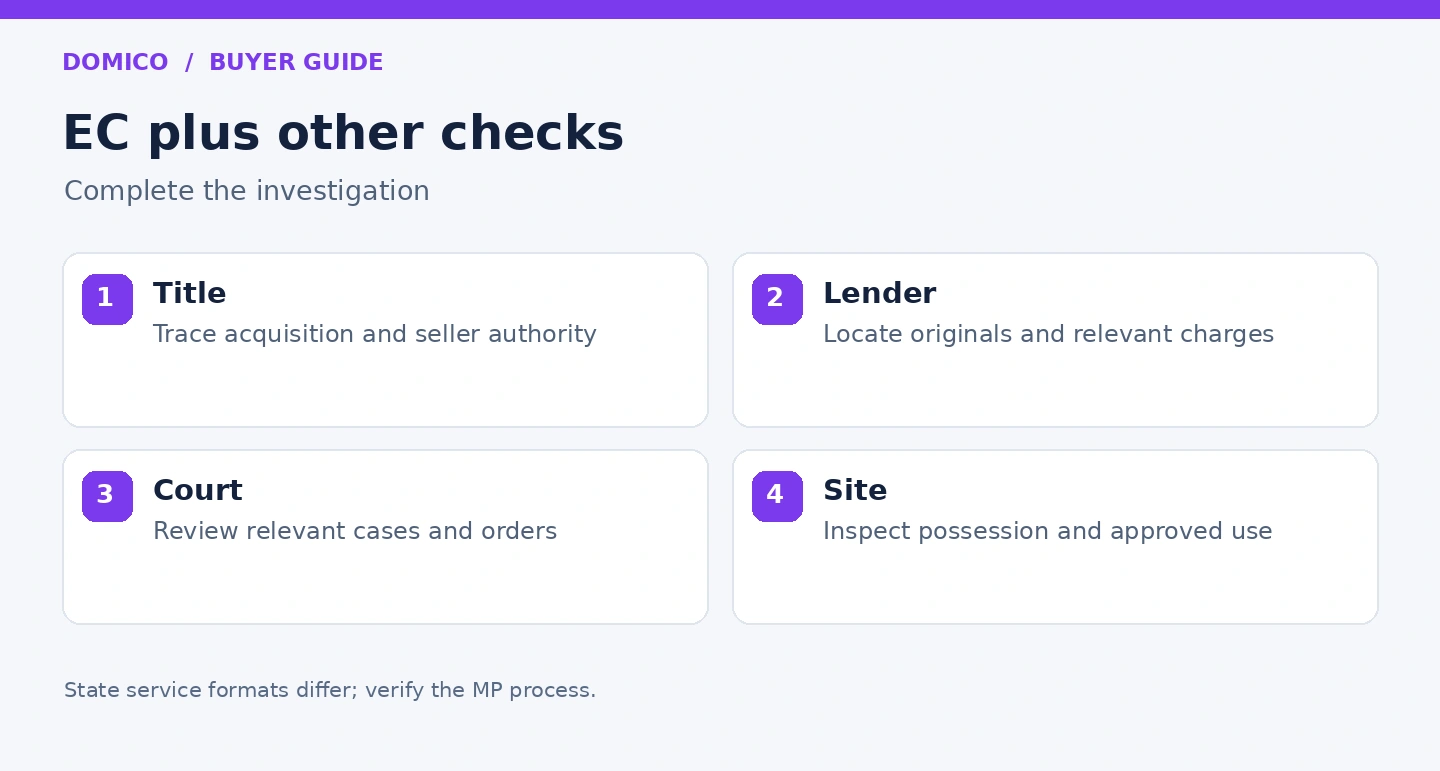
The exact certificate name, format, period and service vary by state. Some places use a service explicitly called an Encumbrance Certificate, or EC. Elsewhere, the practical work may involve registration-record searches, certified copies and a lawyer's assessment of encumbrances.
For Madhya Pradesh, use official registration services and the concerned Sub-Registrar office to establish what search and certified record are available for the property. The MP government's public-service information identifies registered-document search and certified-copy services. Do not assume that another state's form numbers or tutorial describe the current MP workflow.
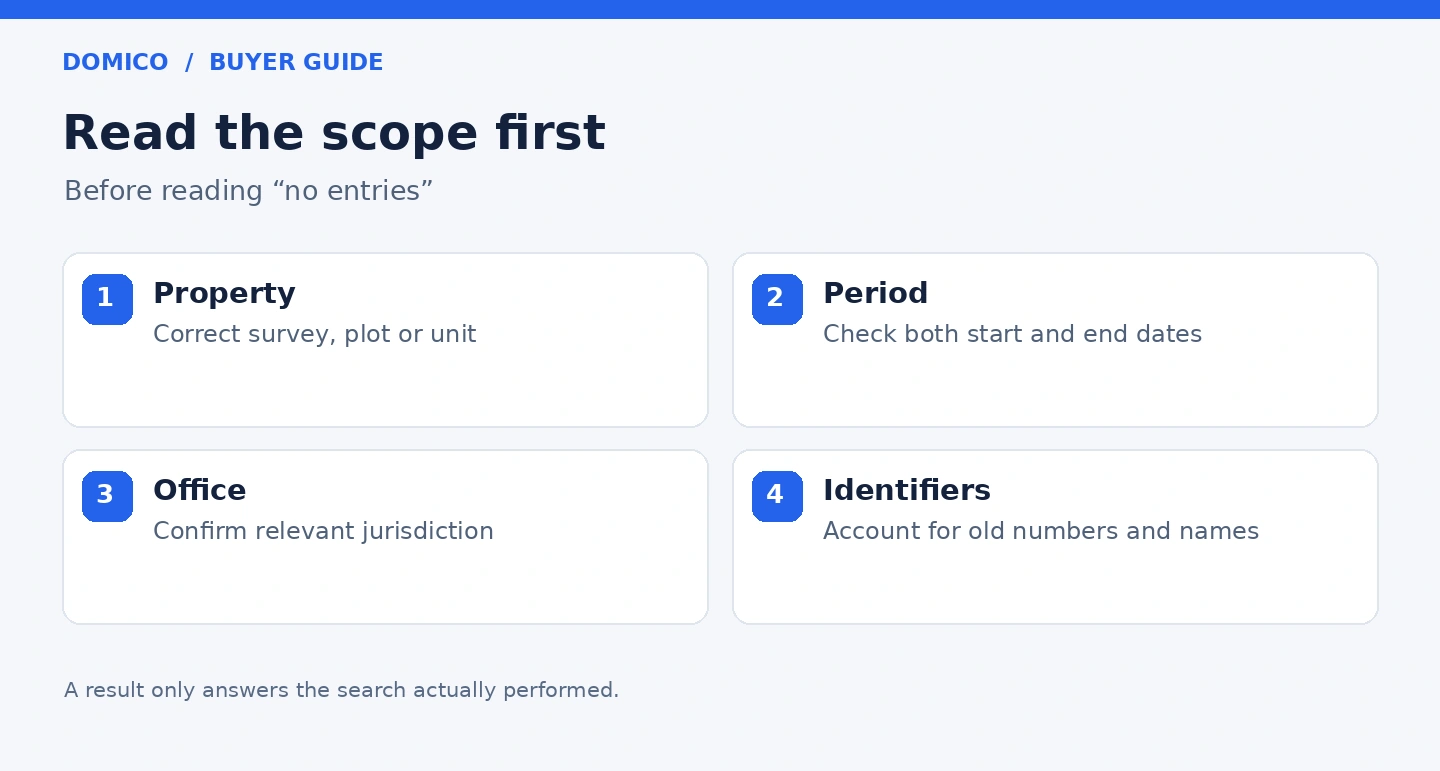
Read the search scope before the result
Check the property identification, offices or registration jurisdictions, dates covered and names or other identifiers used. A result covering one year cannot be assumed to describe the previous twenty. A search against an old survey number may need to be connected to subsequent subdivisions.
Ask who performed the search and whether the supplied document is an official certificate, a search output, a certified copy or a lawyer's summary. Each can be useful, but their roles differ.
The Registration Act provides the legal framework for registration records, inspection and certified copies, subject to applicable provisions and state practice. It does not turn every online no-result screen into a complete certificate of title.
| Search element | What to verify | Why a mistake matters |
|---|---|---|
| Property description | Survey, plot, unit and boundaries where relevant | Wrong identity can miss entries |
| Time period | Start date and end date | Earlier or later events may be outside scope |
| Jurisdiction | Relevant registration office or offices | Records may not all be in one place |
| Name variations | Current and prior holder identifiers | Indexing may differ across documents |
| Output type | Official record, search result or legal summary | Different outputs support different conclusions |
What to do when an entry appears
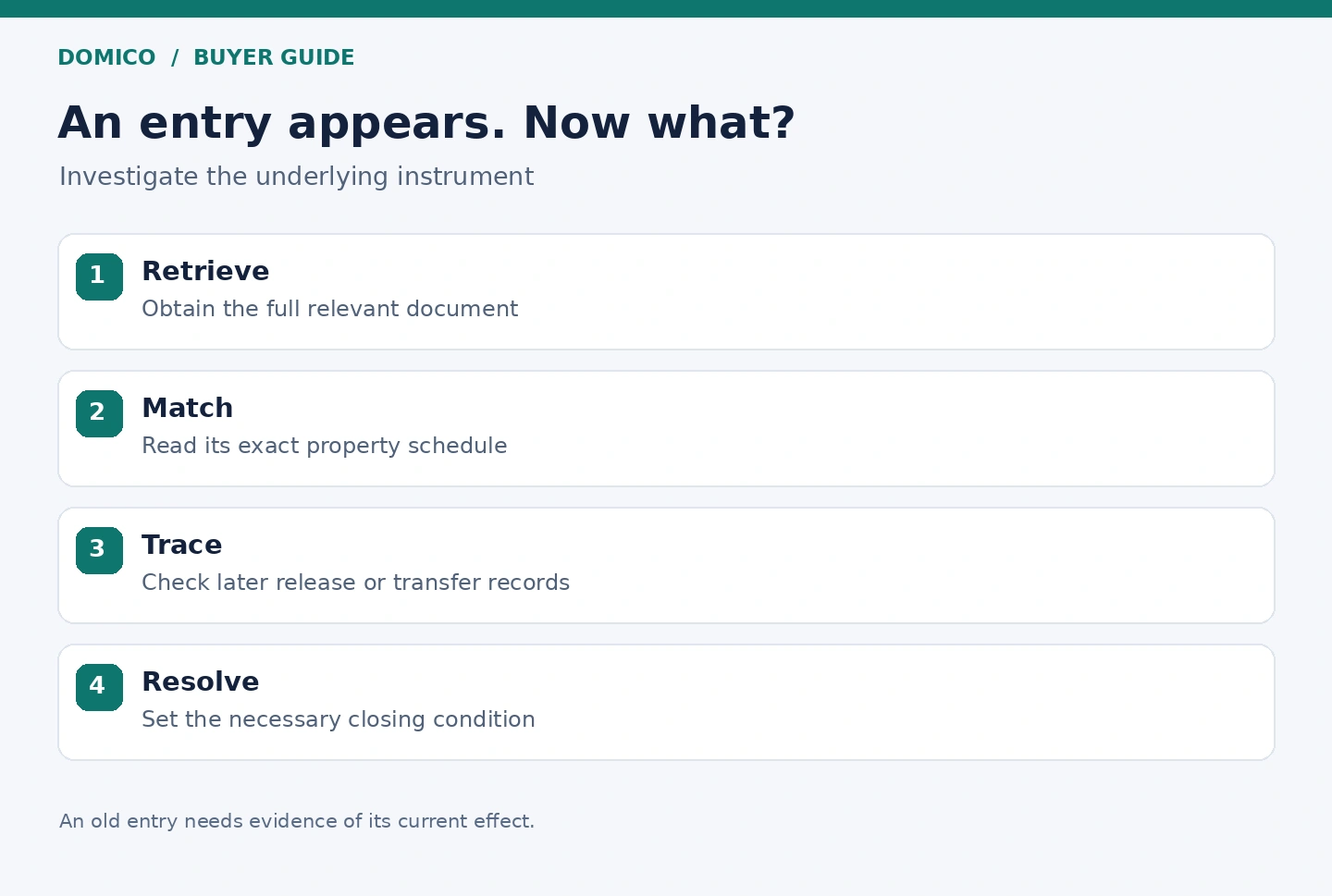
Read the underlying instrument rather than deciding from a short index label. A mortgage, release, sale, gift, lease or attachment-related entry can have a different effect, and its current status may depend on later documents.
If a mortgage is shown, obtain lender information and the documents supporting release or closure. A seller's loan-payment receipt may not explain every step needed to discharge the interest and return originals.
If a sale or transfer appears, connect it to the ownership chain. A transaction involving only part of the parent parcel may or may not affect the selected plot. A lawyer should assess the exact property schedule, parties and legal effect.
If an entry is unclear, put it on the open-issues list. Do not delete it from a buyer-facing summary because the seller says it is “old.” Old entries can be resolved; the resolution needs evidence.
What a no-encumbrance result cannot establish alone
A result reflects the searched records and method. It should not be treated as proving that every possible unregistered claim, possession issue, family right, litigation matter or administrative restriction is absent.
For example, the search may not answer who physically occupies the property or whether the seller has disclosed all heirs. It does not establish structural condition, residential land use or approval of a construction extension.
Security interests also need appropriate investigation. Ask the lawyer what separate lender or security-interest checks are relevant, whether original deeds have been deposited and where they are held. Do not infer that a missing mortgage entry in one record proves no lending arrangement ever existed.
The purpose is not to dismiss the EC. It is to avoid asking it to answer questions outside its scope.
Choose the period based on the title investigation
A seller may provide a convenient recent certificate because it is easy to obtain. Ask your lawyer whether the period and records are suitable for the property's history and the proposed purchase.
An appropriate review may need earlier acquisition documents, changed property identifiers or records from a former jurisdiction. There is no benefit in searching a long period under an inaccurate description. Correct identification comes first.
If an older record is not digitised, ask how the relevant historical material can be inspected or obtained. An online limitation should be recorded as a limitation, not silently converted into a finding that no entry exists.
Worked example: a clear recent result misses the relevant question
An illustrative buyer is purchasing a flat for ₹58 lakh. The seller supplies a no-encumbrance search covering the last two years. The seller acquired the flat eight years earlier and says the original deed is “in safe custody.”
The two-year search may be accurate within its scope, but it does not explain the original deed's location or the earlier period. The buyer asks the lawyer to review the acquisition history, extend or supplement the searches as appropriate and establish whether a lender holds the originals.
Suppose a loan is then identified with an illustrative ₹12 lakh balance. The purchase may still be possible through an appropriately controlled closure. What changes is the closing plan: the buyer needs lender confirmation and a documented sequence rather than paying the full price on the strength of the recent search alone.
The sample amounts show why scope matters. They are not a statement about a real flat or a standard loan-closure process.
| Separate buyer check | Question it answers | Why EC alone is insufficient |
|---|---|---|
| Title chain | How did the seller acquire transferable rights? | Index entries need legal interpretation |
| Seller authority | Who must execute the sale? | Family or representative issues need documents |
| Originals and lender position | Where are deeds and is release required? | One search may not reveal the whole arrangement |
| Litigation review | Are claims or operative orders relevant? | Court investigation has its own scope |
| Possession and approvals | What is occupied and lawfully usable? | These are different evidence systems |
Use certified copies to investigate important entries
Where an instrument matters to your purchase, obtain an appropriate copy from the official source and have it reviewed. A readable copy is essential: the legal effect may turn on the schedule, exclusions, conditions or the exact parties.
Compare the copy with what the seller supplied. Missing pages, annexures or maps can change the interpretation. Preserve the registration reference and source so the document can be retrieved again if needed.
Do not treat a notarised photocopy, an official certified copy and an online image as identical for every purpose. Ask the lawyer and receiving lender what form of evidence is appropriate.
Refresh material searches near closing
A search is time-bound. If weeks or months pass after the initial investigation, ask which checks should be updated before registration and payment. The seller should also disclose intervening transactions or proceedings as required by the agreement and applicable law.
Where a charge is being released as part of the sale, retain evidence of the required discharge steps. If a record still shows an old interest after closure, ask what updating process and proof are needed.
Keep the final search outputs with the lawyer's interpretation. Future buyers may find a clear record of the investigation more useful than a single unexplained page marked “clear.”
Printable buyer worksheet
Download the topic-specific review checklist. Use it to record evidence, unanswered questions and follow-up actions for the exact property.
Frequently asked questions
Does a nil EC prove the seller owns the property?
No. It is a search result within a defined scope. Ownership and authority require examination of the title chain, relevant records and facts. A nil result should support that work rather than replace it.
Is the EC process identical in every Indian state?
No. Service names, access, formats and records differ. For MP property, confirm the current official search and certified-copy route with registration services or the concerned office rather than following another state's form-based instructions.
Can a property with a mortgage entry still be bought?
Possibly, but the lender's rights and closure requirements must be addressed through a properly planned transaction. Obtain current lender confirmation and legal advice on payments, release and return of original documents before proceeding.
How long is an EC valid?
Think in terms of its search period and the receiving authority's requirements, not an assumed universal validity period. New events can occur after the end date. Ask whether an updated search is needed for your closing.
What if the property number changed?
Provide the old and new identifiers and documents connecting them. Ask the professional performing the search how those changes were handled. A no-result search against only one incomplete identifier can leave relevant history unchecked.
Use an encumbrance search for what it does well: revealing and investigating relevant records. Complete the purchase with the other evidence it cannot supply.
Related buyer guides
Property Documents Checklist Before Buying in India
Booking Amount and Property Cancellation Terms
Sale Deed vs Agreement to Sell vs Mutation
Sources and further checks
- buyer-guide-100
- homebuyers
- encumbrance-certificate
- indore
Planning to buy or rent in Indore? Browse verified properties in Indore or read more Indore guides.