Buying Guide
Buying a Home for Elderly Parents: Accessibility Checks
Check entrances, lifts, bathrooms, daily services and adaptation costs before buying an accessible home for elderly parents.
Updated 9 min read
Buying Guide
Check entrances, lifts, bathrooms, daily services and adaptation costs before buying an accessible home for elderly parents.
A comfortable home should make ordinary days easier, including the difficult ones.
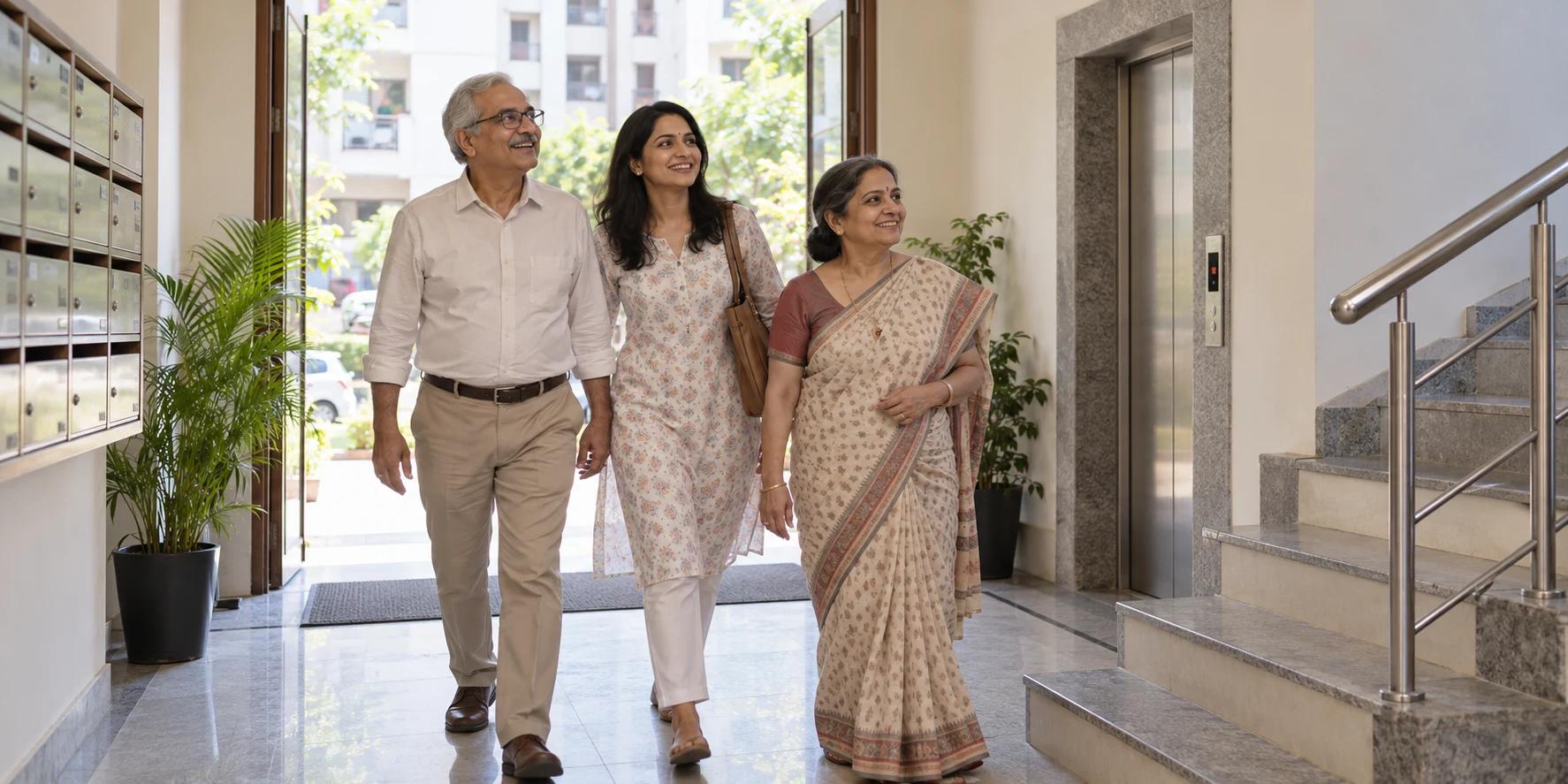
A beautiful apartment can still be exhausting for an older person. Three steps at the entrance, a heavy fire door or a bathroom that cannot accommodate assistance may matter more than an extra balcony. When buying a home for elderly parents, inspect the complete journey from the street to the bedroom. Looking only at the flat misses many of the obstacles they will use every day.
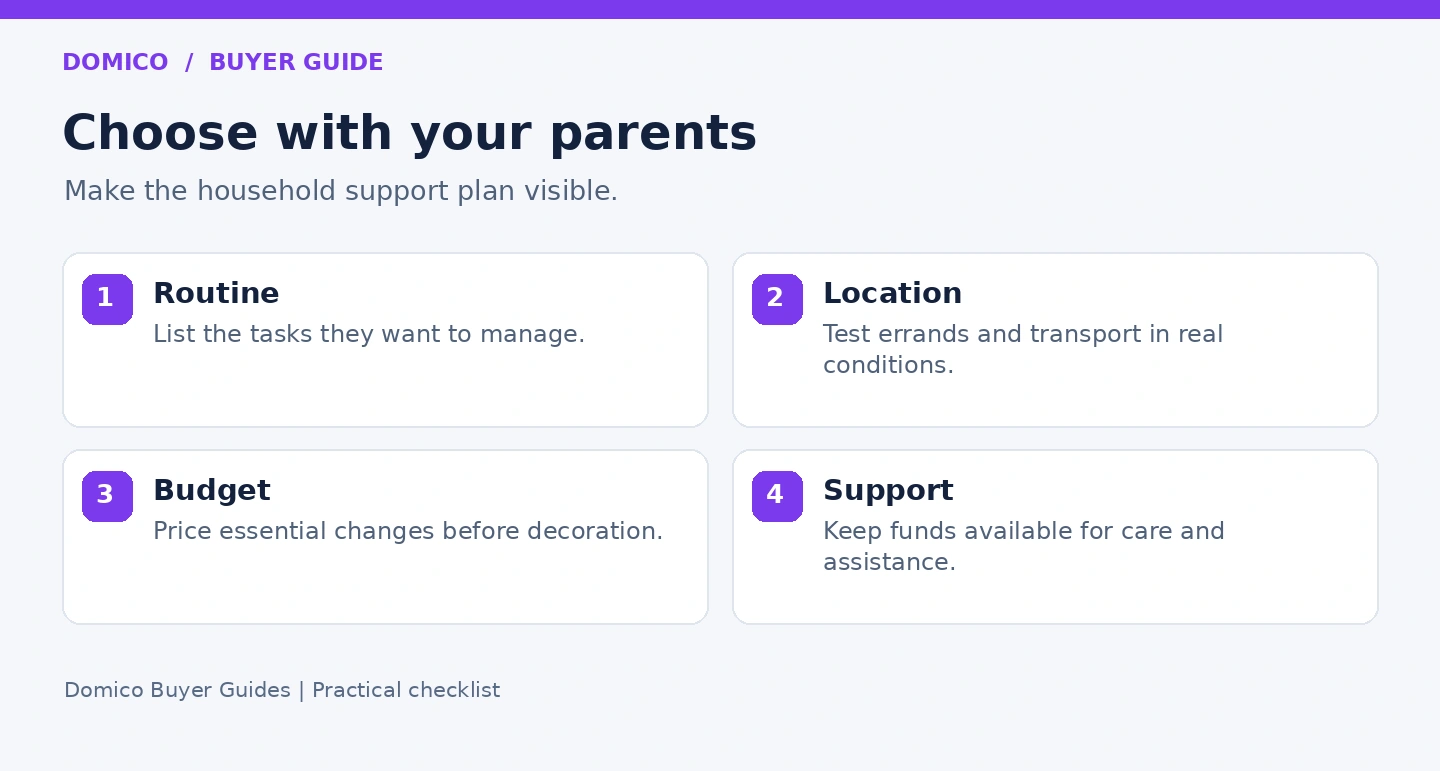
Begin with your parents' present routine, then consider a temporary illness, reduced vision, a walking aid or the need for a caregiver. This does not mean assuming a medical condition. It means choosing a home that leaves room for changing needs and personal preferences.
Ask your parents which activities they want to manage independently: collecting deliveries, taking a walk, visiting neighbours, preparing tea or attending appointments. A home close to family may be more useful than a larger apartment in an unfamiliar location. Some parents value a busy neighbourhood; others need a quieter bedroom and a short, level walking route.
Make a short list of essential needs together. Include practical details such as the side of the bed they prefer, whether they normally sit while bathing and whether they can comfortably operate a particular latch. Do not substitute a developer's claim of “senior-friendly” for an actual trial of these tasks.
The Government of India's accessibility guidelines provide a useful design reference. Ask an accessibility professional to assess the applicable requirements and the proposed home. A sales visit with a tape measure is a screening exercise, not a compliance certificate.
Start where a taxi would stop during rain. Is there a safe place to get out? Can a person reach the entrance without stepping into traffic, climbing a kerb or crossing a slippery parking ramp? Check whether the apparent accessible entrance is open during ordinary hours or normally blocked by a parked vehicle.
Follow the route through the gate, lobby, lift and apartment door. Note changes in level, thresholds, loose mats and heavy doors. If there is a ramp, look at its entire length, landings, surface, handrails and exposure to rain. A steep short ramp may be harder to use than it appears in a photograph.
| Journey | What to test | Useful evidence |
|---|---|---|
| Vehicle to entrance | Level drop-off and sheltered stopping | Visit during a normal busy period |
| Gate to lobby | Continuous, unobstructed walking route | Walk it with the intended user |
| Lobby to lift | Door effort, turning space and controls | Measure clear spaces and try controls |
| Lift to flat | Corridor lighting and thresholds | Repeat the route after sunset |
| Flat to outdoors | Independent return journey | Check exit doors and gate operation |
Do the route in both directions. A door that is easy to push on arrival may be difficult to pull while leaving. The goal is a route your parents can use with confidence, rather than one that requires a helpful person to appear every time.
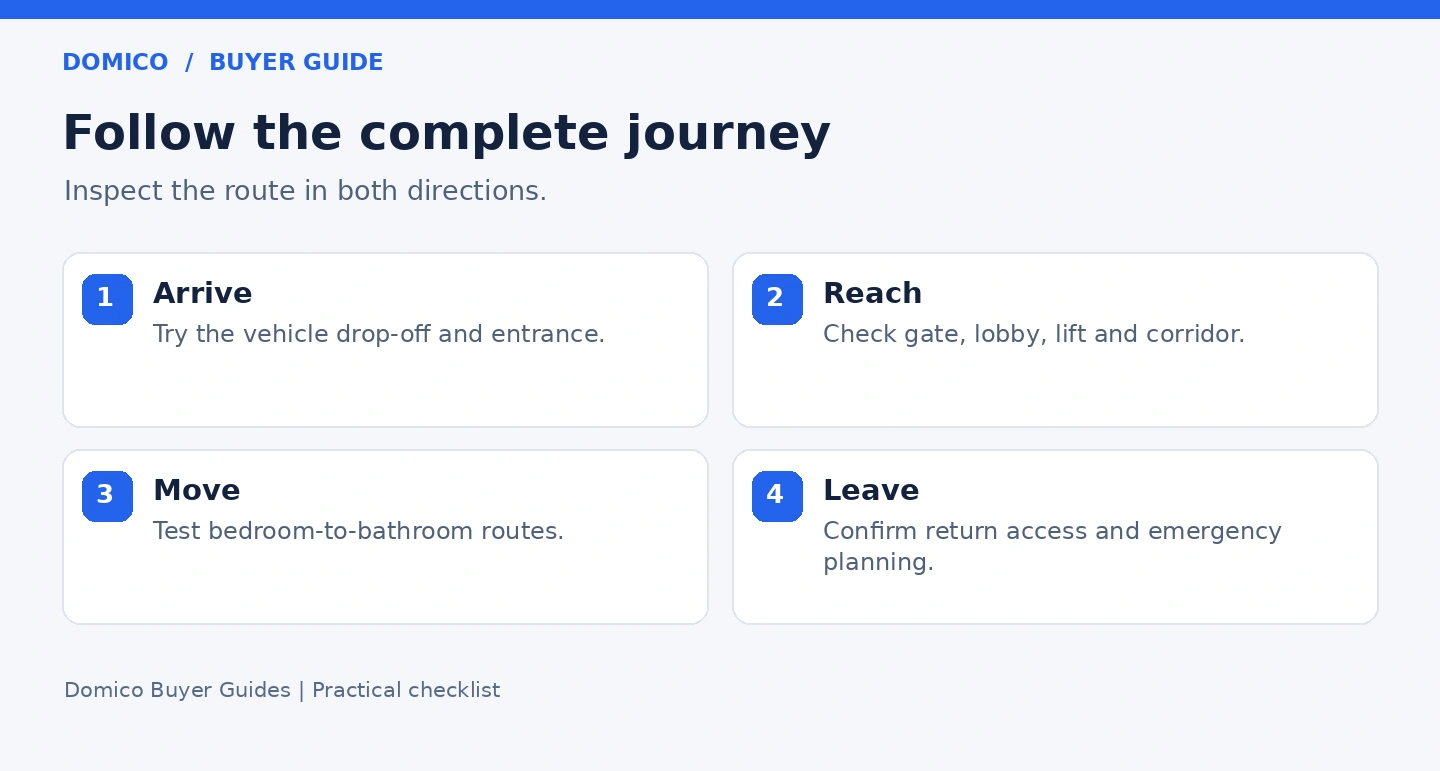
Inspect the lift car, door opening, levelling and control visibility. If a wheelchair or walker is already used, test it with permission and appropriate assistance. Confirm whether another person can accompany the user without awkward manoeuvring. Ask the facility manager about service arrangements, breakdown records and what backup power actually operates.
A ground-floor home can reduce lift dependence, but it still needs checks for entrance steps, privacy, drainage and security. A higher floor with a reliable accessible lift may work well. Avoid treating floor number alone as a complete answer.
Emergency arrangements deserve a separate discussion. Do not assume a normal passenger lift can be used during a fire. Ask the building's responsible professional or management to explain the approved evacuation plan and how residents who need assistance are supported. A plan that depends only on relatives arriving from elsewhere is incomplete for daily decision-making.
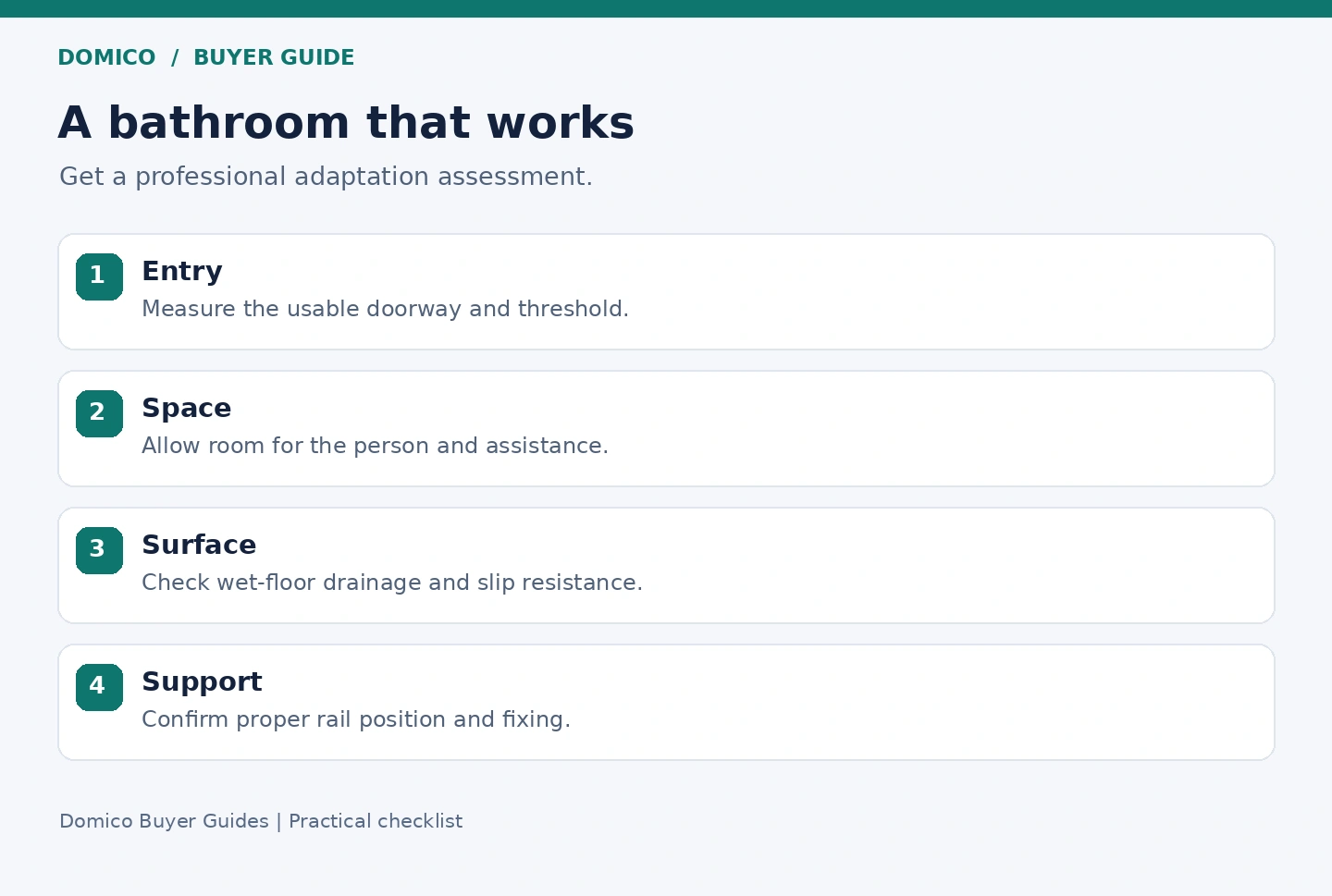
Bathrooms combine wet surfaces, narrow spaces and movements that may require support. Examine the route from the bedroom, the door, threshold, drainage and the space around the toilet. Check whether someone could help without standing in an unsafe position.
Look beyond a label such as “anti-skid tile”. Examine the installed surface, slope and likely water spread. Ask a suitable professional about slip resistance and modifications. Grab rails need appropriate positioning and secure fixing into a suitable substrate; a towel rail is not a substitute.
Where changes are proposed, confirm whether the layout, plumbing and building rules allow them. Moving a door or removing a partition may need permissions and technical review. Obtain a specific scope and estimate before assuming an unsuitable bathroom can be corrected cheaply after purchase.
Draw the actual bed, wardrobe and any walking aid onto the floor plan. Leave workable routes to both sides of the bed and to the bathroom. Check whether the bedroom door can open fully after furniture is installed. A large advertised bedroom area can conceal an awkward shape.
In the kitchen, consider reach, lighting, ventilation and where frequently used items will be kept. Heavy overhead storage may be inconvenient even when the room looks spacious. Check that switches, sockets and appliance controls can be reached without climbing or stretching across a hot surface.
Small details matter because they recur. Window handles, balcony thresholds, curtain controls and door locks should be easy for the intended user to operate. Ask permission to try them. Confirm which sample-flat fittings will actually be delivered and record any changes promised by the seller.
Map the grocery shop, pharmacy, doctor and family support network, but then inspect the journey. A pharmacy 300 metres away is less convenient if reaching it requires crossing a difficult road. Consider whether groceries and medicines can reliably be delivered to the actual building entrance.
For healthcare, check the relevant hospital's services directly. A nearby clinic and a hospital with an emergency department serve different purposes. Travel time changes with traffic, road closures and the time of day. Do not build the purchase decision around a single map estimate or an advertised distance.
| Daily need | Question to answer | What can go wrong |
|---|---|---|
| Medicines | Can the usual prescription be obtained nearby? | A shop exists but lacks required stock |
| Walking | Is there a safe, level route with places to rest? | The garden is reached by steps |
| Help at home | Can a caregiver enter without repeated delays? | Access rules are unclear |
| Appointments | Is transport practical at the likely travel time? | A short route becomes congested |
| Social contact | Are familiar people and activities accessible? | Isolation despite a larger home |
Imagine two apartments with a purchase price of Rs 60 lakh. Flat A needs Rs 2.4 lakh of bathroom, threshold and lighting changes. Flat B needs Rs 80,000 of minor work. These are hypothetical quotations, not market rates. The initial adaptation gap is Rs 1.6 lakh.
Suppose Flat A also adds Rs 2,000 per month in likely transport spending because regular services are farther away. That is Rs 24,000 per year, or Rs 1.2 lakh over five years before any inflation. The comparison now includes Rs 2.8 lakh of additional identified costs for A across the adaptation and transport assumptions.
This does not automatically make B the right choice. A may have nearby family or a layout your parents prefer. The calculation simply makes a recurring inconvenience visible. Record lifestyle benefits alongside the costs instead of reducing the decision to price per square foot.
Create three lists: required before moving in, useful soon and optional later. Resolve barriers to safe entry, bathing and essential movement before spending on decorative changes. Have technical work checked by suitable professionals and agree responsibility for common-area changes with management.
| Priority | Example | Before purchase |
|---|---|---|
| Essential | Unusable entrance or bathroom route | Confirm a feasible, permitted solution |
| Important | Poor bedroom lighting or difficult handles | Obtain a written scope and estimate |
| Preference | Extra storage or decorative fittings | Compare comfort against available budget |
Keep money available for assistance and routine care after buying. Spending every available rupee on the apartment can weaken the support system the home was meant to improve.
No. Check the actual entrance, drainage, security, privacy and ventilation. A ground-floor apartment behind several steps can be less convenient than an accessible upper-floor home with dependable services. Match the choice to the person's needs and the building's operating arrangements.
Consider where a caregiver could sleep, store belongings and use a bathroom while preserving everyone's privacy. Extra area helps only if the layout works. Compare the cost of a suitable room with the family's realistic support plan and the likelihood of needing overnight assistance.
Sometimes, but the feasibility depends on its size, door position, plumbing, structure and permitted alterations. Get a professional assessment before purchase. Do not assume every wall can be removed or that a grab rail can be securely fixed anywhere.
Ask who responds, how help is requested, what backup systems exist and how staff are trained. Request the building's evacuation arrangements for residents needing assistance. Confirm practical responsibilities rather than relying on a verbal promise that security staff will manage everything.
Take the intended residents at a comfortable time, with any assistance they normally use. Try the entrance, lift, bathroom route and essential controls. Record their concerns without rushing. Revisit after dark if lighting and access are important unresolved questions.
The most useful apartment is one your parents can comfortably inhabit. Buy for their everyday independence, their relationships and a realistic plan for support.
Download the topic-specific review checklist. Use it to record evidence, unanswered questions and follow-up actions for the exact property.
Planning to buy or rent in Indore? Browse verified properties in Indore or read more Indore guides.
Check who owes the lender, how builder-paid interest works, when support ends and whether you can carry the loan if payments stop.



