Buying Guide
Flat Possession Checklist: Inspection and Handover
Prepare for flat possession with room-by-room inspection, document review, meter readings, snag records and handover follow-up.

Table of contents
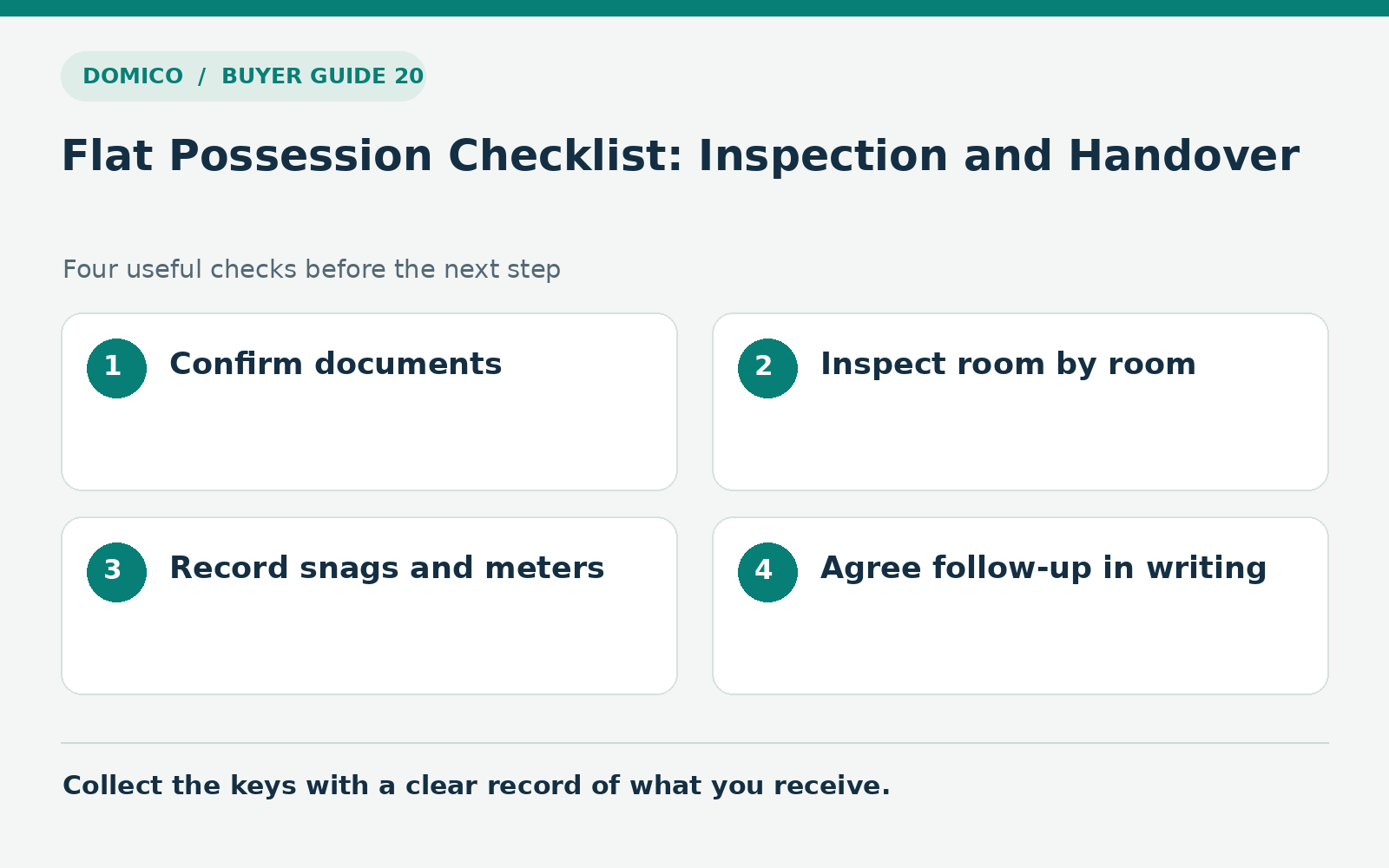
Collect the keys with a clear record of what you receive.
A flat possession checklist helps you connect the handover documents, the actual unit and the payments being settled. Before signing the final papers, inspect the home, record visible defects, check agreed fixtures and understand outstanding work. The aim is a usable home and an accurate handover record, not simply a key photograph.
Possession is a significant stage whether the flat is new or resale. The exact documents, obligations and legal position depend on the transaction. This guide gives you a practical inspection and handover method, with appropriate professional checks for matters a buyer cannot certify through a walk-through.
Arrange a proper handover appointment
Ask for the proposed handover documents and final statement in advance. Confirm that you can inspect the exact unit with sufficient time and that the authorised representative can answer questions. Avoid an appointment structured only around signing and collecting keys.
Bring the relevant agreement, specification schedule, unit plan and a list of earlier unresolved items. Carry a phone, notebook and simple measuring tools where permitted. If you have identified technical concerns, arrange an appropriate independent professional rather than attempting specialist tests yourself.
Confirm which services will be available for demonstration. Water, ordinary power functions and installed equipment should be assessed appropriately. A feature that cannot be tested should be marked as untested, not treated as satisfactory by default.
| Before the appointment | What to request | Why it helps |
|---|---|---|
| Handover paperwork | Proposed possession and acknowledgment documents | Gives time to understand the wording |
| Final account | Itemised demands, credits and payments | Makes reconciliation possible |
| Unit specification | Agreed plan and included fixtures | Establishes the inspection basis |
| Relevant building records | Applicable completion or occupancy information | Clarifies the legal readiness questions |
| Open-work list | Earlier defects and promised work | Prevents issues disappearing at handover |
Review the documents before signing
Check the property identification, parties, relevant dates and statements about condition, payments or completion. Read broad acknowledgments carefully. Do not confirm that everything is complete or received if you have not checked the matters described.
Ask your adviser about relevant completion and occupancy records and their scope for the building or phase. For covered promoter transactions, the RERA framework addresses obtaining and making available the applicable completion or occupancy certificates. The exact documents should be reviewed for your property.
If something is missing, identify the specific document and the proposed next step. Do not accept a general assurance that all papers will come later without understanding the effect on occupation, financing or the transaction. Seek case-specific advice where a material issue remains.
Inspect the exact flat systematically
Begin at the entrance and move room by room. Compare the actual layout and included items with the agreed specification. Check doors, windows, flooring, visible wall condition, fittings and everyday usability. Photograph defects with permission and label the location clearly.
Look for visible damp, staining, cracks or poor finishing, but avoid diagnosing concealed or structural issues yourself. Significant concerns need a qualified professional. An inspection checklist records observations; it is not a building safety certificate.
Use consistent wording. “Bedroom window does not close fully” is more actionable than “window bad.” A precise observation helps the responsible team understand the work and lets you check whether the later repair addresses it.
Check kitchen and bathroom functions
Ask the authorised representative to demonstrate ordinary water flow, drainage and included fixtures. Look for visible leaks around accessible connections and signs of water collecting where it should drain. Test normal operation without dismantling systems or creating damage.
Check the delivered kitchen provisions against the written specification. Identify what is included and what you must arrange. A sample apartment may have contained appliances or storage that were never part of the agreed package.
If waterproofing, plumbing or drainage concerns are material, obtain a professional assessment and a written repair scope. Do not rely only on a promise that an issue will disappear after regular use. Record whether the item was observed, tested or left inaccessible.
| Inspection area | Ordinary check | Record if unresolved |
|---|---|---|
| Doors and windows | Open, close and inspect visible alignment | Exact location and operating problem |
| Walls and floors | Observe finish, stains and visible damage | Photograph and description without unsupported diagnosis |
| Water and drainage | Demonstrate normal functions where available | Test limitation or visible leak location |
| Installed fixtures | Compare with agreed specification | Missing, damaged or substituted item |
| Technical systems | Use qualified professionals as needed | Assessment, recommended work and responsibility |
Check electrical provisions safely
Have normal switches and included equipment demonstrated by the authorised representative. Confirm the visible provisions described in the specification. Specialist testing of wiring, earthing, protective devices or safety should be carried out by a qualified electrician.
Do not open live panels, handle exposed wires or attempt improvised tests. If a service is incomplete or unsafe-looking, keep clear and request professional attention. The handover process should not require the buyer to take technical risks.
Ask about the scope of backup power and how relevant equipment is maintained. Record the actual provision rather than a broad label. A building's common-area backup and the circuits available inside a flat can be different arrangements.

Walk through the common access and facilities
Check the route from the entrance and relevant parking area to the unit. Observe lift operation, accessible stairs and practical movement for the intended occupants. Confirm the documented parking arrangement and access devices rather than assuming an empty space is yours.
Ask which common facilities are operational, which belong to the relevant phase and what remains to be completed under the agreement. Keep future commitments distinct from facilities available for use now. A wider township illustration does not settle the scope for your unit.
For fire, structural and other safety matters, request the relevant records and obtain appropriate advice. A buyer's walk-through cannot certify compliance. Do not enter restricted plant rooms, roofs or active construction areas without proper authorisation and supervision.
Create a short, specific snag list
A snag list is a record of identified defects or unfinished items. Use one line per issue with the room, observation, photograph reference, responsible party and proposed completion date. Group significant concerns separately from minor cosmetic work so that priorities remain clear.
Ask the authorised representative to acknowledge the list through an appropriate written process. Keep your own copy and the response. If the proposed handover document contains a conflicting broad statement, have the wording reviewed rather than relying on a separate verbal assurance.
After repairs, reinspect the actual items and record the result. A work-completed message is useful, but it does not replace checking whether the specific problem has been addressed. For technical issues, use the relevant professional to verify the outcome.
Understand applicable defect rights
For transactions covered by section 14(3) of RERA, specified defects brought to the promoter's notice within five years from handover fall within the statutory framework. The provision requires rectification without further charge within thirty days, with compensation addressed if the obligation is not met.
The scope includes the categories stated in the Act, not an unlimited promise that every future change or wear item is covered. Ask a lawyer to apply the provision, agreement and facts to a material issue. Keep the handover date, notice, evidence and response carefully.
Do not delay reporting an issue because it seems inconvenient to raise it after possession. Use the proper documented channel and seek advice about relevant deadlines and remedies. A clear dated record is more useful than repeated informal calls with no retained explanation.
Reconcile the final account
Match each demand and credit to the agreement and earlier receipts. Check how the booking amount, instalments, lender releases and any adjustments have been applied. Ask for an itemised explanation of any difference before accepting a final balance.
Clarify maintenance advances, deposits, service charges and the date from which recurring amounts apply. A refundable deposit and an expense are different items. Ask what period each payment covers and which future charges remain separate.
For resale, confirm the agreed treatment of outstanding maintenance, utilities and other relevant amounts. Record the cut-off and settlement arrangement appropriately. Do not assume every past charge is handled identically across buildings or transactions.
| Handover record | What to note | Supporting evidence |
|---|---|---|
| Final payments | Agreed amount, credits and balance | Reconciled statement and receipts |
| Meter readings | Relevant meter identifiers and readings | Dated photographs or signed record |
| Keys and access | Number of keys, cards and devices | Handover inventory |
| Open work | Exact issues and agreed follow-up | Acknowledged snag list |
| Documents | Items received and still outstanding | Clear document inventory |
Record the practical handover
List the keys, access cards, remotes and other devices received. Ask for relevant operating manuals, warranties and service contacts for included equipment. Confirm how the maintenance or association team can be contacted after moving in.
Record meter details and readings with a clear date. Check the process for utility and applicable association records to be updated. Keep the possession record with the deed, agreement and payment file rather than treating it as an isolated form.
For a resale home, inspect the agreed fixtures and vacant-possession condition. Make sure the belongings that should leave have been removed and the items that should remain are present. A simple inventory can avoid disagreement after everyone has left the property.
Plan the first weeks after possession
Complete essential work before optional decoration where practical. Keep the defect-reporting file active and avoid covering a significant issue with new finishes before it has been assessed. If work could affect a claim or technical diagnosis, seek advice first.
Understand building rules for moving, contractor access and renovation. Obtain required permissions for proposed changes. Do not assume ownership permits structural alterations, enclosure of open spaces or changes to shared services without review.
Update the household budget with actual maintenance and operating expenses. Preserve a suitable reserve for normal ownership responsibilities. The financial plan should continue beyond registration and the first day of occupation.
What to do if a material issue remains
Identify the issue precisely and seek legal or technical advice on its significance. A missing material record, a serious defect and a minor paint touch-up require different responses. Avoid making a blanket decision from a generic online checklist.
Ask for the proposed resolution and timing in writing. Understand the effect of accepting possession, signing acknowledgments or making further payments in your specific case. Do not assume every disputed item gives the same right to withhold money or refuse handover.
Keep the communication factual and preserve the complete file. The goal is a clear position and an appropriate resolution, supported by the agreement, applicable law and evidence from the actual unit.
Frequently asked questions
Should I inspect before signing possession papers?
Arrange an inspection and review the proposed documents so that acknowledgments are accurate. Ask an adviser about material wording or unresolved issues. Do not confirm facts you have not checked simply to complete the appointment quickly.
Is a snag list enough to protect every right?
It is a useful record, but legal rights depend on the contract, law and facts. Use appropriate notices and advice for significant issues. Keep evidence of the handover, issue, request and response.
Can I carry out technical tests myself?
Limit your checks to safe ordinary observations and permitted demonstrations. Use qualified professionals for electrical, structural, waterproofing and other specialist assessments. Do not dismantle systems or attempt unsafe tests.
What if a promised facility is unfinished?
Check whether it belongs to your phase and contractual scope, then document the actual position and proposed completion. Seek advice on the agreement and applicable legal framework if the issue is material.
What should I retain after collecting the keys?
Keep the possession record, final account, payment evidence, meter readings, key inventory, relevant documents and acknowledged open-work list. Store them with the permanent ownership file and keep secure backups.
Finish with a clear record
When buying a flat in Indore, plan the handover as carefully as the shortlist. A usable home, accurate documents and a specific follow-up list provide a stronger start to ownership than a hurried signature.
Primary references and scope
- Real Estate Act, India Code — relevant promoter, possession and defect provisions.
- Haryana RERA: central Act text — official reproduction, including sections 11 and 14; check MP-specific rules and application separately.
- MP RERA — relevant state authority records and current procedures.
Prepared on 18 October 2026. This checklist is not a technical certification or legal opinion. Obtain case-specific professional advice for material defects, documents or disputed obligations. Images illustrate the topic.
Continue reading
- homebuyers
- buying-guide
- flat-possession-checklist
- indore
Planning to buy or rent in Indore? Browse verified properties in Indore or read more Indore guides.



