Buying Guide
Buying in a Woman’s Name: MP Costs and Ownership
Check MP registration charges, lender concessions, tax eligibility and ownership rights before deciding how to register a home in a woman’s name.
Updated 8 min read

Buying Guide
Check MP registration charges, lender concessions, tax eligibility and ownership rights before deciding how to register a home in a woman’s name.
A woman’s ownership should be a real financial decision, with every claimed saving checked separately.
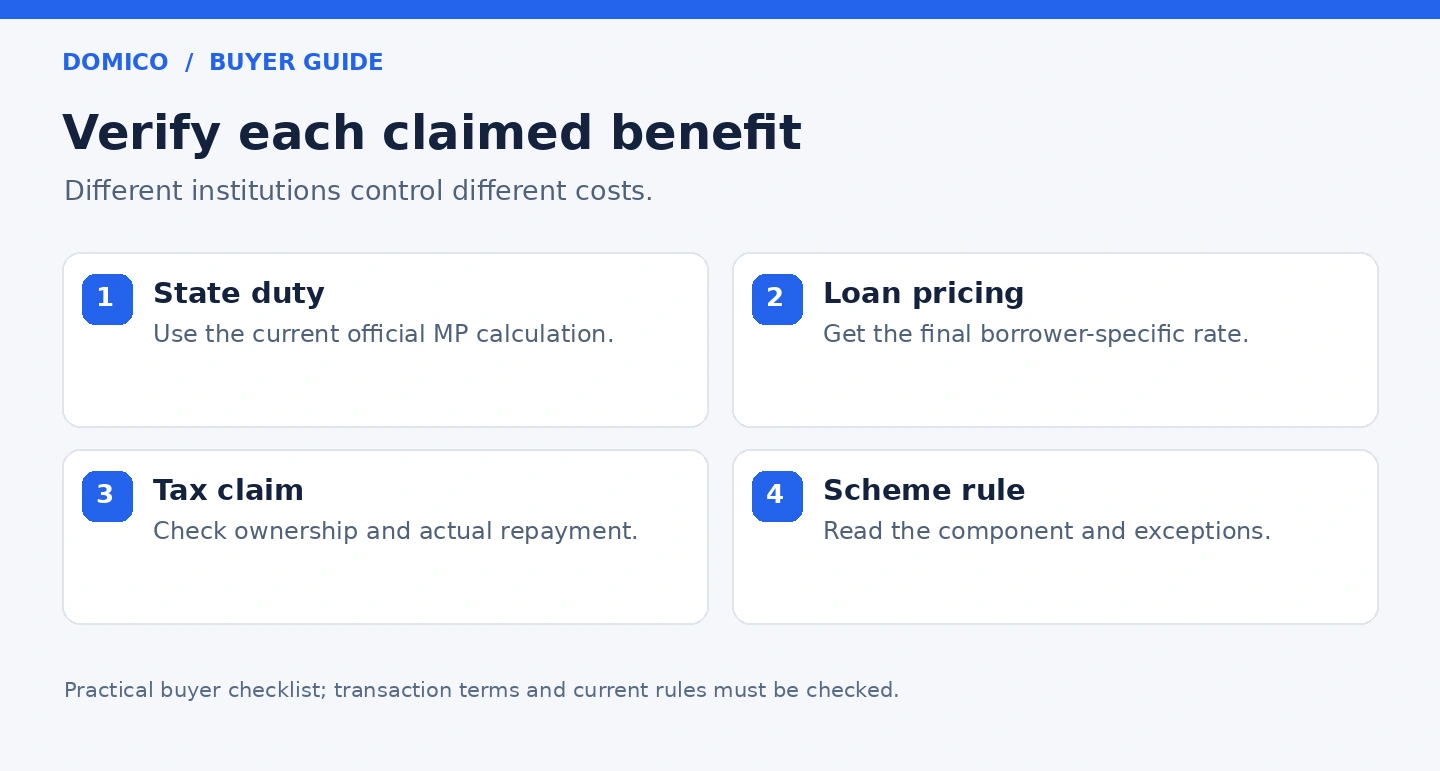
A family is told to register the home in a woman's name because it will automatically reduce stamp duty, guarantee a cheaper loan and double tax benefits. These are three separate claims. They need three separate checks.
For a Madhya Pradesh purchase, do not carry a concession from another state into your budget. State duty rules, lender pricing, housing-scheme conditions and income-tax treatment operate differently. The correct decision begins with actual ownership intentions and current written calculations for the specific transaction.
Buying in a woman's name does not automatically reduce every purchase cost. Obtain the current MP duty and registration calculation for the actual deed and property, and ask for the notification supporting any claimed concession. This guide does not assume a gender-based MP duty discount that has not been established for your transaction.
A lender may separately offer a concession under its product conditions. A housing programme may have female or joint ownership requirements. Neither automatically proves that the state's conveyance duty is lower. Keep those benefits in separate lines of the worksheet.
| Possible saving or condition | Who determines it? | Evidence to request |
|---|---|---|
| Stamp duty or registration concession | State law and current notifications | Official calculation and applicable notification |
| Home-loan rate concession | Lender’s current product terms | Written borrower-specific quote |
| Housing-scheme ownership condition | Relevant scheme rules | Official guideline and eligibility confirmation |
| Income-tax deduction | Tax law and individual facts | Ownership, borrowing and repayment analysis |
| Builder promotion | Seller’s written commercial offer | Clear price adjustment and terms |
Use the MP Registration and Stamps department and the current official process for valuation and charges. Ensure the property location, use, area and deed type are correct. A concession on a gift deed or another category should not be copied into a normal sale deed without authority.
Ask the registration professional to provide the charge breakup and identify any concession actually applied. If someone claims a special rate for women, ask for the exact current notification, its effective period and eligibility conditions. A social-media chart is not enough for a large transaction.
If comparing alternative ownership arrangements, keep every other property and deed input the same. A change in property value, relationship or transaction type can otherwise be mistaken for a gender-related saving. Retain the final official assessment used for payment.
SBI's home-loan FAQ describes a 0.05 percentage-point concession where a woman is the main applicant or co-applicant, subject to the lender's terms. This is one lender's published illustration, not a universal entitlement or a promise that it applies to every current offer.
Ask the actual lender whether the concession is already included in the quoted rate, whether co-ownership is also required, and whether it can be combined with other pricing adjustments. Compare the final rate, APR and fees against another complete offer. A concession off a higher base rate may still leave a more expensive loan.
Also confirm the woman's borrowing responsibility. Signing as a co-borrower is not simply a way to obtain a small discount; it can create real repayment liability. The benefit should be evaluated alongside that commitment.
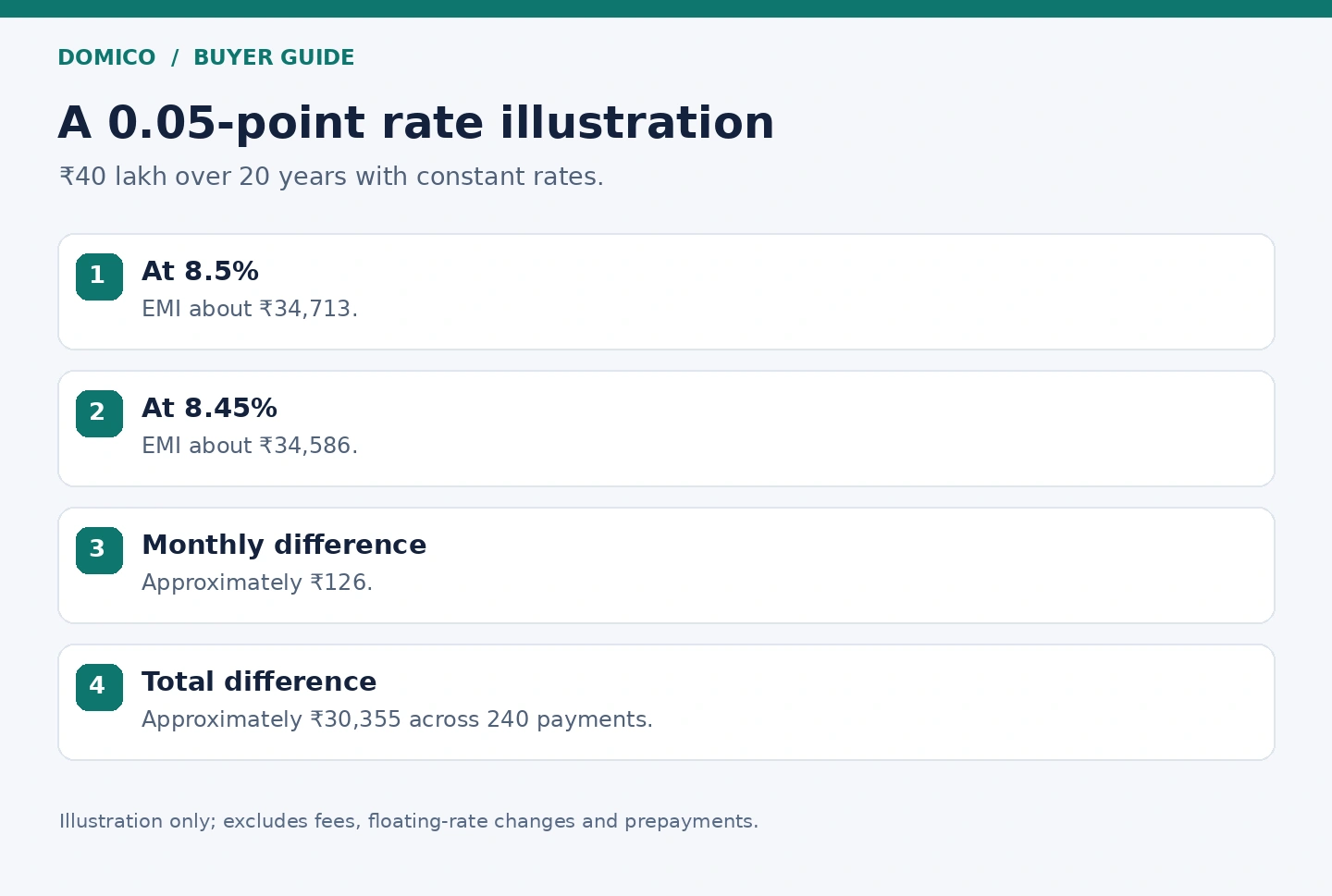
Consider an illustrative ₹40 lakh loan over twenty years. At a constant 8.5%, the monthly EMI is approximately ₹34,713. At 8.45%, it is approximately ₹34,586. The difference is about ₹126 a month, or approximately ₹30,355 across 240 payments under these fixed assumptions.
| Illustrative loan | EMI | Total difference over 20 years |
|---|---|---|
| ₹40 lakh at 8.5% | About ₹34,713 | Baseline |
| ₹40 lakh at 8.45% | About ₹34,586 | About ₹30,355 lower total repayment |
| Assumptions | Same principal and tenure | No rate changes, fees or prepayments |
The saving can be useful, but it should not dictate an ownership structure that does not fit the family. Floating rates, refinancing and prepayments will change the actual result. Use the example to understand scale, then obtain the lender's current written illustration.
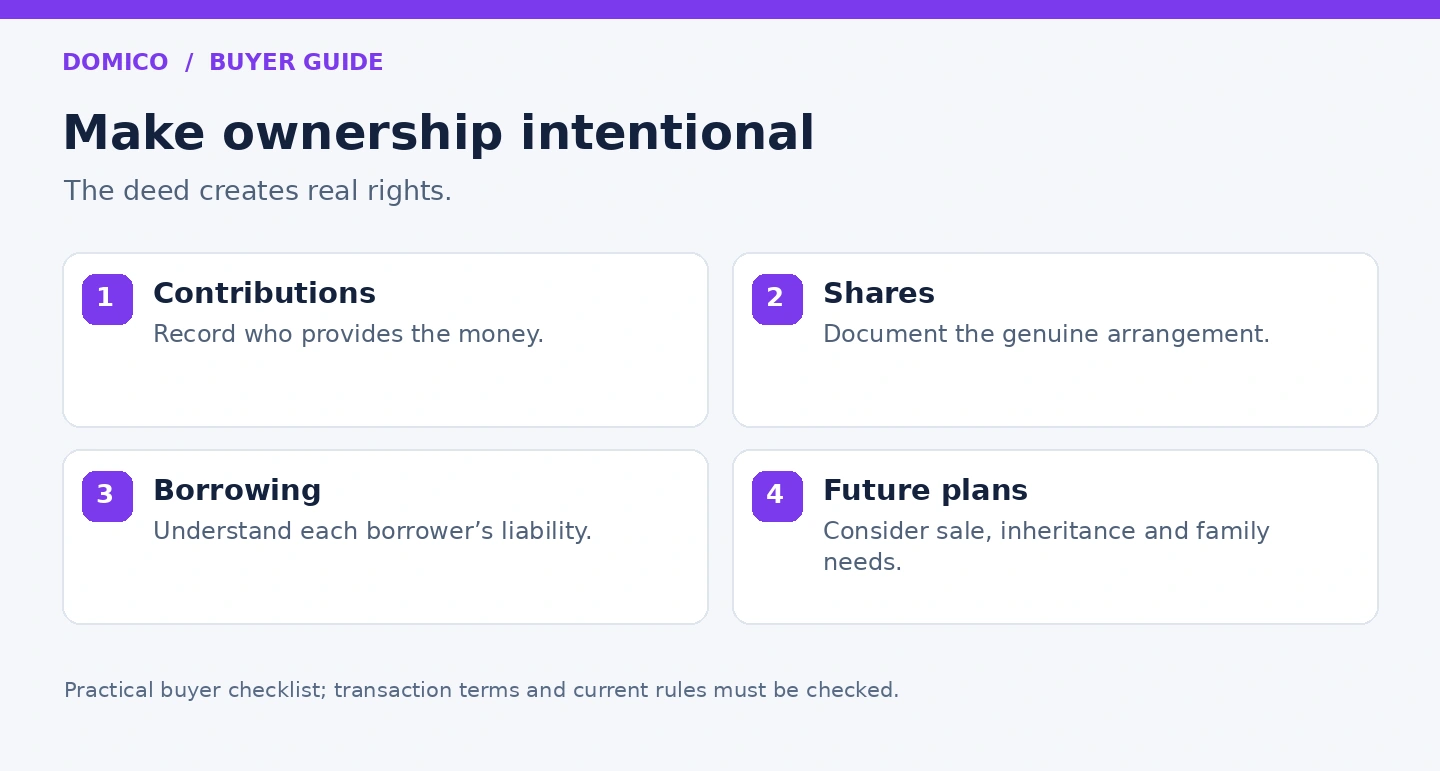
The registered ownership arrangement affects control, future sale, inheritance and the treatment of the asset within the family. A woman registered as owner is not merely lending her name to the transaction. Ask an independent lawyer to explain the rights and responsibilities being created.
If one person contributes the money while another holds title, document the real source and intention. Gift, loan, beneficial ownership, tax-clubbing and benami-law questions can depend on the relationship and facts. Do not use a borrowed name to hide ownership or assume a family relationship removes every legal issue.
Where spouses buy jointly, state the intended shares and financing arrangement clearly. An informal promise that the property will be treated differently later may not match the registered record. Correct advice before purchase is more useful than a dispute after it.
Home-loan deductions should be examined through ownership, borrowing, property use, actual repayment and the regime selected. Adding a woman's name does not automatically create a second full deduction for the same payment.
For example, if only one person genuinely bears the eligible interest, the household should not simply claim the same interest again in another return. Likewise, a co-borrower who has no relevant ownership position should not assume borrowing liability alone establishes every claim.
Use the current co-owner provisions and the relevant tax-year rules. Compare each person's full return rather than only the headline housing deduction. Tax planning should follow the genuine arrangement and supporting evidence.
The PMAY-Urban 2.0 guidelines contain female or joint ownership provisions with specified exceptions. Where the household seeks assistance, check the exact component and ownership conditions before finalising the deed.
Meeting an ownership condition does not by itself establish complete scheme eligibility. Household income, existing property, previous benefits and the selected home can still matter. Obtain confirmation through the relevant official process rather than relying on a seller's promise that adding a name guarantees a subsidy.
If the family has an unusual situation, such as no adult female member or a different household structure, ask how the published exceptions apply. Do not change facts on the application to fit a simplified sales explanation.
| Worksheet line | Amount to enter | Avoid this assumption |
|---|---|---|
| Property price | Actual agreed amount | A label creates a discount |
| Duty and fees | Official transaction-specific calculation | Another state’s concession applies in MP |
| Loan cost | Final rate, APR and charges | The advertised concession is additional |
| Tax | Verified individual annual outcome | Two names mean double relief |
| Scheme benefit | Confirmed eligibility and release treatment | Maximum assistance is immediate cash |
| Legal structure | Appropriate ownership and contribution records | A registered owner has no real rights |
The best arrangement is one the family understands and can document. If there is a genuine saving, record its exact amount and source. If a saving remains unverified, leave it out of the committed budget until it is confirmed.
A builder may quote a women's special offer while the bank separately advertises a rate concession. Ask whether the builder's benefit is an actual reduction in the agreed property price, a reimbursement after registration or a conditional marketing credit. Write the amount and trigger into the commercial terms.
If reimbursement depends on completing registration by a particular date, check what happens when the lender or seller causes a delay. A promise of a future credit should not be treated as money already available for duty payment. Keep enough genuine funds to meet the actual deadline.
For a bank concession, compare the final sanction rate with the written quote. Ask whether another promotional adjustment has already absorbed the same discount. The useful number is the final contractual cost, not the sum of every percentage mentioned in an advertisement.
Save the official calculation, lender quote and seller promotion separately. If a promised saving is missing at settlement, these records identify which institution made the promise and what conditions applied. They also prevent an unverified headline from influencing a permanent ownership decision.
Download the topic-specific review checklist. Use it to record evidence, unanswered questions and follow-up actions for the exact property.
Do not assume one. Obtain the current official calculation and the notification supporting any concession claimed for your deed and property. State-specific benefits should be verified at the time of registration.
No. Pricing and eligibility are lender-specific and can change. Ask for the final written rate and APR, including whether a concession has already been applied.
Not automatically. Loan liability and property ownership are separate. Check the registered document and have the intended structure explained before signing.
The same payment cannot simply be claimed twice. Each person's ownership, borrowing, contribution and tax conditions must support the allocation.
Consider long-term rights, contributions, inheritance and repayment responsibility alongside cost. A small immediate saving should not create an ownership arrangement the family does not actually intend.
Planning to buy or rent in Indore? Browse verified properties in Indore or read more Indore guides.
Check who owes the lender, how builder-paid interest works, when support ends and whether you can carry the loan if payments stop.



