Buying Guide
Buying a Tenanted Property: Possession and Rent Checks
Check tenancy rights, rent receipts, refundable deposits and vacant-possession conditions before buying an occupied home or rental investment.

Table of contents
Buying the ownership does not automatically make the rooms vacant.
A tenanted property presents two different purchase decisions. You might want an investment with an existing rental arrangement. Or you might want a home for your own family, with the seller promising that the occupant will leave before completion. Those objectives need different documents and different payment conditions.
The danger is allowing the transaction to drift between them. A buyer agrees to pay for vacant possession, then discovers at registration that the tenant needs more time. Or an investor pays a premium for an attractive rent without checking whether it is actually being received.
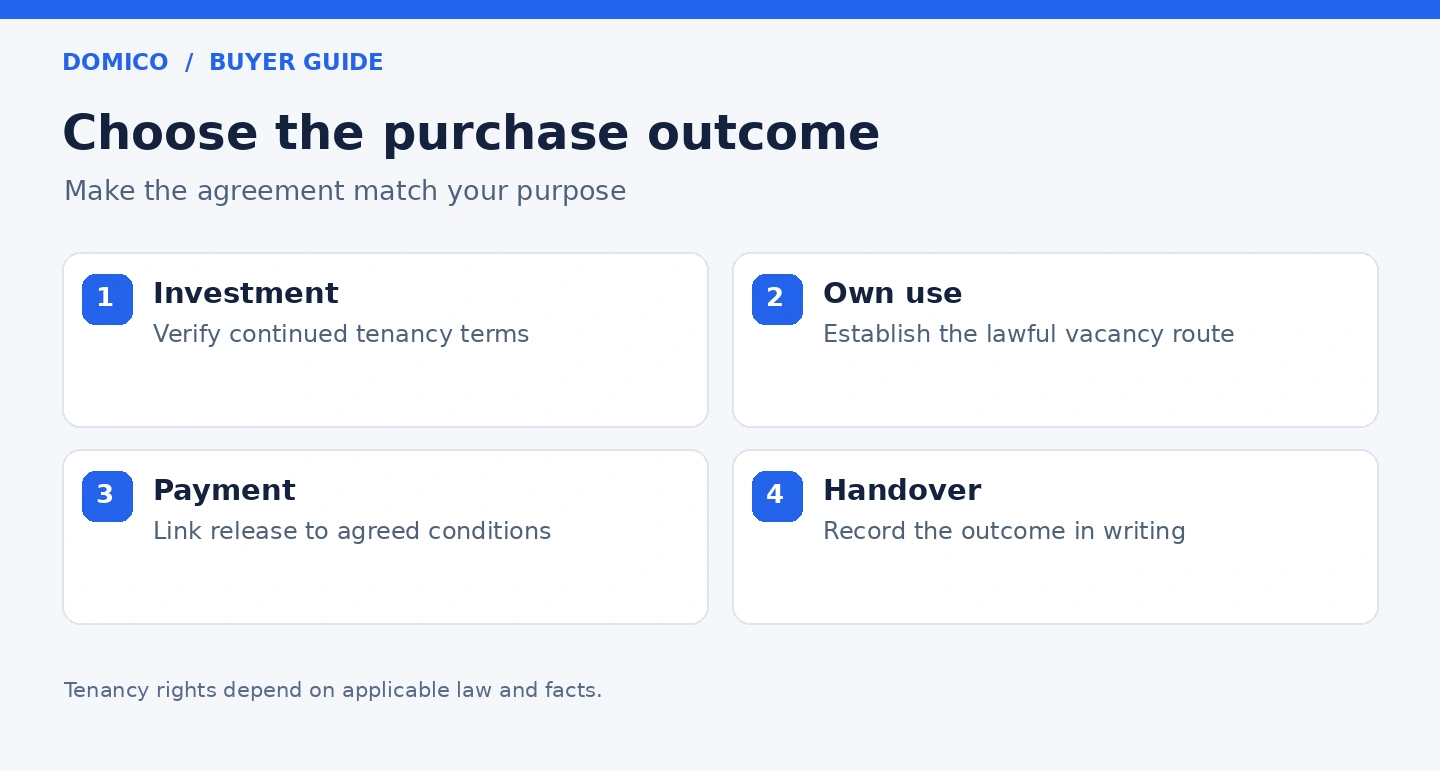
Start by stating which outcome you are buying: continued tenancy on verified terms, or vacant possession on an agreed date.
Identify everyone occupying the property
Ask whether the occupant is a tenant, licensee, family member, employee, caretaker or another person claiming a right to remain. Labels used casually by the owner may not describe the legal position.
Obtain the relevant agreement, extensions, payment records, deposit details and notices. Inspect the property with proper permission and ask the seller to arrange a documented introduction where appropriate. Do not pressure an occupant to disclose private information unrelated to the purchase.
Your lawyer should review the applicable state law and contract. The Transfer of Property Act's provisions on leases and transfer of the lessor's interest are part of the legal framework, but local tenancy protections and the actual arrangement can affect the answer.
Decide whether you want the tenant to remain
If you want an investment, review the tenant and lease as part of the asset. If you want to move in, investigate the lawful route to vacancy before assuming that an expiry date guarantees departure.
A seller's promise to “manage the tenant” is not a possession document. Ask what notices have been issued, whether the occupant disputes them, and what evidence will confirm that the premises have been surrendered.
| Purchase objective | Main diligence question |
|---|---|
| Continue the existing tenancy | Are the lease, payments, deposit and obligations verified? |
| Obtain vacant possession | Can lawful vacancy be demonstrated before the agreed payment stage? |
| Renovate before reletting | When will access be available and what work is permitted? |
| Occupy part and rent part | Is the physical and legal arrangement workable? |
Read the entire lease, including amendments
Check the premises covered, lease period, rent, escalation, security deposit, renewal provisions, termination rights, lock-in, repair obligations and restrictions on use. Look for side letters or emails changing the original agreement.
Confirm whether parking, furniture, appliances or a storage area are included. The seller may describe these as their own possessions while the tenant believes they are part of the rental arrangement.
Ask who pays society maintenance, property tax, utilities and major repairs. A gross monthly rent is not necessarily the owner's net income. Review whether there are rent-free periods, adjustments for repairs or deposits being informally set off against rent.
Verify rent through a payment trail
Request an appropriately redacted rent ledger and supporting receipts or bank credits. Compare the agreement amount with the money actually collected. A promised future rent should not be presented as an established current yield.
If rent is overdue, ask whether there is a dispute, an agreed temporary reduction or a repayment arrangement. Do not value arrears as cash already received. Your agreement should state whether earlier arrears belong to the seller and how any recovery will be handled.
An investment buyer should also compare the rent with the local market and tenant turnover risk. A rent above comparable homes may be attractive, but it can also be unsustainable at the next renewal.
Reconcile the security deposit
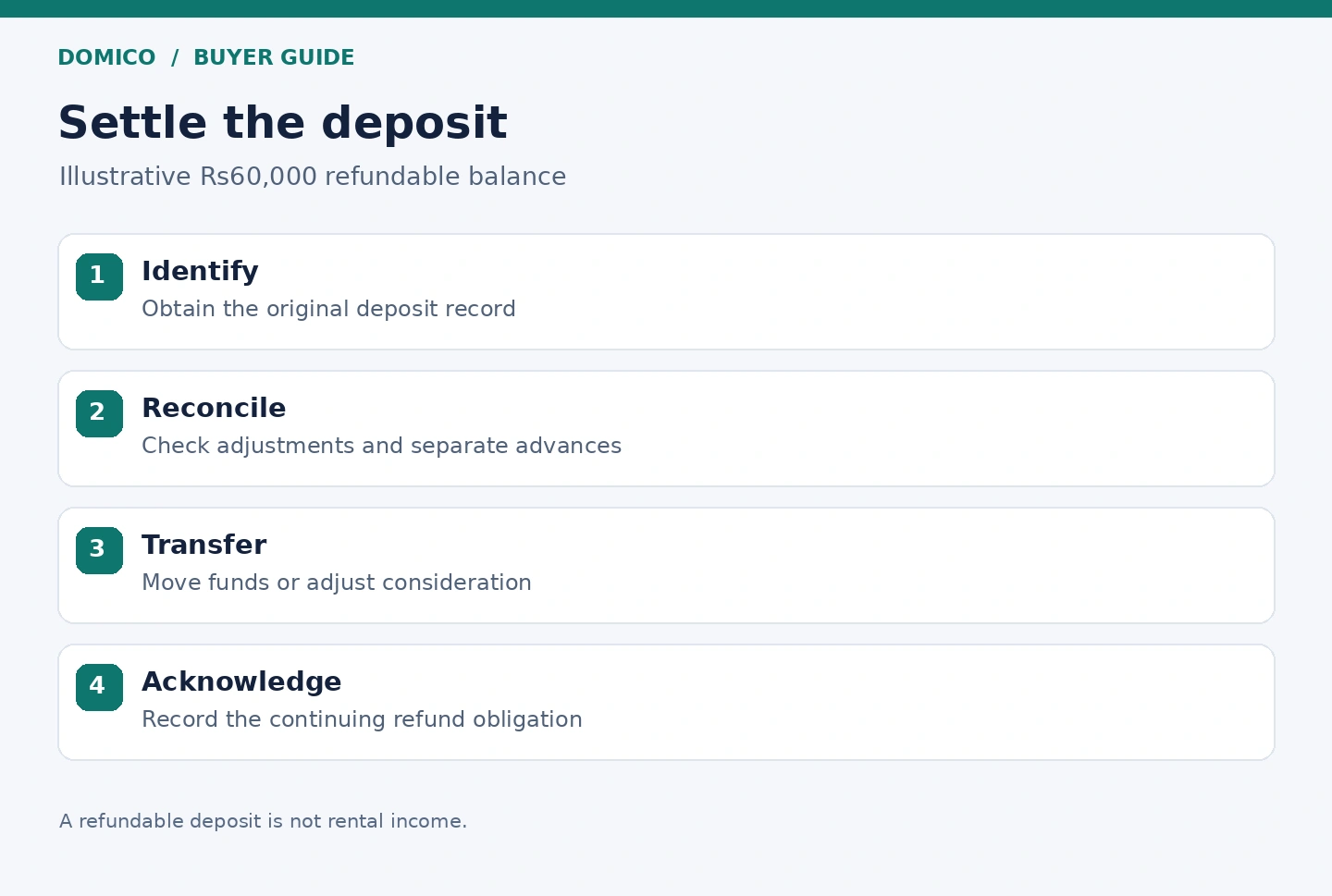
A refundable tenant deposit is a liability to be accounted for, not an extra profit from the sale. Ask for the original receipt, current balance, agreed deductions and the mechanism for transferring responsibility.
Get the seller, buyer and tenant to acknowledge the relevant position in the form your lawyer recommends. The buyer should not assume responsibility for refunding Rs 1 lakh while the seller quietly retains that same amount without an adjustment.
| Illustrative rental position | Amount |
|---|---|
| Monthly rent | Rs 20,000 |
| Refundable deposit held by seller | Rs 60,000 |
| Agreed transfer of deposit liability to buyer | Rs 60,000 |
| Adjustment or transfer needed at closing | Rs 60,000, subject to documented reconciliation |
The deposit remains refundable under the applicable agreement and law. It should not be added to rental income when calculating returns. Also identify whether a maintenance advance or utility deposit is separately held by another entity.
If you require vacancy, link it to completion
Have the lawyer frame clear conditions for delivery of vacant possession. Define what “vacant” means: occupants and belongings removed, keys delivered, access available and no continuing rental claim inconsistent with your purchase.
Consider a joint inspection close to completion and a signed surrender or handover record in an appropriate form. How money is retained or released should depend on the actual risk and transaction structure. There is no standard token deduction that solves every possession problem.
Do not accept a rushed change from vacant possession to “tenant will leave next month” without reassessing the deal. That change can affect your rent, EMI overlap, moving plans and legal exposure.
If the tenant remains, organise the landlord transition
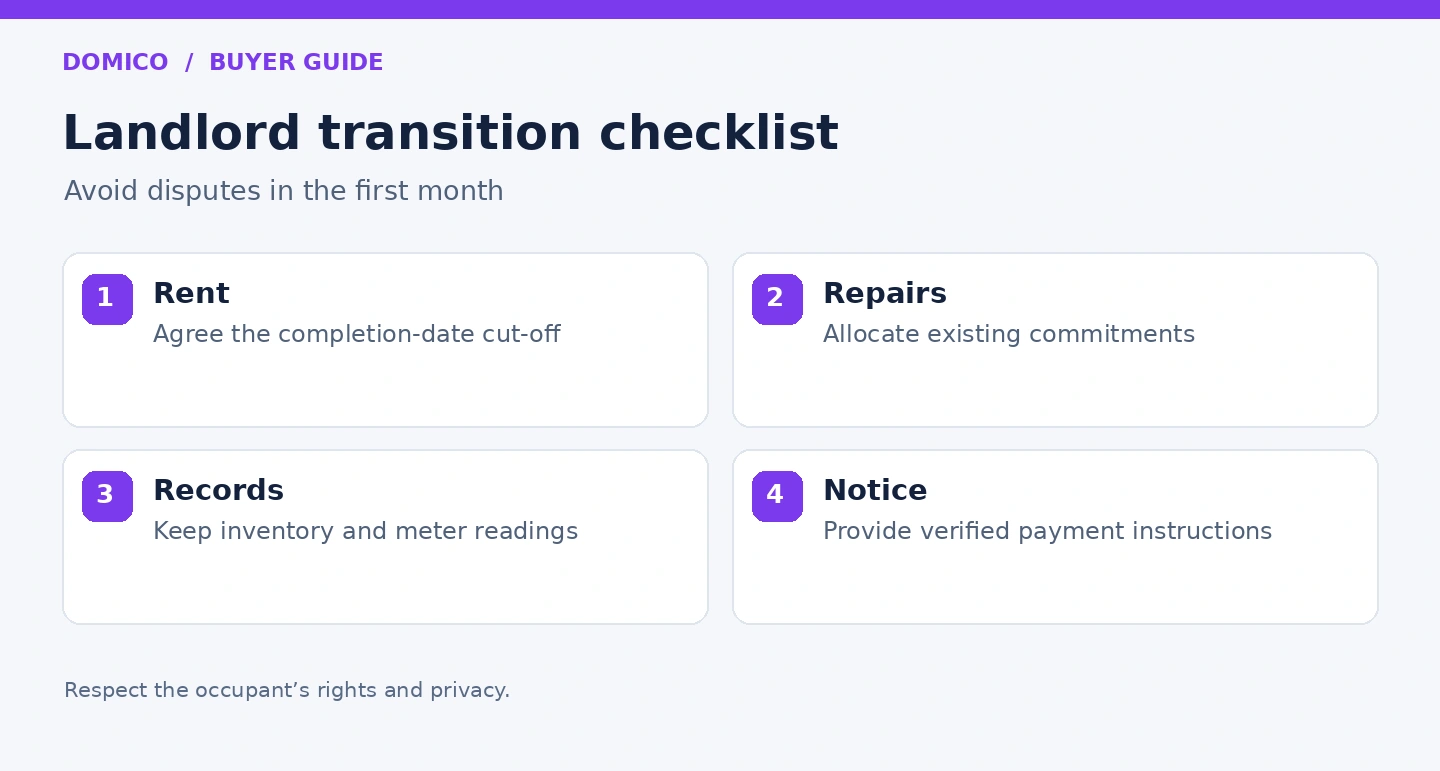
The occupant needs reliable written information about the ownership change, the effective date and verified payment instructions. Your lawyer can advise how the transfer and notices should be documented under the applicable framework.
Agree how rent for the month of completion will be divided. Clarify who handles complaints arising before closing, who pays for an existing repair commitment and how the deposit is recorded. Use a single reconciled statement rather than informal WhatsApp calculations.
If a tenant has already paid rent in advance, account for that credit. Otherwise the buyer may expect a payment that the tenant has already validly made to the previous owner.
Check the property with the tenancy in mind
Inspect condition without assuming that every mark is recoverable from the tenant's deposit. The agreement and evidence matter. Record existing defects so that buyer and tenant do not begin their relationship with an argument about who caused them.
For furnished homes, prepare an inventory showing the items, ownership and condition. Confirm appliance warranties, meter readings and any repair orders already placed. Discuss privacy and access: owning the home does not justify unannounced entry into an occupied residence.
| Closing item | Seller and buyer should settle |
|---|---|
| Rent cut-off | Who receives each part of the completion month? |
| Deposit | Amount, custody, adjustment and refund responsibility |
| Arrears | Whether any exist and who owns the claim |
| Repairs | Outstanding commitments and agreed payer |
| Possession | Continued tenancy or evidenced vacant handover |
| Tenant communication | Effective date and verified new payment details |
Budget for a delayed handover
Imagine an illustrative buyer paying Rs 25,000 monthly rent elsewhere while expecting to occupy the purchased home. A two-month delay in vacancy means Rs 50,000 of extra rent before considering moving, storage or financing effects.
That number does not establish a legal compensation entitlement. It shows why possession timing has financial value. A slightly lower purchase price may not compensate you for an uncertain move-in date if your household has little flexibility.
If you are buying for rental income, test a vacancy period after the current tenant leaves. A home with an existing occupant can still experience re-letting costs, repairs and a gap in receipts later.
Printable buyer worksheet
Download the topic-specific review checklist. Use it to record evidence, unanswered questions and follow-up actions for the exact property.
Frequently asked questions
Does selling a property cancel its tenancy?
Do not assume that it does. The lease, applicable tenancy law and transaction circumstances need review. The buyer should understand the occupant's position before purchasing.
Can I evict the tenant after registration because I need the home?
Any recovery of possession must follow the lawful route applicable to the arrangement. Discuss the facts with a local lawyer. Do not use threats, lock changes or disconnection of essential services.
Should the tenant's deposit reduce the seller's payment?
It needs a documented settlement reflecting who holds the money and who assumes the refund obligation. The exact closing mechanism should be agreed rather than treated as an automatic universal deduction.
Is an occupied home a better investment?
It can offer an established rental stream, but only if the agreement, collections, condition and tenant position are verified. An unverified rent claim should not support a higher valuation.
What if there is no written rental agreement?
That increases the need to establish the actual arrangement, payment history and legal position. Absence of a written agreement does not prove that an occupant has no rights.
Make the possession outcome explicit
Before paying a major instalment, ensure the contract, inspection and closing statement all describe the same outcome. Buy a verified tenancy or verified vacancy; do not leave the distinction to moving day.
Sources and related reading
- buyer-guide-100
- homebuyers
- tenanted-property
- indore
Planning to buy or rent in Indore? Browse verified properties in Indore or read more Indore guides.



