Buying Guide
Can You Afford a Second Home? A Cash-Flow Stress Test
Test second-home affordability with upfront costs, household obligations, rental vacancy, income changes and a retained emergency reserve.
Updated 8 min read

Buying Guide
Test second-home affordability with upfront costs, household obligations, rental vacancy, income changes and a retained emergency reserve.
A second home should fit the household even when it earns nothing for a while.
A second property may be a family home, a future retirement base, a rental investment or a place used on holidays. The affordability question changes with the purpose. What remains constant is that the purchase competes with emergency savings, existing debt, education, retirement and ordinary living expenses.
Do not begin with the maximum loan a lender might sanction. Begin with the cash the household can safely commit and the recurring costs it can continue to carry. A loan approval and a resilient family budget answer different questions.
Write down why you want it and when you expect to use it. A home for parents may justify costs through family support, while a rental property needs a credible tenant and income plan. A holiday home used a few weeks each year should be compared with the cost and flexibility of alternatives.
List the benefits that depend on a future event: relocation, retirement, a road opening or rent rising. Then ask whether the purchase still makes sense if that event arrives later. Do not count the same property as a guaranteed rental, a permanently available holiday home and an immediate resale option at the same time.
SEBI's investment planning guidance emphasises goals, horizon, liquidity and risk. Use those as distinct questions rather than allowing a favourable price to decide the purpose after the fact.
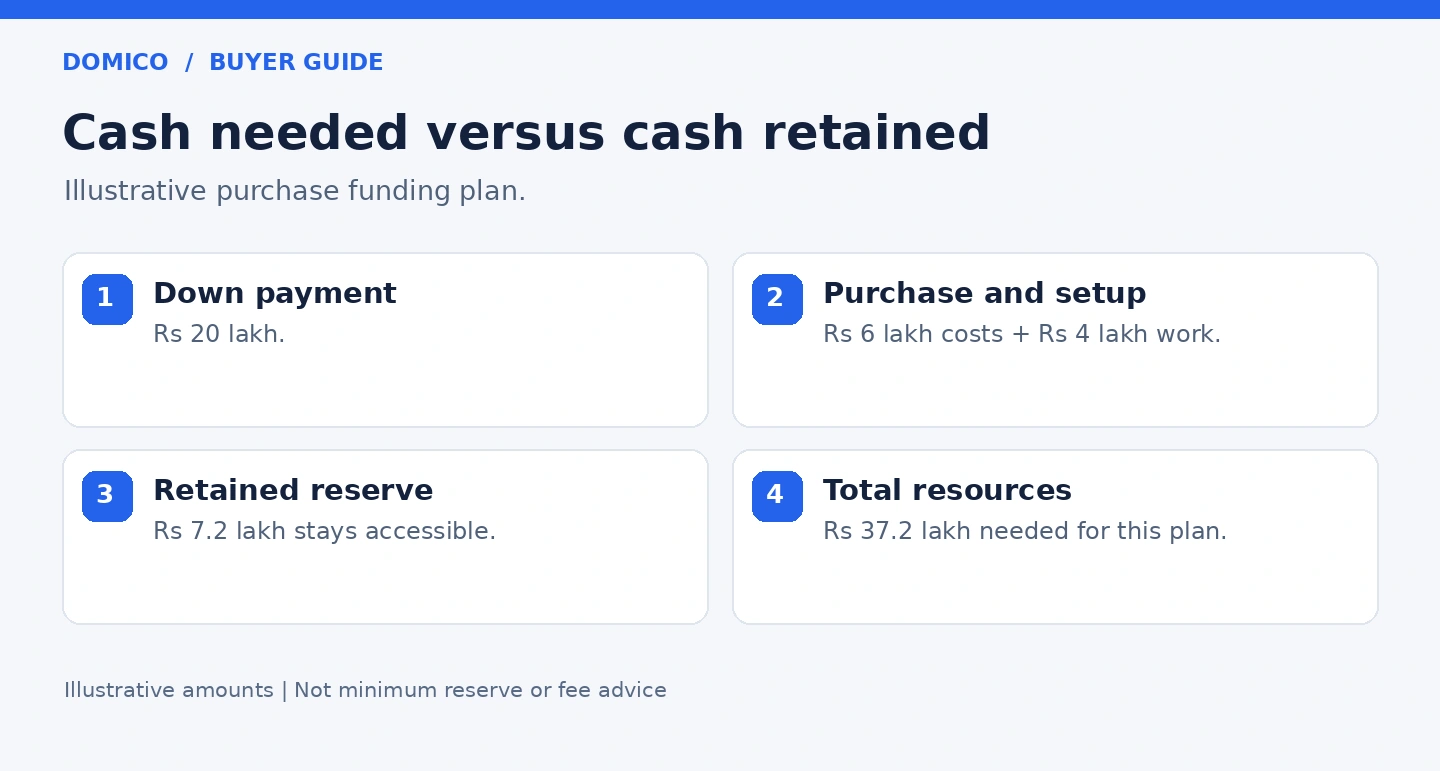
The down payment is only one part. Add the applicable acquisition charges, professional work, brokerage, essential repairs, furnishing and initial service deposits. Obtain current official calculations and quotations. A general online percentage will not capture every property's transaction or condition.
Keep the emergency reserve outside the purchase budget. If spending on the home leaves the family unable to handle a loss of income or an urgent expense, the apparent affordability depends on everything continuing smoothly.
| Illustrative upfront requirement | Amount |
|---|---|
| Down payment | Rs 20,00,000 |
| Purchase and transaction costs | Rs 6,00,000 |
| Initial repairs and furnishing | Rs 4,00,000 |
| Separately retained household reserve | Rs 7,20,000 |
| Total cash needed to fund this plan | Rs 37,20,000 |
These amounts are hypothetical, not required minimums or local fee estimates. The reserve remains available cash; it is not an expense paid to the seller. The distinction matters because the household needs both purchase funding and retained liquidity.
Use ordinary take-home income that is reasonably dependable. Separate bonuses, commissions and business distributions from recurring income, then decide conservatively how much can support a long-term commitment. Review expenses across enough months to catch school fees, insurance, travel and annual bills.
Include current EMIs, essential living costs and contributions towards important goals. Add the second property's full loan payment and owner-paid running costs. If it is distant, include inspections, caretaker arrangements and travel. If it is rented, use realistic net receipts rather than gross advertised rent.
| Illustrative monthly budget | Amount |
|---|---|
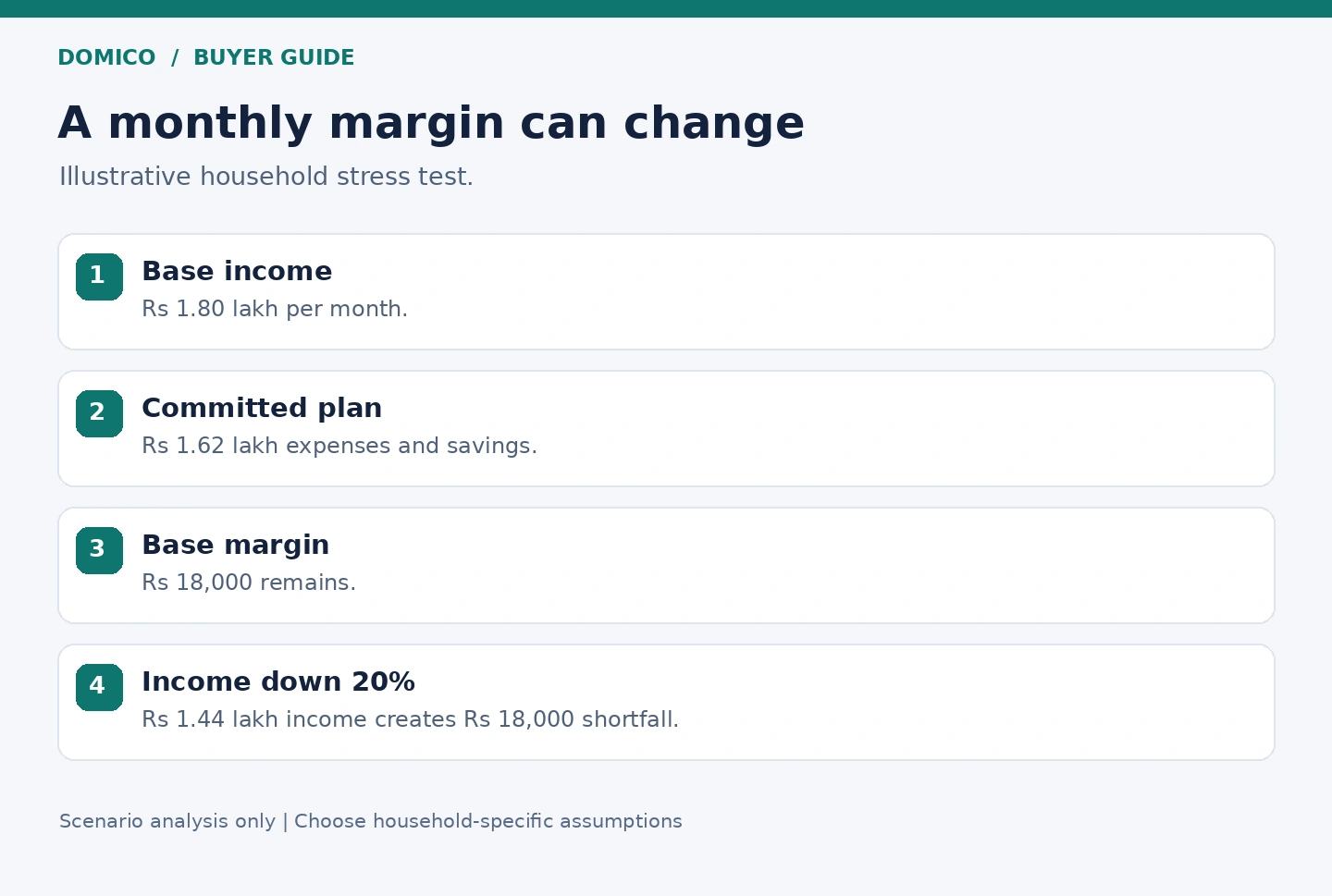
| Take-home household income | Rs 1,80,000 |
| Essential living expenses | Rs 65,000 |
| Existing loan payments | Rs 35,000 |
| Planned savings for other goals | Rs 20,000 |
| New property loan payment | Rs 35,000 |
| Second-home operating allowance | Rs 7,000 |
| Remaining monthly margin | Rs 18,000 |
The Rs 18,000 margin is what remains under these assumptions. It is not automatically sufficient. The household must judge its job stability, dependants, insurance, likely repairs and tolerance for uncertainty.
Reduce the illustration's income by 20%, from Rs 1.8 lakh to Rs 1.44 lakh. Keep the listed expenses and goal contributions unchanged at Rs 1.62 lakh. The budget now has a monthly shortfall of Rs 18,000.
Next decide what can realistically change. Some discretionary expenses may be reduced. A loan instalment, school commitment or essential treatment may not be flexible. Record an actual response plan rather than assuming the family will “manage somehow”.
The RBI's financial awareness booklet explains budgeting, accessible savings and responsible borrowing. Apply those principles by testing a weaker month before taking a commitment that lasts for years.
A rental second home should be tested without rent for a period appropriate to the circumstances. A holiday home may need maintenance even when unused. An under-construction home may create overlapping rent, loan interest and delayed fit-out costs.
Try two adverse events together. For example, a temporary income reduction and a repair bill, or a vacancy and an interest-rate change. You are not predicting disaster. You are checking whether ordinary uncertainty would force an urgent asset sale or expensive short-term borrowing.
| Stress case | Budget question | Possible response before buying |
|---|---|---|
| Income falls | Which obligations remain fixed? | Reduce the loan or postpone purchase |
| Rental vacancy | Can owner costs and EMI continue? | Retain a dedicated carrying allowance |
| Major repair | Is there cash beyond routine upkeep? | Inspect condition and obtain quotes |
| Slow resale | Can the household hold longer? | Avoid using the property as emergency cash |
| Rate increase | How would EMI or tenure change? | Get a lender illustration and test it |
Avoid assuming future appreciation will pay today's bills. A property can appear valuable while producing no cash and taking time to sell.
Add the value and debt of the existing home, proposed second property and any business exposure linked to real estate. A household can have substantial assets and still have little accessible cash or diversification.
Consider whether earnings and property demand depend on the same local industry or economic cycle. If income falls at the same time that selling becomes harder, the household may face pressure on both sides of the budget. This is a planning consideration, not a prediction about a particular city.
Also discuss ownership and family expectations. Who will pay costs, use the home, manage tenants and decide when to sell? Where several family members contribute, obtain suitable legal and tax advice and record the arrangement before transferring money.
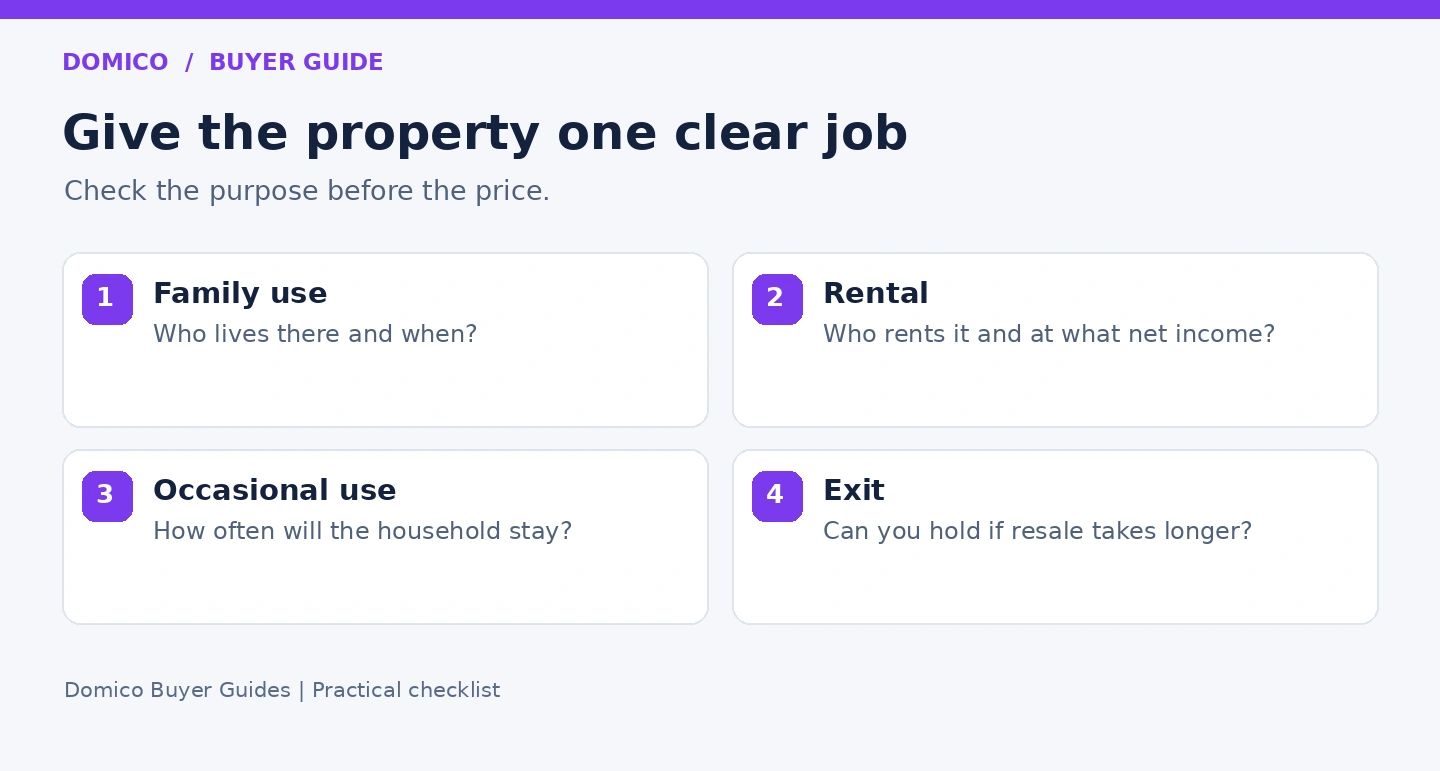
A purchase can be affordable yet fail to serve a clear goal. It can also be attractive on price but unaffordable once complete cash requirements are included. Evaluate those questions separately.
For a rental, compare net income and funding gaps. For future personal use, consider whether the location and building will still suit that use. For occasional visits, compare the annual ownership cost with realistic days of occupation, without treating emotional value as meaningless.
Set the maximum commitment before negotiations. Include a ceiling for essential work and a minimum reserve the family will retain. A seller's deadline should not change those limits without new evidence about the household's capacity.
Check how the new obligation fits existing insurance and family arrangements. If one earner becomes unable to work, who funds the instalment and who can manage the property? Review the relevant cover, exclusions, nomination and succession arrangements with suitable professionals. Do not assume adding a property automatically protects dependants; a heavily committed asset may also create bills they must manage.
Keep a secure record of lender details, essential documents and the person responsible for regular payments. Discuss access appropriately with the household without sharing passwords or sensitive records unnecessarily. This planning is particularly useful when the second home is in another city or is intended for parents who will not manage its financial administration.
No. Lenders assess repayment using their criteria. Your budget must also protect family goals, future expenses and comfort with uncertainty. Use the sanctioned amount as an available option, not a compulsory target.
There is no universal requirement. Calculate the likely net rental receipts and the cash the household must add. The key is whether that funding gap remains manageable during vacancy and other adverse changes.
Choose it from your household's essential obligations, income stability, dependants and accessible alternatives. This article's reserve is illustrative. A personalised financial plan can help establish an amount that fits your circumstances.
No. It still involves running costs, condition, legal issues, market value and resale timing. Removing the loan reduces one obligation, but it does not make the property equivalent to readily available cash.
Consider postponing when the purpose is vague, the reserve is exhausted, the budget depends on uninterrupted rent or major costs remain unknown. Waiting can create room to reduce debt, inspect alternatives and clarify the intended use.
A second home should expand the family's options. Test the purchase against the household's real commitments so it does not quietly remove them.
Download the topic-specific review checklist. Use it to record evidence, unanswered questions and follow-up actions for the exact property.
Planning to buy or rent in Indore? Browse verified properties in Indore or read more Indore guides.
Check who owes the lender, how builder-paid interest works, when support ends and whether you can carry the loan if payments stop.



