Buying Guide
Buying Part of a Plot: Subdivision and Access Checks
Understand the difference between a defined parcel and an undivided share, then test access and independent usability.
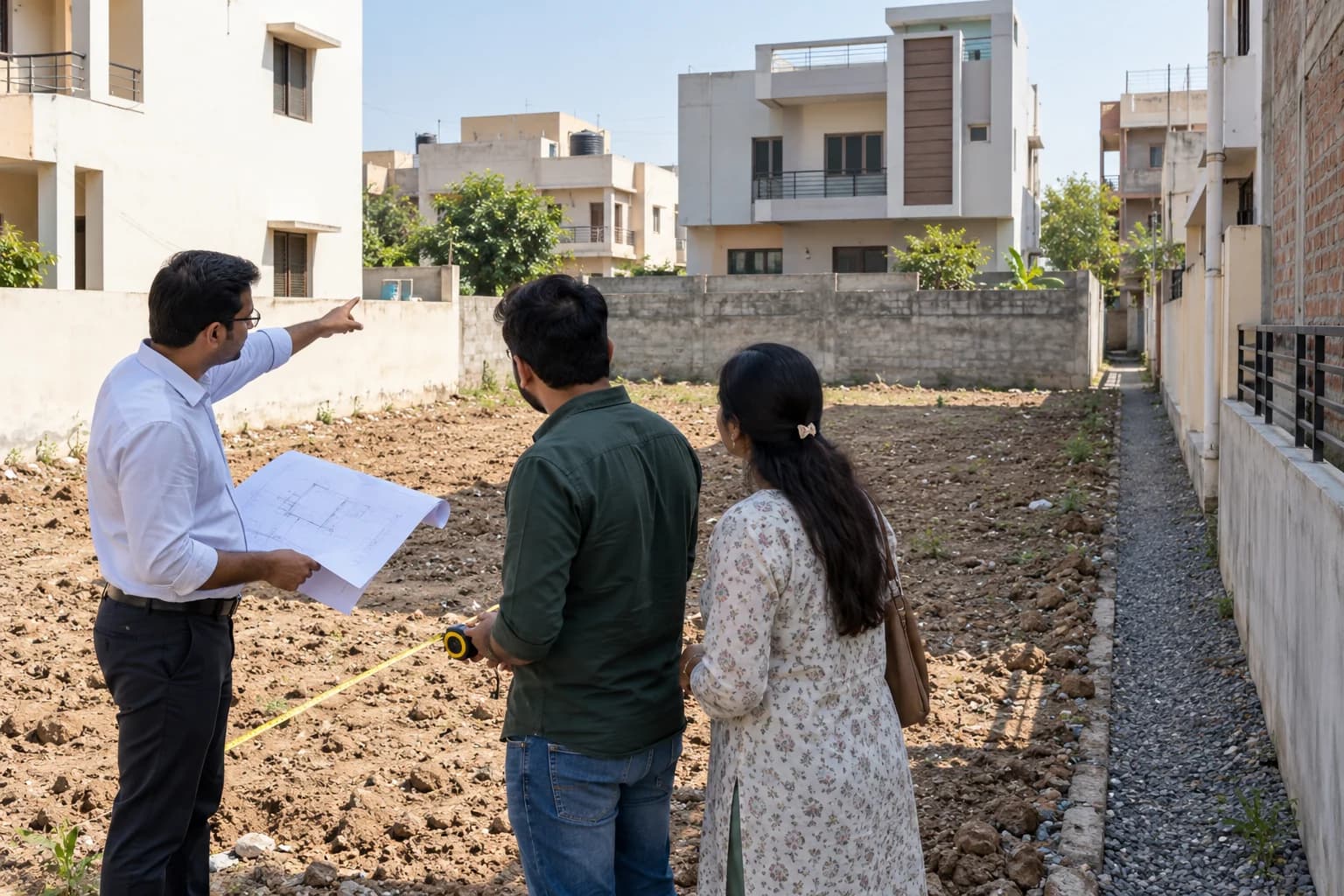
Table of contents
A large plot is divided with a line on a sales sketch. One half fits your budget, so the offer looks simple. Before proceeding, establish whether that half exists as the property you think you are buying.
A line on a sketch does not create a separate, usable plot. Buying part of a larger parcel can be perfectly understandable as a transaction, but title, subdivision, access and building feasibility must be examined together.
First ask what interest is actually being offered
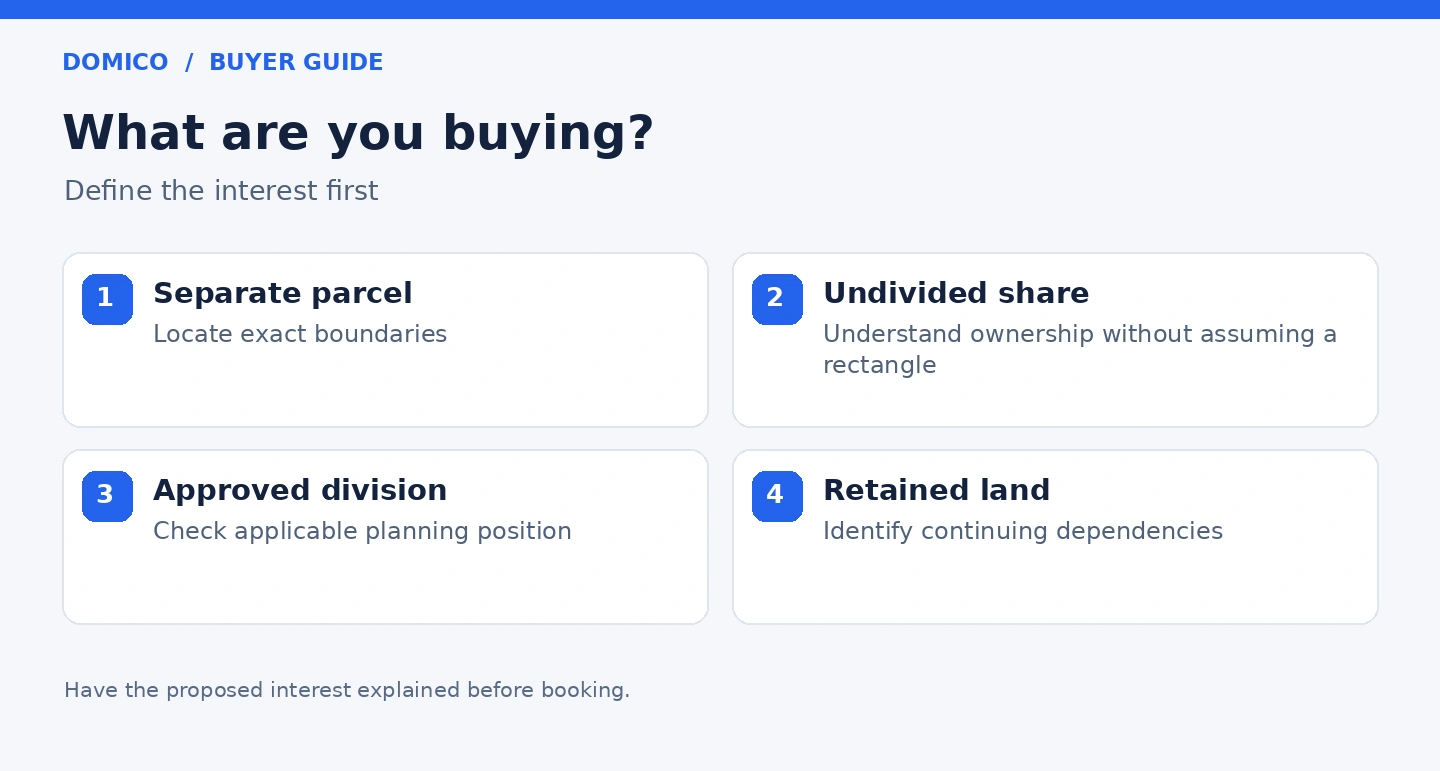
There is a major difference between buying a separately identified parcel and buying an undivided share in a larger property. An undivided share does not necessarily mean exclusive ownership of the particular rectangle marked for you during the site visit.
Ask the seller and your lawyer to describe the proposed interest precisely. Will the deed convey a defined portion with boundaries? Is there an effective partition or subdivision? Are you acquiring a share with arrangements among co-owners? What permissions or records are needed for the intended use?
The Transfer of Property Act forms part of the legal framework for transferring interests in property. The practical rights depend on the documents, the seller's ownership and applicable planning rules, not the sales team's shorthand.
| Offer description | Question the buyer must resolve | Why it matters |
|---|---|---|
| Half of an existing plot | Is it an approved or otherwise lawful separate parcel? | Separate construction may depend on it |
| Share in a large holding | Is the share undivided or physically partitioned? | Exclusive possession may not follow the sales sketch |
| Newly numbered plot | What creates the numbering and boundaries? | Private numbering may not be approved identification |
| Rear portion | What legal route reaches it? | Access must cross another part of the land |
| Part of agricultural land | What use and division rules apply? | Residential expectations need independent support |
Check the seller's power to divide and sell
Review the seller's acquisition document and current ownership position. If several people own the parent parcel, establish which interests are being transferred and whether the required parties will execute the relevant documents.
Do not assume one co-owner can promise exclusive ownership of a preferred portion without examining the legal structure. A family understanding may need to be reflected through an effective instrument or process before a buyer can safely rely on it.
Look for restrictions arising from allotment, lease, prior agreements or other documents. A property that is transferable as a whole may raise additional questions when divided. Have the lawyer identify the exact issue rather than assuming that registration of some document proves the division is acceptable for every purpose.
Examine the planning and revenue position separately
In Madhya Pradesh, planning permissions and land-record processes answer different questions. The TCP Directorate and its layout permission guidance are official planning resources. The MP Bhulekh portal supports land-record investigation.
Ask a planner what subdivision or layout requirements apply to the location and proposal. Avoid universal minimum-plot-size claims from unrelated cities or old online examples. The relevant controls may depend on the applicable plan, scheme, layout and intended development.
Separately ask whether revenue subdivision, partition or record changes are required and what has actually been completed. An application receipt is not the same as an operative approved layout or a final record supporting the new identity.
Access is often the hidden cost of a rear portion
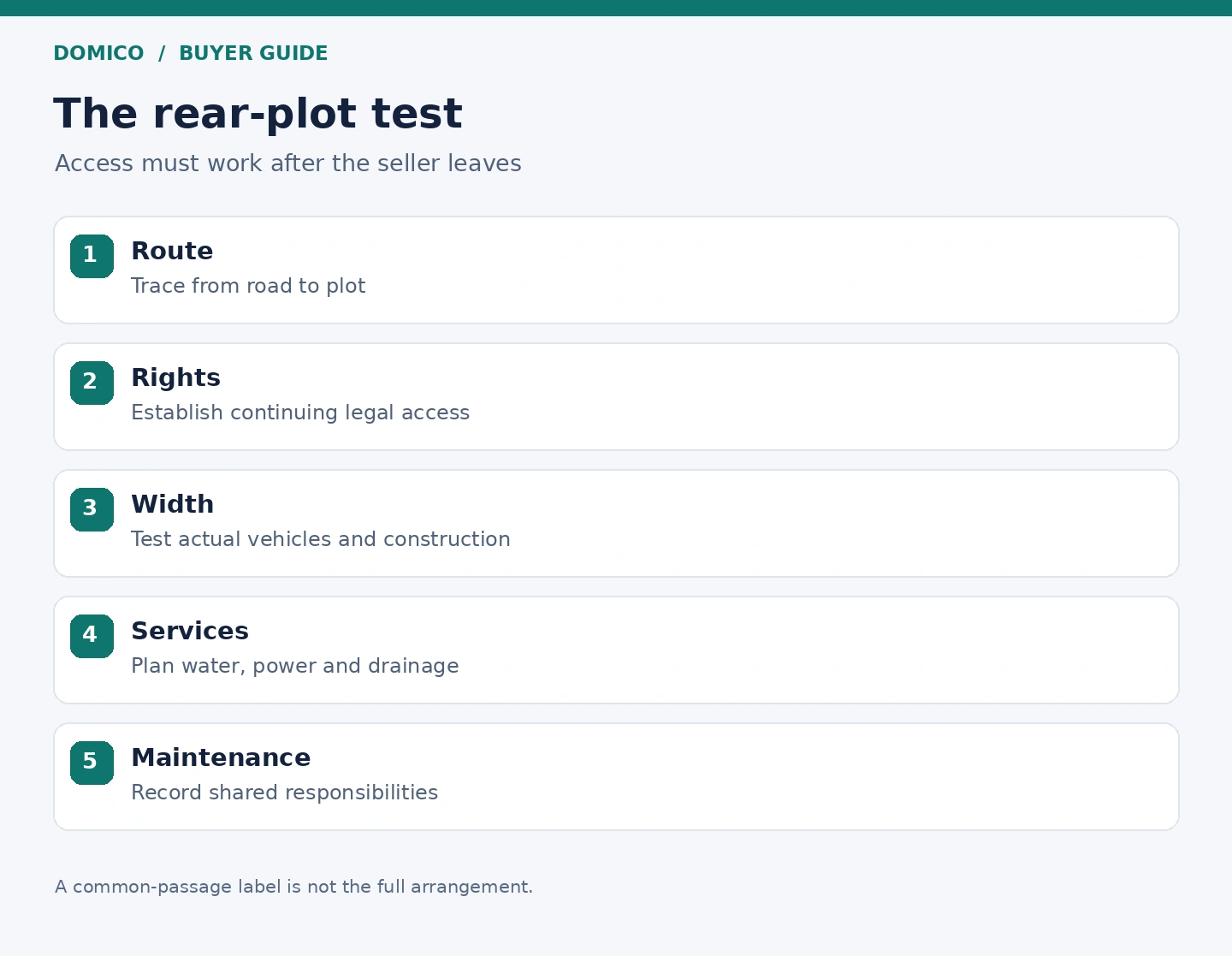
If the purchased land does not front a public or established internal road, identify how it will be reached. Measure the approach strip and establish its ownership, legal use and maintenance arrangements.
Ask whether the approach remains part of the seller's retained land, is conveyed with your parcel, or is subject to a properly established right. A coloured arrow labelled “common passage” does not explain whether the arrangement will survive a later sale or dispute.
Check whether vehicles can turn, whether emergency and construction access are workable, and whether gates or parked vehicles can obstruct the route. A narrow access strip can reduce the usable area of both portions and alter the economics of the split.
Test both plots, not only the one you buy
A subdivision can create problems on the retained portion that later become the buyer's problems. An existing staircase, drain, foundation, water line or roof may cross the proposed boundary. A shared structure may require technical and legal arrangements.
Ask an architect or engineer whether the proposed division creates lawful and practical building parcels. Review setbacks, frontage, light, ventilation, parking and structural relationships under the applicable controls. Do not plan a building from gross area alone.
Where an existing house is being divided, inspect independent entry, electrical metering, water supply and sewage disposal. A separate front door does not automatically establish a self-contained, independently transferable property.
Worked example: the access strip changes the area
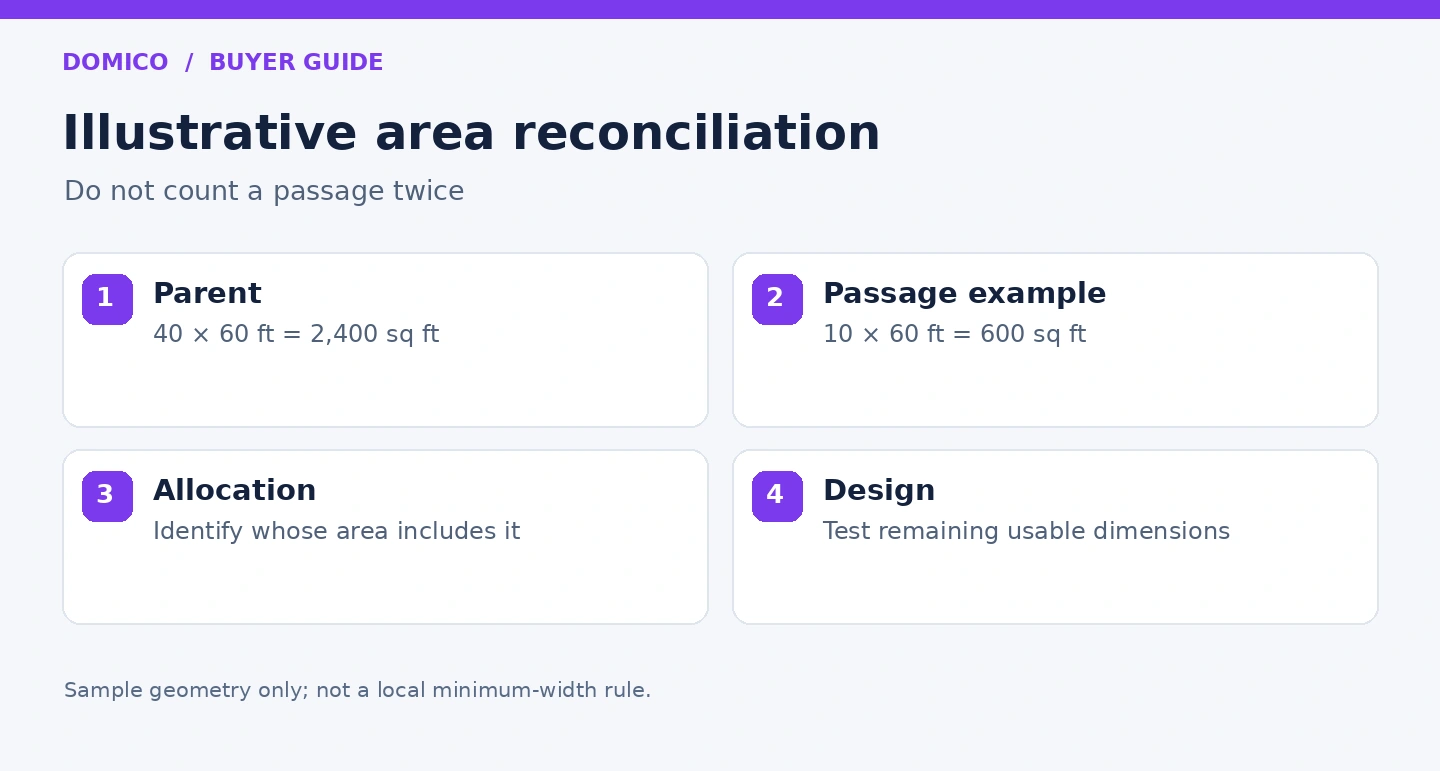
Suppose an illustrative 40-by-60-foot parent plot contains 2,400 square feet. A seller offers the rear half as “1,200 square feet” and says a 10-foot-wide passage will run along the full 60-foot depth.
That passage occupies 600 square feet in a simple rectangular calculation. But the buyer must establish how it is allocated: within the rear parcel's quoted area, outside it, shared, separately owned or carved from both portions.
If a rear rectangle is measured after reserving the passage, the actual private usable dimensions may be very different from the advertised half. The drawing must reconcile all areas without counting the same passage twice.
At a sample rate of ₹3,000 per square foot, a 200-square-foot misunderstanding changes the base calculation by ₹6 lakh. More importantly, the remaining width may not support the intended house. The correct sequence is to establish the legal division and measured geometry, test construction feasibility and then negotiate price.
This is an illustrative geometry problem, not a statement of permissible access widths or local subdivision standards.
| Design or service issue | What to establish before closing | Useful written output |
|---|---|---|
| Approach strip | Ownership, scope and continuing right | Accurate plan and legal instrument |
| Water and sewage | Independent connection or shared obligation | Technical arrangement and responsibility |
| Existing structure | Safe relationship to the new line | Engineer's assessment |
| Shared wall or roof | Rights, maintenance and alterations | Lawyer-reviewed agreement |
| New plot dimensions | Usability under applicable controls | Architect's feasibility assessment |
Document shared obligations clearly
If any feature remains shared, record who can use it, who maintains it and how costs are divided. Consider access for repairs, replacement of buried pipes, drainage discharge and restrictions on blocking the route.
A good arrangement should be understandable to future owners, not only to today's cooperative seller. Ask the lawyer how the intended rights and obligations will be created and bind the relevant parties.
Avoid vague promises to “adjust later.” Once a third party buys the retained portion, informal flexibility can disappear. The transaction should not depend on a neighbour's continuing goodwill to operate basic services or reach the road.
Use payment milestones to close identified gaps
Create a list of required documents and outcomes: satisfactory title review, effective subdivision or partition position, verified plan, usable access and clear service arrangements. Ask your lawyer to make material payments conditional on appropriate evidence.
Do not let a low total ticket price hide a higher effective cost per usable square foot. Include necessary survey, professional review, access works and service separation when comparing the offer with an already established plot.
Before execution, compare the final deed schedule with the agreed plan. Mark retained land and shared features clearly enough that neither portion depends on guessing the meaning of a hand-drawn line.
Printable buyer worksheet
Download the topic-specific review checklist. Use it to record evidence, unanswered questions and follow-up actions for the exact property.
Frequently asked questions
Is buying an undivided share the same as buying the rear half?
Not necessarily. A share describes an ownership interest, while an identified rear portion describes physical land. Ask your lawyer what rights the proposed instrument actually creates and whether a partition or other arrangement is needed.
Does a separate sale deed prove subdivision approval?
A registered instrument and planning approval answer different questions. Investigate applicable subdivision, layout and construction requirements separately. Do not infer that a division supports an independent house merely because a deed can be presented.
Who should own the access passage?
There is no single arrangement that fits every transaction. The buyer needs a clear and durable right appropriate to the intended use, with boundaries and maintenance responsibilities documented. Have the lawyer assess the proposed ownership or easement structure.
Can I build first and obtain approvals later?
Do not assume retrospective approval will be available. Establish the applicable permissions and construction feasibility before committing to the purchase or building work. A future regularisation promise is not a reliable substitute for that assessment.
Why inspect the seller's retained portion?
The split may leave shared structures, drains, access or services that affect both owners. Understanding the retained portion helps identify dependencies before they turn into disputes over repairs, passage or construction.
A smaller parcel can be a sensible purchase when it is clearly defined, legally transferable and practically usable. The discount should come from buying less land, not from accepting unanswered questions.
Related buyer guides
Plot Buying Checklist: 20 Checks Before Booking
Hidden Costs of Buying a Property: A Budget Guide
Sale Deed vs Agreement to Sell vs Mutation
Sources and further checks
- buyer-guide-100
- homebuyers
- plot-subdivision
- indore
Planning to buy or rent in Indore? Browse verified properties in Indore or read more Indore guides.



