Buying Guide
Plot Area or Number Mismatch: What Buyers Should Do
A practical method for identifying document mismatches and deciding which corrections must precede a purchase.

Table of contents
The brochure says plot 64. The deed says plot 46. The site marker says 64-A. Everyone at the sales office calls it a harmless numbering issue. It may be explainable, but you should understand the explanation before the property is registered in your name.
A small mismatch on paper can become a large problem at resale. The objective is not to reject every imperfect file. It is to establish one consistent identity for the land and correct material errors through the appropriate process.
Classify the mismatch before trying to fix it
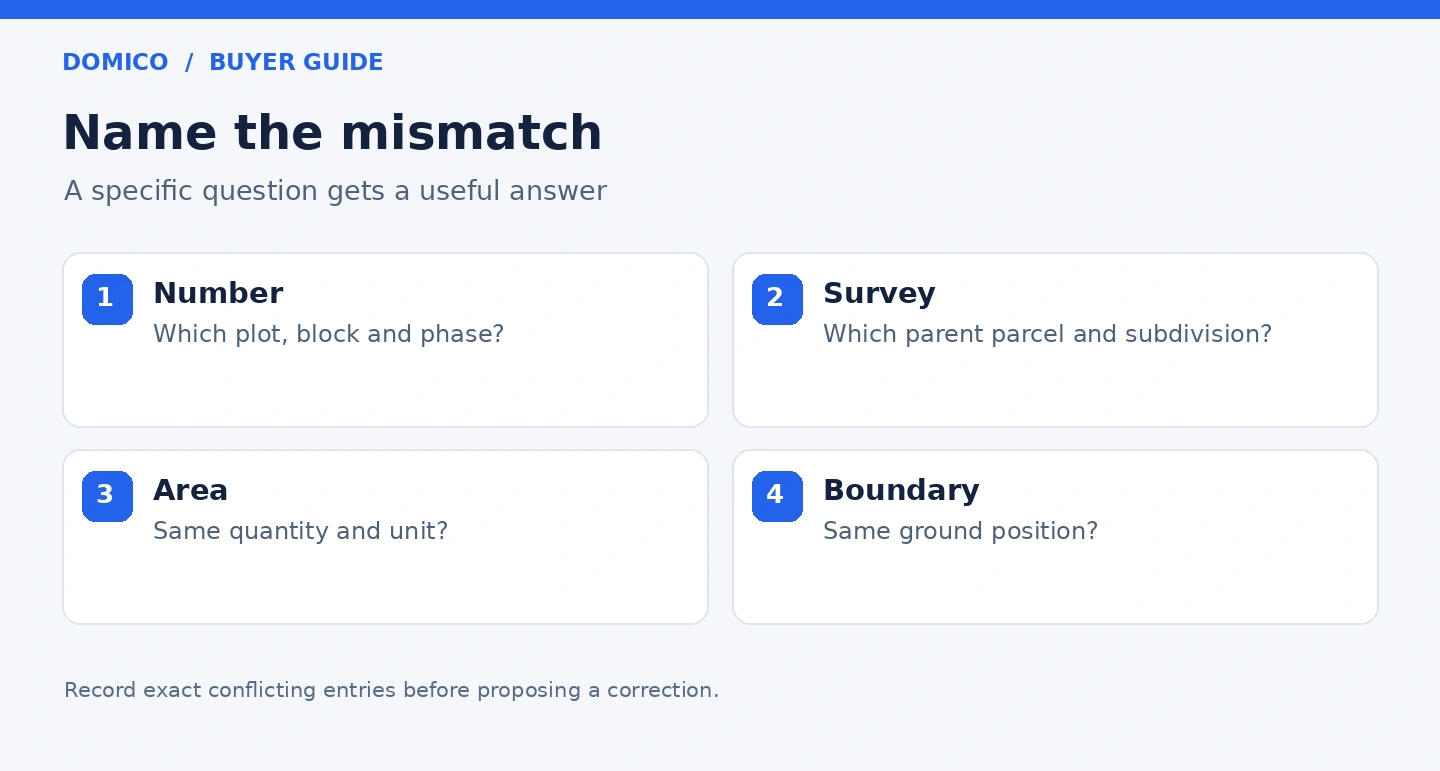
An area difference is not the same as a plot-number difference. A changed survey subdivision is different from a typing error. A unit conversion can create an apparent shortage even when the original figures agree.
Create a list of the exact conflicting entries. Record the document, page, date, field and value. Avoid saying “documents do not match” when you can say “the approved layout shows plot 64 as 100 square metres, while the draft deed calls it 100 square feet.”
That level of precision helps the lawyer, surveyor and planning professional identify whether they are dealing with one error or several related questions.
| Mismatch type | Possible explanation to investigate | Appropriate next check |
|---|---|---|
| Plot number | Typo, renumbering, different block or wrong property | Approved drawing and revision history |
| Survey number | Subdivision, old identification or unrelated parent land | Revenue records and supporting orders |
| Area | Unit issue, incorrect schedule or actual shortage | Calculation and ground measurement |
| Dimensions | Approximation, irregular shape or changed boundary | Survey and approved layout |
| Boundaries | Old descriptions or conflicting property position | Title schedule, map and site verification |
Build a property identity sheet
Put the selected plot number, block, phase, village, survey number, area, dimensions and boundaries on one page. Add a separate row for the seller's name and acquisition document. Then compare that sheet against every material record.
Use the current MP Bhulekh service for relevant revenue information and obtain the approved layout through the appropriate planning source. Do not rely only on the seller's freshly prepared summary.
Keep the original wording alongside any translated or simplified explanation. A lawyer reviewing the legal schedule needs the source entry, not merely the interpretation used by the sales team.
Check units before assuming land is missing
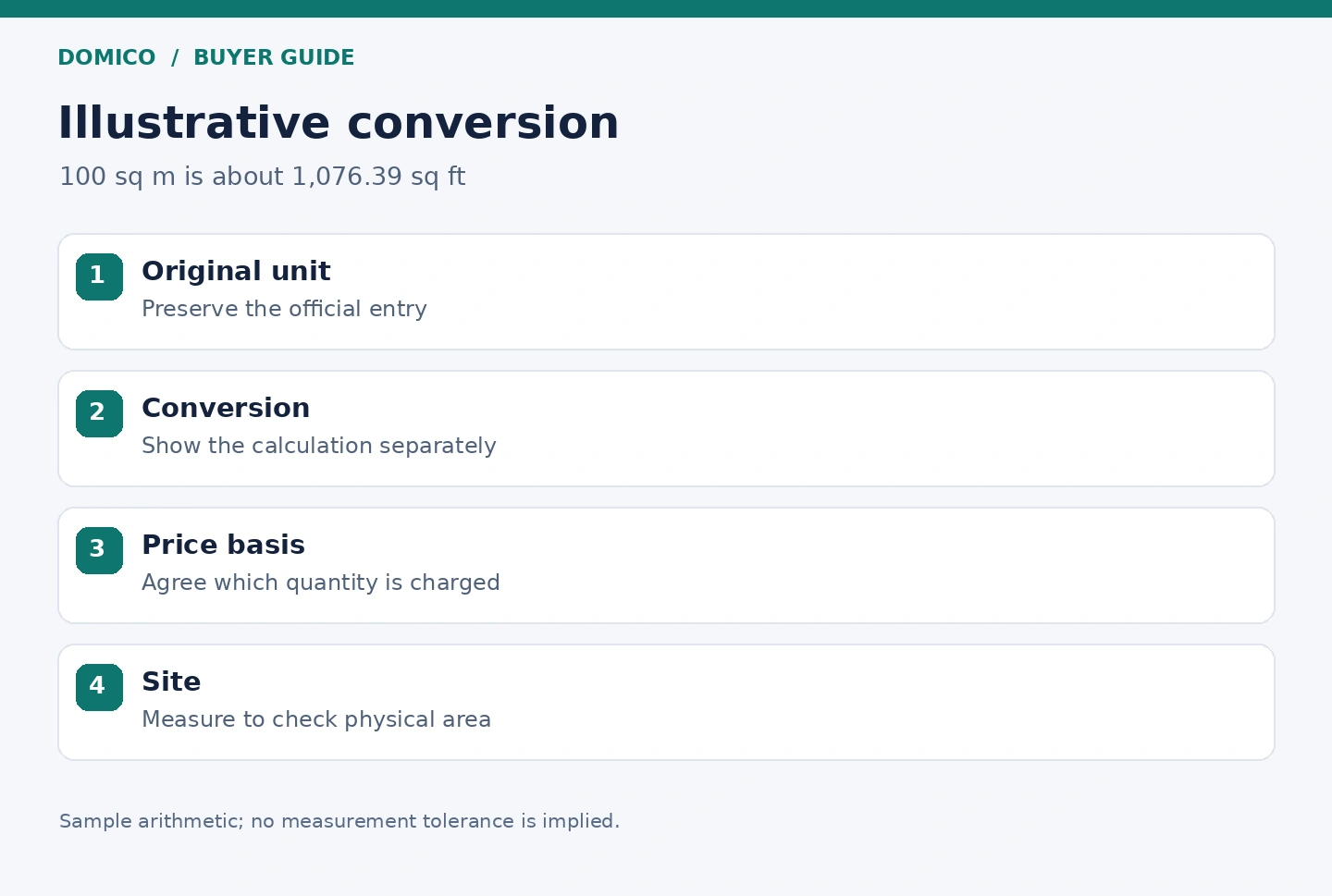
Area may be stated in hectares, square metres or square feet. Dimensions may use metres while a brochure converts them into feet. Rounding at several stages can create apparent differences.
One square metre is approximately 10.7639 square feet. Thus 100 square metres is approximately 1,076.39 square feet, not 1,000 square feet. A plot marketed as “about 1,000 square feet” needs an exact contractual area and unit before price and payment can be assessed.
Also confirm that the figures describe the same object. Parent-land area, an undivided ownership share and an individual colony plot are not interchangeable. Perfect arithmetic will not fix a comparison between different interests.
Plot renumbering needs a traceable chain
A genuine revised layout may change numbering or dimensions. Ask for the earlier approved drawing, later approved revision and a clear connection between old and new identification. Establish what the seller actually acquired and what is now proposed to be transferred.
A handwritten renumbering note or a fresh sales-office printout may help explain the claim, but should not be treated as the final evidence. Ask the competent authority or relevant professional to confirm the operative approved position.
Then check which identification appears in allotment records, loan papers, tax entries and the proposed deed. The transaction file should explain the history clearly enough that a future lender or buyer can follow it without meeting today's agent.
When area and dimensions disagree
For a rectangular plot, frontage multiplied by depth gives a basic area check. For an irregular plot, that shortcut may be wrong. Ask a surveyor to use the actual geometry and appropriate measurement method.
A 1,000-square-foot area can be arranged in very different shapes. A narrow frontage, angled corner or shallow usable section may change the house you can build. Area is therefore one part of the investigation, not the sole definition of value.
Where an existing wall is treated as the boundary, compare it with records and survey results. Do not automatically reduce the legal area to the enclosure, or assume everything enclosed belongs to the seller.
Worked example: the conversion error that changes the offer
An illustrative plot is offered at ₹3,000 per square foot, described verbally as 1,000 square feet. The approved drawing states 100 square metres, and the draft price sheet uses 1,076 square feet.
At the quoted rate, 1,000 square feet produces ₹30 lakh. Using 1,076 square feet produces ₹32.28 lakh. The ₹2.28 lakh difference is not a mysterious fee; it arises from two different quantities used for the same price discussion.
The buyer should first establish the correct exact area and the agreed charging basis. The agreement should then state that basis clearly, including how any permitted adjustment is handled. The legal property description should preserve the authoritative unit where appropriate rather than borrowing a rounded promotional figure.
Now imagine that the measured plot is actually smaller than the approved 100 square metres. That introduces a separate boundary or area issue. Solving the conversion does not solve the shortage.
These sample figures illustrate arithmetic and documentation, not an acceptable measurement tolerance or a current market quote.
| Question before changing the price | Why it comes first | Useful evidence |
|---|---|---|
| Which area is authoritative? | Prevents negotiating on the wrong quantity | Approved record and title schedule |
| Are both figures in the same unit? | Exposes conversion errors | Transparent conversion sheet |
| Is the plot shape verified? | Establishes actual usability | Survey sketch and dimensions |
| Is the same plot being compared? | Avoids a deeper identification mistake | Block, phase and parent-land match |
| What correction is legally required? | Prevents repeating an error | Lawyer's proposed correction route |
Correct the right record through the right route
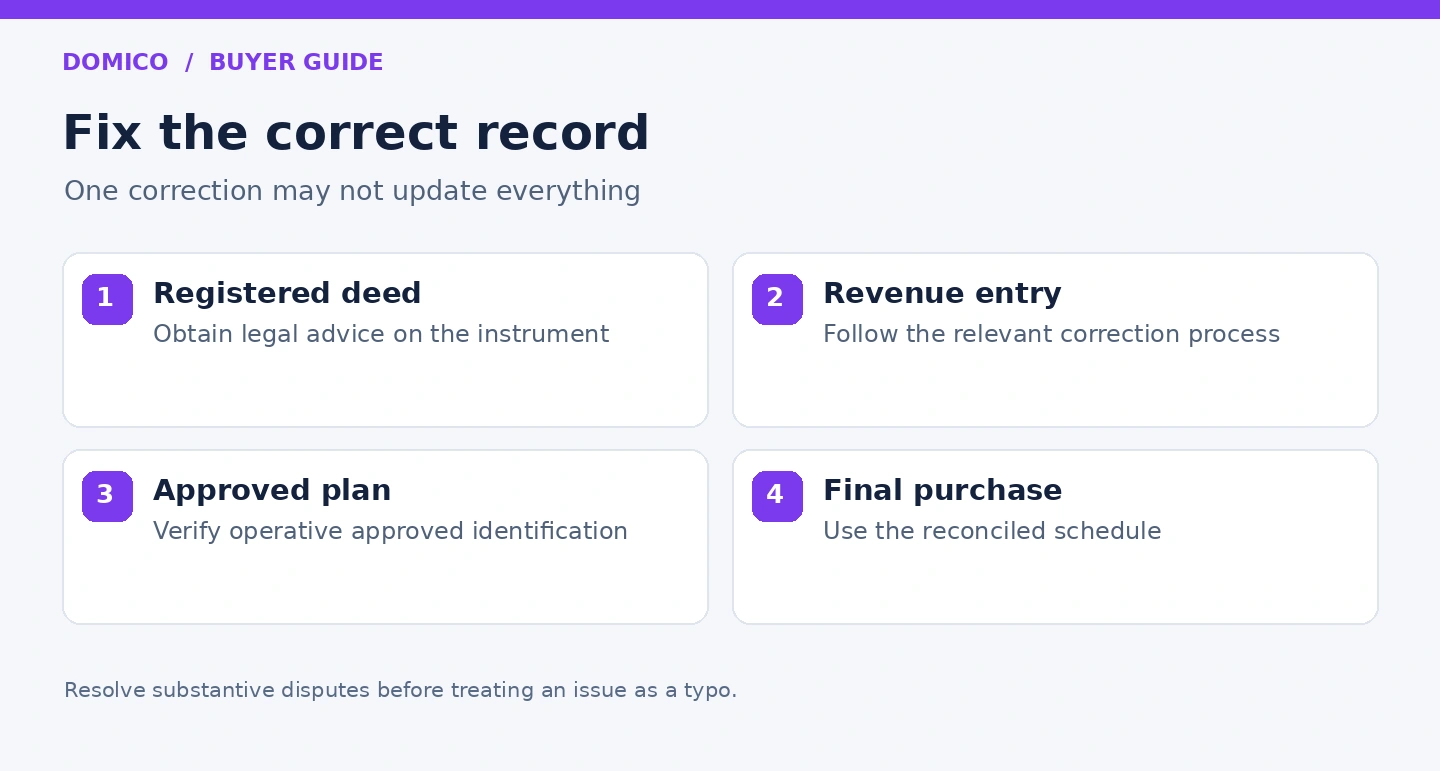
The Registration Act and state procedures form part of the framework for registered documents. A material error in a registered deed may need a properly executed correction or other legal remedy. Your lawyer should determine the appropriate route and the parties required.
A revenue-record correction is a different process from changing a registered conveyance. A planning-record revision is different again. Do not assume a corrected entry in one system automatically updates every other record.
If another person's rights are affected or the parties disagree about what was sold, the issue may go beyond a clerical correction. Obtain legal advice before signing a document that characterises a substantive change as a simple typo.
Decide what must happen before payment
Separate items into three categories: already explained with supporting evidence, pending correction with a defined process, and unresolved substantive disagreement. This makes the risk easier to evaluate.
Ask your lawyer to identify payment conditions for material items. The seller should not receive the benefit of a clean-file price while the buyer accepts responsibility for fixing an unclear identity after closing.
Keep a dated version of the final property schedule reviewed by all relevant professionals. Before execution, compare that schedule against the final deed rather than assuming the drafting team copied it correctly. A last-minute transposition can recreate the same problem you spent time resolving.
Printable buyer worksheet
Download the topic-specific review checklist. Use it to record evidence, unanswered questions and follow-up actions for the exact property.
Frequently asked questions
Is a one-digit plot-number mistake always harmless?
No. It may be a clear typo, but it can also identify a different plot. Check the complete schedule, approved layout, block, phase and boundaries. The seriousness depends on whether the property can be established consistently and whether anyone else's rights are involved.
Can the seller correct the deed after selling to me?
Do not assume the process will be simple or that every necessary person will cooperate later. Ask your lawyer what should be corrected before closing, who must sign and whether the proposed sale would otherwise repeat the defect.
Should I accept less land in exchange for a discount?
First establish the actual property, cause of the difference and whether the verified plot remains lawful and usable for your purpose. A discount addresses price; it does not cure a title, approval, boundary or access problem.
Does the boundary description always override the area?
Avoid applying a universal rule from an online article. Interpretation depends on the document, facts and applicable law. A lawyer should examine the complete deed and evidence rather than choosing whichever field gives the buyer a larger parcel.
What if the bank has already approved the property?
Ask what was actually checked and whether the mismatch was considered. A lender's decision serves its own lending purpose. The buyer should still understand the property identity and obtain advice on material discrepancies before signing.
Clear identification is not unnecessary paperwork. It is the foundation on which possession, construction, finance and the next sale depend.
Related buyer guides
Property Documents Checklist Before Buying in India
Plot Buying Checklist: 20 Checks Before Booking
Sale Deed vs Agreement to Sell vs Mutation
Sources and further checks
- buyer-guide-100
- homebuyers
- plot-area-number-mismatch
- indore
Planning to buy or rent in Indore? Browse verified properties in Indore or read more Indore guides.



