Buying Guide
Net Rental Yield: Calculate Rent After Costs and Vacancy
Calculate net rental yield using all-in purchase cost, realistic occupancy, owner expenses and separate loan and tax calculations.
8 min read

Buying Guide
Calculate net rental yield using all-in purchase cost, realistic occupancy, owner expenses and separate loan and tax calculations.
Rent on the listing is revenue. What stays with you is a different number.
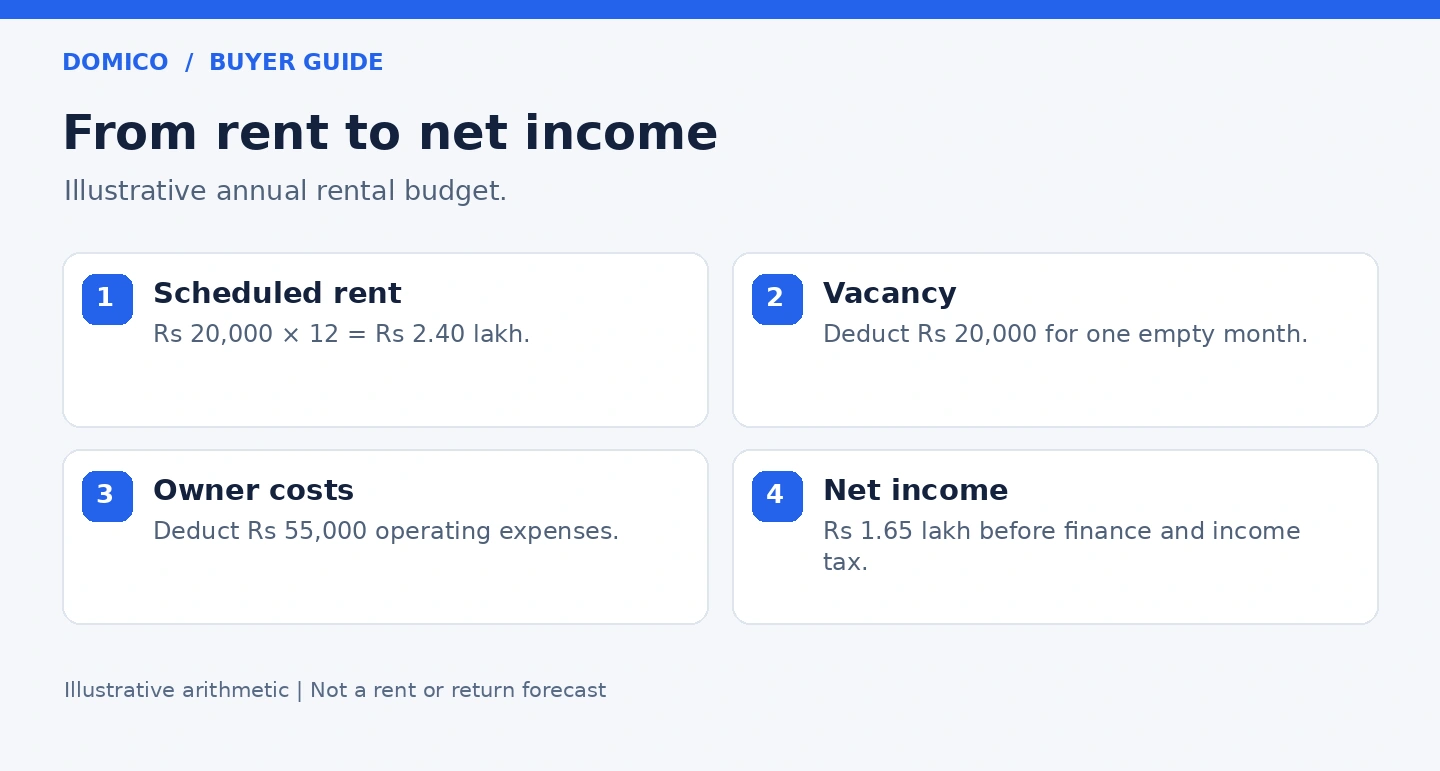
A flat advertised at Rs 20,000 monthly rent does not necessarily produce Rs 2.4 lakh of spendable annual income. Vacancy, owner-paid maintenance, repairs and letting costs can reduce the amount substantially. A loan then creates a separate cash-flow obligation. Net rental yield helps you compare the property's operating income with the capital committed to buying and preparing it.
Use the calculation before purchase, then replace estimates with actual records after letting. It is a decision tool, not a promise of future rent or a substitute for checking title, demand and building condition.
For a practical buyer comparison, calculate pre-financing net rental yield as:
Annual rent actually expected to be collected, minus owner-paid operating expenses, divided by total acquisition and initial letting-ready cost, multiplied by 100.
Write the definition above your worksheet. Some advertisements calculate gross yield using only the quoted purchase price and twelve fully occupied months. Others call a figure “net” without saying whether they deducted vacancy or maintenance. Different definitions can make the same property appear to offer different returns.
Keep income tax and loan payments in separate sections. This preserves a clear view of how the property operates before the investor's tax position and financing choice are introduced.
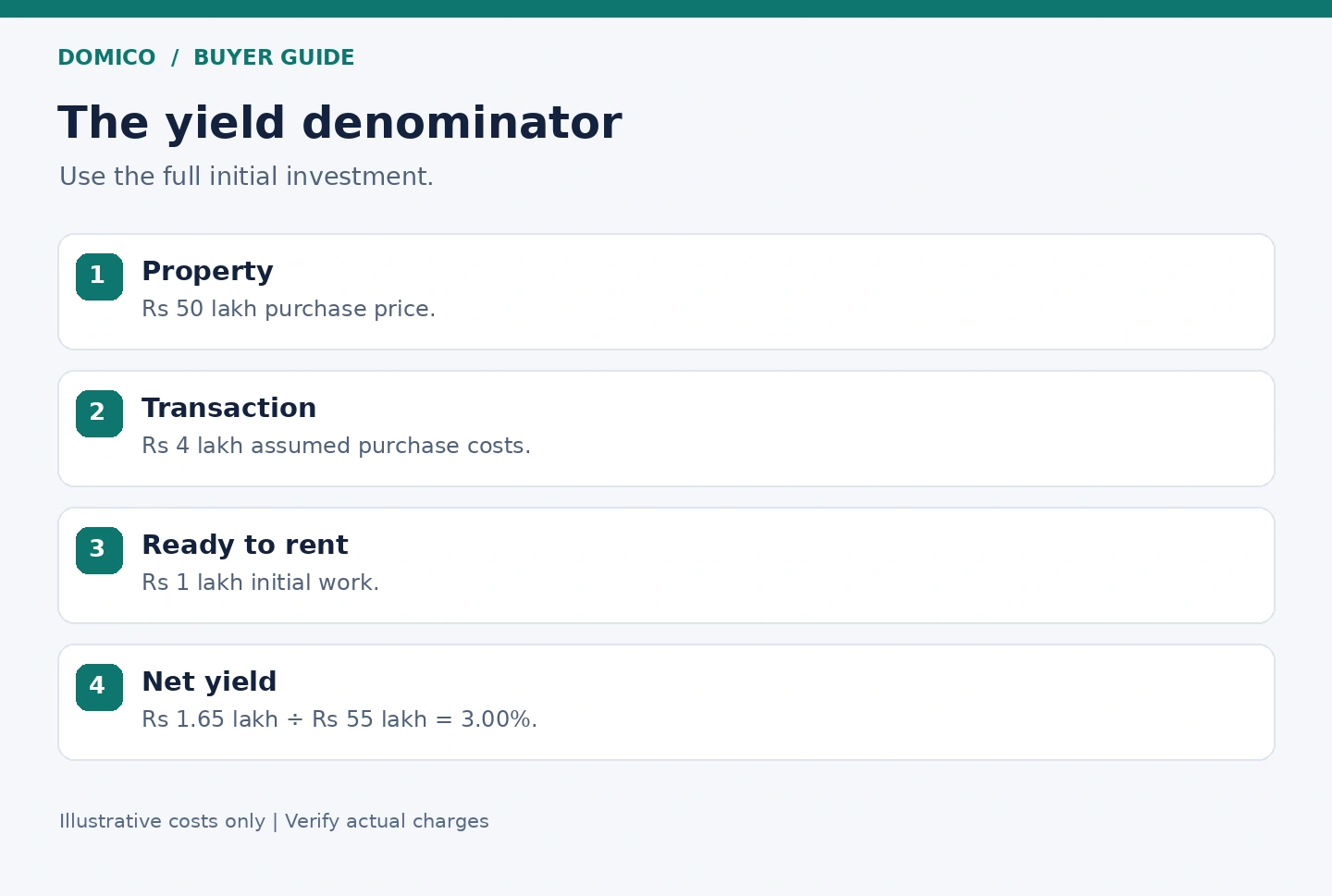
Start with the agreed property price. Add the applicable purchase costs you will actually bear, such as stamp duty, registration, legal review, brokerage and initial work needed to make the unit rentable. Obtain current calculations and quotations rather than copying a generic percentage.
Furniture, appliances and essential repairs can be material for a furnished rental. Include their initial cost in the investment figure, then budget for future replacement separately. A refundable deposit is not a purchase expense merely because cash passes through your account; classify it according to the actual arrangement.
| Capital item | Illustrative amount | Treatment |
|---|---|---|
| Purchase price | Rs 50,00,000 | Acquisition capital |
| Purchase and transaction costs | Rs 4,00,000 | Acquisition capital |
| Initial letting-ready work | Rs 1,00,000 | Initial investment |
| Total | Rs 55,00,000 | Yield denominator in this example |
These are hypothetical inputs, not an estimate of Indore transaction charges. The point is to compare income against the full Rs 55 lakh committed, rather than only the Rs 50 lakh advertised price.
Look for comparable homes with similar carpet area, furnishing, floor, parking, building services and tenant audience. Asking rents show what owners hope to receive. They do not establish the final contracted amount or how long the unit will remain empty.
Discuss recent completed lettings with more than one local source and examine available evidence with personal details protected. Ask whether the stated rent includes maintenance, furnishings, parking or other services. Compare like with like before selecting an assumption.
Include a vacancy allowance. One empty month at Rs 20,000 reduces annual collection by Rs 20,000. Do not count a refundable security deposit as rental income. Also distinguish an agreed rent from payment actually received when assessing an occupied property.
List costs according to who must pay them under the actual tenancy and society arrangements. Owner-paid maintenance belongs in the operating budget. A bill paid by the tenant should not also be deducted unless you have a reason to expect the owner will bear it.
Allow for repairs, property-related insurance where applicable, local property taxes and letting or turnover expenses. A new appliance will not fail every year, but a reserve can help spread an irregular cost across the investment period. Do not confuse a planning reserve with a tax deduction; tax treatment requires a separate calculation.
For the illustrative property, assume Rs 20,000 monthly rent, one vacant month and the following annual owner costs:
| Annual cash item | Illustrative amount |
|---|---|
| Scheduled rent for twelve months | Rs 2,40,000 |
| Less one vacant month | Rs 20,000 |
| Expected collected rent | Rs 2,20,000 |
| Owner-paid maintenance | Rs 24,000 |
| Local property tax | Rs 6,000 |
| Property insurance | Rs 3,000 |
| Repair allowance | Rs 12,000 |
| Letting and turnover allowance | Rs 10,000 |
| Total operating costs | Rs 55,000 |
| Net operating income | Rs 1,65,000 |
The pre-financing net rental yield is Rs 1,65,000 ÷ Rs 55,00,000 × 100 = 3.00%. Gross scheduled rent divided by the same investment would be about 4.36%. Both are arithmetic descriptions of these assumptions; neither predicts what a real property will earn.
Suppose the household's loan payment is Rs 32,000 per month. That is Rs 3,84,000 per year. Against the example's Rs 1,65,000 net operating income, the annual cash shortfall before personal tax is Rs 2,19,000.
This does not mean the full EMI is an operating expense. EMI includes interest and principal repayment; principal reduces the loan balance. The household still has to fund the entire payment, so a cash-flow test is essential even when principal is building equity.
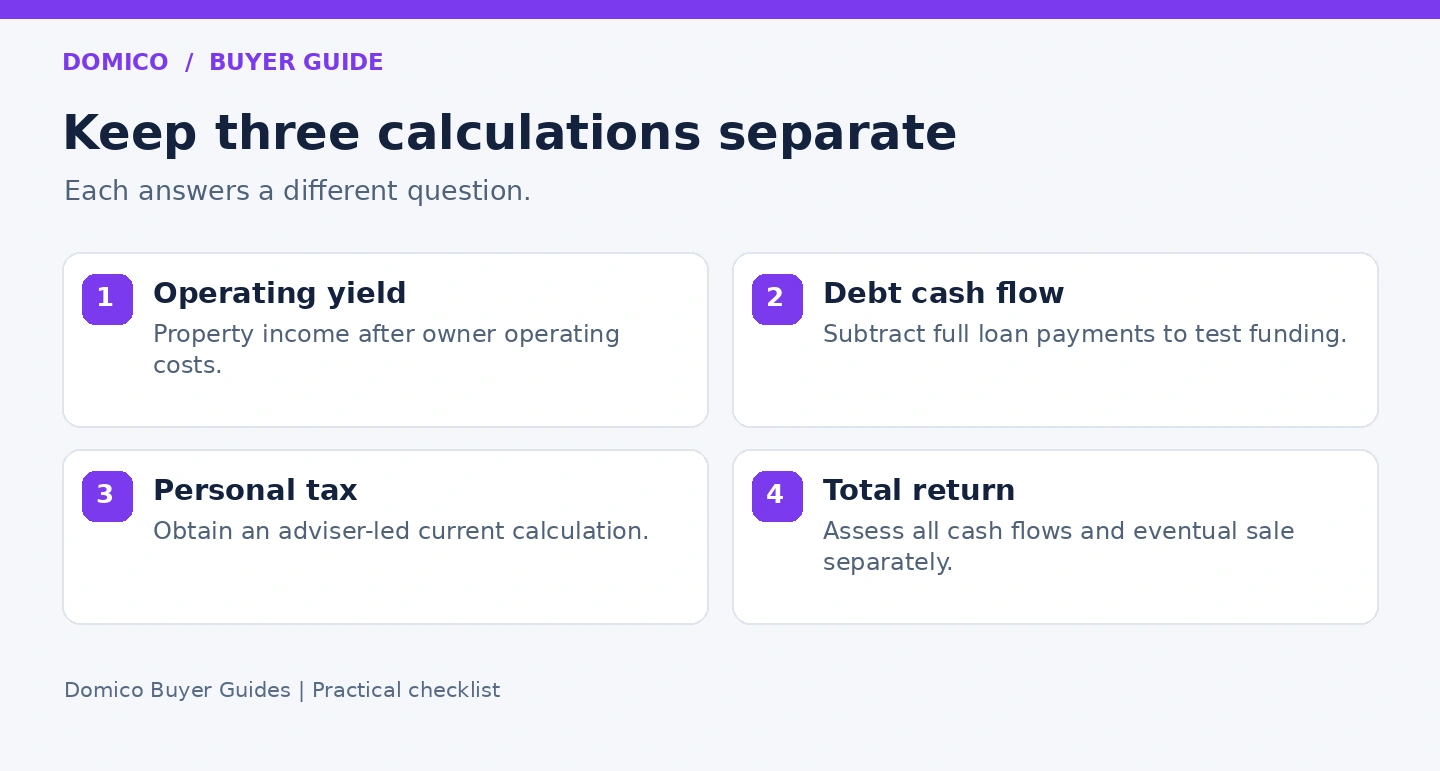
Keep three clearly labelled outputs: property operating yield, cash flow after debt payments and investment return after all relevant cash flows. Mixing them can produce attractive-looking percentages that do not tell you how much money the household must supply each month.
Local property tax is an operating cost when the owner bears it. Income tax on rental activity is a different calculation. The taxable amount may differ from the operating income in your worksheet because statutory rules, allowable deductions, ownership, borrowing and the applicable tax regime matter.
Ask a qualified tax adviser to calculate the current treatment for your facts. Do not simply deduct your salary's headline tax rate from gross rent. Likewise, do not assume every cash expense in a rental budget is deductible in the same year.
For comparison, show pre-tax operating yield first, then add an estimated tax line supported by advice. SEBI's investment planning guidance identifies tax, risk, horizon and liquidity as separate considerations; a single yield percentage cannot capture the whole decision.
Run at least one less favourable case. Try lower rent, a longer vacancy and a repair bill in the same year. A property that is manageable only at full rent and perfect occupancy may create pressure when ordinary interruptions occur.
| Scenario | Collected rent | Operating costs | Net income | Yield on Rs 55 lakh |
|---|---|---|---|---|
| Base illustration | Rs 2,20,000 | Rs 55,000 | Rs 1,65,000 | 3.00% |
| Two vacant months | Rs 2,00,000 | Rs 55,000 | Rs 1,45,000 | 2.64% |
| Two vacant months plus Rs 30,000 extra repair | Rs 2,00,000 | Rs 85,000 | Rs 1,15,000 | 2.09% |
These are sensitivity cases, not forecasts. They reveal which assumptions deserve better evidence. If an extra vacant month changes the decision, investigate leasing demand before negotiating the purchase price.
Do not deduct maintenance twice when comparing an inclusive rent with an owner-paid bill. Do not add a security deposit to income while ignoring that it may need to be refunded. Do not assume rent rises every year if the agreement or market evidence does not support it.
Keep expected appreciation out of rental yield. Capital growth is a separate uncertain component and only becomes realised through a sale or other transaction. A low operating yield can still form part of a deliberate investment plan, but it should not be disguised by adding an unsupported annual appreciation assumption.
Maintain a record of where every input came from and when it was checked. A spreadsheet with dated evidence is more useful than a beautifully formatted percentage with no supporting details.
Download the topic-specific review checklist. Use it to record evidence, unanswered questions and follow-up actions for the exact property.
There is no universal number that establishes a good purchase. Compare verified local rents, complete acquisition costs, condition, tenant demand, liquidity and alternatives. This article's 3% illustration is a calculation example, not a city benchmark or investment recommendation.
For a purchase decision, all-in acquisition cost shows income against the money you expect to commit. For an existing owner deciding whether to hold or sell, current realisable value can answer a different question. Label the denominator so readers know which decision the figure addresses.
In the operating definition used here, debt service is separate. EMI affects household cash flow and the return on the owner's equity. Showing the loan separately lets you compare properties before introducing different financing arrangements.
Do not count a refundable deposit as ordinary rent. Record its liability and the terms governing use, deductions and refund. Check the tax treatment of unusual arrangements with an adviser rather than assuming the accounting label settles it.
Update it before purchase when new evidence arrives, after a lease is signed and at least when rent, major costs or occupancy change. Keep an actual-versus-budget record so your next decision uses the property's history rather than its original sales estimate.
Know what the property earns before asking what it might appreciate. Rental income becomes useful when the costs, vacancies and funding gap are visible.
Planning to buy or rent in Indore? Browse verified properties in Indore or read more Indore guides.
Check who owes the lender, how builder-paid interest works, when support ends and whether you can carry the loan if payments stop.



