Buying Guide
Land Diversion in MP: Residential Plot Buyer Checks
Understand which land diversion records to inspect and how to match them to your exact plot before booking.
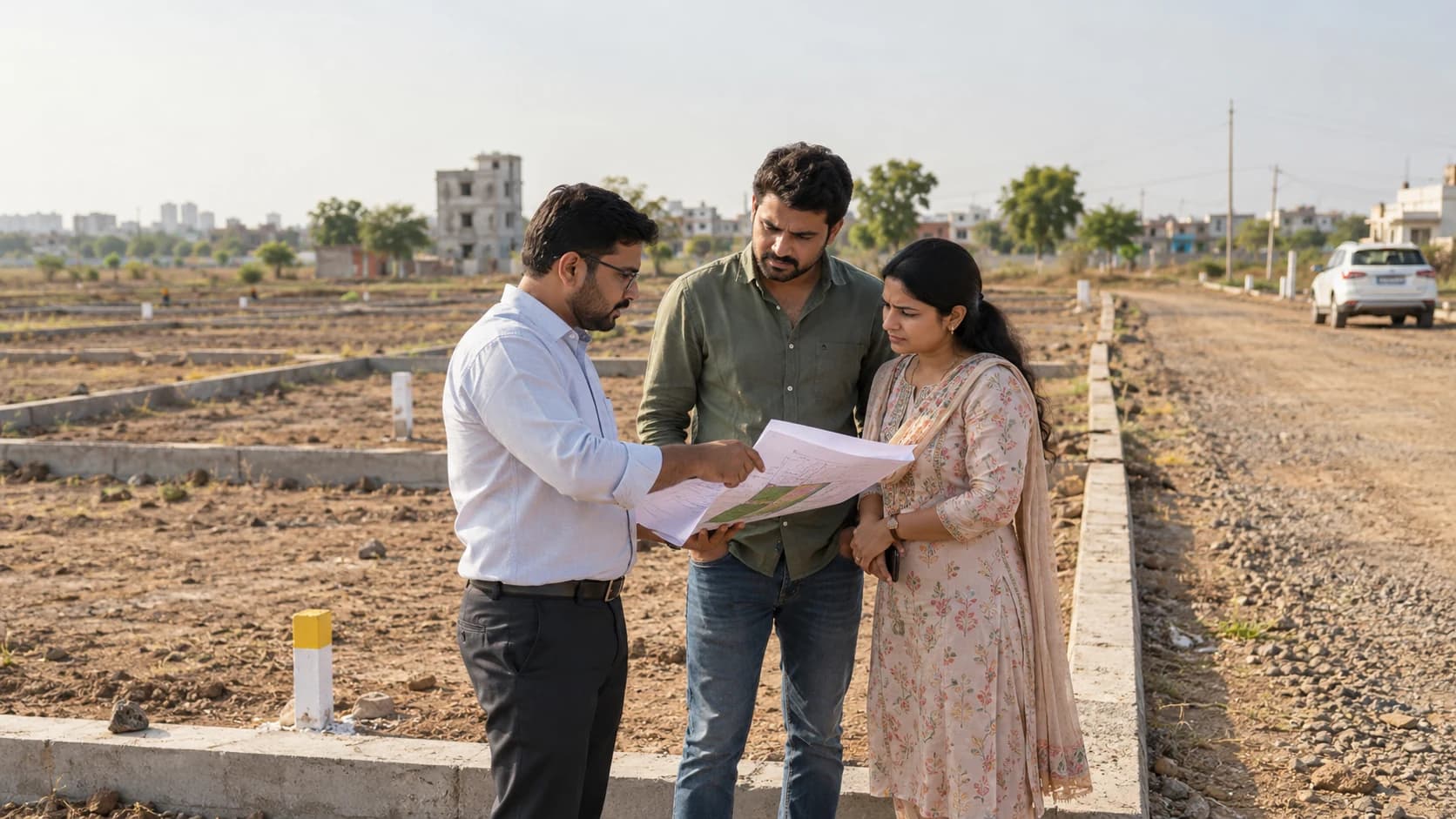
Table of contents
“Residential plot” describes what the seller wants you to buy. The records must explain whether the land can be used for that purpose. In Madhya Pradesh, this is where land diversion becomes an important part of a buyer's investigation.
A residential promise should have a traceable record behind it. Before buying, separate the revenue-use question from the planning-permission question. They are connected, but one document does not answer both.
What land diversion means for a buyer
In ordinary property discussions, diversion refers to the change or treatment of land for a use different from its earlier revenue classification, often agricultural to residential or commercial. The precise legal process, assessment and documentation depend on the land, location and applicable provisions at the time.
The current framework should be checked through the MP Revenue Department's land-revenue resources. Avoid assuming that an old reference to a particular section, form or fee describes every present transaction. State rules and online processes have changed over time.
For a buyer, the practical task is straightforward: establish what use is recorded, what treatment is required for the proposed use, whether it covers the exact land, and what obligations remain.
Four questions that must stay separate
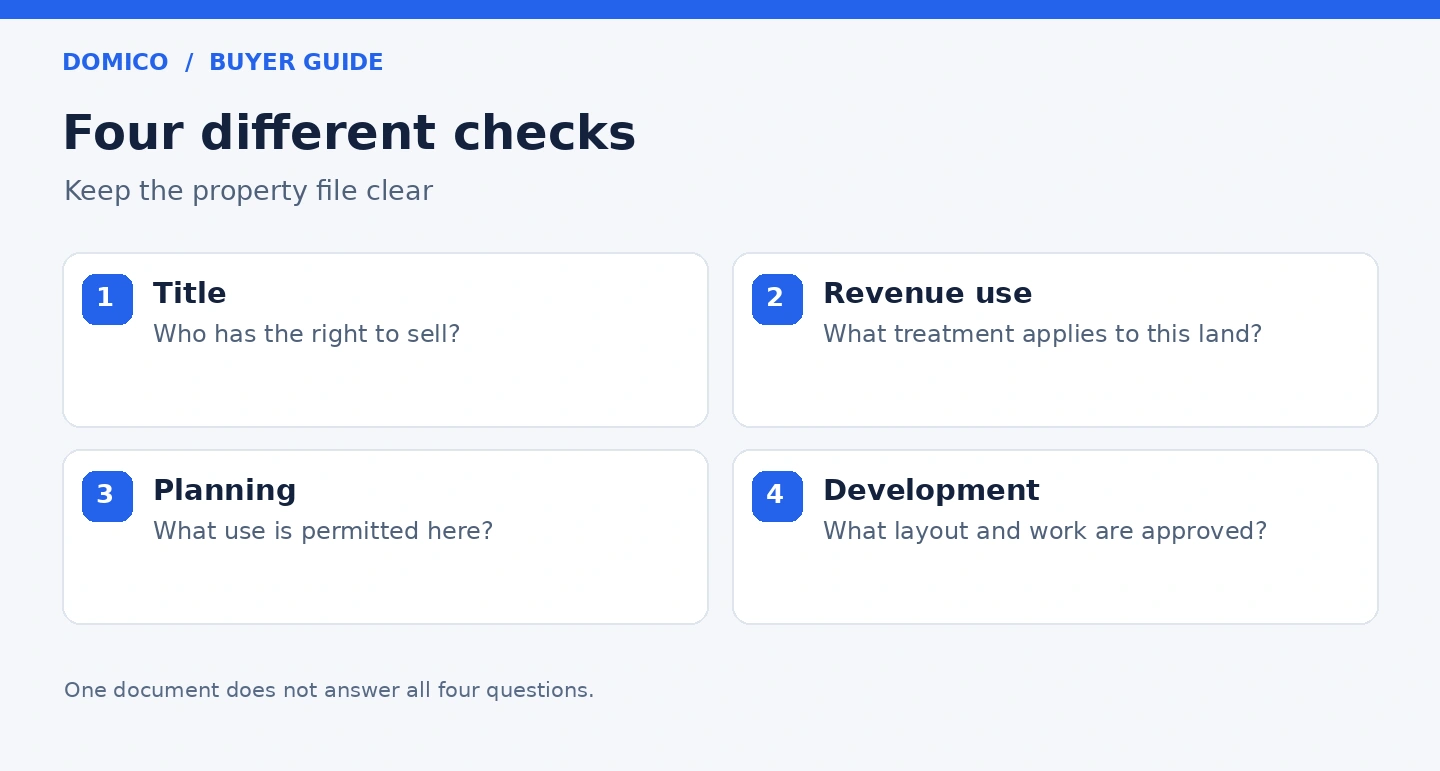
A diverted parcel is not automatically a fully approved plotted colony. Likewise, a residential colour on a development-plan map is not a document proving that the seller owns the land.
| Question | Evidence to investigate | What it does not automatically establish |
|---|---|---|
| Who can sell the land? | Title chain, holder records and sale authority | Residential development permission |
| What revenue use applies? | Diversion-related records, assessments and applicable orders | Approval of every colony plot |
| What planning use is permitted? | Operative development plan and competent authority records | Completion of revenue obligations |
| What development is approved? | Approved layout, permission conditions and other applicable approvals | Transferable title without defects |
An easy way to avoid confusion is to ask the seller for four separate file sections: title, revenue use, planning and development. Put the actual document under the question it answers. If the same single page is offered as the answer to everything, seek clarification.
Begin with the exact parcel and intended use
Collect the village, tehsil and complete survey numbers before checking diversion. Identify whether the offer concerns the whole landholding, part of it or a plot inside a larger development. Obtain the area in the original unit and a map showing the relevant portion.
Then describe your intended use in plain language. A family home, a shop with a residence above it, a warehouse and an agricultural holding with incidental structures can raise different questions. Do not buy on a residential assumption when your actual plan is commercial.
If the seller says a future change is “easy,” ask for a written explanation from the appropriate professional or authority. An application that might be possible is different from a completed process that covers your intended purchase.
The diversion file to ask for
Request the actual official record supporting the seller's statement that the land has been diverted or reassessed as required. Depending on the case and period, this may involve an order, intimation, assessment, payment records and updated land records. Ask your lawyer to identify which combination applies.
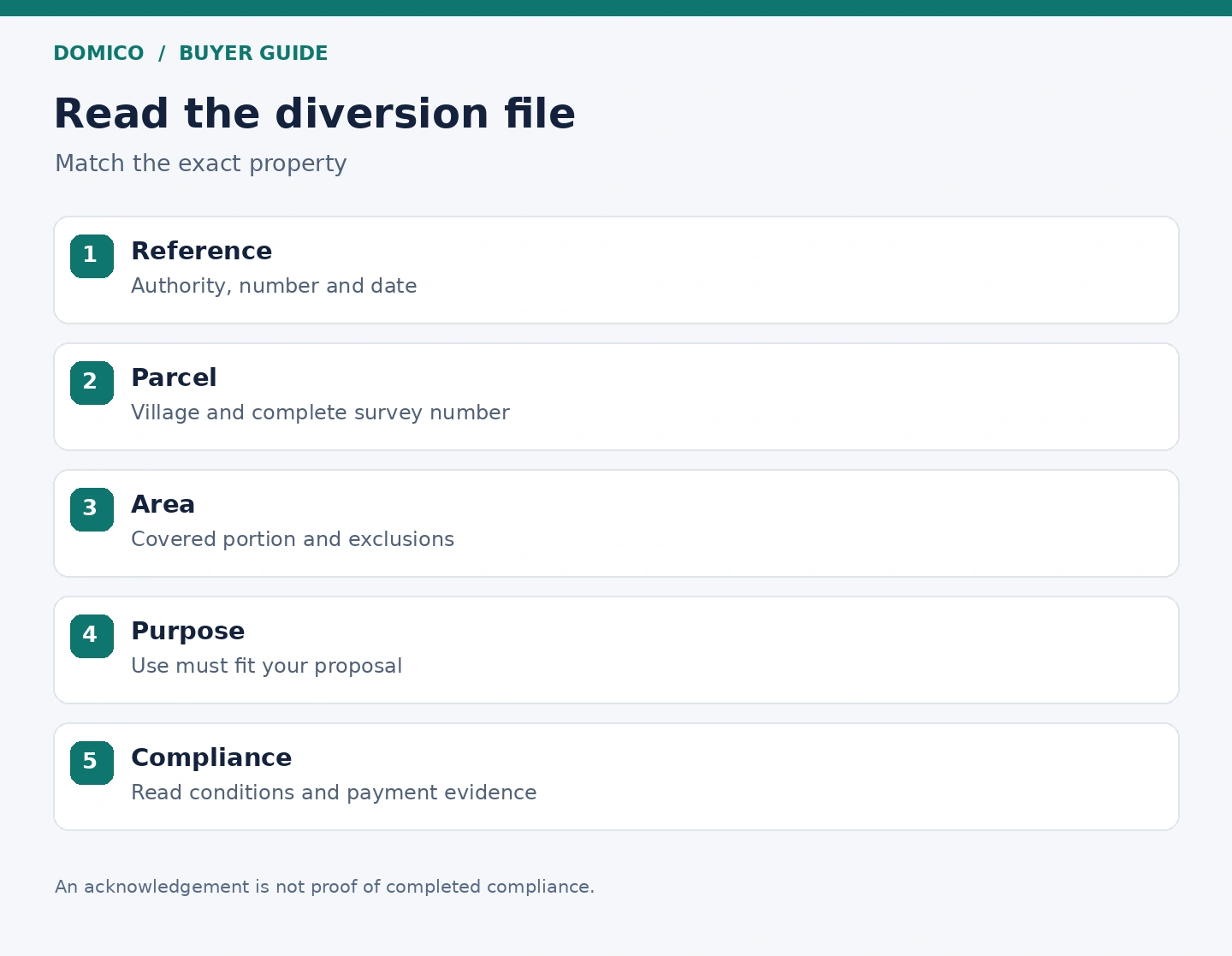
Look for the issuing authority, reference number, date, applicant, village, survey number, area and stated purpose. Read attached maps and schedules. A document relating to 0.40 hectare does not necessarily cover an adjoining 0.10 hectare simply because both are sold under one project name.
The official MP Bhulekh portal supports land-record checks. MP district service pages also direct citizens to official land-record and diversion services. These are better starting points than websites whose names resemble a government service but are privately run.
Verify the area, purpose and conditions
Area is often where a reassuring file becomes less reassuring. Compare the diversion-related area against the parent title documents, current revenue record and the development layout. Explain partial coverage, excluded portions and changed survey numbers.
Purpose matters equally. Ask whether the recorded treatment matches the proposed residential use. If the land includes both residential and commercial components, identify each part. Never infer permission for a shop from permission associated with housing elsewhere on the parcel.
Read conditions about payments, compliance or further requirements. Distinguish between a completed payment and a challan generated but not paid. Obtain official receipts and ask whether any recurring or pending liability affects the seller or the transaction. Do not accept an agent's rough charge estimate as the final assessment.
| Item to compare | Useful buyer question | Evidence to keep |
|---|---|---|
| Survey identification | Is this the exact parent land of my plot? | Complete schedule and relevant map |
| Covered area | Is all the necessary land included? | Area statement with exclusions explained |
| Recorded purpose | Does it match my proposed use? | Official entry or applicable document |
| Financial compliance | What has been paid and what remains? | Assessment, receipts and balance confirmation |
| Conditions and later changes | Is there an unresolved requirement? | Complete order and subsequent correspondence |
An illustrative purchase with partial coverage
A buyer selects a 1,000-square-foot plot in a development advertised at ₹32 lakh. The seller supplies a document referring to residential treatment of 0.60 hectare. The project brochure, however, includes 0.80 hectare of land.
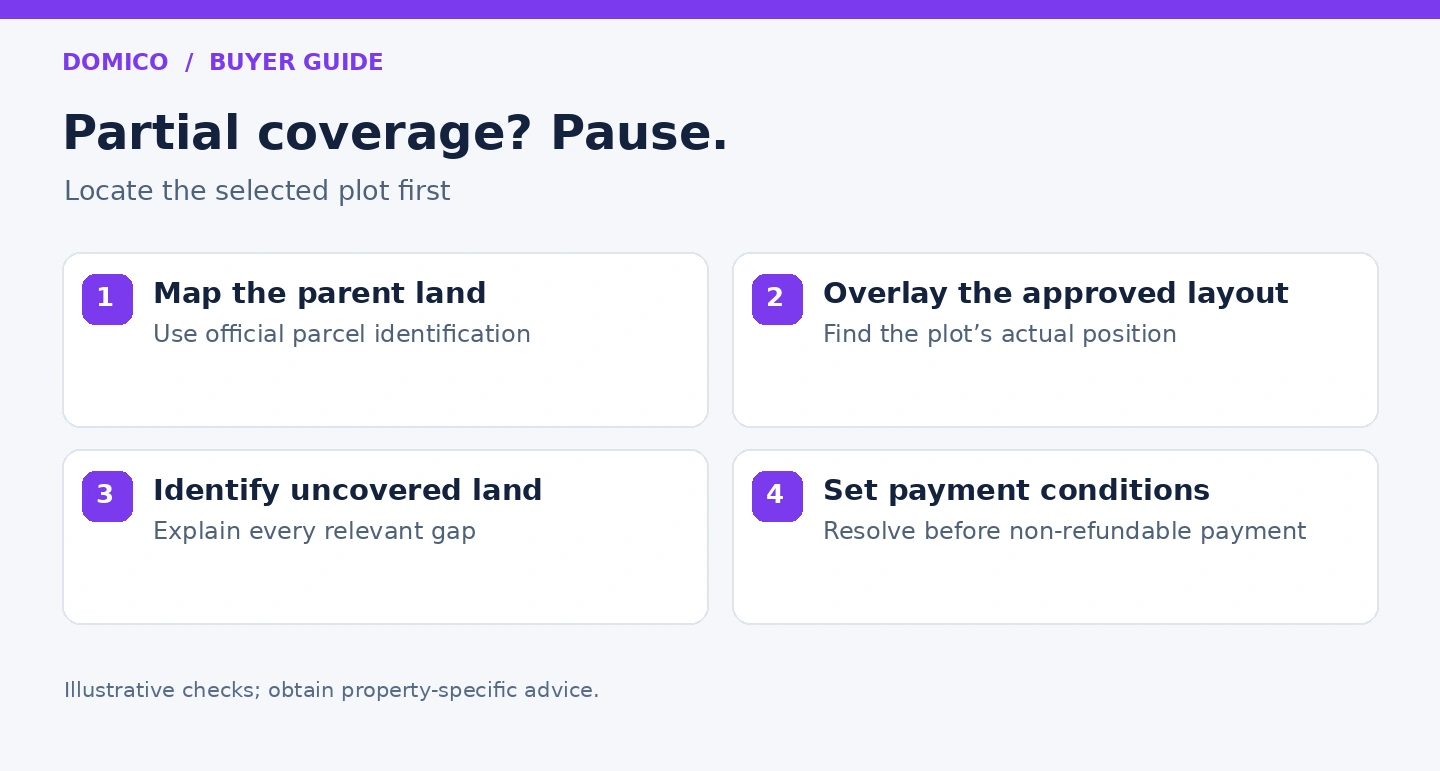
The difference of 0.20 hectare equals 2,000 square metres. It is not safe to assume that the buyer's plot falls inside the covered part. A planner connects the approved drawing to the revenue map and marks the selected plot's parent parcel. The seller is then asked to produce the corresponding record for that land.
Suppose the buyer is asked to pay ₹1 lakh immediately because “the balance diversion is in process.” The buyer should understand this as an unresolved condition, not a minor paperwork delay. If proceeding is still being considered, the lawyer should define documentary conditions, payment timing, a realistic long-stop date and consequences if the required position is not achieved.
This example uses invented areas and prices to illustrate a verification method. It is not a claim about a real Indore project or an estimate of government charges.
Diversion and TNCP approval are different checks
The Directorate of Town and Country Planning publishes planning resources and legislation. Its development permissions concern planning matters. Revenue documentation concerns another part of the file.
A seller may show a planning approval and say that all revenue questions are therefore settled. Another seller may show a diversion-related receipt and call the colony approved. Both shortcuts leave gaps. Ask which authority issued each document, the legal purpose it serves and whether it applies to the exact land and phase.
Where a project requires RERA registration, check that independently too. Registration is not a substitute for examining the approved development documents or the seller's title. You are looking for a consistent file across systems.
Be careful with land sold as small agricultural pieces
A low ticket price can make a small piece of agricultural land look like a residential plot. Before comparing it with an approved colony, establish what is actually being transferred and whether the proposed division, access and future construction are permissible.
Ask who will complete any required process, by when and at whose cost. Obtain a professional assessment of feasibility before treating promised future permission as part of today's value. A private sketch with numbered rectangles is not, by itself, an approved subdivision.
Check access and services on the same basis. A dirt track, nearby power line or future pipeline statement does not solve land-use or development-permission questions.
Put unresolved matters into the transaction terms
Create a short list of missing items rather than accepting “all documents available” as a conclusion. Name the record required, the exact parcel it must cover, the person responsible and the payment milestone it affects.
Ask your lawyer to review representations about permitted use and pending liabilities. Keep copies of the official records relied on, not merely an email saying that they were checked. If a seller refuses to provide a complete document before receiving a non-refundable payment, consider what practical ability you would have to investigate after paying.
Where the file is historical or the process has changed, seek written clarification through the relevant revenue office. A document can be old and valid; it still needs to be connected to current land identification and any later changes.
Printable buyer worksheet
Download the topic-specific review checklist. Use it to record evidence, unanswered questions and follow-up actions for the exact property.
Frequently asked questions
Does diversion make a colony fully approved?
No single revenue-use document answers every approval question. Check title, planning land use, layout permission, relevant local development requirements and RERA applicability separately. Ask a professional to identify the permissions required for the exact property.
Can I rely on an application acknowledgement?
An acknowledgement establishes that something was submitted, not necessarily that the required legal or administrative position has been achieved. Examine the applicable procedure, current status, assessment and compliance records before treating the matter as complete.
Are diversion charges the same throughout Madhya Pradesh?
Do not assume a universal figure. The calculation can depend on the land, location, use, area and applicable rules. Obtain the official assessment relevant to the property and check who is contractually responsible for outstanding amounts.
What if only part of the land is covered?
Identify the covered portion on the official and approved maps. Establish whether the selected plot, necessary roads and relevant project land are within it. A percentage of overall coverage is not enough; the geographic connection matters.
Is an old diversion order useless?
Not automatically. Historical documents may form an important part of the file. Check authenticity, land identification, conditions, subsequent changes and the current legal position. Do not replace a case-specific review with an assumption based solely on age.
Buy a usable property, not an unresolved promise of future usability. Clear documentation now makes construction, finance and resale easier to assess later.
Related buyer guides
Property Documents Checklist Before Buying in India
Plot Buying Checklist: 20 Checks Before Booking
Booking Amount and Property Cancellation Terms
Sources and further checks
- buyer-guide-100
- homebuyers
- mp-land-diversion
- indore
Planning to buy or rent in Indore? Browse verified properties in Indore or read more Indore guides.