Buying Guide
How to Read Khasra and B-1 Records in MP
A practical guide to matching MP land records with the seller, title documents, approved layout and the actual plot.

Table of contents
A plot can look perfectly clear from the road while its records tell a more complicated story. Before asking how quickly you can register it, ask a simpler question: can you connect the land being shown to the land recorded by the government?
Khasra and B-1 records help you make that connection in Madhya Pradesh. They are valuable starting points for identifying a parcel and examining recorded rights. They do not, by themselves, settle every question about ownership, building permission or a dispute.
This guide explains how to read them as a buyer, prepare a useful comparison sheet and decide which differences need correction before money changes hands.
What Khasra and B-1 records help you understand
A Khasra is organised around a survey parcel. Depending on the record format and period, it can show the survey number, recorded area, recorded holder and information about land use or cultivation. B-1, commonly referred to as a Khatauni extract in MP, presents account or holding-related information. Current portal labels and available fields can vary.
Use the actual column headings on the issued record. Do not assume that a code, remark or abbreviated entry means the same thing as an agent's explanation. Ask the revenue office or your lawyer to interpret an unfamiliar entry and note the explanation against that specific field.
The official MP Bhulekh portal is the appropriate starting point for state land records. A forwarded screenshot is useful for beginning a search; it is a poor substitute for obtaining the record independently.
| Record or document | Main question it helps answer | What still needs separate checking |
|---|---|---|
| Current Khasra extract | Which survey parcel and recorded details are involved? | Complete title history and sale authority |
| B-1 or relevant holding extract | How are recorded rights or holdings reflected? | Whether all underlying transfers are valid |
| Cadastral or revenue map | Where does the survey parcel sit among other parcels? | Accurate ground demarcation |
| Registered title documents | How does the seller say ownership was acquired? | Planning permissions and physical possession |
| Approved colony layout | Where is the marketed plot within the approved development? | Connection to the correct parent survey land |
Start with the village, not just the project name
Marketing names are designed to be memorable. Land records use administrative identifiers. A colony advertised as being on Ujjain Road may fall in a particular revenue village and tehsil that never appears prominently in the brochure.
Ask for the district, tehsil, revenue village and complete Khasra number, including any subdivision suffix. Obtain the current seller's name as written in the records and the number and date of the seller's acquisition document. Where a project spans several survey numbers, request the full list and identify which parent parcel contains your selected plot.
A project name or Google Maps pin cannot replace this identification. Equally, two villages may have similarly numbered survey parcels. The number makes sense only within its correct village and administrative context.
Make one folder for the exact property under consideration. Put the village name in its title. This small habit reduces the chance of mixing a nearby project's documents into the same purchase file.
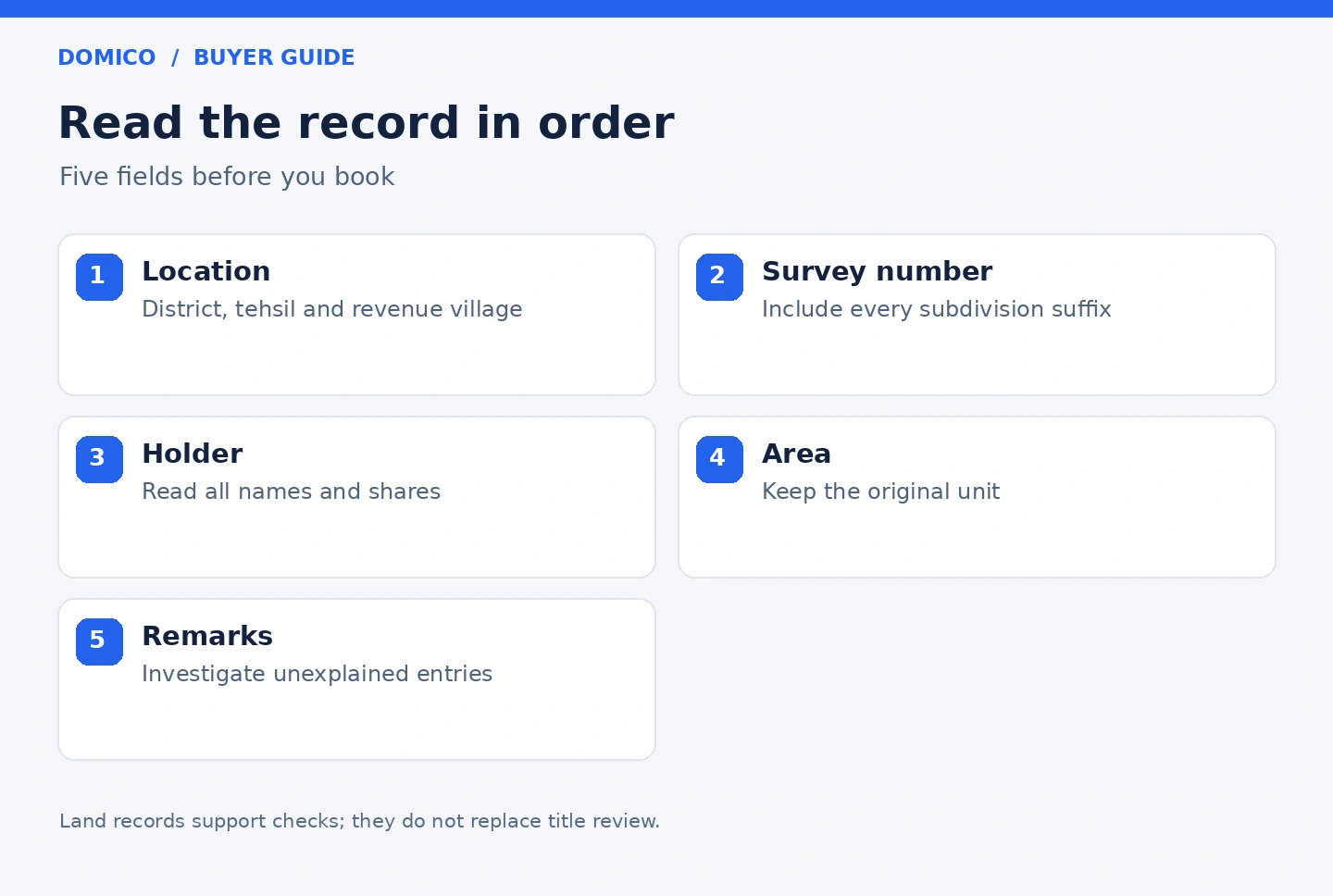
Read the record in a fixed order
1. Confirm the location and record period
Check the district, tehsil, village, survey number and record year or issue date. A genuine extract for the wrong year can miss a later change. An older record may still help explain history, but it should not be presented as the complete current position.
2. Read every recorded name and share
Match names against identity documents and the seller's title chain. A spelling difference may be clerical, but do not decide that without supporting records. If several people are recorded, establish what each person owns and who will join or authorise the sale.
A seller who says “the family has agreed” has given you an explanation, not the documents needed to establish authority.
3. Check the area and unit
Read whether area is expressed in hectares, square metres or another unit. Keep the original entry and a separate conversion. One hectare equals 10,000 square metres; one square metre is approximately 10.7639 square feet. Round only for explanation, not when drafting the legal property schedule.
Do not confuse the area of a parent Khasra with the size of an individual colony plot. Roads, open space, amenities and multiple saleable plots can sit within a larger parcel.
4. Examine use, classifications and remarks
Read the complete record, including remarks that appear less prominent than the owner's name. Flag references to proceedings, restrictions, tenancy, government interests or changes for professional examination. A buyer does not need to become a revenue-law expert; the buyer does need to avoid skipping an inconvenient column.
5. Connect entries to the documents behind them
Where the recorded holder changed through purchase, inheritance, partition or another event, ask for the document or order supporting that change. The MP Revenue Department provides the state land-revenue framework. Have a lawyer check current provisions and any relevant later orders rather than relying on an old blog's procedural deadlines.
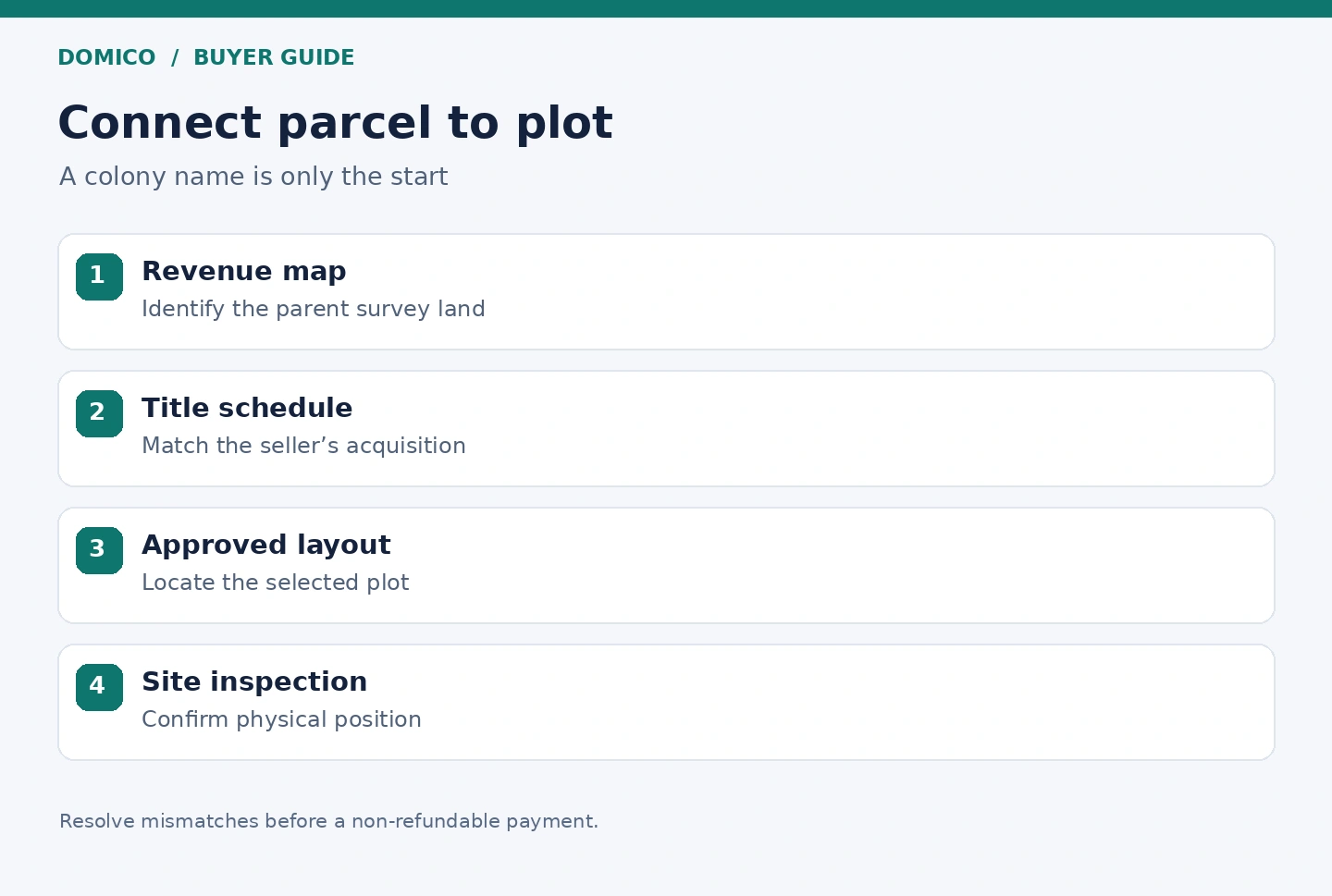
Build a cross-check sheet before booking
A compact sheet makes contradictions visible. Use separate columns for what each document actually says and what still needs explanation. Do not silently “correct” a mismatch in your own spreadsheet.
| Field | Revenue record | Seller's title document | Approved layout or site | Action |
|---|---|---|---|---|
| Village and survey number | Copy exact entry | Copy property schedule | Identify parent parcel | Resolve any difference |
| Recorded holder | List all names | List purchaser or transferee | Identify developer authority | Verify sale rights |
| Parent area | Keep original unit | Check conveyed area | Check land included in layout | Explain exclusions |
| Plot identification | May not use colony numbering | Check individual plot number | Match approved drawing | Establish a clear link |
| Boundaries or remarks | Record available details | Compare description | Inspect on the ground | Seek measurement if unclear |
Send this sheet with the underlying documents to your lawyer. A specific question such as “does this deed connect plot 42 to Khasra 118/2?” is more productive than asking whether a thick file “looks legal.”
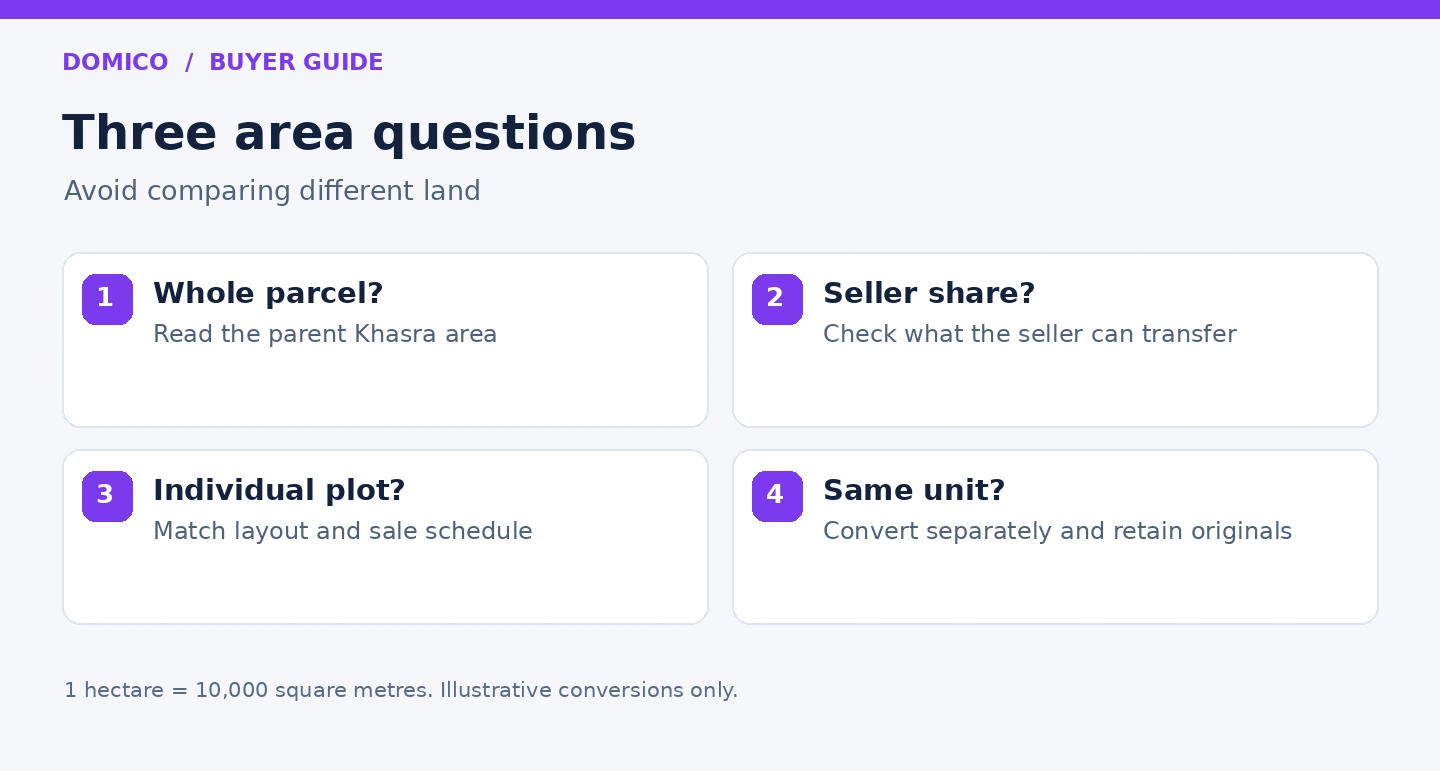
Worked example: one parent parcel, many plotted units
Consider an illustrative purchase of an 800-square-foot plot priced at ₹3,000 per square foot. The advertised base price is ₹24 lakh. The seller supplies a Khasra extract showing a parent parcel of 0.20 hectare.
That parent area equals 2,000 square metres, or about 21,527.8 square feet. It does not prove that every square foot is available for sale, and it does not identify which 800-square-foot rectangle belongs to you.
The buyer asks for the approved layout and discovers that the selected plot is connected to a different subdivision suffix from the one on the extract. This may be an explainable file mix-up. It may also be a material identification problem. The sensible next step is the same: request the correct extract, supporting title documents and a professional match before paying a non-refundable amount.
There is no need to accuse anyone to pause a transaction. A precise unresolved question is enough reason to hold the decision.
What these records cannot prove on their own
Revenue entries do not replace a full investigation of title. A current name entry is not a complete answer to an earlier defective transfer, an undisclosed heir, a mortgage or a pending dispute. Registration, revenue records, planning permissions and possession answer different questions.
Khasra and B-1 records also do not automatically establish that residential construction is permitted. Check applicable land-use planning, diversion or revenue-use requirements, colony permissions and the individual building approval process separately. An electricity connection, a neighbouring house or a bank's interest in financing should not be treated as a universal approval certificate.
Online map boundaries should not be used as precise setting-out instructions for a boundary wall. Where the plot location or edge is unclear, arrange the appropriate survey and demarcation process before construction or closing.
If the seller's name has not been updated
An out-of-date entry needs an explanation supported by documents. It does not automatically mean the seller has no rights, but it creates additional work for your adviser and can complicate finance, mutation and future resale.
Ask what event caused the change, when the corresponding application was made, whether an order exists and whether objections or competing claims remain. Obtain the application reference and the complete order where relevant. A verbal assurance that “mutation will happen later” leaves the buyer carrying uncertainty that could have been investigated beforehand.
Use the Indore revenue contacts directory to identify the relevant office through official channels. Confirm who is responsible for the exact village instead of relying on a middleman's contact alone.
Agree on clear conditions before paying
Your booking terms should identify the parcel accurately and record which documents the seller must supply. Ask your lawyer to make important payment milestones depend on resolving named discrepancies, establishing transferable title and completing the agreed checks.
Keep a dated record of extracts obtained and documents reviewed. If closing is delayed, refresh material records and ask whether intervening transfers, charges or orders need another check. The useful date is the date relevant to your transaction, not merely the date on a tidy PDF.
Take the checklist to your review
Download the printable Khasra and B-1 review worksheet. Record the exact property details, supporting evidence and questions that remain open.
Frequently asked questions
Is a Khasra number the same as a colony plot number?
Usually they identify different levels of land. A survey number identifies revenue land, while an approved colony drawing may divide that land into individual plots. Ask for a documented connection between the two, including the exact parent parcel and approved plot number.
Can I buy solely because B-1 shows the seller's name?
That is a useful entry, but it is not a complete title investigation. Check how the seller acquired rights, the earlier chain, encumbrances, authority to sell and the physical property. Resolve any conflicting evidence before relying on the entry.
What if the record shows hectares but the offer uses square feet?
Keep both values and show the conversion explicitly. Then establish whether you are comparing a whole parent parcel, a seller's undivided share or an individual approved plot. A correct conversion cannot fix a comparison between different pieces of land.
Is a downloaded record enough for a bank or registration?
The receiving authority or lender determines the form it accepts. An informational view, digitally signed extract and certified copy may serve different purposes. Ask which current document is required and obtain it through the official service rather than assuming every download has the same status.
Should I reject a property because of one spelling error?
First establish whether it is a clerical issue or a deeper identity mismatch. Obtain supporting identity and acquisition records and ask how correction will be completed. The concern is not the size of the typo; it is whether the seller's identity and rights can be established consistently.
Read the records to identify the land. Cross-check the documents to understand the purchase. A clear chain between the two is worth more than a confident sales explanation.
Related buyer guides
Property Documents Checklist Before Buying in India
Plot Buying Checklist: 20 Checks Before Booking
Sale Deed vs Agreement to Sell vs Mutation
Sources and further checks
- buyer-guide-100
- homebuyers
- mp-khasra-b1
- indore
Planning to buy or rent in Indore? Browse verified properties in Indore or read more Indore guides.