Buying Guide
Seller Lost Original Property Papers: Buyer Checks
Understand what certified copies and loss reports can establish, and what still needs investigation when original deeds are missing.

Table of contents
A seller says the original sale deed was lost during a move. They offer a photocopy and a discount. The right response is neither instant rejection nor instant acceptance. First establish what is missing, why it is missing and what the absence could conceal.
Replace the evidence gap, not just the missing paper. A certified copy can help establish a registered document's contents. It does not, by itself, explain whether an original was deposited with a lender or whether another transaction affects the property.
Define exactly what has been lost
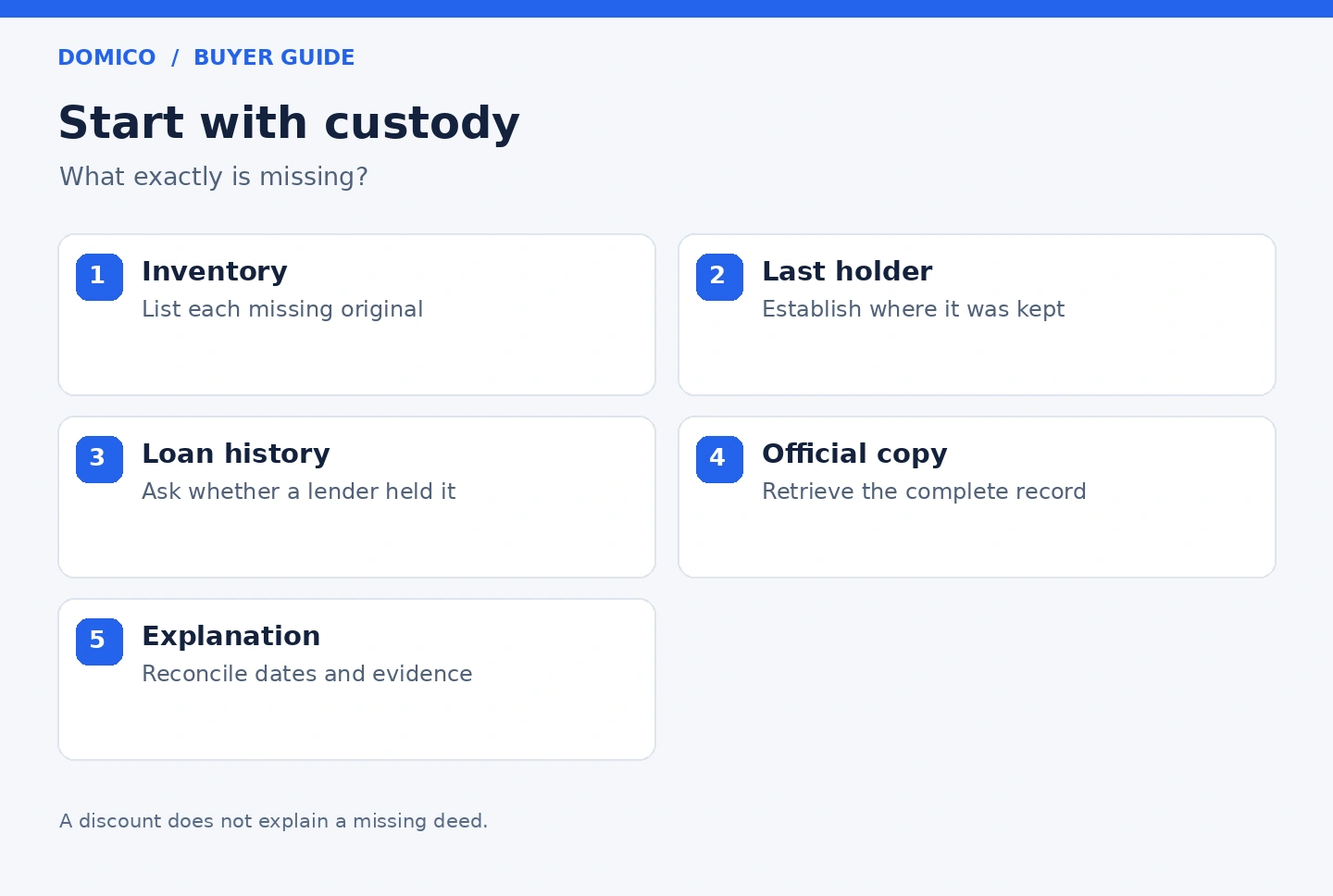
Ask for a written inventory of the missing documents. Is it the current owner's original acquisition deed, an earlier link document, an allotment letter, a share certificate or an entire file?
Record when the loss was discovered, who last held the documents and what efforts were made to locate them. Ask whether the originals were ever deposited with a bank, housing finance company, lawyer, developer or other custodian.
Different missing items create different questions. A missing old photocopy in a chain is not identical to a missing current original known to have been held by a lender. The investigation should focus on the actual gap rather than a generic “lost documents” checklist.
| Missing item or explanation | Main question to investigate | Useful evidence |
|---|---|---|
| Current original sale deed | Was it lost or deposited elsewhere? | Custody history and independent checks |
| Earlier title document | Is the ownership chain still established? | Official copy and chain review |
| Original held by a lender | What loan and release position applies? | Lender confirmation and document inventory |
| Entire old file missing | What records can be reconstructed? | Registration and authority records |
| Only an unreadable scan supplied | Does a complete authentic record exist? | Appropriate certified or official copy |
Obtain the registered document from the official source
Use the relevant registration office or official service to obtain an appropriate copy. The Registration Act provides the framework for inspection and certified copies, subject to applicable requirements. The MP government's service information identifies registered-document search and certified-copy services.
Retrieve the full instrument, including schedules, endorsements and annexures where part of the record. Compare it with the seller's copy and the property being offered.
A certified copy helps with the contents and official record of the document. Ask the lawyer what evidentiary and practical role it can serve in this transaction, rather than assuming it recreates every function of the original.
Investigate the possibility of a lender holding originals
Ask about every relevant loan against the property and obtain documentary details. A seller saying “the loan was closed years ago” should be able to provide the appropriate lender evidence and explain the return of documents.
Where a lender is involved, communicate through verified official channels with the necessary borrower authorisation. Establish the current account status, documents held, release requirements and any registry updates relevant to the lender's interest.
The RBI's direction on return of property documents after repayment addresses regulated entities and applicable cases. It also contains provisions concerning loss or damage of originals by a lender. Your lawyer and lender should assess its application; a buyer should not convert it into a promise that every missing deed will be replaced by a bank.
Use several checks, with their limitations understood
Have the lawyer examine the title chain, registration records, relevant security-interest information, court issues and actual possession. Ask what identifiers, periods and jurisdictions were checked.
A recent no-encumbrance result is not enough if the original's custody is unexplained. Likewise, a police loss report records a complaint or account of loss; it does not adjudicate ownership or remove an undisclosed lender's rights.
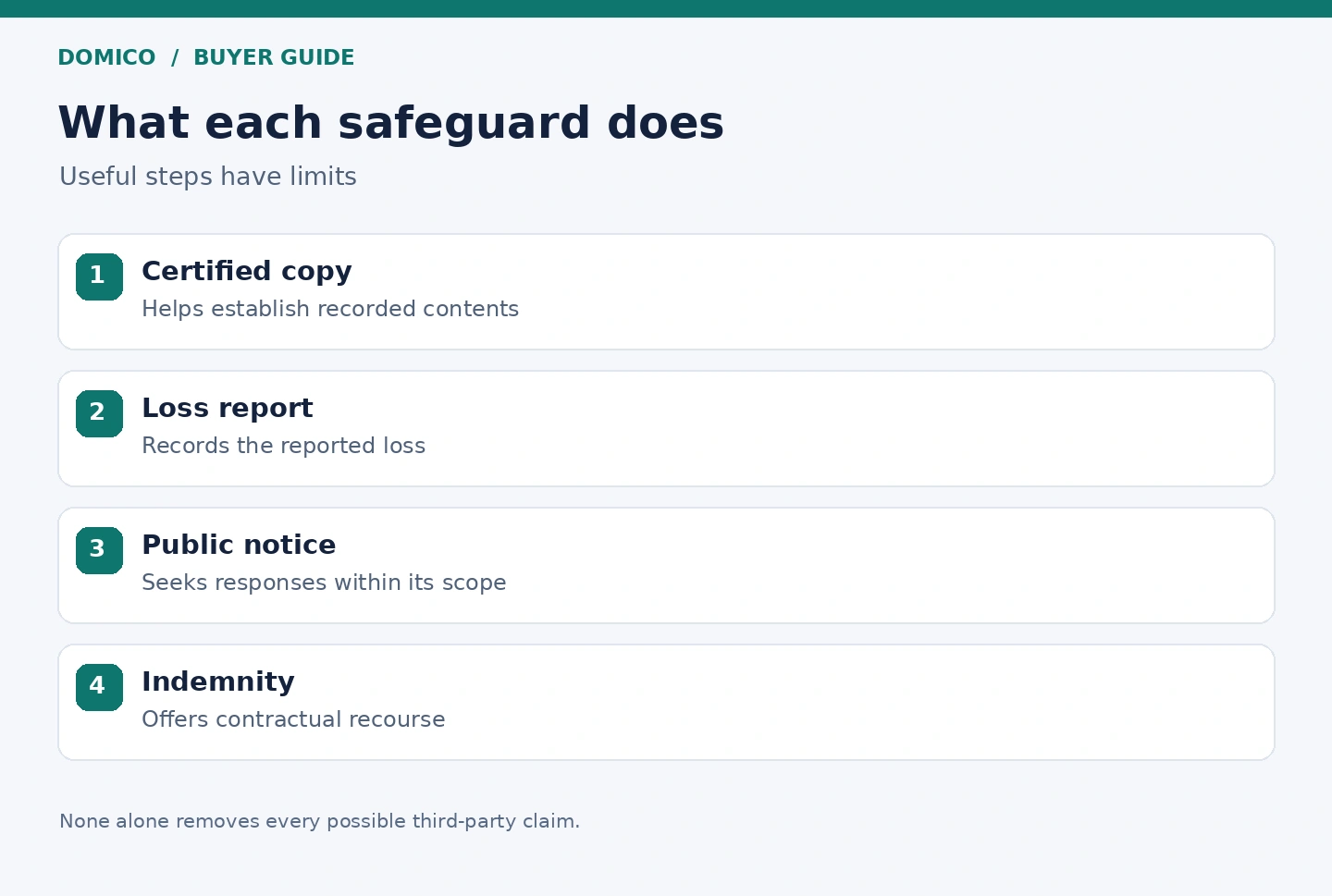
The seller may be advised to give a public notice or execute an affidavit or indemnity. These can be part of a professional risk-management approach where appropriate, but they are not universal cures. A notice with no response does not prove the absence of every claim.
Assess the seller's explanation for consistency
Compare dates across the seller's account, any loan closure, document return, loss report and certified-copy application. Ask about inconsistencies directly and calmly.
For example, a seller may say the deed was lost five years ago while a later lender inventory lists the original as received. That conflict needs explanation. It may be a documentation error, but the buyer should not choose a preferred version without evidence.
A cooperative seller can provide a clear narrative and authorise necessary verification. Pressure to accept a discount in place of investigation is a reason to pause.
Worked example: a discount is smaller than the uncertainty
An illustrative house is offered at ₹50 lakh, reduced to ₹48 lakh because the original deed is missing. The seller says the ₹2 lakh saving compensates for “paperwork inconvenience.”
The buyer's lawyer obtains a certified copy but still cannot establish where the original went. A historical loan is then identified. The next question is whether that loan and the related interest were fully dealt with, not whether the discount looks attractive.
If the lender confirms closure and explains the document history, the file can be assessed on that evidence. If the position remains uncertain, the buyer cannot sensibly price the risk merely by accepting ₹2 lakh off.
The sample values are illustrative. Missing-original cases differ, and no discount percentage makes an unexplained title or lender issue acceptable by default.
| Proposed reassurance | What it can contribute | What it does not settle alone |
|---|---|---|
| Certified copy | Contents of the registered record | Original's custody or every later claim |
| Police report | Documented account of reported loss | Final ownership determination |
| Public notice | Opportunity for responses in its scope | Guaranteed absence of hidden interests |
| Indemnity | Contractual recourse against its provider | Removal of a third party's existing rights |
| Price reduction | Lower acquisition cost | Legal or financing acceptability |
Check financing before becoming contractually committed
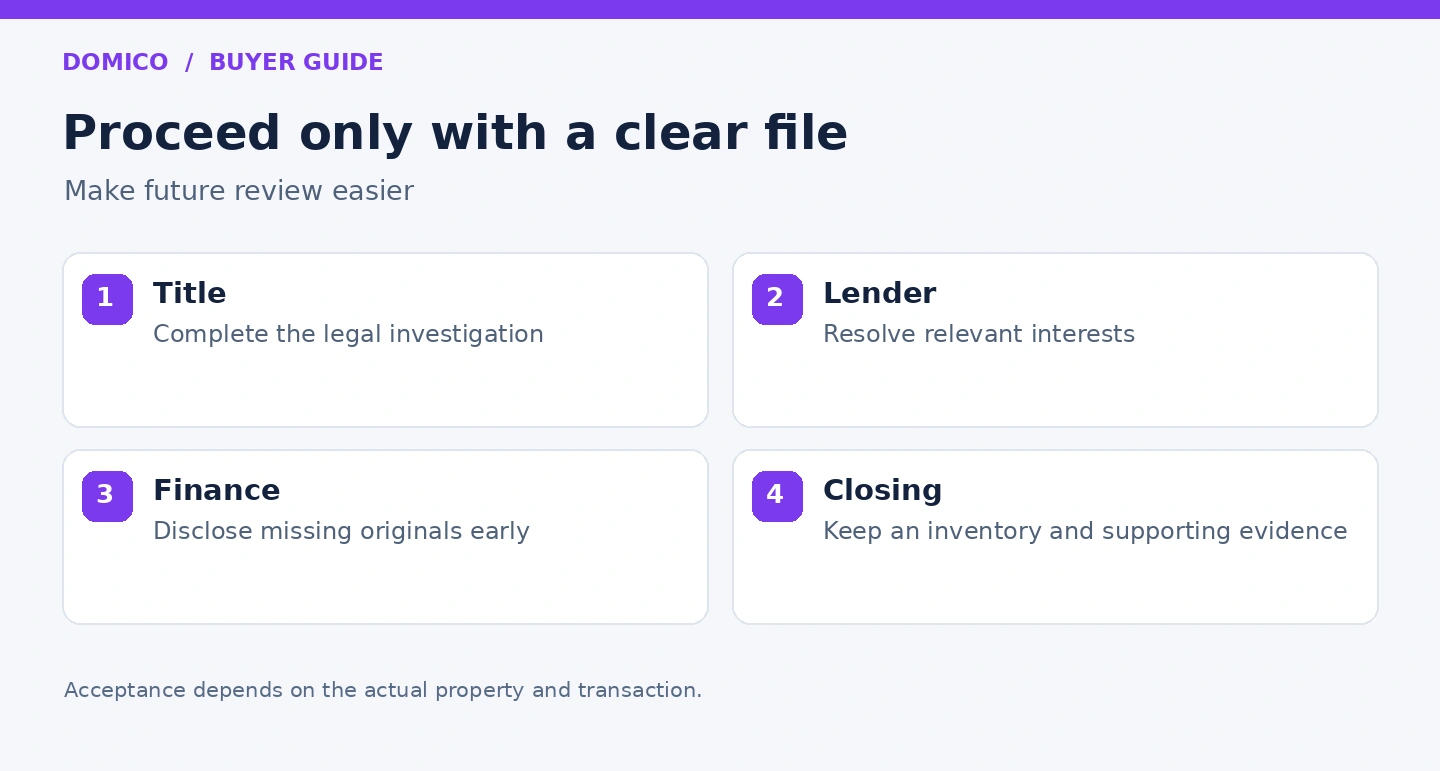
If you need a home or plot loan, disclose the missing originals to the proposed lender early. Ask what documents and investigation it requires and whether the property is acceptable under its policy.
A lender's willingness is useful information but does not replace the buyer's independent assessment. Conversely, a seller's claim that “another bank will finance” is not a loan commitment to you.
Make the booking terms consistent with the unresolved financing and legal issues. Ask the lawyer how conditions and refund consequences should be framed if the necessary evidence cannot be obtained.
Prepare the closing and future resale file
If professional advice supports proceeding, retain the reconstructed record, custody explanation, relevant lender documents and the legal opinion. The final transaction should disclose material facts appropriately rather than making the missing original disappear from the narrative.
Ask how originals or available documents will be handed over, and obtain an inventory. For a continuing lender relationship, establish which institution will hold which documents after closing.
Think about the next buyer. A missing-original history that is well investigated and documented is easier to explain than a file containing only an affidavit and an unexplained discount. Good records do not guarantee future acceptance, but they help future reviewers understand the evidence.
When it is reasonable to pause or walk away
Pause if the seller refuses independent verification, cannot identify the property consistently, supplies incomplete copies or changes the custody story repeatedly. Also investigate any known lender interest that remains unresolved.
You do not need to prove fraud before deciding the evidence is insufficient for your purchase. The buyer's task is to decide whether the property and transaction are acceptable, not to solve every unexplained history at personal expense.
Compare the total effort, financing limits and remaining uncertainty with alternative properties. A cheaper asking price can be a poor saving if it leaves the buyer unable to complete or later resell comfortably.
Printable buyer worksheet
Download the topic-specific review checklist. Use it to record evidence, unanswered questions and follow-up actions for the exact property.
Frequently asked questions
Is it illegal to buy a property whose original deed is lost?
There is no useful blanket answer based only on that fact. The lawyer must assess title, the reason for absence, available evidence and transaction requirements. Financing and future resale acceptance also need consideration.
Does a certified copy replace the original completely?
It can establish the contents of an official registered record, but it does not answer every question about custody, security interests or later transactions. Ask what role it serves in the specific legal and lending assessment.
Is a police loss report enough to proceed?
No single loss report is a complete title investigation. It should be examined with the custody history, official copies, lender position and other relevant records. A reported loss does not extinguish another person's rights.
What if the bank lost the papers?
Obtain the lender's written account and relevant inventory, then investigate applicable RBI directions and the required assistance or remedies. Confirm the effect on the proposed sale and financing with your lawyer and lender.
Should I accept an indemnity from the seller?
Have it reviewed as part of the overall transaction. Its value depends on wording, enforceability and the provider's ability to meet obligations. It is a form of recourse, not a substitute for resolving an identifiable third-party interest.
Missing paper is a reason to investigate. An unexplained gap is a reason to hold the decision until the evidence supports it.
Related buyer guides
Property Documents Checklist Before Buying in India
Home Loan Eligibility by Salary: A Practical Guide
Booking Amount and Property Cancellation Terms
Sources and further checks
- buyer-guide-100
- homebuyers
- lost-original-property-papers
- indore
Planning to buy or rent in Indore? Browse verified properties in Indore or read more Indore guides.