Buying Guide
Joint Home Loan Tax Benefits: Ownership and EMI Shares
Understand joint home loan tax claims using ownership, borrowing, repayment evidence and individual deduction limits, with a 60:40 example.
Updated 8 min read

Buying Guide
Understand joint home loan tax claims using ownership, borrowing, repayment evidence and individual deduction limits, with a 60:40 example.
Two names on a loan do not automatically create two full tax deductions.
Buying a home jointly can spread responsibility and reflect the family's ownership plan. It can also create confusion at tax time. One spouse may be on the deed, both may be on the loan and all EMIs may leave a third joint account. Without a clear trail, a simple household arrangement becomes difficult to explain.
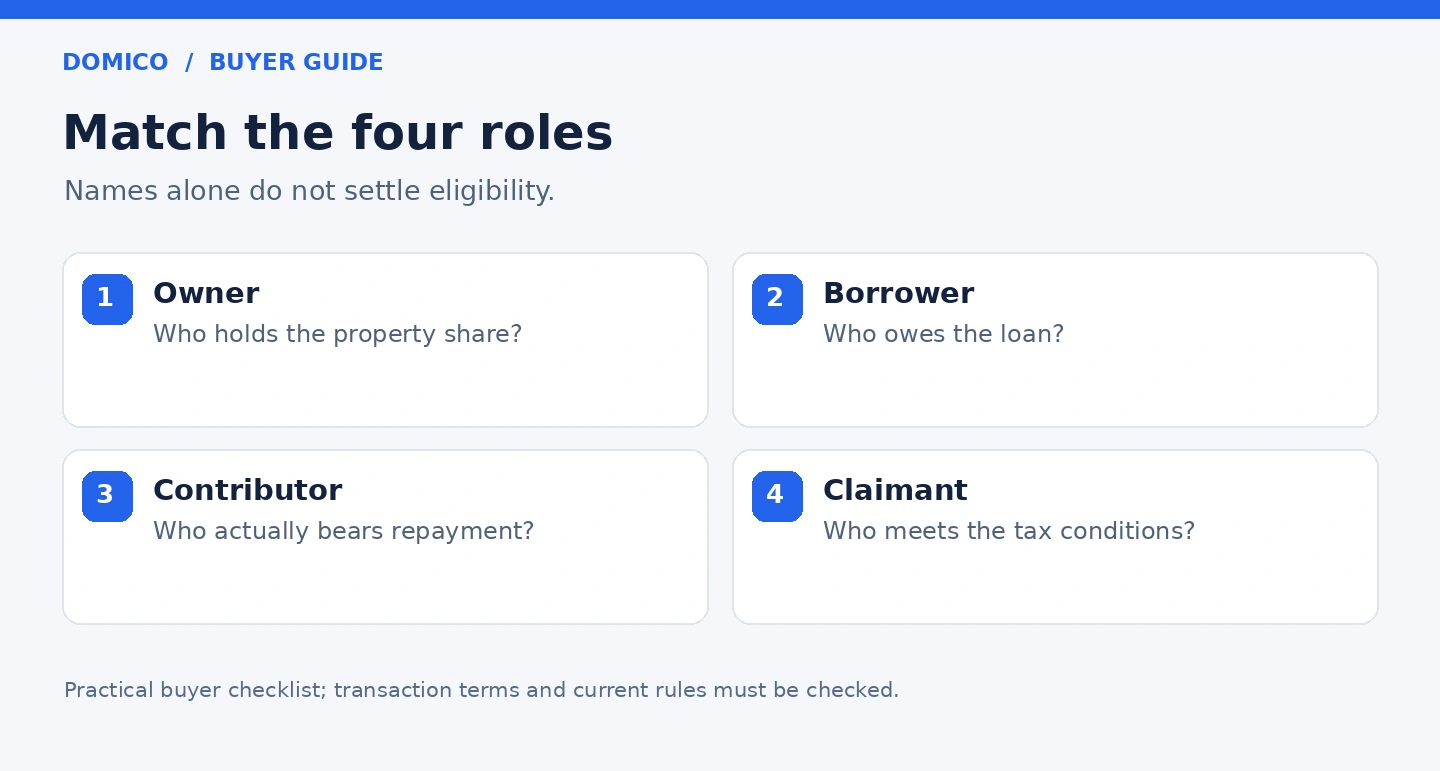
The useful starting point is to separate ownership, borrowing and actual repayment. They are connected, but they are not interchangeable. A defensible claim should match the property's legal and beneficial position, the eligible borrowing, the repayment contribution and the applicable tax rules.
Read the registered document and identify each owner's share. Where shares are definite and ascertainable, the current section 24 of the Income-tax Act, 2025 addresses separate computation for co-owners. That is a useful framework, but it does not mean every co-borrower owns the property or qualifies for every deduction.
A person added to strengthen income eligibility may be a co-borrower without being a co-owner. Another person may own part of the home but not have the relevant borrowing or repayment facts. Ask a tax professional to assess the actual arrangement rather than reading the deduction limit as an automatic entitlement.
| Role | What the record shows | Why it matters |
|---|---|---|
| Co-owner | Interest in the property | Establishes ownership position |
| Co-borrower | Liability under the loan | Establishes borrowing obligation |
| EMI contributor | Funds actually paid or borne | Supports repayment allocation |
| Tax claimant | Person claiming a permitted benefit | Must satisfy the relevant conditions |
The same person can occupy all four roles, but do not assume that the labels line up merely because a bank form lists several names. Keep the deed, loan contract and payment trail together.
The EMI should be divided into interest and principal using the lender's certificate and statement. Each component follows its own tax framework. Do not split the total EMI in half and describe that figure as the deduction.
For qualifying self-occupied interest, relevant old-regime conditions and ceilings apply individually where the co-owner qualifies. Eligible principal payments fall within the specified-payment framework and each person's available aggregate limit. One spouse's unused room does not automatically transfer to the other.
For tax years from April 2026, use the current sections and schedules. Many familiar explanations refer to the 1961 Act. The official transition FAQ explains the new framework, including section 123 and ScheduleXV for the specified-payment deduction.
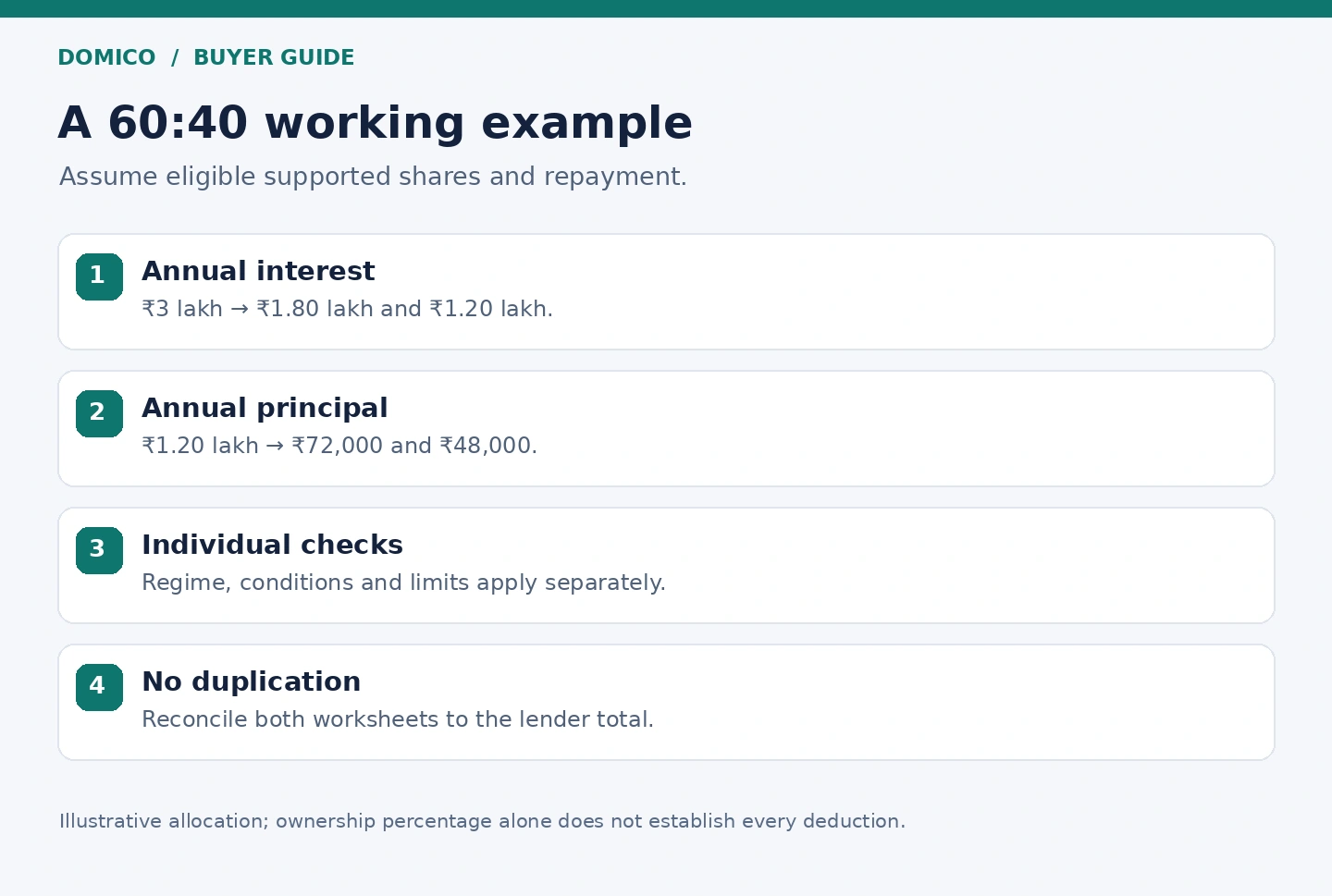
Assume two eligible co-owners and co-borrowers hold and bear the relevant borrowing in a properly supported 60:40 arrangement. Suppose qualifying annual interest is ₹3 lakh and principal repaid is ₹1.20 lakh. The first worksheet allocation is ₹1.80 lakh interest and ₹72,000 principal for Owner A, and ₹1.20 lakh interest and ₹48,000 principal for Owner B.
This is an illustrative allocation method, not a rule that a deed percentage automatically decides every claim. The actual financing and repayment facts must support the treatment. Regime choice, property use and individual conditions still need to be checked.
| Illustrative annual amount | Total | Owner A:60% | Owner B:40% |
|---|---|---|---|
| Eligible interest before individual checks | ₹3,00,000 | ₹1,80,000 | ₹1,20,000 |
| Principal repayment before limit checks | ₹1,20,000 | ₹72,000 | ₹48,000 |
| Individual deduction room | Must be checked | Depends onA’s other claims | Depends onB’s other claims |
If Owner A already has ₹1.30 lakh of other qualifying payments within an applicable ₹1.50 lakh aggregate limit, only ₹20,000 of room remains for eligible principal in this simplified example. Owner B's position must be computed separately. The allocated principal and the deductible principal are therefore not necessarily the same.
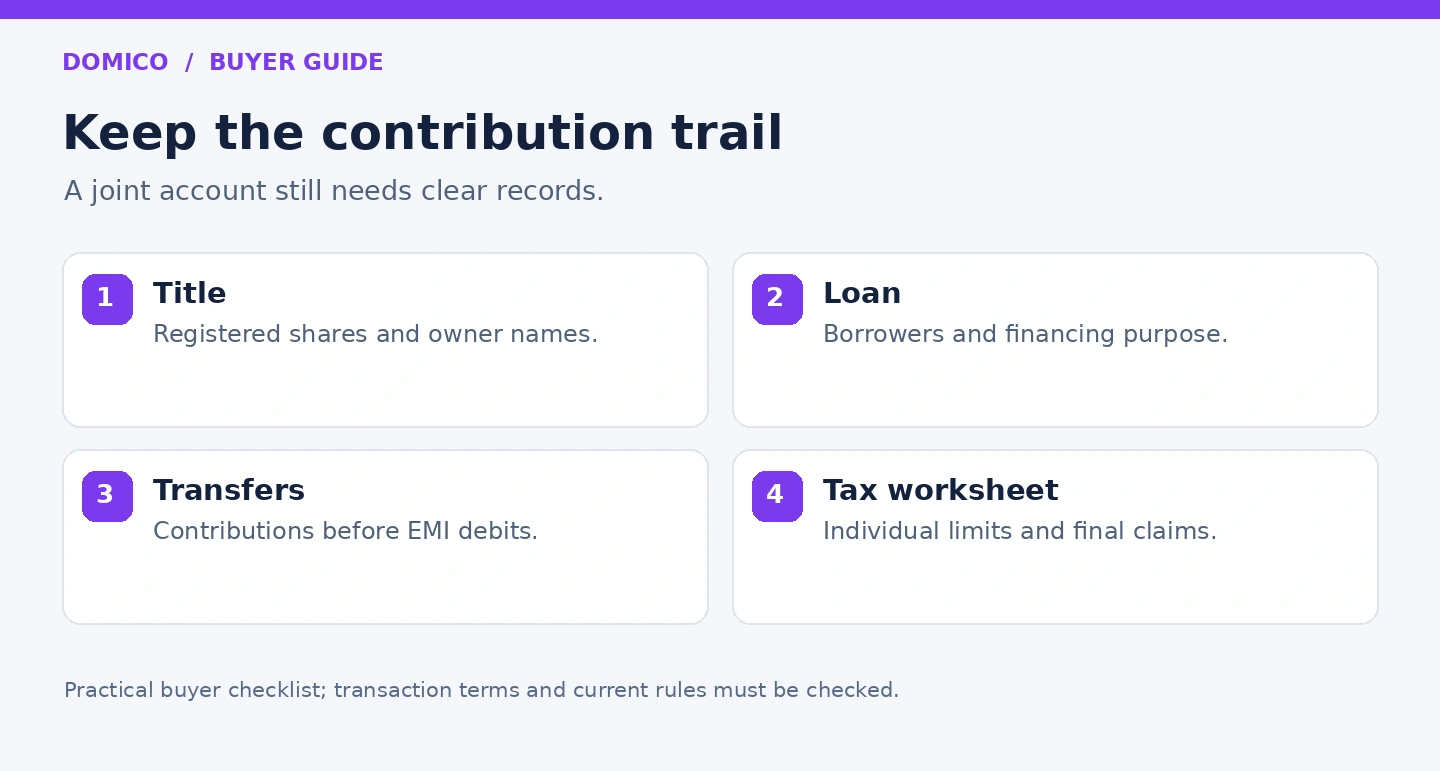
A joint account makes EMI payment convenient, but the account title alone may not show who funded it. Retain salary transfers, contributions and other records that explain the amount each person actually bore. A simple monthly ledger can prevent uncertainty several years later.
If one spouse transfers ₹20,000 and another ₹15,000 into the account before a ₹35,000 debit, keep the transfers visible. If contributions change, record the reason and review whether the tax allocation still fits. Do not create a retrospective 50:50 narrative just because it gives a more attractive deduction.
Where one person funds another's contribution, a gift, loan, ownership and possible clubbing analysis can arise. Obtain advice on the complete arrangement. A family understanding about who will eventually repay is not necessarily enough to establish the current tax result.
Do not assume that adding the other person's name gives them a deduction for money they did not bear. Conversely, paying the whole EMI does not automatically give one person every benefit irrespective of ownership and statutory conditions.
The correct answer can depend on legal ownership, beneficial ownership, borrowing and actual contribution. Have the structure reviewed before booking if tax benefits materially affect the plan. Correctly documenting the arrangement at purchase is easier than trying to reconstruct it from cash transfers later.
If the household's objective is simply administrative convenience, consider whether the proposed ownership and borrowing structure also fits inheritance, future sale and relationship risks. Tax savings should not be the only reason to add a co-owner who will hold real legal rights.
A household can have different individual income profiles. Where permitted, one person's regime comparison can differ from another's. The home-loan claim must still meet the relevant rules; a shared property does not turn two individual returns into one pooled calculation.
Self-occupied interest and specified principal-related deductions are not available under the new regime in the same way as under the old regime. Compare each person's complete tax position and then review the combined household result. Avoid choosing a regime by looking only at one housing deduction.
Do not claim the same payment twice. A useful control is to reconcile total interest and principal allocated across all owners with the lender's annual statement. The sum of individual worksheets should explain the whole amount without exceeding it.
If the home is under construction, keep the pre-completion interest trail and review when a claim can begin. The date the loan starts and the date the property qualifies for a particular deduction may differ. Each co-owner's share of prior-period amounts should be supported consistently.
If the property is rented, rental income and expenses must also be allocated appropriately. A self-occupied example should not be copied into a rental return. Limits on losses and their use can affect the result.
After a balance transfer or borrower change, retain both the earlier and new loan records. A new account number should not break the evidence linking the borrowing to the property. If an owner exits, obtain advice on the transfer, loan release and future claims before continuing the old allocation.
| Record | Purpose | Check to perform |
|---|---|---|
| Registered ownership document | Identifies owners and shares | Match all names and percentages |
| Loan agreement | Identifies borrowers and liability | Confirm relation to the property |
| Annual lender statement | Separates principal and interest | Reconcile with actual payments |
| Contribution ledger | Shows who bore repayments | Match bank transfers and debits |
| Individual limit worksheet | Tests each owner’s eligibility | Include other qualifying payments |
| Return working papers | Records final claims | Prevent duplicate allocation |
A short signed family note can help explain the intended contribution arrangement, but it should not conflict with the legal documents or substitute for actual evidence. Have significant mismatches corrected through proper legal and tax advice.
Prepare one household worksheet showing total interest, total principal and the amount allocated to each claimant. Then give each person their supporting contribution records and individual calculation. This does not combine the tax returns; it checks that the same loan has been accounted for consistently.
Where the two returns are prepared by different professionals, share the relevant allocation information through an appropriate private channel. Otherwise, each preparer may independently assume that the full certificate belongs to their client. A short reconciliation prevents a simple communication failure from becoming a duplicate claim.
If ownership or contributions change during the year, record the actual date and obtain advice on the effect. Do not keep an old percentage merely because it was convenient in the previous return. Consistency is useful only when it reflects the current arrangement.
Download the topic-specific review checklist. Use it to record evidence, unanswered questions and follow-up actions for the exact property.
Not simply because both names appear. Claims must reflect the eligible amount attributable to each person and their individual conditions. The same interest cannot be counted twice.
No. Borrowing liability and property ownership are different. Check the registered title and the financing documents rather than assuming the bank's borrower list establishes ownership.
It proves the account made the debit, but may not establish equal funding. Keep records of contributions and have the allocation reviewed against the complete arrangement.
Individual limits are not automatically transferable between spouses. Compute each person's eligible claim and available room separately.
Ownership creates real rights and future consequences. Consider contribution, inheritance, sale and borrowing responsibility alongside tax. A suitable structure should remain sensible even if a tax benefit changes.
Planning to buy or rent in Indore? Browse verified properties in Indore or read more Indore guides.
Check who owes the lender, how builder-paid interest works, when support ends and whether you can carry the loan if payments stop.



