Buying Guide
15 vs 20 vs 30-Year Home Loan: EMI and Interest
Compare 15-, 20- and 30-year home loans with a ₹40 lakh worked example, total interest, retirement checks and practical prepayment planning.

Table of contents
A smaller EMI can come with a much longer bill.
When a lender asks you to choose fifteen, twenty or thirty years, the difference may seem like a simple monthly affordability decision. In reality, the term determines how quickly you build equity, how much interest you could pay and how long the EMI remains part of your working life.
The right tenure is one that protects the household today and still fits the future. A very short term can leave no room for emergencies. A very long term can quietly turn a manageable purchase into decades of interest. Comparing both the monthly and lifetime numbers makes the trade-off visible.
What changes when you extend the tenure?
With the same principal and rate, stretching repayments over more months lowers the EMI. However, the principal reduces more slowly, so interest has more time to accumulate. The lower payment is useful for cash flow but does not mean the borrowing itself costs less.
Age, lender policy, income and the property's eligibility can limit the term available. Treat a thirty-year option as something to confirm, not an entitlement. The final repayment date is particularly important if it falls after your planned retirement or beyond a period of dependable business income.
The RBI's home loan consumer guidance encourages borrowers to compare rates, terms and total costs. For a current offer, use the lender's KFS and repayment schedule rather than relying solely on a calculator result.
₹40 lakh over 15,20 and 30 years
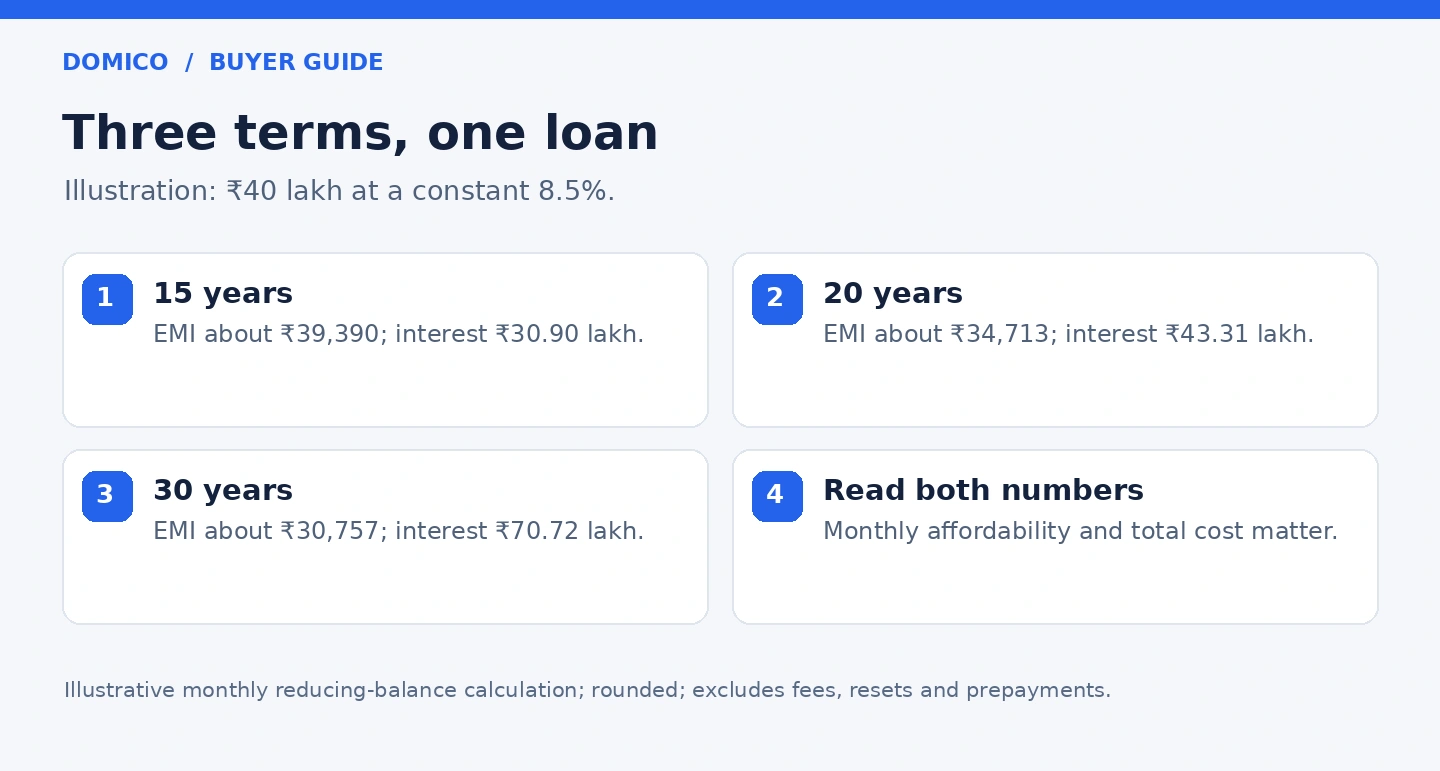
The following illustration assumes a ₹40 lakh loan at a constant 8.5% annual rate, monthly reducing-balance repayments and no fees, prepayments or rate changes. Actual floating-rate outcomes will differ.
| Tenure | Approximate monthly EMI | Total repayment | Interest within total repayment |
|---|---|---|---|
| 15 years | ₹39,390 | ₹70.90 lakh | ₹30.90 lakh |
| 20 years | ₹34,713 | ₹83.31 lakh | ₹43.31 lakh |
| 30 years | ₹30,757 | ₹110.72 lakh | ₹70.72 lakh |
Moving from twenty to thirty years reduces the illustrative EMI by about ₹3,956. Under these unchanged assumptions, it increases total interest by approximately ₹27.41 lakh. That is why the monthly saving needs to be considered alongside the extra ten years of payments.
Moving from twenty to fifteen years increases the EMI by about ₹4,677 but reduces interest by roughly ₹12.41 lakh. The shorter option can be attractive when that larger compulsory payment fits comfortably within stable income.
Understand the calculation
A standard monthly EMI can be calculated using the principal, monthly interest rate and number of payments. The monthly rate is the annual nominal rate divided by twelve. Total interest in a constant-rate illustration equals EMI multiplied by the number of months, less the original principal.
This method is helpful for comparing terms, but it does not predict future floating rates. It also excludes processing fees, insurance, irregular disbursements and payment-date effects. Use rounded calculator outputs for planning and the lender's schedule for the contractual figures.
If a salesperson quotes only total interest, ask what assumptions produced it. If a calculator quotes only EMI, look for the total repayment. Both numbers are needed to understand the offer.
Start with a household surplus calculation
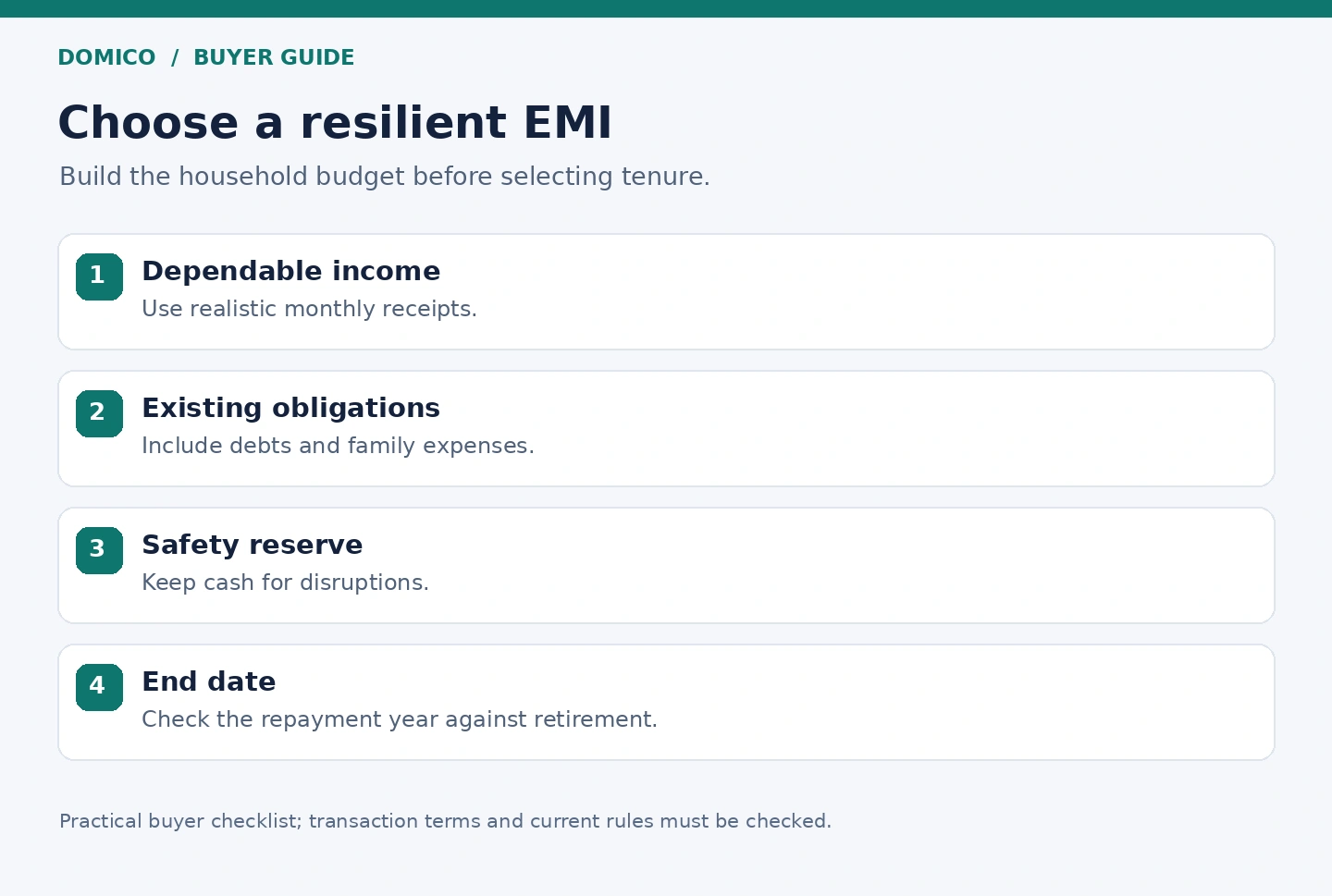
Write down reliable take-home income, existing EMIs, rent during any overlap, food, utilities, travel, school fees, insurance and recurring family support. Include annual expenses by setting aside a monthly amount. A budget that ignores renewals, repairs and festivals can overstate what is available for an EMI.
Next, decide how much cash should remain for emergencies and future goals. The leftover amount is more useful than a generic claim that every household can spend a certain percentage of salary on housing. Two families with the same income can have very different obligations.
For a self-employed buyer, test the EMI against a lower-income month and a slow quarter. For a salaried buyer, consider one temporary income gap. A term is affordable when the payment survives realistic disruptions, not only the best month of the year.
A longer sanctioned term with voluntary prepayments
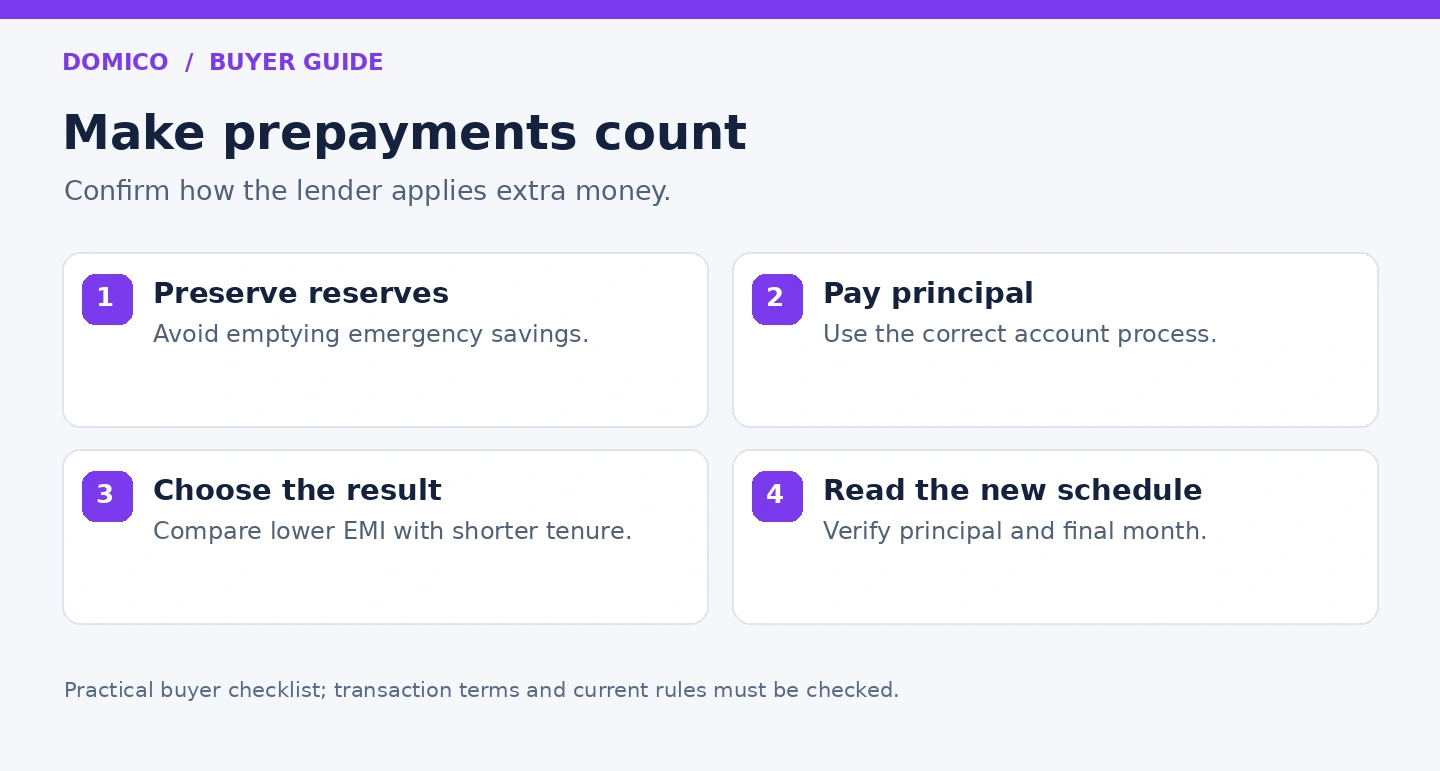
Some borrowers choose a manageable compulsory EMI and make extra principal payments when money is available. This can provide flexibility, but the interest saving occurs only when the extra payments actually happen and are applied to principal.
Ask the lender how to request a tenure reduction after prepayment. If the EMI is lowered instead, the household gets more monthly breathing room, while the interest outcome may differ. Obtain an updated schedule so you can see the result rather than assuming it.
The RBI 2025 prepayment directions contain protections for qualifying loans sanctioned or renewed from 1 January 2026. Confirm how the rules apply to your rate type and loan purpose. Do not select a product based on an unverified assurance about future exit charges.
A flexible plan is different from a vague promise to prepay. Decide a realistic review date, the source of extra funds and the emergency balance you will preserve. Avoid using all available savings to reduce the loan if it leaves the family exposed to the next unexpected expense.
Rate increases and tenure extension
A floating-rate rise may lead to a higher EMI, a longer remaining term or both, depending on the applicable arrangement and borrower choice. A long loan can become longer still. Check the new closing date every time the account resets.
For example, a buyer planning to finish a loan before retirement may discover that the latest statement now carries payments into retirement. The same EMI amount on the bank message can hide that change. Review outstanding principal, current interest, months left and the final payment date together.
Discuss available options early. Waiting several years while the principal falls slowly can make the eventual correction more demanding. The objective is to keep repayment aligned with income, not to avoid every EMI change at any cost.
Do not shorten the term by weakening the rest of the purchase
A fifteen-year loan can look efficient, but not if the higher EMI forces you to borrow separately for registration, essential repairs or furnishing. Compare the whole household debt position rather than celebrating a short home-loan term while carrying expensive unsecured debt.
Keep purchase costs and immediate habitability work outside the EMI comparison. A home that needs ₹4 lakh of unavoidable repairs requires that cash whether the mortgage lasts fifteen or thirty years. Your emergency reserve should not be counted twice as both the down payment and the post-purchase safety net.
| Household situation | Question to test | Possible planning response |
|---|---|---|
| Stable surplus and strong reserves | Can the higher EMI remain comfortable? | Compare a shorter contractual term |
| Variable income | Can a weak quarter cover compulsory payments? | Prefer a resilient EMI and disciplined optional prepayments |
| Retirement approaching | When does dependable income reduce? | Align end date and retirement funding |
| Significant near-term family costs | What will compete with the EMI? | Preserve room for known obligations |
| Expected bonus or asset sale | Is the money certain and when will it arrive? | Treat it as optional until received |
Make a one-page tenure decision
Save the three EMI calculations, total interest illustrations and the budget used to choose. Add your expected retirement date, emergency reserve and a plan for any voluntary prepayments. Ask the lender to confirm the selected term in the sanction letter and agreement.
Review the choice when income changes, rates reset or a large prepayment becomes possible. A tenure is not a measure of financial success. It is a tool for balancing cost, flexibility and the ability to keep every payment on time.
Turn the comparison into a repayment calendar
Mark the expected final EMI month for each tenure, then add major family milestones such as school transitions, retirement or an expected business investment. This makes the term more concrete than a number in a calculator. An apparently small EMI difference can matter when several obligations fall in the same year.
For example, someone beginning a twenty-year loan at age forty-five should explicitly discuss the years after expected retirement. The bank's willingness to offer a term does not prove that the household has funded those years. Identify the income source or revised repayment plan rather than leaving the final instalments to an unspecified future asset sale.
Keep the calendar flexible. Update it after a rate reset or part-prepayment, and confirm that the lender's revised schedule reflects the intended end date. The useful test is whether the household's plan and the actual account remain aligned.
Printable buyer worksheet
Download the topic-specific review checklist. Use it to record evidence, unanswered questions and follow-up actions for the exact property.
Frequently asked questions
Is a thirty-year home loan a bad choice?
Not automatically. It can make the compulsory EMI more manageable, but usually increases interest under otherwise identical assumptions. Its suitability depends on cash flow, age, prepayment discipline and the terms actually available.
Should I always choose the shortest tenure the bank allows?
Only if the EMI leaves sufficient room for essential expenses, insurance, emergency savings and other goals. A shorter loan that regularly strains the household is not a sound plan.
Can I reduce the tenure later?
Ask the lender about part-prepayments, EMI increases and the process for revising the schedule. The result depends on the account terms and how the extra payment is applied.
Is total repayment the same as the property cost?
No. It includes loan principal and interest under the calculation assumptions. Your purchase budget can also include the down payment, registration charges, taxes, repairs and other spending outside the loan.
Why does interest change so much over a longer term?
The outstanding principal remains unpaid for more months. Because each month's interest is calculated on the relevant balance, slower principal reduction can substantially increase the accumulated interest.
Sources and related reading
- buyer-guide-100
- homebuyers
- home-loan-tenure
- indore
Planning to buy or rent in Indore? Browse verified properties in Indore or read more Indore guides.