Buying Guide
Home Loan Tax Benefits: Old vs New Regime Guide
Separate home loan interest and principal, check deduction limits and compare old versus new tax regimes under the current tax-year framework.
Updated 8 min read

Buying Guide
Separate home loan interest and principal, check deduction limits and compare old versus new tax regimes under the current tax-year framework.
A deduction reduces taxable income. It does not make the EMI free.
Home loan tax benefits can improve the cost of ownership, but they should be calculated after the loan is affordable, not used as a substitute for affordability. A buyer may hear about ₹2 lakh of interest relief and assume that ₹2 lakh will return to the bank account. That is not how a deduction works.
The more useful question is how much tax the household actually saves under each available regime after considering all income, deductions and conditions. A home loan is one input in that comparison. The interest paid, principal repaid, property use and the rest of your tax position all matter.
The Income-tax Act, 2025 applies to tax years beginning from 1 April 2026, subject to transition provisions. Earlier years continue to require the appropriate earlier law. Separately, taxpayers may compare the old and new tax regimes where they are eligible to choose. These are two different distinctions.
Many familiar articles use section 24(b) for home-loan interest and section 80 C for qualifying principal payments under the 1961 Act. Current references include section 22 for house-property deductions and section 123 with ScheduleXV for specified qualifying payments under the 2025 Act. Use the provision for the relevant tax period rather than mixing old labels into a new return.
| Distinction | What it answers | Buyer’s task |
|---|---|---|
| 1961 Act vs 2025 Act | Which law applies to the tax period? | Identify the correct year and transition |
| Old vs new tax regime | Which permitted tax computation is used? | Compare the full eligible return |
| Interest vs principal | What part of the EMI was paid? | Obtain the lender’s breakup |
| Self-occupied vs let-out | How is the property used? | Apply the appropriate house-property rules |
The official transition FAQ is a useful starting point for the change in section references. It does not remove the need to check the current provision and the actual facts.
An EMI can contain interest and principal, but their amounts change as the balance reduces. The full EMI is not one large deduction. Ask for an annual interest certificate and loan statement showing the relevant amounts for the year.
Interest is examined under house-property provisions. Eligible principal and specified acquisition-related payments can fall within the relevant deduction framework and aggregate limits, subject to conditions. Existing provident-fund contributions or other qualifying payments may already use part or all of that limit.
This is why two buyers paying the same EMI can receive different tax outcomes. One may have unused deduction room, another may already have exhausted it and a third may use a regime that does not permit the relevant claim.
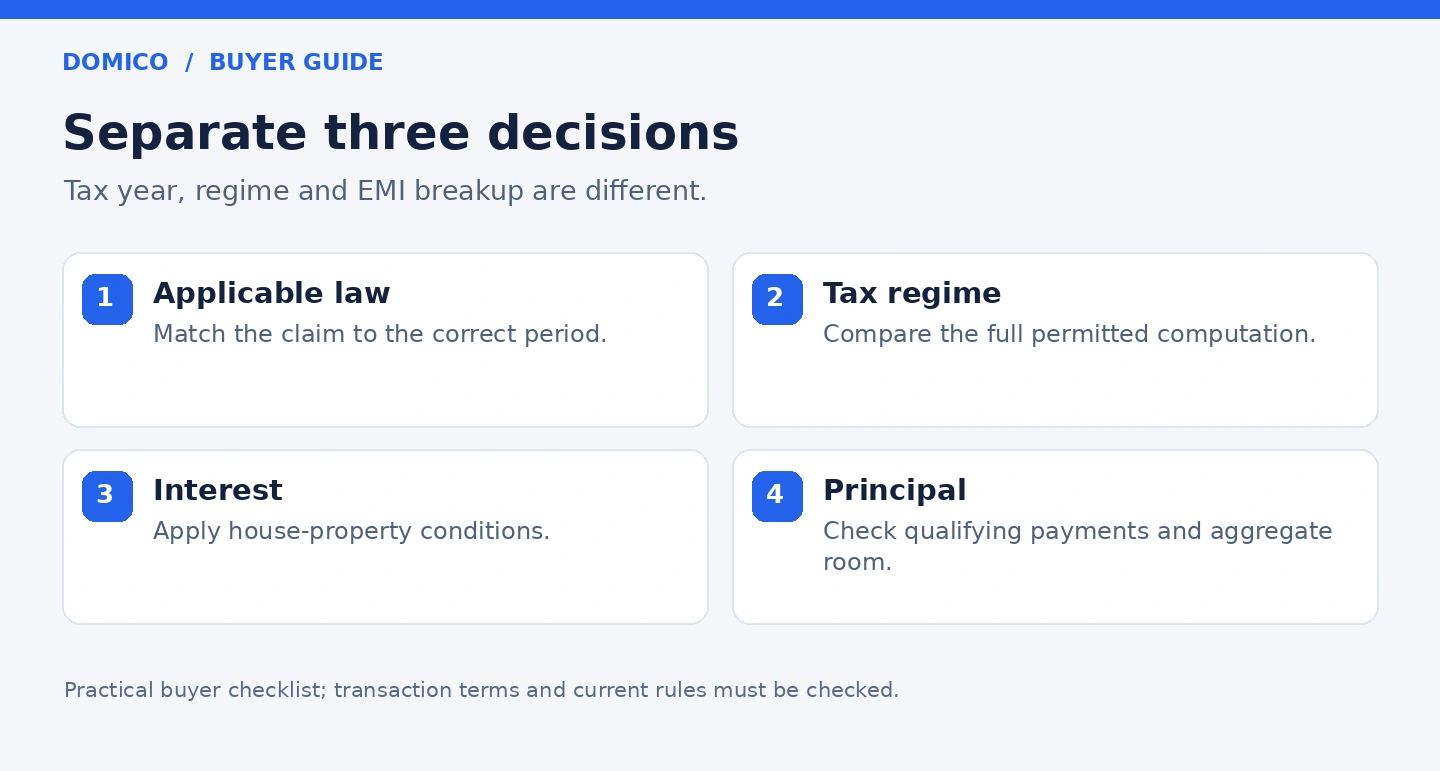
The current section 22 provides an interest deduction framework with a ₹2 lakh ceiling for qualifying self-occupied acquisition or construction cases, subject to conditions including completion timing and an interest certificate. Other cases can have a lower limit. The ceiling is not a blanket promise for every housing-related borrowing.
Check the purpose of the loan, completion records and whether the property qualifies for the treatment claimed. A repair loan and an acquisition loan should not be assumed to receive identical limits. Multiple self-occupied properties also require attention to the aggregate restriction.
For an under-construction purchase, keep prior-period interest records and completion evidence. The timing and permitted treatment of pre-construction interest should be checked rather than treating every payment as immediately deductible in the year it is paid.
The official old-versus-new-regime guidance explains that self-occupied home-loan interest is not available as a deduction under the new regime. The familiar section 123 specified-payment deduction is also not available under the new concessional regime according to the transition guidance.
That does not automatically mean the old regime produces less tax. The new regime's rate structure and other permitted treatment can still produce a better overall result. Compare total tax under both using the same income and only deductions actually available to you.
Let-out property requires a separate computation, including rental income and the applicable restrictions on losses and set-off. Do not extend a self-occupied summary to a rental investment without checking the relevant rules.
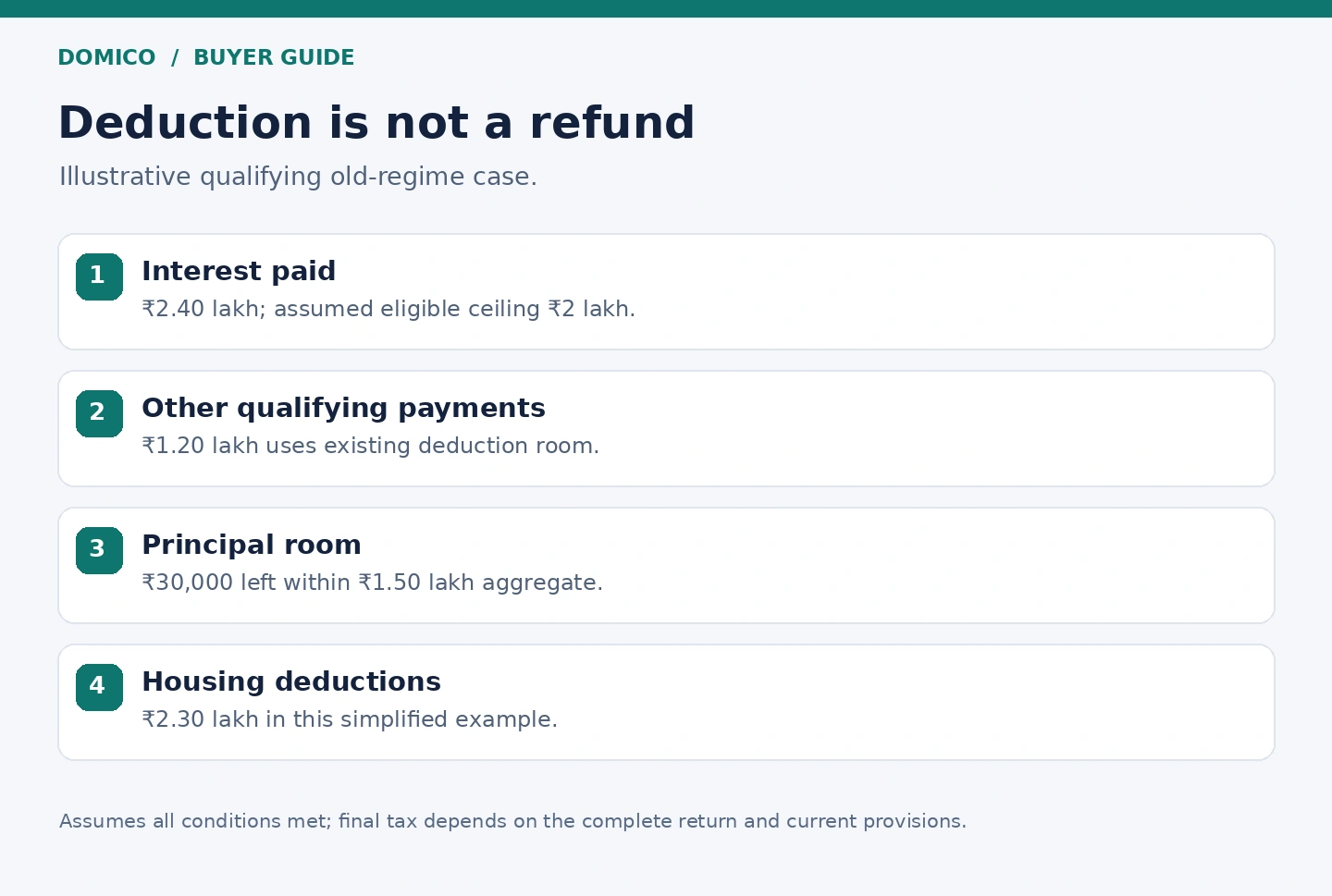
Suppose a qualifying old-regime taxpayer pays ₹2.40 lakh of eligible housing interest and ₹1 lakh of principal during the year. Assume the applicable interest ceiling is ₹2 lakh and the taxpayer already has ₹1.20 lakh of other payments using the ₹1.50 lakh specified-payment limit.
In this simplified case, only ₹30,000 of room remains within that aggregate limit for eligible principal. The potential housing-related deductions added to the comparison are therefore ₹2 lakh of interest and ₹30,000 of principal, rather than the full ₹3.40 lakh cash paid.
| Illustrative item | Amount paid | Amount entering this simplified deduction comparison |
|---|---|---|
| Interest | ₹2,40,000 | ₹2,00,000 assumed qualifying ceiling |
| Principal | ₹1,00,000 | ₹30,000 remaining aggregate room |
| Other qualifying payments | ₹1,20,000 | Already use part of the ₹1.50 lakh limit |
| Housing-related addition | ₹3,40,000 cash paid | ₹2,30,000 potential deduction |
The example assumes eligibility and ignores other restrictions. It does not calculate final tax. The value of ₹2.30 lakh of deductions depends on the complete income computation, rates, rebate, cess and other provisions. A deduction larger than the final taxable amount does not automatically create a cash subsidy of the same size.
Suppose you pay an additional amount of interest solely to preserve a deduction. Even where the expense qualifies, the tax saved normally covers only part of the cost. The rest remains a genuine outflow. Compare the after-tax borrowing cost with the purpose of keeping liquidity, rather than describing the whole interest bill as a benefit.
A buyer with enough cash may still sensibly borrow to preserve emergency funds or avoid selling an important asset at the wrong time. That decision should be based on risk and the full financial position. Tax is a contributing factor, not a reason to maintain unnecessary debt indefinitely.
Likewise, do not choose a more expensive property because a promoter promises large annual savings. Ask for the calculation under your income, property use and regime. A generic example for a high-income household may have little relevance to you.
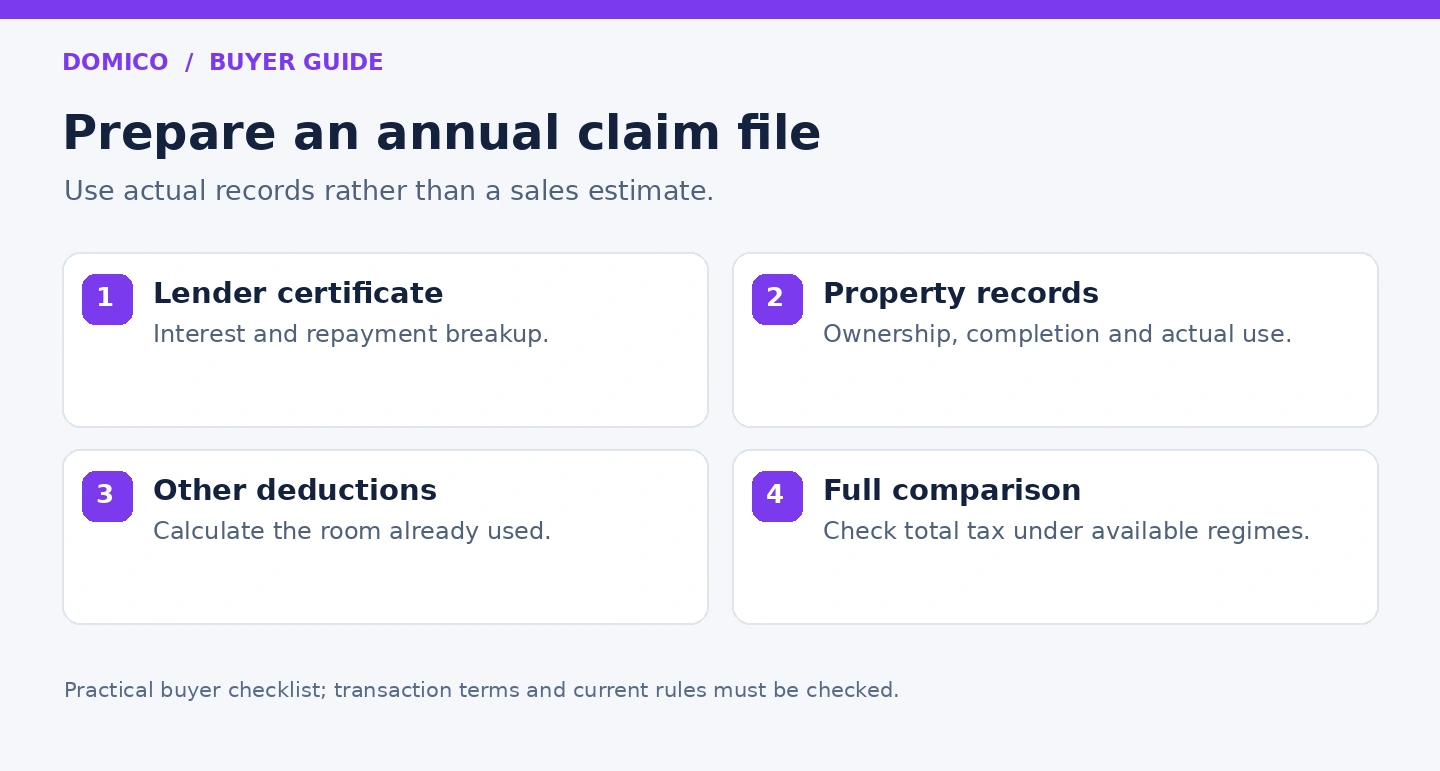
| Record | What it establishes | Useful check |
|---|---|---|
| Loan agreement and sanction | Borrower, purpose and terms | Correct property and loan account |
| Interest certificate | Annual interest details | Reconcile with the statement |
| Principal statement | Eligible repayment amount | Separate principal from interest |
| Title and completion records | Ownership and property stage | Match claim timing and use |
| Other deduction records | Aggregate limit already used | Avoid counting the same room twice |
| Regime comparison | Full annual tax result | Use current law and accurate income |
If you refinance, retain the original borrowing trail and the new account records. A new lender does not erase the need to show the purpose and continuity of the loan. If you make a large prepayment, update the annual estimate rather than continuing to use the original interest projection.
Prepare the comparison after income becomes reasonably predictable and update it before the relevant filing or payroll deadlines. Salaried and business taxpayers can face different option procedures and restrictions. Ask a tax professional to check the switching rules that apply to you.
Save the calculation and assumptions. At the next review, replace estimates with actual certificates. This makes it easier to identify why the result changed and avoids repeating a claim simply because it appeared in last year's return.
A payroll declaration is an estimate used for salary withholding. It is not final approval of a deduction. At year end, replace the estimated interest and principal with the actual lender certificate and check whether possession, use or ownership facts changed.
If the estimate was too high, address the difference in the final tax computation rather than repeating it to match payroll. If an eligible amount was omitted from payroll, ask the tax adviser how it should be dealt with in the return. Preserve the documents supporting the final claim.
This distinction is especially useful after a loan begins midway through a year, a prepayment reduces interest or a construction delay changes the expected completion position. The loan's original illustration is a planning document. Actual records and the applicable law determine the final claim.
Download the topic-specific review checklist. Use it to record evidence, unanswered questions and follow-up actions for the exact property.
No. Separate interest and principal, then apply their respective eligibility conditions and limits. The total amount debited by the bank is not itself the deduction.
No. A deduction reduces eligible taxable income. The actual tax saving depends on the full computation and can be much smaller. A refund also depends on tax already paid or withheld.
No. Compare the total annual liability under the regimes available to you. Rate structures, income and other deductions can change the result.
The treatment of pre-construction interest and its timing requires the applicable statutory conditions. Keep the records and have the claim checked when completion and property-use facts are known.
Not automatically. The applicable year, current provisions and transition rules determine treatment. An old loan and an old tax year are different things; match the claim to the correct framework.
Planning to buy or rent in Indore? Browse verified properties in Indore or read more Indore guides.
Check who owes the lender, how builder-paid interest works, when support ends and whether you can carry the loan if payments stop.



