Buying Guide
Buying a Flat Without an OC: What to Check
Investigate occupancy-certificate coverage, authority records, pending issues, safety, loan conditions and moving costs before buying a ready flat.

Table of contents
A finished-looking home and permission to occupy it answer different questions.
The flat is painted, the lifts run and several families may already be living in the tower. Then you ask for the occupancy certificate and hear that it is “under process.” Before buying, find out exactly what document is missing, which authority issues it and what remains unresolved.
An occupancy certificate, often called an OC, concerns permission for occupation under the relevant local framework. Terminology and procedures can vary, including phased or partial permissions. That makes document identification important: a builder's completion letter, a professional's certificate and an authority's occupancy permission are not automatically the same thing.
This guide helps you investigate the gap. It does not assume that every missing copy means the same legal problem or that every problem can later be regularised.
Understand the certificate being requested
The RERA Act distinguishes a completion certificate from an occupancy certificate. The latter relates to permission to occupy under local law, with relevant civic infrastructure. The applicable local rules determine the precise instrument and competent authority.
Ask your lawyer and architect which certificate or equivalent permission applies to this property. Then request the actual issued document, its annexures and any conditions. Do not accept an unrelated approval simply because its heading contains the word “completion.”
For an older resale building, the task may include obtaining the relevant authority record when the seller has lost a copy. That is different from a building for which permission was never issued.
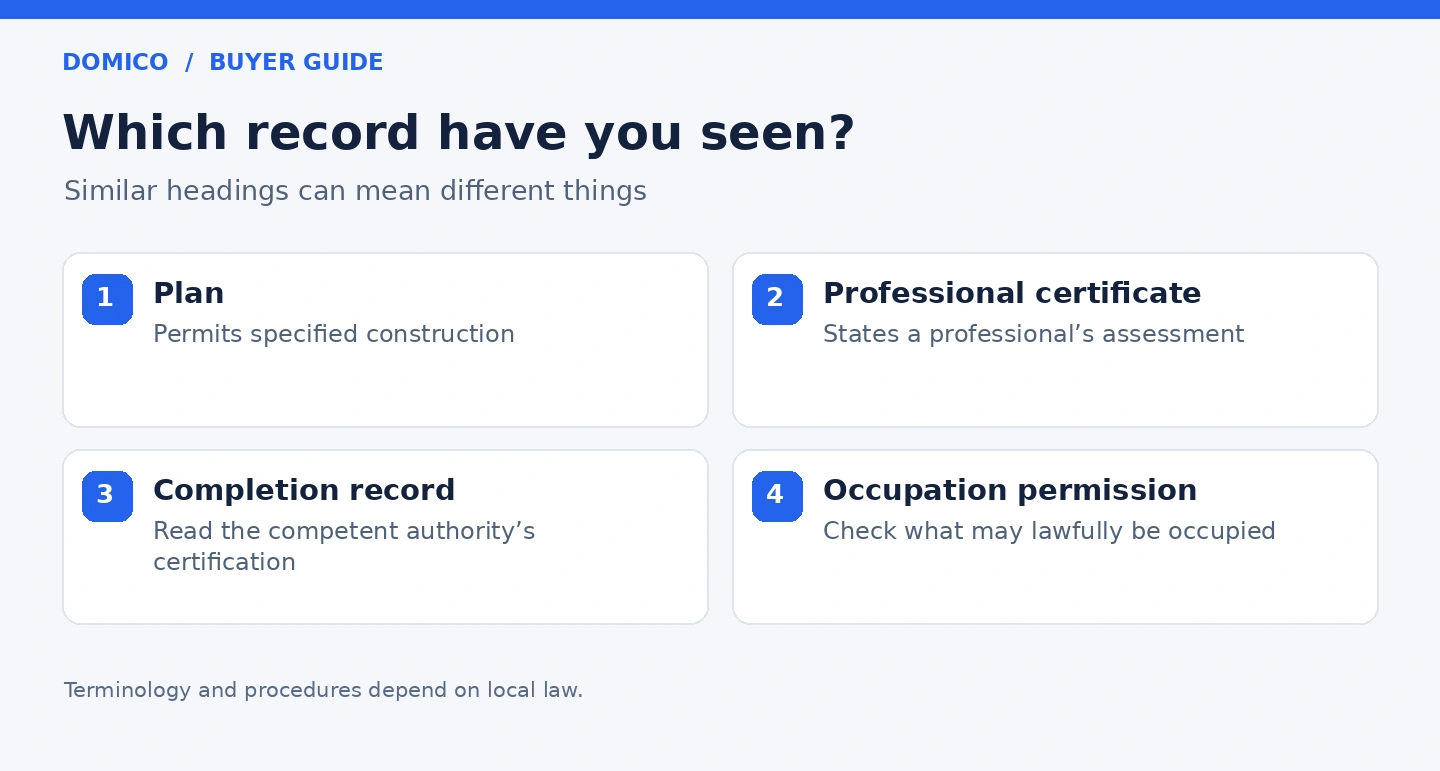
| Record shown | What to investigate |
|---|---|
| Sanctioned building plan | What construction was permitted? |
| Architect or engineer certificate | What professional statement was made? |
| Completion certificate | What did the competent authority certify? |
| Occupancy certificate or local equivalent | Which occupation is permitted, and on what conditions? |
| Application acknowledgement | What was requested, not necessarily approved? |
Identify the exact tower, floor and phase
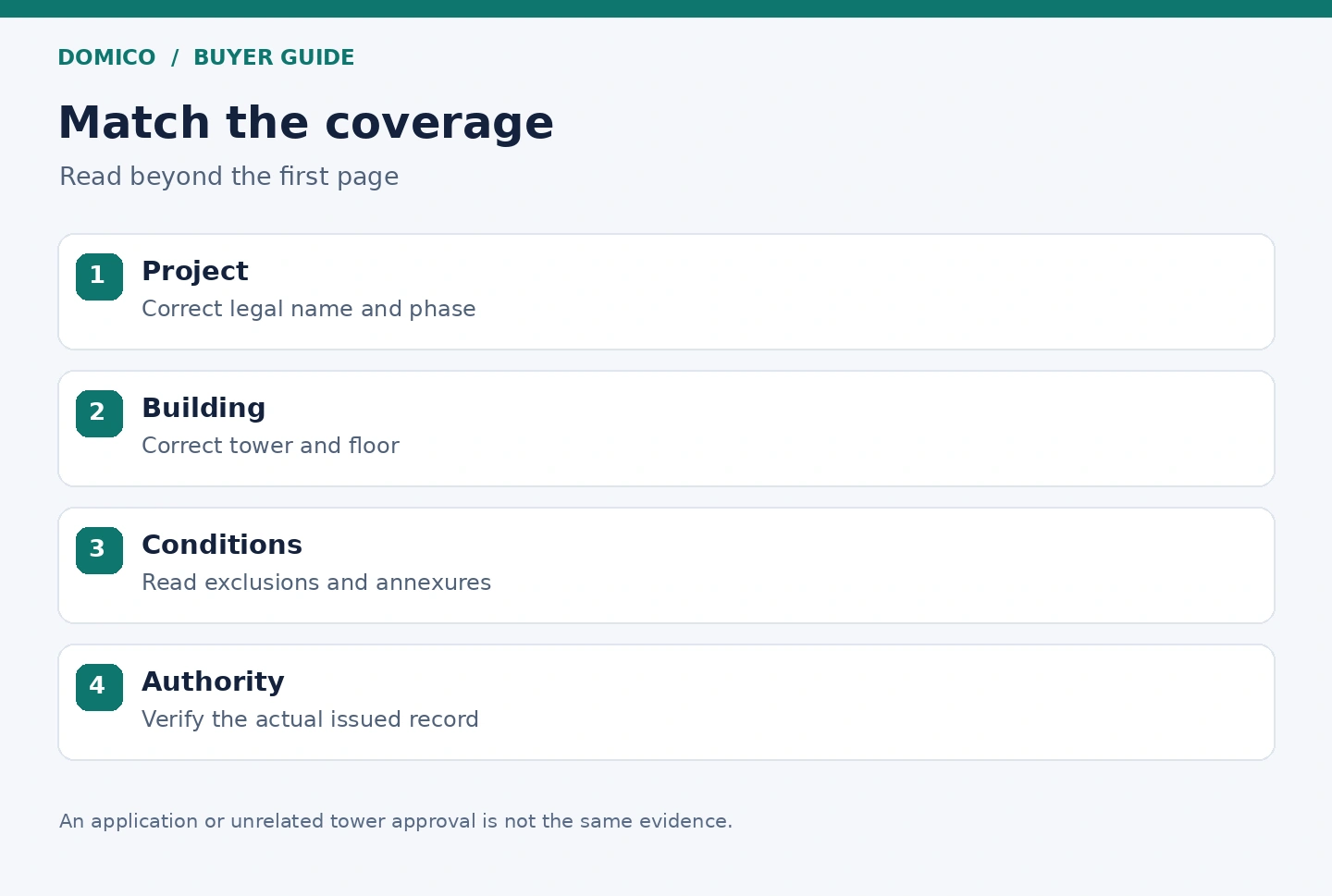
A certificate for one part of a project may not cover every unit marketed under its name. Match the project, phase, building, tower and relevant premises with the certificate and approved plans.
If the document is partial or conditional, ask what it covers and what remains outside it. Your flat's floor, access, essential services and common areas should be considered together. A certificate for Tower A should not casually be presented as proof for Tower C.
Save a copy of the full document. Cropped screenshots can omit conditions, exclusions or annexures that change the meaning of the first page.
Verify the record with the issuing authority
Check the certificate number, date, issuing office and property description through the appropriate official channel. Where a portal does not provide enough information, request the suitable authority confirmation.
A seller's emailed PDF can be genuine but incomplete or applicable to another building. Verification should connect the document to the actual home, not merely confirm that a familiar-looking stamp appears on it.
For a project registered with MP RERA, compare current disclosures and uploaded documents with what the seller supplies. RERA information is useful evidence; it does not replace any required confirmation from the authority that issues occupation permission.
Ask why the OC is missing
The answer may involve an unprovided copy, incomplete application, pending inspection, uncompleted infrastructure, deviations from approved plans or another issue. These are different problems with different possible remedies.
Request a written status supported by the application, authority communications and professional assessment. “All residents are already living here” explains occupation on the ground; it does not explain the approval position.
Have an architect identify whether the building matches the sanctioned plan in relevant respects. If there are deviations, ask whether a lawful route to resolution exists. Do not accept a definite future approval date without evidence supporting it.
Examine essential services and safety
Check water, sanitation, electricity, fire-safety arrangements, access and lift operation through appropriate records and professional inspection. A temporary connection can work on a site visit without establishing permanent service arrangements.
Ask who maintains services, how they are paid for and whether any conditions remain. If a project uses temporary water or power, include the actual cost and reliability in your living budget.
A document review and a physical inspection support each other. Neither should be treated as a guarantee that every aspect of the home is safe. Where there are visible safety concerns, get qualified advice before planning occupation.
Understand lender acceptance without treating it as a guarantee
Tell your lender about the missing certificate before paying a large booking amount. Ask which record it requires, whether it accepts an alternative for the particular building and whether disbursement is conditional.
HDFC Bank's home-loan process lists property documentation and legal assessment as part of the lending journey. A seller's old loan or a bank advertisement for the project does not mean your lender has approved this exact unit and present file.
Likewise, a bank's willingness to lend does not become an independent warranty of perfect title, compliance or construction quality. Keep your own legal and technical review.
Compare the full cost of waiting
An under-process certificate can affect occupation or financing plans. Build a conservative cash-flow scenario rather than assuming that the paperwork will arrive before your current lease expires.
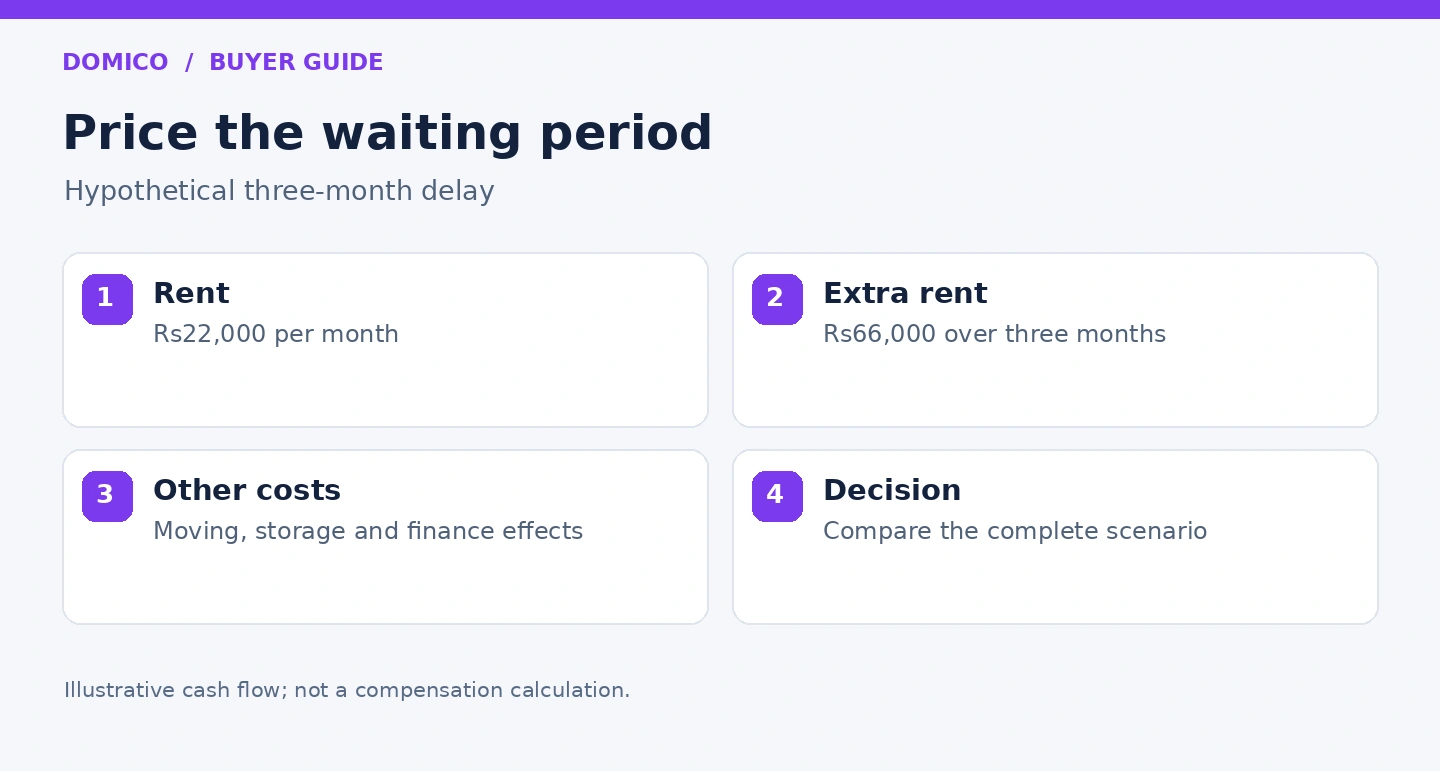
Consider an illustrative buyer who expects to move immediately but needs to rent elsewhere for three more months. At Rs 22,000 monthly rent, the additional rent is Rs 66,000. Add any storage, repeat moving and financing effects separately.
| Hypothetical delay cost | Illustrative amount |
|---|---|
| Three months' alternative rent | Rs 66,000 |
| Storage or second move | Obtain an actual quote |
| Financing or disbursement effect | Calculate from your loan terms |
| Total decision impact | Reconcile all relevant costs before comparing offers |
This is a planning example, not a legal compensation calculation. The correct response may be to wait, renegotiate conditions or select a property with a clearer occupation record.
Put unresolved issues into the agreement
If you are considering proceeding, ask your lawyer to describe the missing item, the seller's responsibility, the evidence required and the consequences of delay or failure. A broad promise that “all approvals will be obtained” may be difficult to apply to a specific gap.
Avoid signing an acknowledgement that every approval has been inspected when that is untrue. Read possession declarations and waivers carefully. The document should reflect what is actually known and pending.
A price discount does not create occupation permission. Evaluate whether the remaining issue is legally resolvable and compatible with your needs before deciding that a cheaper home compensates for it.
Check resale implications
Even if your household can tolerate uncertainty, a future buyer or lender may ask the same questions. Keep a complete file explaining the status and any completed remedy.
Ask whether a later certificate would cover the actual construction being purchased or require changes. A promise to obtain approval for a different plan is not the same as approval for the home you inspected.
| Buyer decision checkpoint | Evidence to seek |
|---|---|
| Applicable permission identified | Local-law and professional explanation |
| Exact unit covered | Certificate and annexure match |
| Current issue understood | Authority status and technical review |
| Finance workable | Your lender's property-specific position |
| Contract protects the agreed outcome | Defined conditions, evidence and remedies |
| Occupation appropriate | Legal and safety position understood |
Keep the authority response and technical opinion with the purchase papers. If a seller later supplies a certificate, compare its scope and conditions with the issue originally identified rather than assuming any new document resolves the entire gap.
Printable buyer worksheet
Download the topic-specific review checklist. Use it to record evidence, unanswered questions and follow-up actions for the exact property.
Frequently asked questions
Is an application receipt the same as an OC?
No. It normally records an application or submission. Check whether the competent authority has issued the relevant permission and what that permission covers.
Does a registered sale deed prove occupation is permitted?
Registration records the transfer instrument. It should not be treated as automatically establishing compliance with every building or occupation requirement.
Can I rely on other families already living there?
Their presence does not settle the legal permission or safety position. Ask for the relevant authority record and investigate the actual status independently.
Is a partial OC acceptable?
Find out exactly what it permits and whether it lawfully covers your unit, access and required services. The title of the document alone cannot answer that question.
Should I reject every property when the seller cannot show a copy?
First determine whether the document was issued and can be retrieved, or whether the permission itself is absent. Those situations require different decisions. Obtain professional confirmation before committing funds.
Ask for the permission, not just the promise
Before buying a ready flat, establish which occupation document applies, whether it covers your unit, why any gap exists and how it affects finance and moving plans. A clear answer is more valuable than another assurance that the building looks complete.
Sources and further reading
- buyer-guide-100
- homebuyers
- flat-without-oc
- indore
Planning to buy or rent in Indore? Browse verified properties in Indore or read more Indore guides.