Buying Guide
Cooperative Society Flat: Membership and Transfer Checks
Review society registration, land rights, share certificates, membership history, dues and transfer records before buying a cooperative flat.

Table of contents
A share certificate is important. It is not the entire property file.
A cooperative housing society purchase can involve ownership or occupation rights recorded through several connected documents. The seller may hold society membership and shares as well as a registered property instrument. The society may hold underlying land rights. The precise arrangement depends on the state law and the society's valid structure.
That is why a buyer should avoid two shortcuts: treating a share certificate as complete proof of an unquestionable title, or ignoring society records because a sale deed exists. The documents need to tell a consistent story.
For an Indore purchase, use the Madhya Pradesh framework and the society's registered bylaws. A Maharashtra transfer checklist found online should not automatically become the rule for an MP society.
Identify what kind of organisation manages the property
A cooperative housing society, apartment owners' association and informal residents' group are not interchangeable. Ask for the organisation's registration details and governing documents.
Find out which entity holds the land and common-property rights and how the individual seller's interest is constituted. Your lawyer should explain whether you are acquiring a flat with associated membership, a leasehold or allotment interest, or another legally recognised arrangement.
The Madhya Pradesh Cooperative Societies Act, published on the Ministry of Cooperation's website, includes provisions relevant to cooperative societies and housing societies. The current applicable law, rules and registered bylaws need to be read together for your transaction.
Trace both the property and membership history
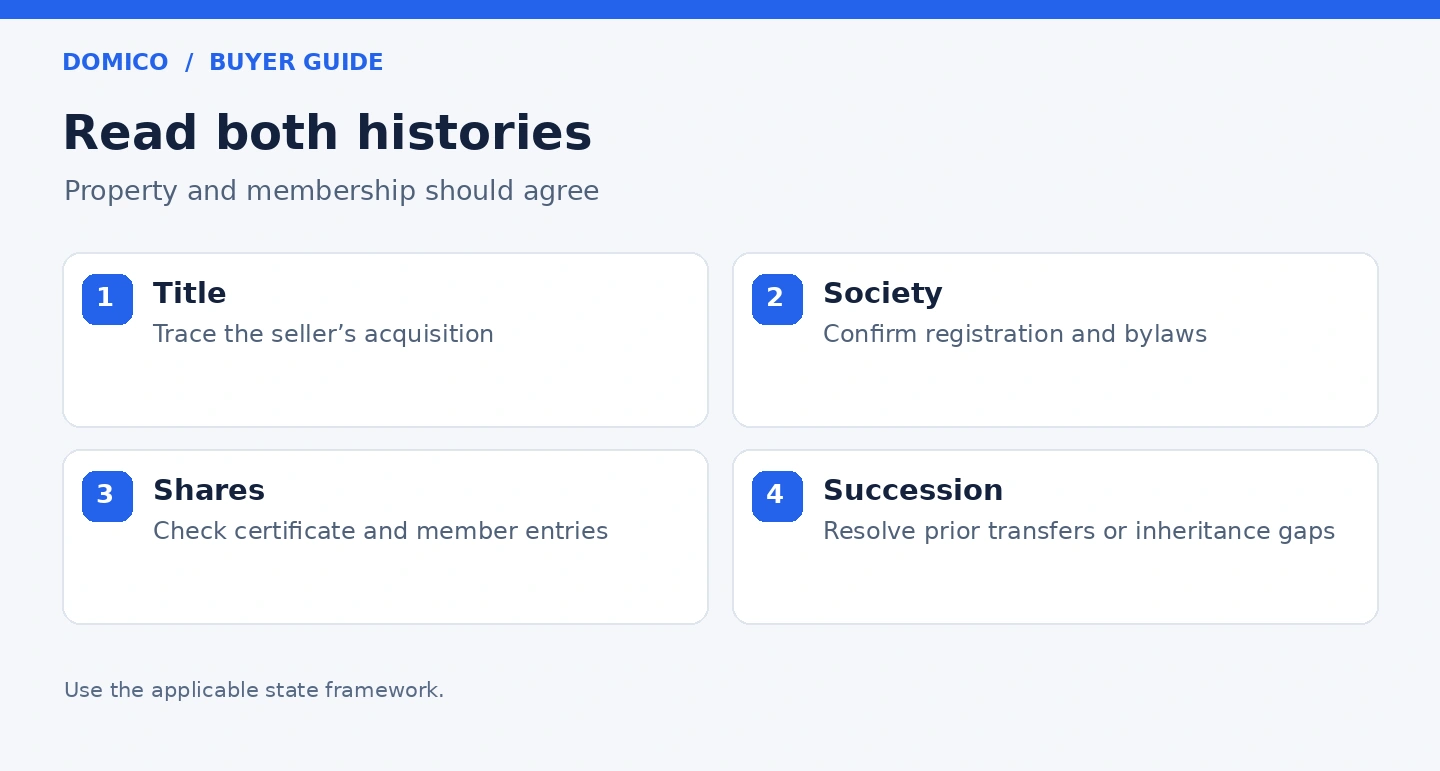
Obtain the seller's registered acquisition documents, allotment records where relevant, share certificate and membership entries. Compare the names, flat number, share details and dates.
If the seller inherited the interest, check the succession documents rather than assuming society nomination or an internal name change settles every ownership question. Where several heirs are involved, their authority and participation require proper review.
Ask whether an earlier transfer is still incomplete in society records. A chain of successive buyers holding unendorsed photocopies can become difficult to reconcile. Resolve the actual gap instead of collecting a new society letter with an unexplained assurance.
| Record | Main question |
|---|---|
| Society registration and bylaws | What legal structure and rules apply? |
| Land title or lease | What rights does the society hold? |
| Seller's acquisition instrument | How did the seller acquire this flat or interest? |
| Share certificate and member register | How is the seller recorded within the society? |
| Transfer or succession file | Are earlier changes properly documented? |
Check the share certificate carefully
Inspect the original where available and compare its particulars with the society's authorised records. Look for unexplained alterations, missing endorsements or inconsistent names.
If the certificate is lost, ask about the applicable duplicate-issue process and supporting records. A newly produced duplicate should be checked against the underlying membership history. It should not be treated as a way to bypass a disputed succession or sale.
Do not assume a certificate gives the holder authority to sell every property right described informally by the family. The registered title and relevant legal structure still matter.
Obtain an itemised dues position
Request a current society statement showing maintenance, special contributions, interest and any other demands. Ask which amounts are disputed and whether a major expenditure has already been approved but not yet billed.
Clarify the allocation of past and future liabilities in the sale agreement. A “no dues” statement dated several months earlier may miss later assessments or unpaid charges. Bring the reconciliation up to the agreed closing date.
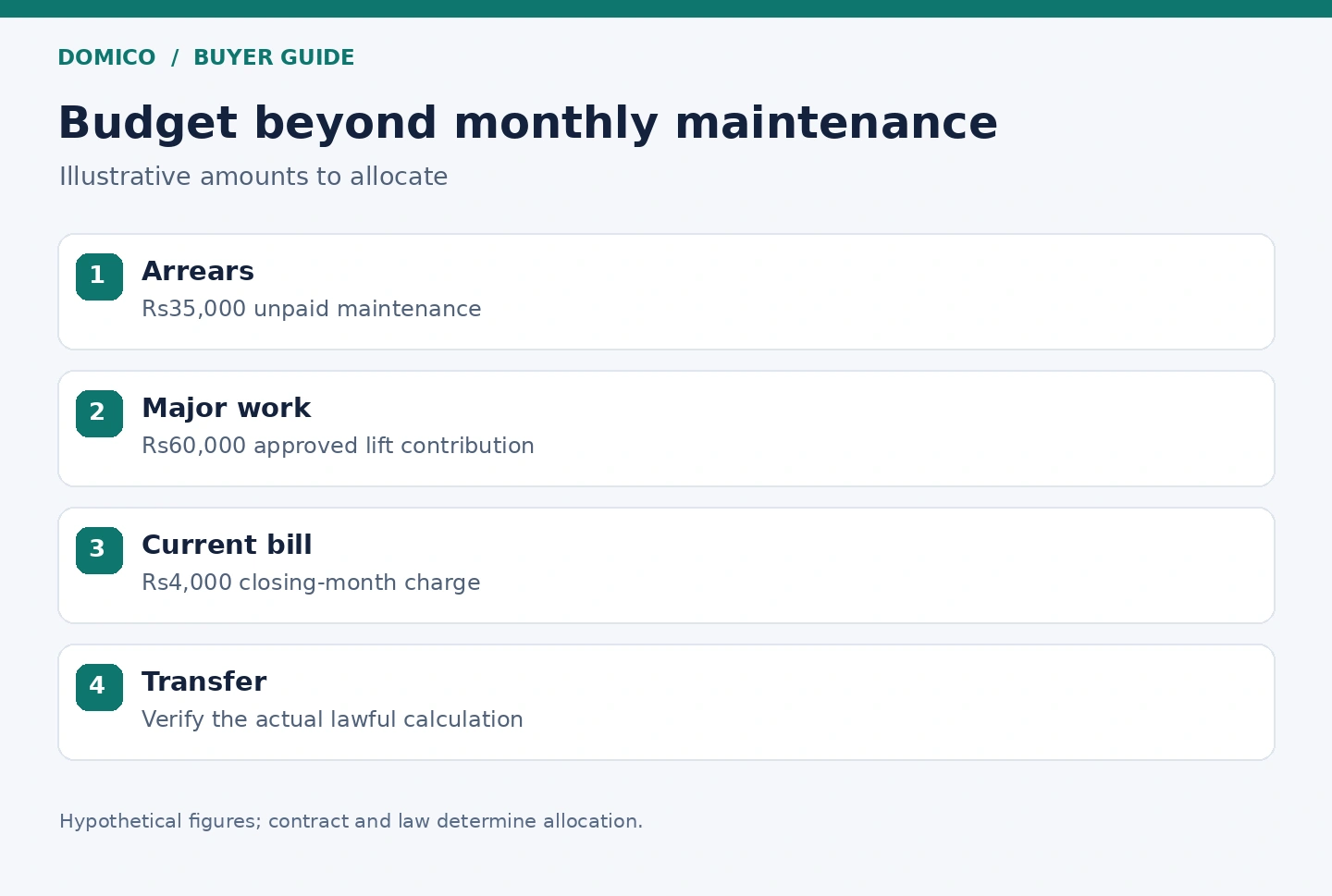
For illustration, a seller may have Rs 35,000 of unpaid maintenance and a Rs 60,000 contribution already approved for lift replacement. If the contribution becomes payable after registration, the parties should still state who bears it rather than arguing later that its billing date decides everything.
| Hypothetical closing issue | Amount | Question to settle |
|---|---|---|
| Unpaid routine maintenance | Rs 35,000 | Who clears the recorded arrears? |
| Approved lift contribution | Rs 60,000 | Who bears the already approved assessment? |
| Current-month maintenance | Rs 4,000 | How is it divided at completion? |
| Transfer-related charge | Actual applicable amount | What lawful rule and calculation support it? |
The example illustrates allocation, not a legal rule that all charges must fall on one party. Your contract and legal review should address the actual demands.
Understand the transfer procedure
Ask the society for its current written checklist, forms, competent decision-making body and applicable timeline. Verify the basis of any fee or premium demanded instead of assuming that a verbal amount is compulsory.
Find out what the buyer must submit for admission or recording and which documents the seller must provide. Coordinate this process with the conveyance and lender requirements. A society approval letter should not be used as a replacement for the legally required transfer instrument.
If there is a restriction or refusal, ask for its written reasons and have the governing rule reviewed. Paying an unexplained extra amount to “avoid trouble” can obscure the real issue.
Review the society's land and building position
A buyer should understand whether the underlying land conveyance or lease is completed and whether any developer handover remains unresolved. Ask for the relevant documents, not merely a statement that the society is functioning.
Check the building's approved plans, applicable completion or occupancy record and any known notices. Internal membership acceptance does not independently establish lawful construction.
Ask about pending disputes over parking, terraces, open land, access or maintenance contracts. These questions affect your daily use and potential future costs even if the apartment itself looks well maintained.
Read the financial position without invading privacy
Relevant audited accounts, budgets and meeting decisions can reveal major pending expenses, collection problems and maintenance priorities. You do not need other residents' unrelated personal banking records to understand these issues.
Look for large unpaid vendor bills, litigation provisions, overdue essential repairs and a mismatch between promised amenities and available maintenance funds. Ask the committee to explain material points in an appropriate written response.
A low monthly bill is not automatically a sign of efficient management. It could also reflect postponed repairs or inadequate reserves. Compare the service level and likely works with the amount being collected.
Clarify parking and exclusive-use claims
Ask the seller to identify the parking arrangement in the approved plan, society record and relevant agreement. Distinguish ownership claims, allocation and permitted use. A painted number or a verbal arrangement may not establish the right described in the advertisement.
The same care applies to terraces, gardens and storage. An exclusive-use practice should be examined under the valid documents and applicable law, particularly if it occupies a common area.
If parking is important to your purchase, test the actual dimensions and access with your vehicle during an authorised visit. A legally recognised allocation can still be physically inconvenient for your needs.
Complete both the transaction and record updates
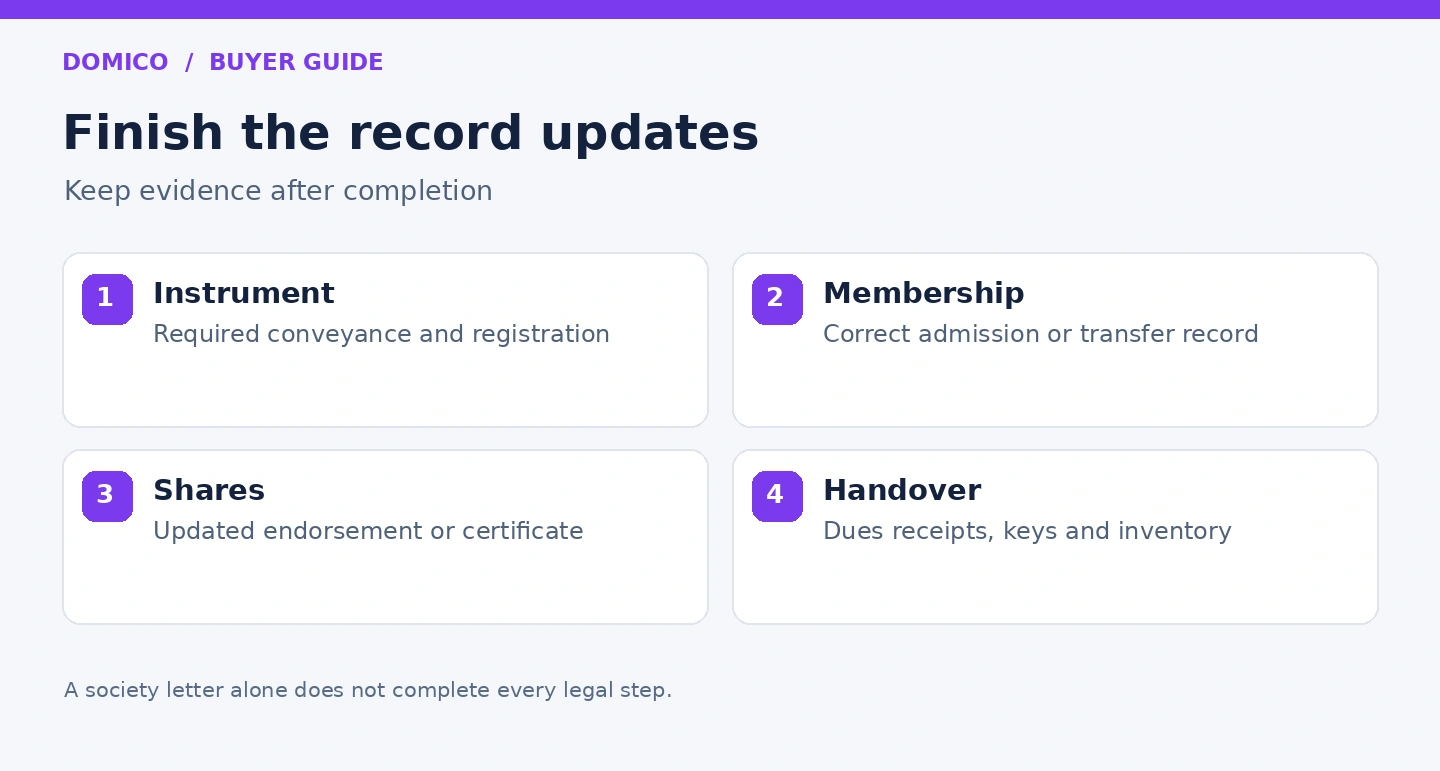
At closing, reconcile the price, dues, originals and possession. Confirm the steps for membership and share-record updates after the required instrument is completed.
| Completion item | Evidence to keep |
|---|---|
| Seller's interest transferred | Properly executed instrument and registration where required |
| Membership process completed | Admission or transfer record under the applicable procedure |
| Shares recorded | Correct endorsement or certificate and member entry |
| Dues settled | Itemised statement and receipts |
| Home handed over | Keys, inventory and meter readings |
Check names and property numbers immediately. Keep copies of applications and acknowledgements so a pending administrative update can be followed without reconstructing the entire file.
Printable buyer worksheet
Download the topic-specific review checklist. Use it to record evidence, unanswered questions and follow-up actions for the exact property.
Frequently asked questions
Does the share certificate prove the seller owns the flat?
It is an important society record, but the title or occupation arrangement and acquisition chain must also be examined. Do not treat one document as a universal substitute for the rest.
Can a nominee sell after the member dies?
A nomination and succession rights are different questions. Have the applicable law, nomination and inheritance position reviewed before assuming the nominee has sole transferable ownership.
Is a society NOC compulsory in every purchase?
Requirements depend on the governing law, bylaws, lender and transaction structure. Ask for the actual applicable requirement rather than importing a rule from another state or society.
Can the society demand any transfer premium it chooses?
Have the legal basis and permitted calculation reviewed. A written demand should identify the relevant rule or valid authority; a verbal claim is not enough.
Should I worry about an upcoming major repair?
Understand its technical need, approved cost, funding and allocation. A planned repair can be sensible maintenance, but it belongs in your purchase budget and closing negotiations.
Buy into the records as well as the building
A society flat purchase becomes clearer when title, membership, shares, dues, common-property rights and possession agree. Ask for that complete picture before treating a neat certificate or a friendly committee meeting as the final check.
Official sources and related reading
- buyer-guide-100
- homebuyers
- cooperative-society-flat
- indore
Planning to buy or rent in Indore? Browse verified properties in Indore or read more Indore guides.