Buying Guide
Buying in a Completed Township Phase: Buyer Checks
Check phase approvals, construction routes, temporary services, maintenance and future amenities before buying in a partly completed township.
Updated 8 min read
Buying Guide
Check phase approvals, construction routes, temporary services, maintenance and future amenities before buying in a partly completed township.
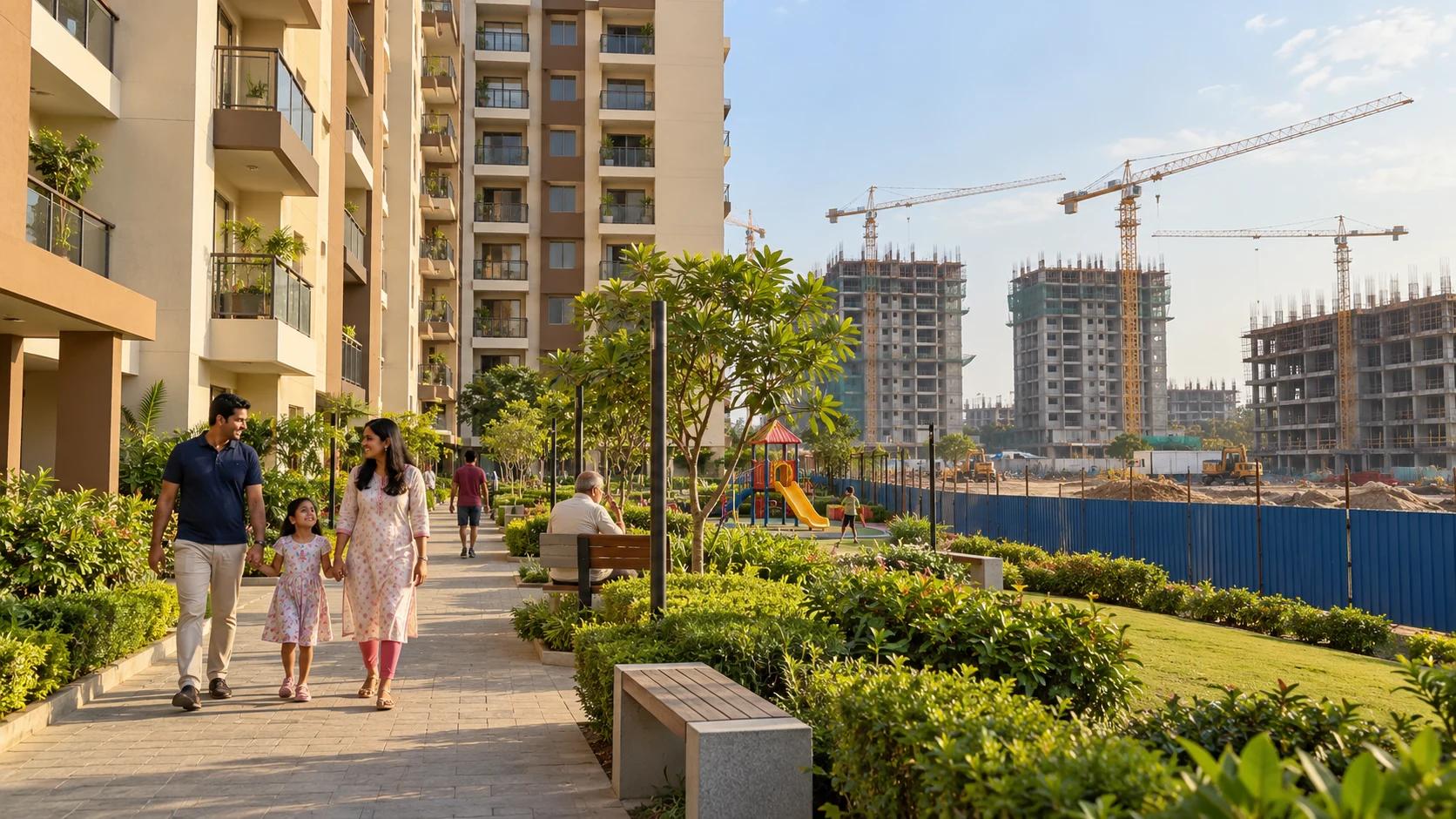
Your apartment may be finished while your surroundings are still a work site.
A completed phase in a larger township can offer a usable home today with more facilities expected later. It can also mean living beside excavation, construction traffic and temporary service arrangements. Buyers need to separate what is complete for their phase from what is promised for the wider development.
The word “completed” should trigger questions about the exact building, approvals, access and services. It should not end the review. Before paying for a finished apartment, understand what daily life will look like until the rest of the township is delivered, including the possibility that later work takes longer than expected.
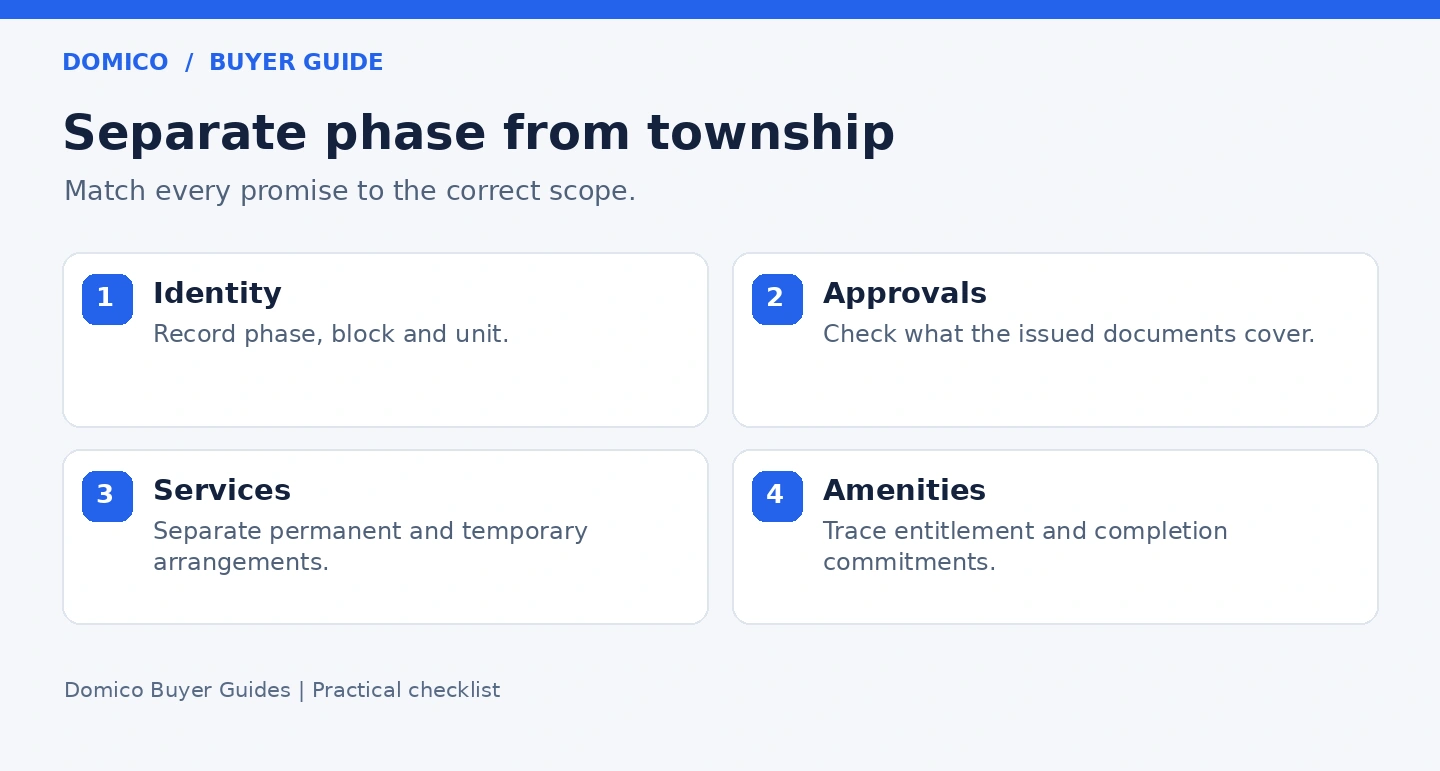
Write down the project name, phase, tower, apartment and relevant registration details. Compare them across the listing, agreement, plan and official records. Marketing material sometimes uses the name of the entire township while documents relate to one smaller phase.
Under the Real Estate (Regulation and Development) Act, phased development is treated through separate phase registration as applicable. Use the official project record to identify the boundaries and commitments of the phase being offered. Do not assume a registration number shown for one phase covers every advertised building or amenity.
Ask the seller to mark your building, entrance, parking and essential services on the approved plans. If access or a water tank lies in another phase, request an explanation of the permanent rights and operating arrangements. The answer should survive a change in sales staff or construction contractor.
Request the applicable completion and occupancy-related documents for the exact building or part being sold. Have an independent professional confirm their scope and any conditions. A certificate covering one block does not automatically answer questions about another block or the entire township.
Then distinguish documents from service readiness. Check electricity, water, drainage, lifts, backup power, waste collection and usable access. Some services may operate through temporary arrangements. Find out what is temporary, who pays, when the permanent arrangement is expected and what happens if that date moves.
| Item | Completed-phase question | Evidence to request |
|---|---|---|
| Building approvals | Does the document cover this block and unit? | Applicable issued approvals and plans |
| Entrance | Can residents use a permanent lawful route? | Layout, access documents and site inspection |
| Water and drainage | Are services permanent and operating? | Connection details and operating records |
| Parking | Is the allocated space usable now? | Approved layout and allocation documents |
| Amenities | Which are delivered for this phase? | Agreement, specifications and current condition |
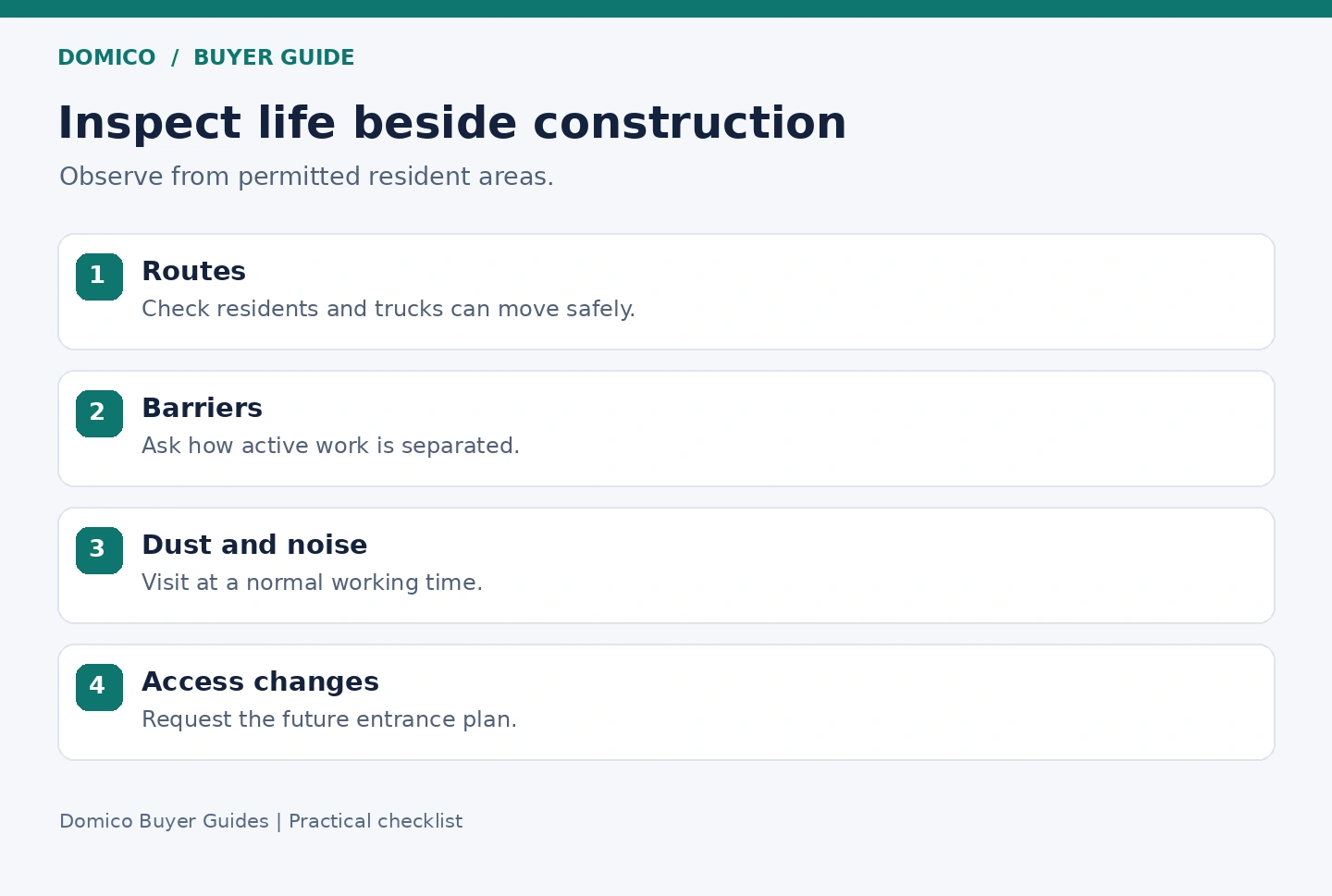
Start at the public road and walk to the apartment. Look for shared movement with trucks, materials and workers. Check whether construction vehicles cross the path children or older residents use. Observe the route at a normal active construction time, with permission and without entering restricted areas.
Ask management how barriers, lighting, dust control and access changes are handled. A temporary gate can be practical, but the future route needs a documented plan. Find out whether residents may lose convenient access while another tower or road is built.
Take photographs from permitted resident areas and keep dated notes. Your purpose is to understand the living arrangement, not to inspect the construction technically. Where safety or engineering questions arise, obtain a professional review.
A brochure may show a large park, clubhouse, school site or retail centre. For each item, ask whether it belongs to your phase, another phase or an independent third party. Identify the document that establishes your entitlement, the completion commitment and any extra membership or operating charge.
Do not put the same value on an operational facility and an artist's impression. An unfinished clubhouse may eventually be useful, but it does not provide today's gym, meeting room or children's activity space. Price the home against facilities that exist and commitments that can be checked.
| Facility status | How to treat it in your decision | Follow-up |
|---|---|---|
| Operational and accessible | Inspect quality, hours and actual charges | Speak with current users |
| Built but not operating | Understand the remaining approvals and setup | Request a documented opening plan |
| Contractually promised | Review exact scope and delivery terms | Obtain legal advice on enforceability |
| Proposed or third-party | Treat availability as uncertain | Verify the responsible entity and approvals |
This is particularly important when sales material presents a whole-township lifestyle while only a small residential cluster currently functions.
A new phase may have few occupied homes. Ask who pays for security, pumps, lifts and cleaning before occupancy grows. Does the promoter subsidise a portion? Is maintenance charged on possession, occupation or another contractual basis? What happens when the subsidy ends?
Request the budget and the charging method. Check whether residents of the completed phase are expected to pay for facilities or infrastructure serving later phases. The rules should explain which expenses are shared, how contributions are calculated and who maintains assets before handover.
Speak with management and, where possible, current residents. Ask factual questions about bills, water interruptions, routes and construction hours. Treat individual comments as leads to verify, not as complete evidence about every building.
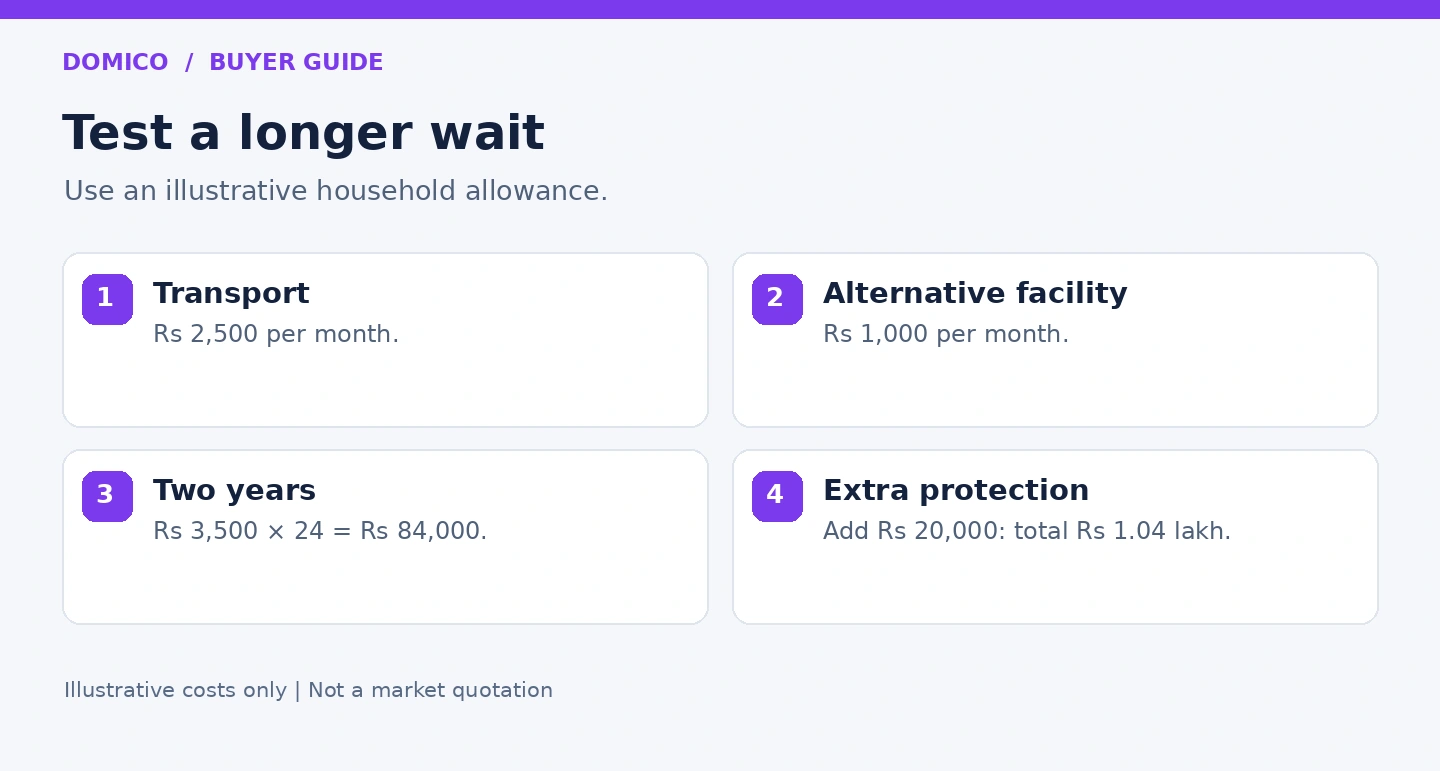
Assume a family compares two otherwise similar homes. The township apartment is Rs 2 lakh cheaper, but the family's expected interim costs include Rs 2,500 per month for transport because the convenient gate is not yet usable and Rs 1,000 per month for an alternative activity facility. These figures are hypothetical.
At Rs 3,500 per month, twelve months costs Rs 42,000 and twenty-four months costs Rs 84,000. Suppose additional temporary fit-out protection and cleaning costs Rs 20,000. The identified two-year allowance becomes Rs 1.04 lakh, before inflation or financing differences.
That does not erase every benefit of the township home. It shows why an assumed six-month inconvenience should also be tested at eighteen or twenty-four months. If the purchase works only when all future promises arrive on the earliest advertised date, the household has little room for delay.
Ask about approved future towers, roads and service areas around the unit. An open view may currently exist because the neighbouring plot is undeveloped. Compare the future layout with windows, balconies and access routes. Do not treat vacant land as a permanent park without supporting records.
Review the agreement's provisions on common areas, construction access, maintenance and amenity use. Applicable rights and consent requirements need legal interpretation in the context of the exact documents. Avoid signing broad acknowledgements merely because the flat itself is ready.
Record responses in a simple register with the document reference and the person responsible for follow-up. Clear unresolved items are more useful than a folder of general township presentations.
Ask the household to imagine living there for two years with only the currently delivered facilities. Would the apartment, services, commute and operating cost still suit you? Then consider the verified future facilities as an additional factor, with uncertainty attached.
| Question | Comfortable answer | Reason to investigate further |
|---|---|---|
| Can we use the home now? | Applicable permissions and services are clear | Completion claim is only verbal |
| Can we move safely? | Resident route works during active construction | Trucks and residents have unmanaged conflicts |
| Can we afford interim life? | Delay allowance fits the household budget | Purchase depends on immediate future amenities |
| Do the documents match? | Phase, unit and promised facilities are traceable | Marketing and agreement describe different scopes |
No. Check the scope of the applicable documents and the actual delivered work. The phase, building and larger development can have different timelines and commitments. Confirm which statement the seller is making.
It depends on the duration, separation, management and your tolerance for disruption. Inspect active conditions and test a longer delay in your budget. Serious unresolved safety or approval issues require professional attention before proceeding.
No. Review your agreement, the facility's phase, entitlement, completion terms and operating charges. A clubhouse pictured in a township brochure may not establish unrestricted access for every buyer.
Ask about actual maintenance bills, water supply, access changes, construction activity and how complaints are handled. Try to verify the answers through bills, notices and management records. Avoid treating one person's experience as a guarantee.
Request the approved layout, the access entitlement, current construction status and a written operating plan. Inspect whether the temporary route is usable if the permanent entrance is delayed. Get legal or technical advice where ownership or safety is unclear.
A finished apartment should be assessed as a home you can use today. Future township facilities add value only when their scope, access and delivery are understood.
Download the topic-specific review checklist. Use it to record evidence, unanswered questions and follow-up actions for the exact property.
Planning to buy or rent in Indore? Browse verified properties in Indore or read more Indore guides.
Check who owes the lender, how builder-paid interest works, when support ends and whether you can carry the loan if payments stop.



