Buying Guide
Bank Auction Property: Checks Before You Bid
Review possession, auction terms, title, dues, inspection limits and funding deadlines before bidding for a bank-auction property.
Table of contents
The winning bid buys a transaction with conditions. Read those conditions before bidding.
A bank-auction home can attract buyers because the reserve price looks lower than nearby asking prices. That comparison is only a starting point. An auction purchase may involve strict payment deadlines, limited inspection, occupied premises, unresolved dues or proceedings that need professional review.
The bank is enforcing a security interest through a particular legal process. Its involvement does not make every property dispute disappear. Your task is to investigate the asset and the sale terms before committing the earnest money deposit or raising a bid.
For a first-time buyer, the most valuable question is often simple: if I win, can I fund, complete and lawfully obtain the property on the terms offered?
Start with the bank's own notice
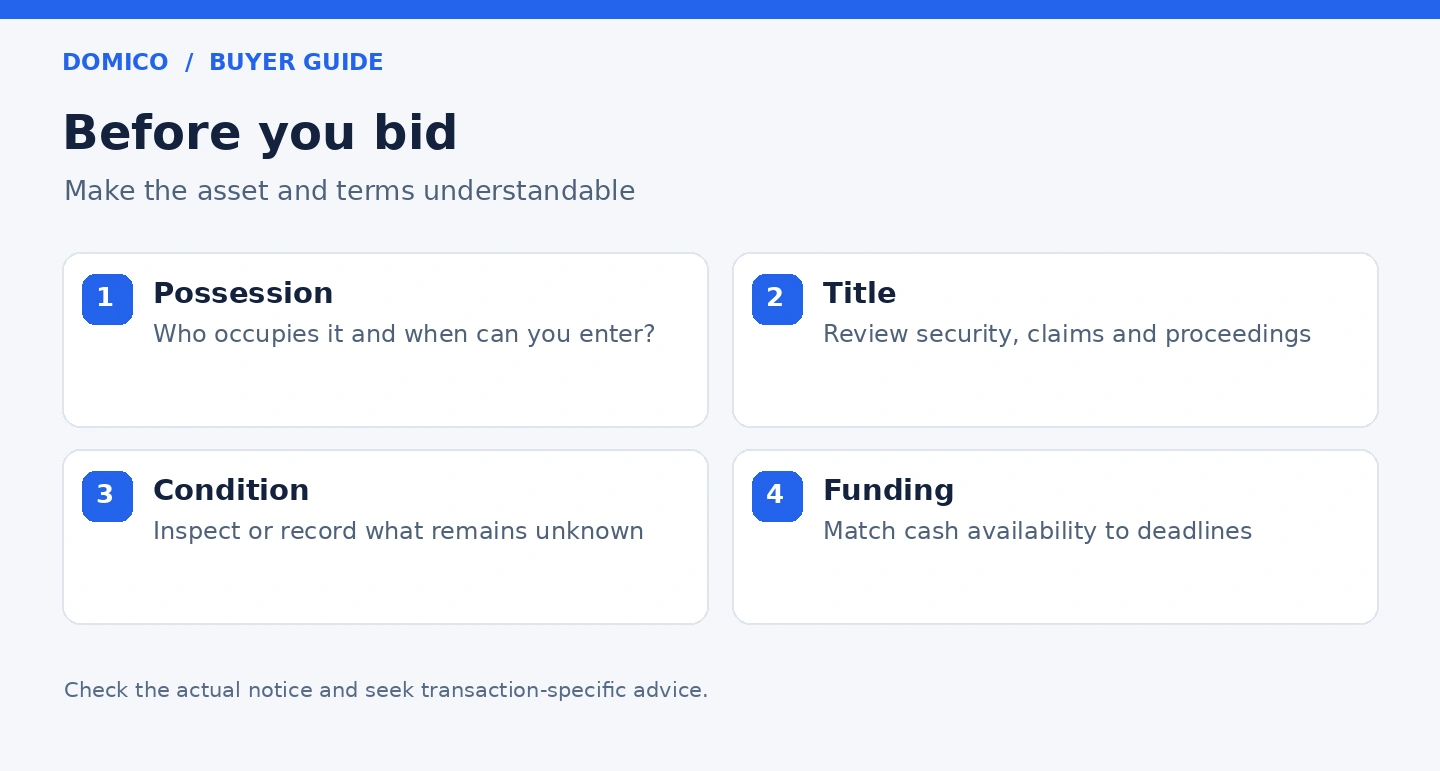
Locate the property through the bank's official auction page and the platform identified in its notice. Check the exact asset description, authorised officer, auction date, reserve price, earnest money deposit, inspection arrangements and payment instructions.
SBI's auction information page directs prospective bidders to property particulars and participation requirements. The controlling documents for your decision are the actual notice, detailed terms and relevant legal framework for that specific sale.
Do not send deposits to a personal account because a broker promises to reserve the property. Independently verify the platform and beneficiary using the bank's published contact route. Save the notice and any amendment with a date so that you can identify which terms you reviewed.
Understand possession before comparing price
Auction notices can distinguish symbolic possession from physical possession. Symbolic possession should not be treated as confirmation that an empty property and its keys are ready for immediate handover. Physical possession also requires careful checking of the precise premises, condition and access.
A published SBI auction notice concerning symbolic possession expressly links physical handover to its availability. That example illustrates why bidders must read their own notice instead of relying on a generic description of bank auctions.
| Possession question | Evidence to seek before bidding |
|---|---|
| Who currently occupies the property? | Inspection, bank confirmation and legal review |
| What possession has the bank taken? | The notice and supporting possession records |
| When can the buyer obtain access? | Written sale terms and an explanation of pending steps |
| Is there a tenant or third-party claim? | Relevant agreements, searches and case documents |
| Are all areas accessible? | Inspection of the actual property, including shared access |
Inspect the asset, not just the photograph
Arrange the authorised inspection. Match the location, property number, floor, boundaries and area with the title schedule and notice. If access to the inside is unavailable, record that limitation in your decision rather than assuming the rooms are in usable condition.
Look for seepage, structural concerns, disconnected services, unauthorised alterations, access disputes and missing fixtures. Get an engineer's assessment when the condition or building age warrants it. A few saved lakhs can disappear quickly if extensive repairs or reinstatement are needed.
Photograph only what you are authorised to record and retain inspection notes. If the notice gives a larger area than the space you can identify, ask for a documented explanation. Do not let the auction countdown replace basic property identification.
Have the legal file reviewed independently
A lawyer should examine the title chain, mortgage, enforcement process, relevant notices, known encumbrances and pending proceedings. Ask which courts or tribunals have been searched and what limitations remain.
The SARFAESI Act provides a statutory framework for security enforcement. The existence of that framework is not a substitute for assessing whether the particular sale and asset present unresolved issues.
Ask whether a stay, challenge or competing claim could affect completion or possession. Do not assume every legal case prevents purchase, but require an explanation of the actual case status and its possible effect. A lawyer's brief saying only “bank property, safe” is too broad for a high-value decision.
Read “as is” language carefully
Auction terms may use expressions such as “as is where is” or “as is what is.” These phrases should prompt detailed questions about condition, possession and liabilities. They are not a useful reason to stop reading.
Ask the authorised officer which dues are known and what records can be supplied. Have your lawyer consider the enforceable allocation of liabilities, statutory charges and the language of the sale certificate. Do not assume either that the buyer pays every old demand or that the bank clears everything.
Property tax, society maintenance, electricity, water and lease or authority dues can involve different rules and records. Obtain written demands or no-dues information from the appropriate entities where possible.
Build the full acquisition budget
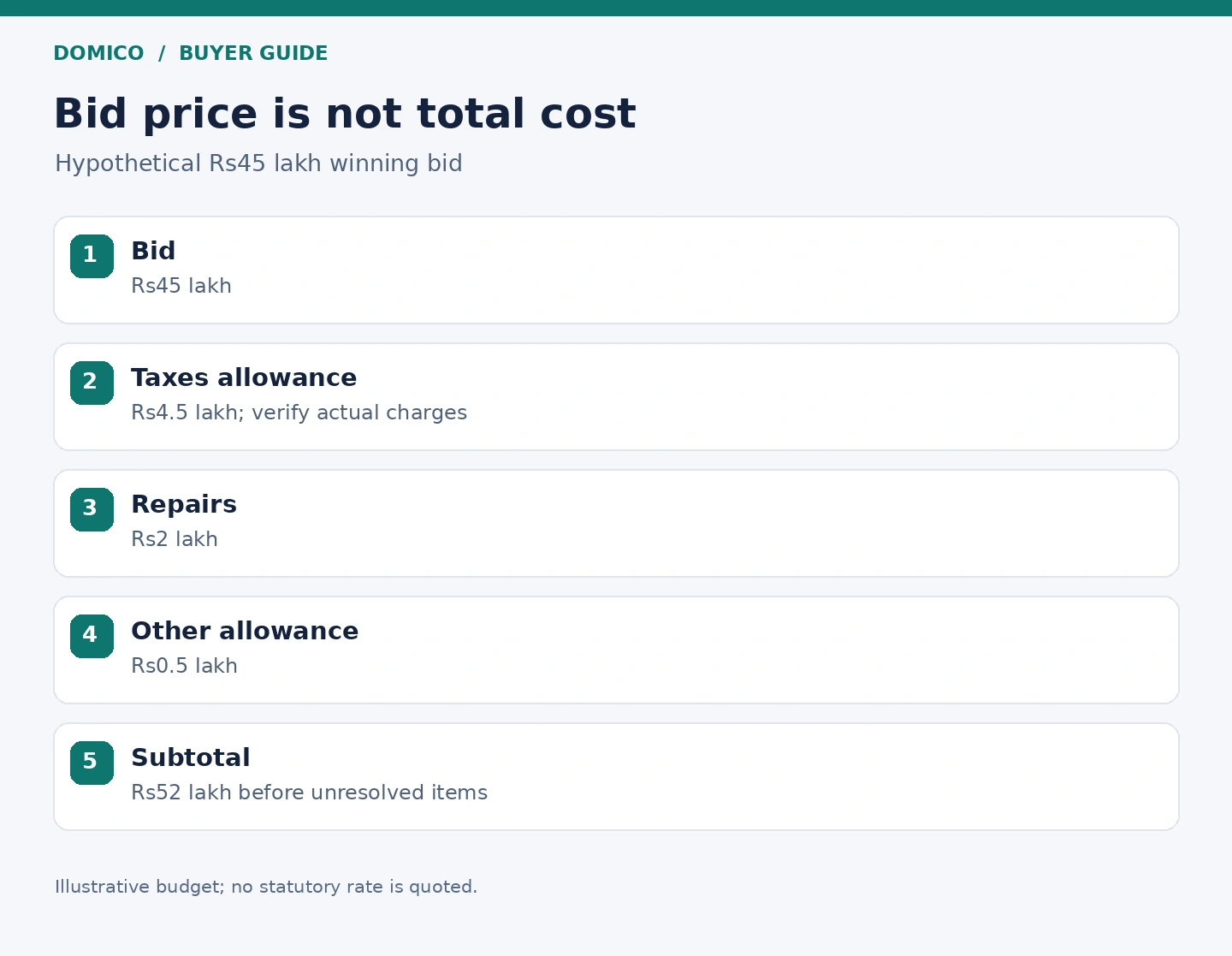
Compare the expected total cash requirement with a normal resale alternative. Include bid price, applicable stamp duty and registration, professional review, known dues allocated to you, repairs, service restoration, funding costs and a contingency for documented uncertainties.
| Hypothetical budget item | Illustrative amount |
|---|---|
| Winning bid | Rs 45 lakh |
| Purchase taxes and registration allowance | Rs 4.5 lakh |
| Repairs and service restoration | Rs 2 lakh |
| Legal, inspection and transaction allowance | Rs 0.5 lakh |
| Total before unresolved liabilities or finance cost | Rs 52 lakh |
The Rs 4.5 lakh is a planning allowance, not an MP statutory-rate quotation. Obtain the actual official calculation. The example shows why comparing a Rs 45 lakh auction bid with a Rs 50 lakh ordinary resale asking price can be misleading.
Set a maximum bid from the complete budget before the auction begins. If competitive bidding crosses it, the economics have changed even if you remain the most interested buyer.
Arrange funding before the deadline arrives
Auction terms can require substantial payment shortly after a successful bid and the balance within a defined period. Read the exact deadlines and default consequences. A normal home-loan application may not move fast enough to meet them.
Tell your lender that this is an auction acquisition. Ask whether it will finance this particular property, which sale documents it requires and when funds can be disbursed. A general eligibility estimate does not establish readiness to pay the auction balance.
Keep money for taxes and transaction expenses outside the bid funding. If you need to liquidate investments or borrow temporarily, understand timing, cost and the risk of funds arriving late. Do not bid on the assumption that an extension will automatically be granted.
Plan the post-auction steps
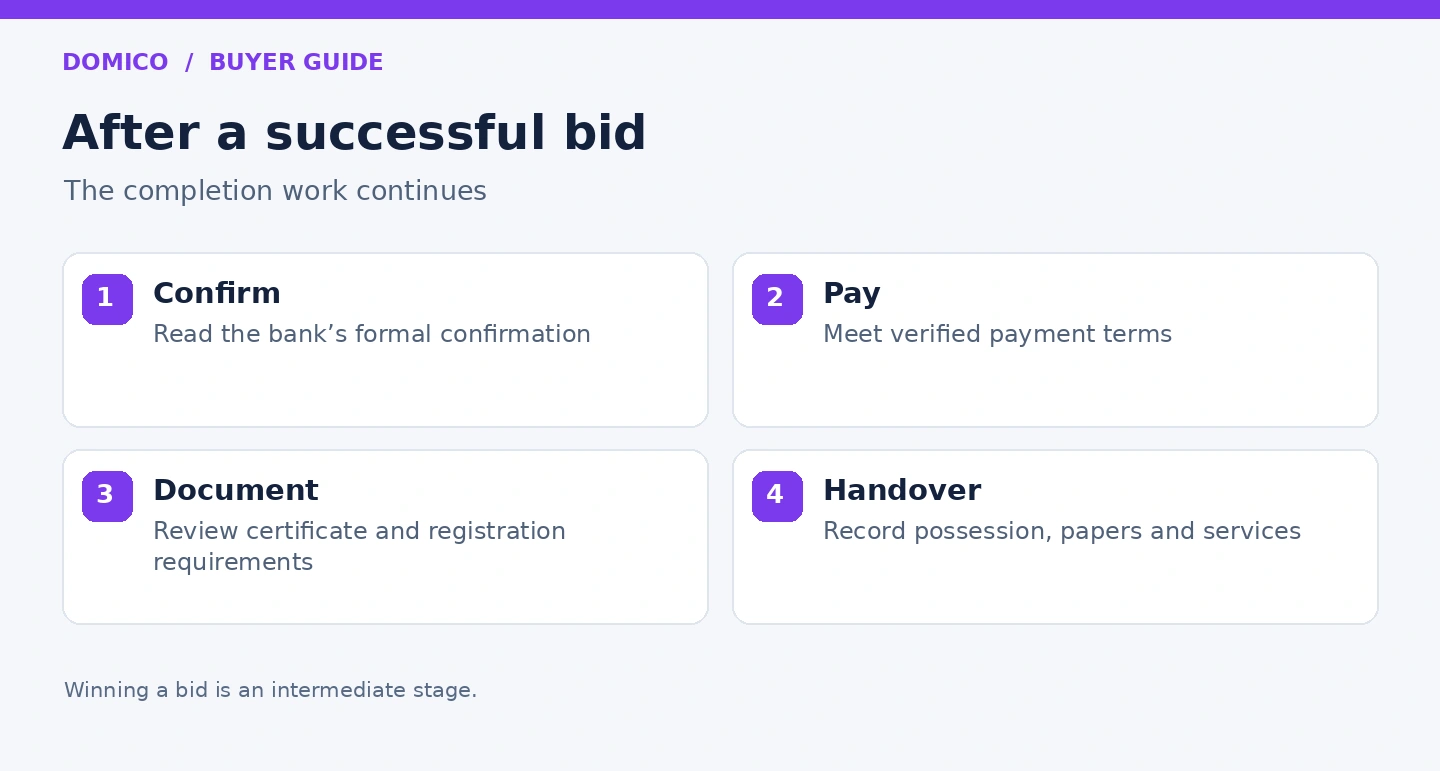
Winning the bid is an intermediate stage. The sale may require confirmation, complete payment, issuance of the relevant sale certificate and compliance with applicable stamp or registration requirements. The exact route should be reviewed for the transaction.
Ask how originals, possession records, keys and service transfers will be handed over. Record the condition at actual possession. If a third party remains in occupation, do not attempt self-help eviction; follow the lawful process advised by your lawyer.
| Stage | Your readiness check |
|---|---|
| Before EMD | Property identity, terms and inspection understood |
| Before bidding | Legal review, full budget and maximum bid settled |
| Immediately after success | Payment deadlines and bank instructions confirmed |
| Before final payment | Required confirmation and completion documents reviewed |
| At handover | Possession, document inventory, keys and services recorded |
Before participating, check the bid increment, any automatic time-extension rule and the procedure for reporting a technical interruption. Test access to the authorised platform before the auction window. These operational details do not change the property’s legal position, but misunderstanding them can cause an avoidable bidding error or leave you unable to participate as planned.
Printable buyer worksheet
Download the topic-specific review checklist. Use it to record evidence, unanswered questions and follow-up actions for the exact property.
Frequently asked questions
Are bank-auction properties always cheaper?
No. The reserve price is not the final bid, and neither is the complete acquisition cost. Compare repairs, liabilities, finance, possession timing and similar completed transactions before judging the discount.
Can I get a home loan for an auction property?
Possibly, subject to lender policy, the property and the sale documents. Arrange a property-specific assessment early. The funding must also fit the auction's payment deadlines.
Does physical possession mean the title needs no checking?
No. Possession and title are separate questions. Even an accessible vacant property requires review of ownership, security enforcement, restrictions and relevant claims.
Can I recover EMD if I change my mind?
Read the exact terms before depositing. Withdrawal, unsuccessful bidding and default after success can have different consequences. Do not treat EMD as an ordinary refundable viewing deposit.
Should a first-time buyer consider a symbolic-possession property?
That depends on the unresolved possession position, legal advice, funding and tolerance for delay. If your priority is moving in by a fixed date, an uncertain possession route deserves particular caution.
Decide before the bidding screen opens
Prepare a written decision sheet covering possession, title, known dues, inspection limits, maximum total cost and payment readiness. The strongest auction decision may be a carefully priced bid—or a clear decision to wait for a simpler property.
Sources and related reading
- buyer-guide-100
- homebuyers
- bank-auction-property
- indore
Planning to buy or rent in Indore? Browse verified properties in Indore or read more Indore guides.



