Buying Guide
How to Estimate Society Maintenance Before Buying a Flat
Build a realistic society-maintenance budget using itemised bills, service costs, water, backup power, reserves and possible special assessments.
Updated 8 min read

Buying Guide
Build a realistic society-maintenance budget using itemised bills, service costs, water, backup power, reserves and possible special assessments.
The EMI buys the flat. Maintenance pays for keeping the building usable.
Two apartments with similar purchase prices can have very different monthly running costs. Security staffing, lifts, water, landscaping, common electricity and repairs all need funding. A low quoted maintenance charge is useful only if it supports the services you will actually receive.
Before buying, build a maintenance budget from records and assumptions you can explain. Do not stop at the amount printed on the sales sheet. Establish what is included, what is collected separately and what could change after the residents take over management.
For a resale flat, ask for recent maintenance invoices and receipts. Review a full year if available so seasonal water costs, annual subscriptions or special collections are visible. Request personal information to be masked where it is not needed.
For a new project, ask for the proposed service budget and the basis of the initial charge. Identify whether it is an estimate, a fixed contractual period or a promotional arrangement. A developer-managed introductory rate may not represent the later operating cost.
The RERA framework is relevant to essential services and promoter obligations, but it does not supply a universal maintenance tariff for every apartment. The project documents, applicable rules and valid association decisions matter.
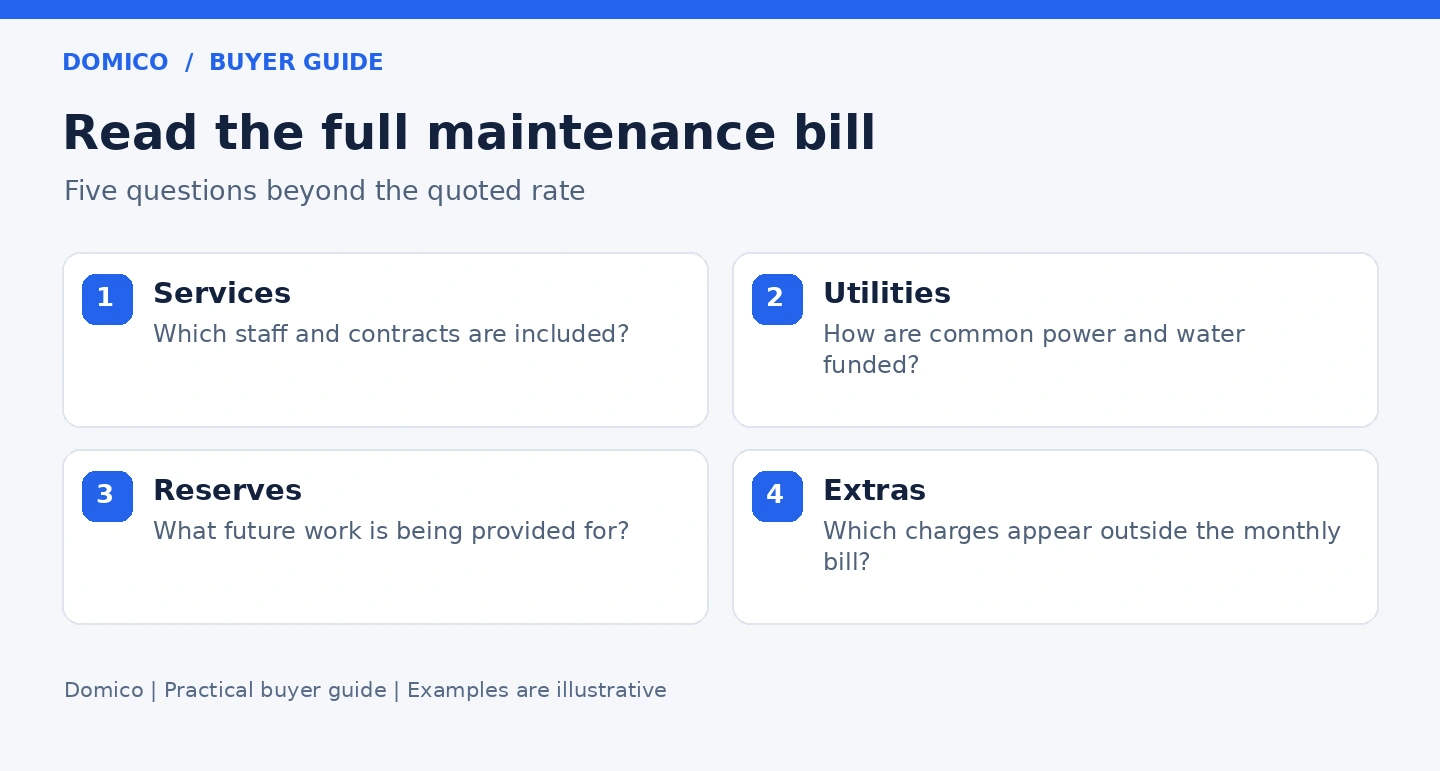
Daily operating expenses keep services running: staff, common electricity, routine cleaning and consumables. Longer-term reserves prepare for future work such as equipment replacement or major repairs. An advance-maintenance deposit is another category that needs its own explanation.
Ask the manager to separate these lines. A combined amount can hide whether the building is saving for future needs or simply using all collections on current bills. Do not assume that a low monthly payment means there will be no larger collection later.
| Cost group | Examples to investigate | Buyer question |
|---|---|---|
| Staffing and contracts | Security, housekeeping, manager | Which services and hours are covered? |
| Common utilities | Lifts, pumps, corridor lighting | What is the actual annual usage and cost? |
| Water and waste | Supply, treatment and disposal | Is any seasonal charge collected separately? |
| Routine repairs | Small equipment and building work | Is the budget based on real maintenance needs? |
| Reserves | Planned major repair or replacement funding | What purpose and rules govern the contribution? |
A society may allocate different cost components using different valid methods. Charges might be equal per unit, area-related, consumption-based or another authorised basis. Do not assume that one method applies to every building or every expense.
Ask which area definition is used if the calculation is per square foot. Carpet, built-up and another documented charging area can produce different totals. Match the rate and area to the invoice rather than using the number from an advertisement.
For resale, verify whether the seller has arrears, interest, disputed charges or approved special assessments. Have the sale agreement allocate responsibility clearly. A no-dues statement should be current enough to reflect the transaction timing.
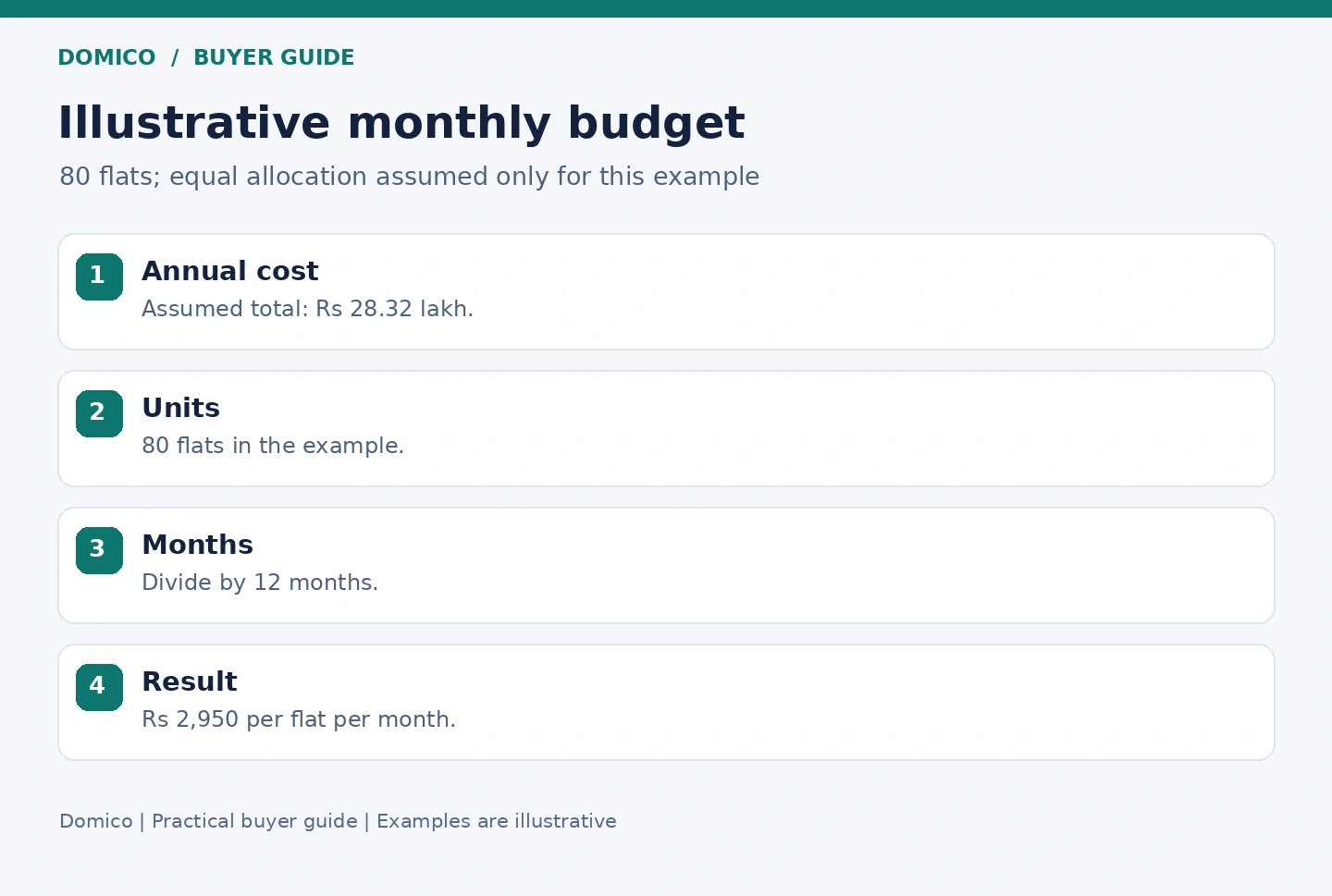
The following example is an invented 80-flat building budget. It is not a market rate, legal allocation rule or a prediction of any named society's expenditure. Equal allocation is assumed solely to make the arithmetic easy to follow.
| Assumed annual expense | Building total | Equal monthly amount per flat |
|---|---|---|
| Staff and service contracts | Rs 12,00,000 | Rs 1,250 |
| Common electricity | Rs 4,80,000 | Rs 500 |
| Water and waste services | Rs 3,84,000 | Rs 400 |
| Routine repairs and administration | Rs 2,88,000 | Rs 300 |
| Planned reserve contribution | Rs 4,80,000 | Rs 500 |
| Total | Rs 28,32,000 | Rs 2,950 |
The monthly figure is Rs 28,32,000 divided by 80 flats and 12 months. A real association may allocate the components differently, and actual costs can vary considerably.
Now compare the result with the quoted amount. If sales material says Rs 1,500 monthly, ask what expense is excluded, subsidised or assumed to be paid elsewhere. The question is not whether the lower quote is dishonest; it is what services and period it actually covers.
A partly occupied project can face different economics from a fully occupied one. Security, lifts and pumps may need to operate even while fewer households are paying. Ask who contributes for unsold units under the applicable documents and rules.
Do not assume that later occupancy will always reduce your bill. More residents can increase water consumption, wear and amenity use. It may also spread some fixed costs across a larger paying base. The budget should show its assumptions.
For a project with several phases, establish which expenses belong to your phase and which are shared across the township. A clubhouse used by many phases should have a clearly explained cost and access arrangement.
Ask for summer water invoices and the supply mix. Tanker dependence can add a variable expense that is not visible in a standard monthly bill. Check whether water is metered, included in maintenance or charged through a separate collection.
For power backup, distinguish common-service costs from the electricity used inside your flat. Ask how backup units are metered and priced, and whether there are fixed capacity charges. A “100% backup” phrase does not explain the bill.
Review the records with the manager rather than applying a guessed percentage increase. For technical issues, ask the relevant service professional to explain the actual system and its maintenance requirements.
A very low bill can reflect efficient management. It can also reflect work being postponed. Ask about lift servicing, roof repairs, painting, pumps, water systems and fire-safety maintenance. Review available contracts and planned expenditure.
The National Building Code overview includes asset and facility management as a discipline. A buyer's practical question is whether the building has a credible plan for maintaining its assets, rather than merely paying this month's utilities.
Look for recurring complaints that remain unfunded. If an assessment has identified significant work, obtain the expected allocation and timing before buying. A future special collection is part of the affordability picture even if it is not part of the monthly rate.
Add maintenance to EMI, property tax provision, home insurance where relevant, private utilities and routine home repairs. Keep the categories separate so that the same cost is not counted twice.
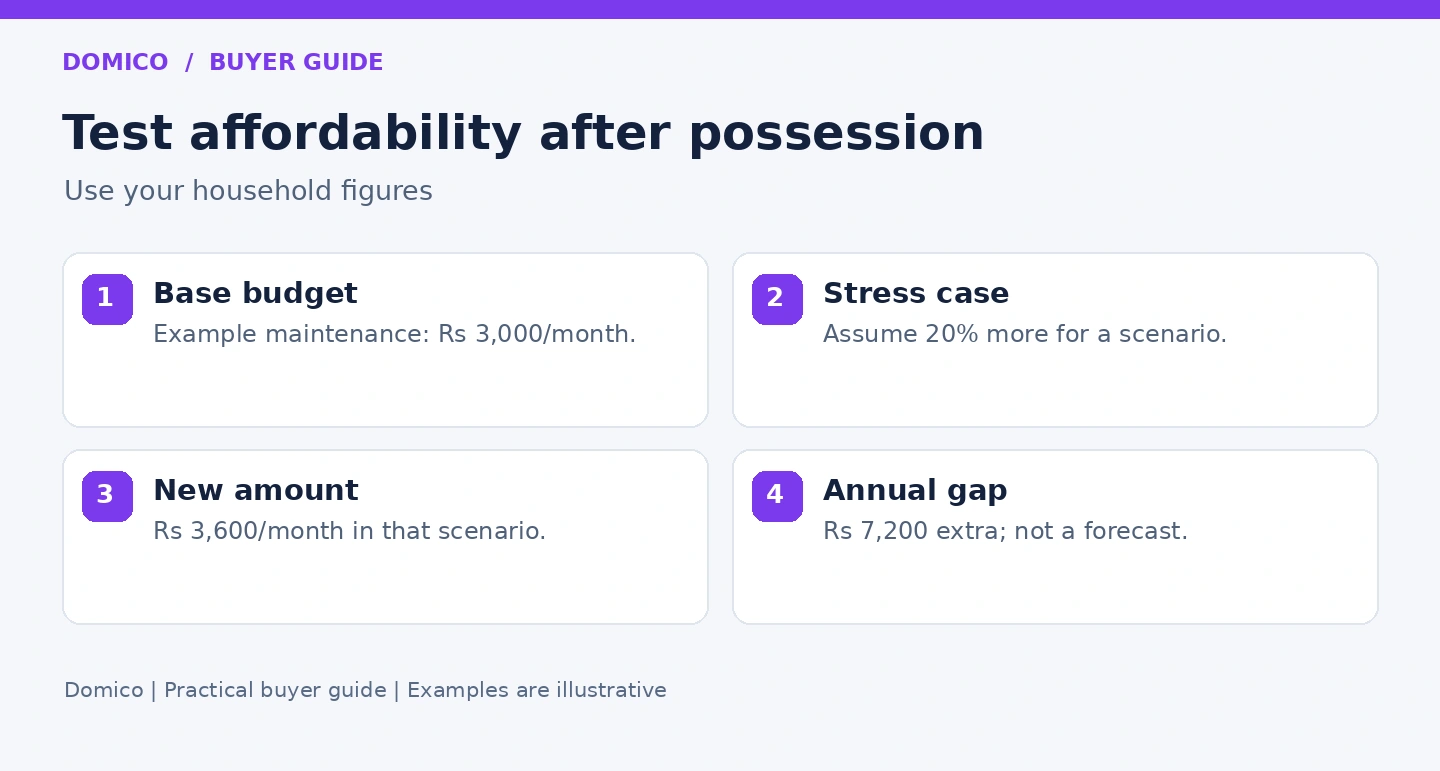
For illustration, a Rs 3,000 monthly maintenance budget is Rs 36,000 annually. If you test a 20% increase, the revised monthly figure is Rs 3,600 and the annual difference is Rs 7,200. This is a stress assumption, not a forecast or a claim that charges will rise by that rate.
Ask whether the household could manage that increase alongside a major one-time repair contribution. The exercise helps you judge resilience without pretending to predict exact future charges.
| Question | Useful evidence | Reason to investigate further |
|---|---|---|
| What does the bill include? | Itemised invoices and service scope | Important services collected separately without clarity |
| Is the budget funded? | Collection position and approved accounts | Repeated shortfalls with no plan |
| Are assets maintained? | Service records and repair programme | Important work repeatedly postponed |
| What changes after handover? | Proposed budget and transfer documents | Introductory charges treated as permanent |
| What will this flat owe? | Applicable allocation and current dues | Unexplained differences between similar units |
Reconcile annual payments separately from the monthly rate. For example, an assumed Rs 6,000 annual service collection adds an average Rs 500 per month to a household budget even if the invoice arrives only once. Check whether that amount is already included elsewhere before adding it. Ask when the last approved budget was revised and which service assumptions have changed since then; an old rate may describe a different staffing level or supply arrangement.
There is no single answer for every society and charge. Review the applicable legal framework, governing documents and valid decisions. Ask for the actual calculation used for the flat.
Check the governing rules and the nature of each charge. Do not assume that non-occupation removes all obligations, because many common services continue regardless of whether a particular flat is occupied.
Read the exact contract, funding arrangement, exclusions and conditions. A promotional phrase does not explain how future services and replacements will be funded.
No. Compare the balance with liabilities, asset condition and planned work. A large number can be inadequate for an expensive repair programme.
Recent invoices, payment receipts, a current dues position, approved special assessments and the budget basis are useful starting points. Have transaction liabilities allocated clearly in the agreement.
A realistic maintenance budget makes the home easier to own after the excitement of possession has passed.
Download the topic-specific review checklist. Use it to record evidence, unanswered questions and follow-up actions for the exact property.
Planning to buy or rent in Indore? Browse verified properties in Indore or read more Indore guides.
Check who owes the lender, how builder-paid interest works, when support ends and whether you can carry the loan if payments stop.



