Buying Guide
Self-Employed Home Loan: ITR and Document Guide
Organise ITRs, accounts, bank statements, debt records and sustainable cash flow for a truthful, well-prepared self-employed home-loan application.

Table of contents
A busy business is not the same as a documented repayment income.
Self-employed homebuyers often know their business is doing well but struggle to explain that performance in a home-loan file. Sales arrive through different accounts, expenses vary, some months are seasonal and the latest tax return may show a different picture from current cash flow.
The lender's task is to assess sustainable repayment capacity. Your task is to present a complete, consistent and truthful record that makes the business understandable. A large turnover figure alone cannot answer how much cash is reliably available for a home EMI.
This guide covers document organisation and financial preparation. It does not suggest increasing reported income artificially or promising that a particular number of ITRs guarantees approval.
Identify the applicant and business structure
A sole proprietor, partner, company director and independent professional may receive income in different ways. Tell the lender the actual structure, your ownership or role and which income you want assessed.
If your business is a company, its turnover is not automatically your personal income. Salary, distributions and other receipts need to be understood through the appropriate records. A partnership's profit also needs to be distinguished from the individual partner's assessable position.
Ask for the lender's checklist for your specific category. HDFC Bank's document checklist and ICICI Bank's required-document page show that home-loan documentation is organised by applicant type. The list requested for your file can include additional items.
Understand what the core documents show
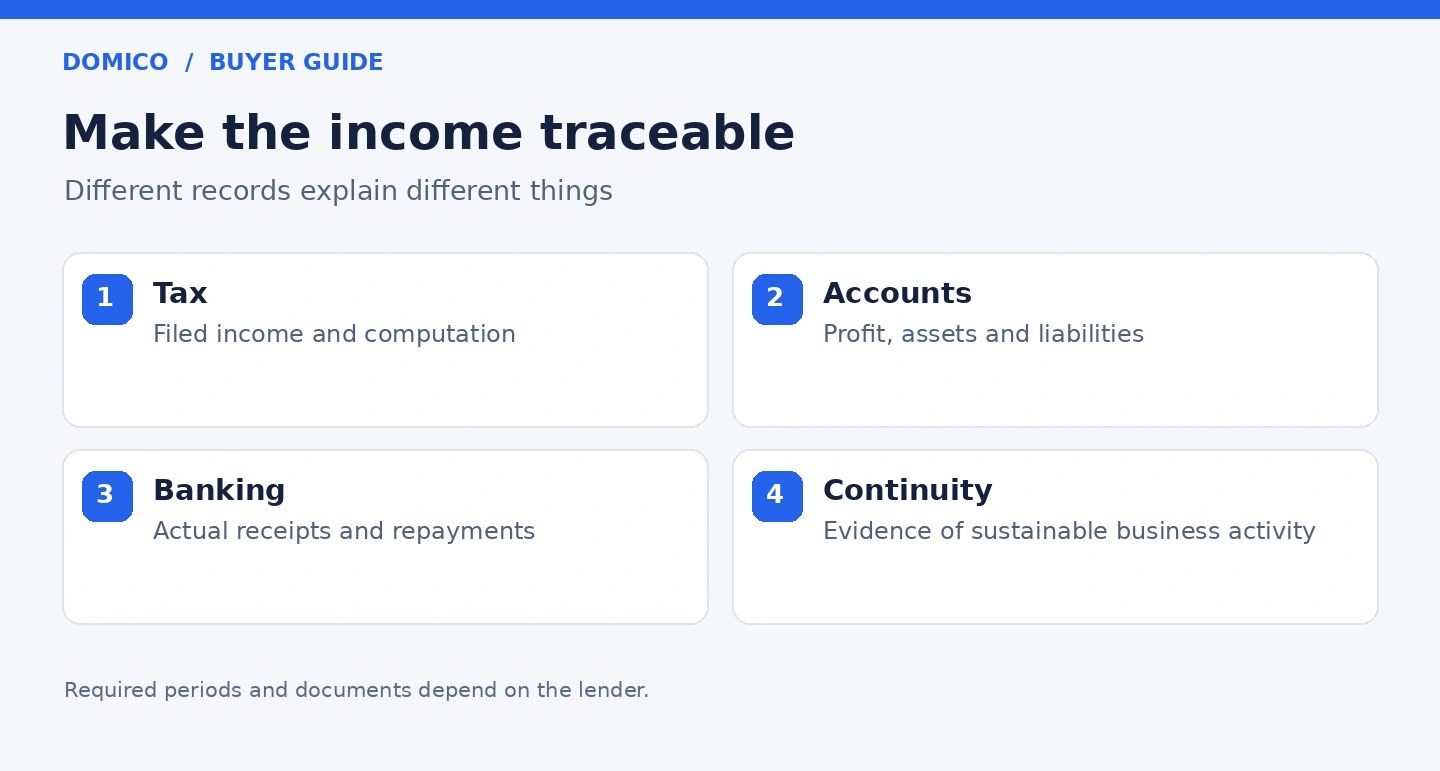
The lender may request income-tax returns, computation statements, financial accounts, banking records, business-existence evidence and existing-loan information. The required periods and acceptable forms depend on policy and circumstances.
| Record | What it helps explain |
|---|---|
| ITR and tax computation | Reported income and tax position |
| Profit and loss account | Revenue, expenses and business earnings |
| Balance sheet | Assets, liabilities and financial structure |
| Bank statements | Actual receipts, payments and account behaviour |
| Business or professional evidence | Nature and continuity of activity |
| Existing loan statements | Current repayment obligations |
A return acknowledgement alone may not contain all the details needed for assessment. Ask whether the lender requires the complete filed return, computation and supporting financials.
Reconcile turnover, profit and personal cash flow
Turnover is the value of business activity recorded under the relevant accounting basis. Profit reflects the relationship between revenue and expenses. Cash available to you can differ again because customers have not paid, stock has increased, debt needs repayment or money must stay in the business.
Avoid presenting every credit into a bank account as income. Transfers between your own accounts, loan proceeds, refunds and capital introduced can inflate visible inflows without increasing earnings.
Prepare a reconciliation with your accountant. It should explain major receipts, unusual months and the link between accounts and tax records. A clear explanation of a legitimate difference is better than trying to hide it.
Use a conservative income view
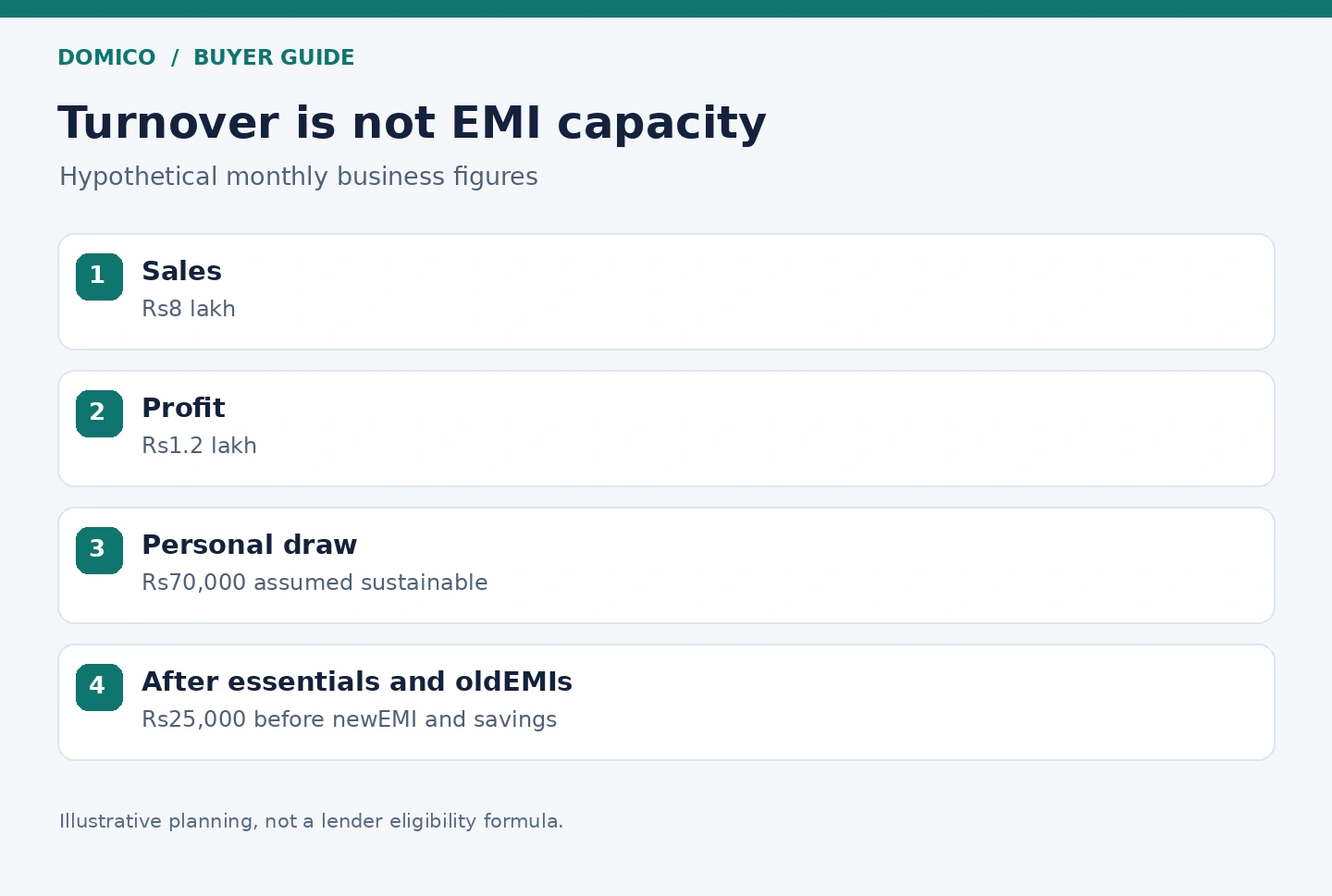
Imagine an illustrative proprietor with Rs 8 lakh average monthly sales and Rs 1.2 lakh average monthly accounting profit. After working-capital needs and business-debt payments, the owner regularly draws Rs 70,000 for household use.
| Hypothetical monthly business picture | Amount |
|---|---|
| Sales | Rs 8,00,000 |
| Accounting profit | Rs 1,20,000 |
| Sustainable personal draw assumed for planning | Rs 70,000 |
| Household essentials | Rs 35,000 |
| Existing personal EMIs | Rs 10,000 |
| Balance before new home EMI and savings | Rs 25,000 |
These figures are illustrative, not a lender's income formula. A proposed Rs 30,000 home EMI would already exceed the planning balance before emergency savings. A business with strong sales can still require a lower home budget or a larger sustainable own contribution.
Explain seasonality and recent changes
If earnings peak during a festival, admission season or project cycle, show the full pattern. One excellent month should not be annualised without considering quieter months and collection delays.
If the business recently expanded, explain the funding, new expenses and how stable the additional income is. If profits fell temporarily, identify the reason and provide records showing the present position. Do not promise a future client contract as though it were cash already earned.
HDFC Bank's published process notes that business sustainability and cash flow are considered for self-employed applicants. Use your documents to explain those points rather than handing over a large unlabelled folder.
Organise banking without manufacturing activity
Use appropriate accounts consistently and keep business and personal transactions understandable. Reconcile large cash deposits, customer collections and inter-account movements. The objective is accurate records, not creating a temporarily impressive statement.
Do not circulate borrowed money through accounts to resemble business receipts. Do not obtain false invoices or revised financials that misstate reality. Such shortcuts can undermine both the application and your wider tax or legal position.
If past records are incomplete, discuss the legitimate correction and documentation route with your accountant. Better recordkeeping now can support a stronger application later even when it cannot rewrite the past.
Review debt at both business and household levels
List business loans, overdrafts, credit cards, personal loans and any obligations you guarantee or service. Tell the lender the complete position it requests. A low personal EMI figure can be misleading if the business must make large debt payments before you can draw income.
Separate short-term working-capital requirements from money genuinely available for the down payment. Using the business's entire cash buffer to buy a home may force expensive borrowing when suppliers or salaries fall due.
Stress-test the budget with delayed customer collections and a weaker sales period. Keep enough liquidity for both household essentials and reasonable business continuity.
Prepare the own-contribution trail
The lender will need to understand the buyer's contribution and the property's payment structure. Organise savings records, legitimate asset-sale proceeds or documented family gifts where applicable.
If a relative funds part of the down payment, record whether it is a gift or a loan and have the tax and documentation position checked. A repayable family advance also affects practical affordability even when it does not resemble a regular bank EMI.
Do not assume a bank will fund the entire advertised property price plus registration and furnishing. Ask for the actual finance basis, margin and excluded expenses for your proposed purchase.
Avoid booking before the property and income are reviewed
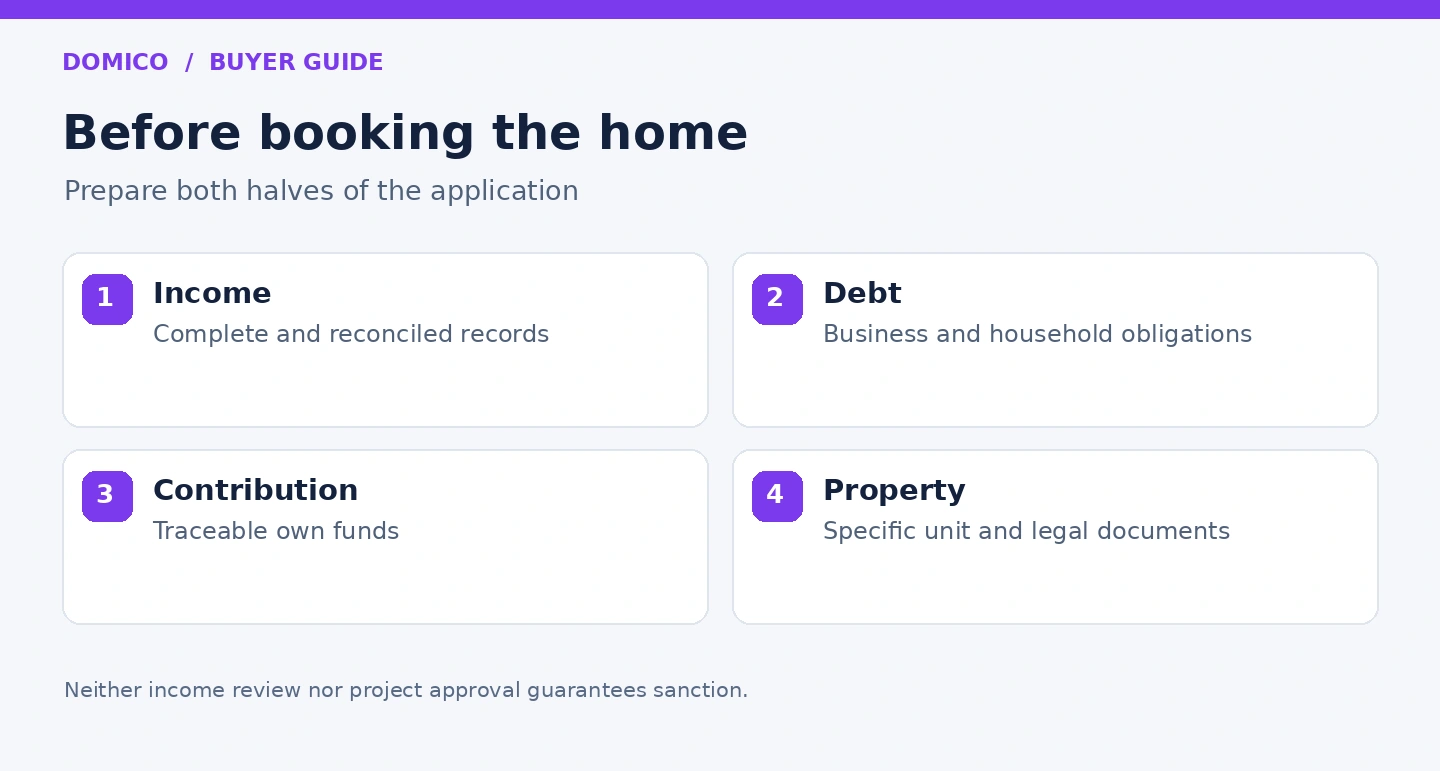
A lender may be comfortable with your income while rejecting the property documents or valuation. Conversely, a well-approved project does not guarantee that your financial file qualifies.
Send the identified property and draft terms for the relevant assessment. If the seller requires a non-refundable payment before a bank decision, understand the risk and have the agreement reviewed before accepting the deadline.
| Application stage | Self-employed buyer's useful preparation |
|---|---|
| Preliminary discussion | Accurate business structure and realistic budget |
| Income assessment | Complete tax, financial and bank records |
| Property review | Identified unit, title and approval documents |
| Sanction review | Amount, tenure, pricing, validity and conditions |
| Disbursement readiness | Own contribution, originals and verified payment instructions |
Compare offers using the complete terms
An advertised interest rate may not be the rate offered to your file. Compare the actual sanction terms, fees, annual percentage rate where provided, security requirements, insurance choices and disbursement conditions.
Ask which income method was used if the approved amount is lower than expected. A clear answer may help you identify whether the limitation comes from profit, debt, business continuity, loan tenure or property valuation.
Do not select a costly product solely because it asks for fewer documents. Understand the repayment burden and alternatives. Faster processing can be useful, but it cannot make an unaffordable loan suitable.
Printable buyer worksheet
Download the topic-specific review checklist. Use it to record evidence, unanswered questions and follow-up actions for the exact property.
Frequently asked questions
How many years of ITR are needed?
The period depends on the lender, applicant category and product. Obtain the current checklist for your file. Do not assume one universal requirement applies to every self-employed borrower.
Will turnover decide the loan amount?
Turnover alone does not establish repayment capacity. The lender examines the relevant income, financials, account behaviour and obligations under its policy.
Can a newly started business get a home loan?
Possibilities vary by product and applicant profile. Ask about acceptable evidence and continuity requirements. Avoid treating an online eligibility estimate as confirmation of approval.
Can my spouse's income be included?
Potentially, if the proposed co-applicant and income meet lender policy. Ownership, loan responsibility and documents must be aligned, and the additional borrower should understand the obligations.
Should I file a higher income just to qualify?
Financial and tax records should accurately reflect the facts. Discuss lawful reporting with your accountant; do not create artificial income or false documents to obtain a loan.
Make the business easy to understand
A strong self-employed file connects tax records, accounts, banking, business continuity and sustainable personal cash flow. Once those agree, choose a home budget that protects both the household and the business that will repay the loan.
Primary sources and related reading
- buyer-guide-100
- homebuyers
- self-employed-home-loan
- indore
Planning to buy or rent in Indore? Browse verified properties in Indore or read more Indore guides.



