Buying Guide
Seepage in a Resale Flat: Checks Before You Buy
Investigate damp patches, repair history, shared plumbing, inspection evidence and contract conditions before buying a resale flat with seepage.
Updated 8 min read
Buying Guide
Investigate damp patches, repair history, shared plumbing, inspection evidence and contract conditions before buying a resale flat with seepage.
Fresh paint can hide a stain. It cannot explain where the water came from.
A damp patch in a resale flat should start an investigation, not an instant rejection or a quick discount calculation. The problem might be a local plumbing leak, a rainwater entry point, an issue in a shared service shaft or moisture condensing on a surface. Different causes require different work and different people to cooperate.
The buyer's task is to establish what is known, what remains uncertain and whether the repair can be verified before purchase. A promise to repaint the room is not the same as identifying and addressing the source. This guide focuses on the questions to resolve before you accept that risk.
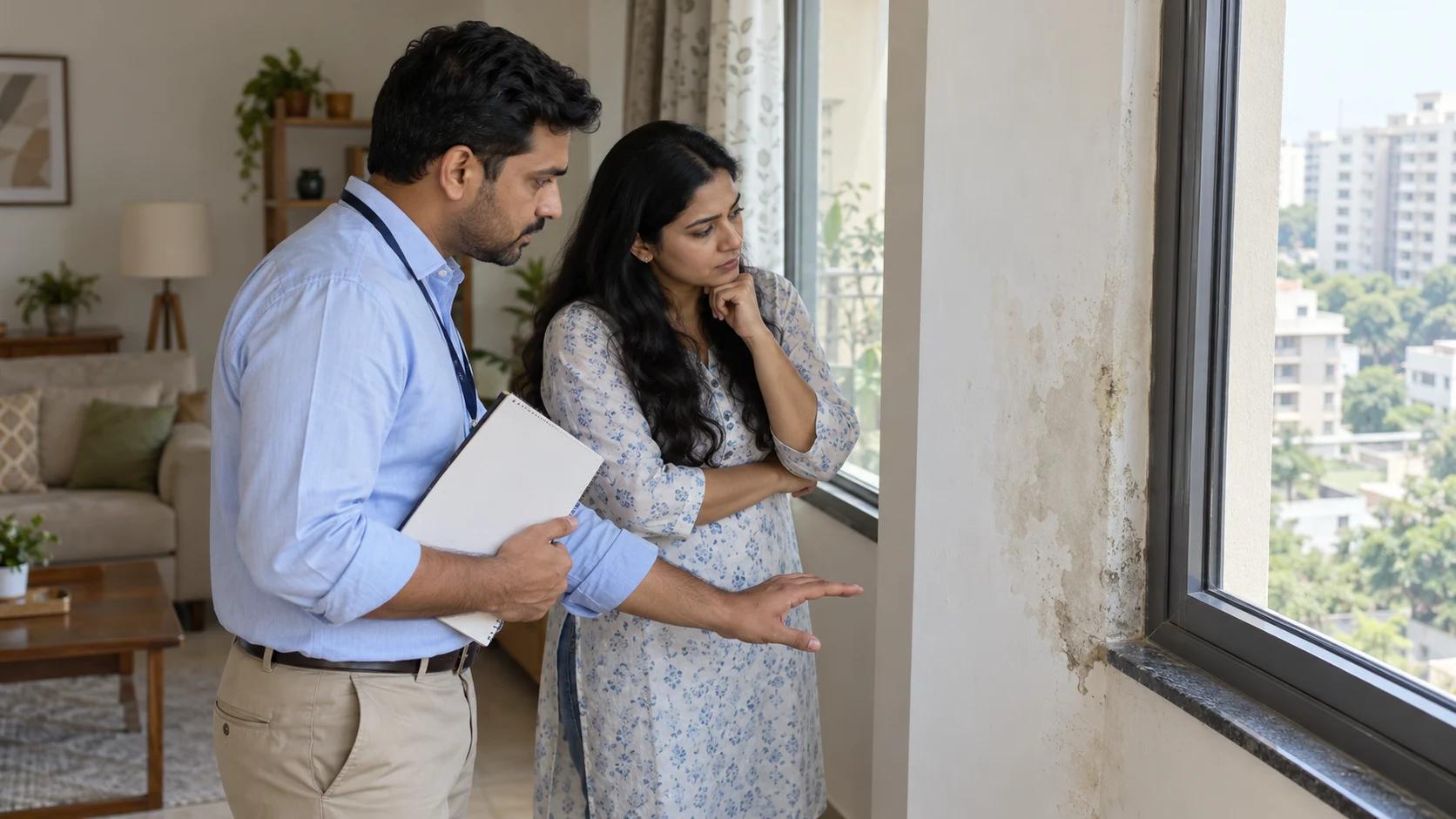
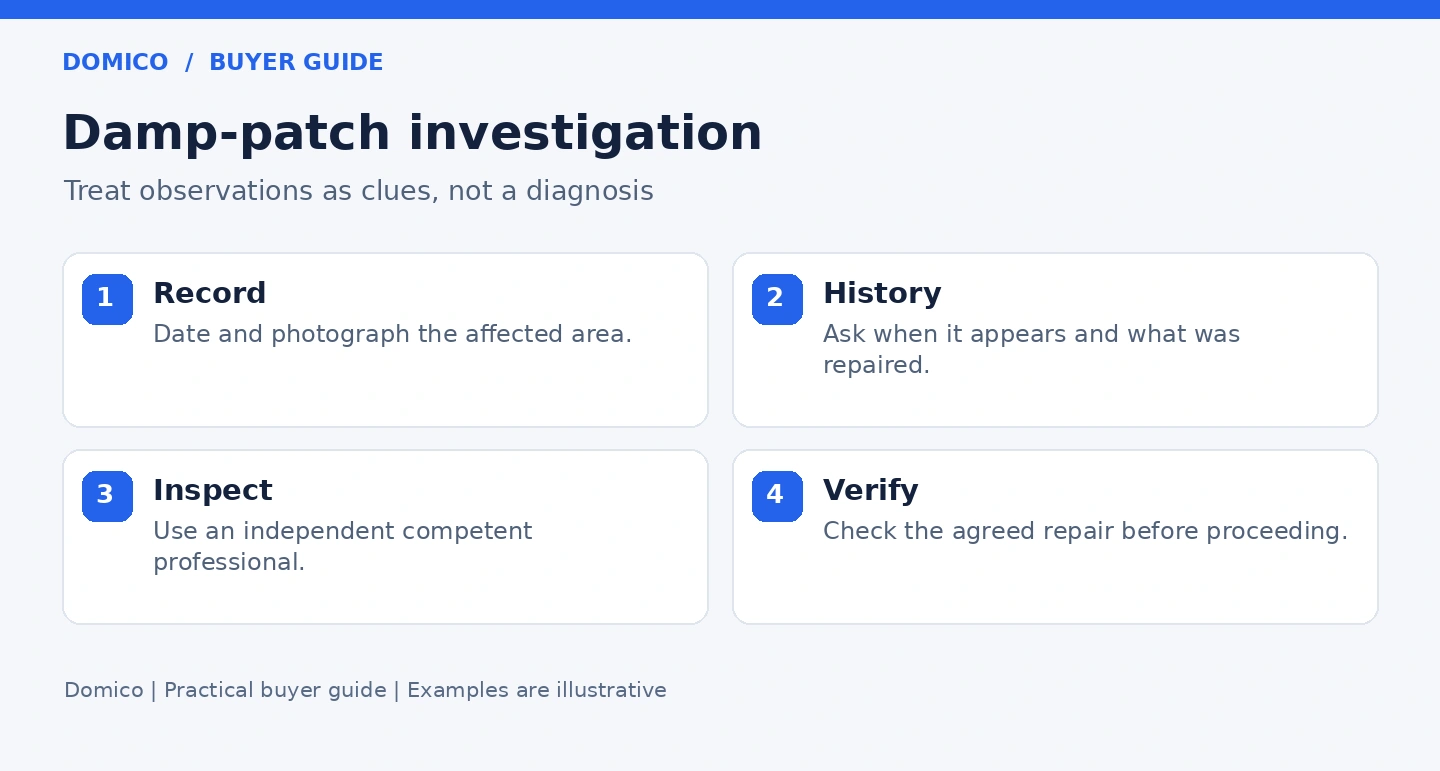
With the owner's permission, photograph the affected area from a distance and close up. Note the room, wall or ceiling, approximate extent and date. Record whether the surface feels damp without disturbing materials or accessing unsafe places.
Look for paint bubbles, discolouration, salt-like deposits, damaged skirting, swollen wood, a musty smell or repeated local repainting. These are observations to investigate, not a diagnosis. Do not scrape surfaces or open electrical fittings yourself.
Ask when the issue first appeared, whether it changes during rain and what repairs were attempted. Request old photographs, invoices and complaint messages where the seller is willing and entitled to share them. A dated history is more useful than “this happened once long ago.”
| Observation | A question it raises | What it cannot establish alone |
|---|---|---|
| Stain below a bathroom | Is a pipe, joint or waterproofing area involved? | The precise source or who is responsible |
| Dampness near an external window | Does rain enter through the facade or seal? | That replacing sealant will fully solve it |
| Ceiling patch on the top floor | Is roof or terrace water involved? | Whether the structure is affected |
| Mould behind furniture | Are moisture and ventilation conditions contributing? | That residents alone caused the problem |
A competent independent inspector should consider the location, construction and history before recommending treatment. The RICS consumer guide on damp emphasises investigating moisture sources rather than treating a damp label as a diagnosis. Its legal context is overseas; the investigation principle is useful, while Indian responsibilities require local advice.
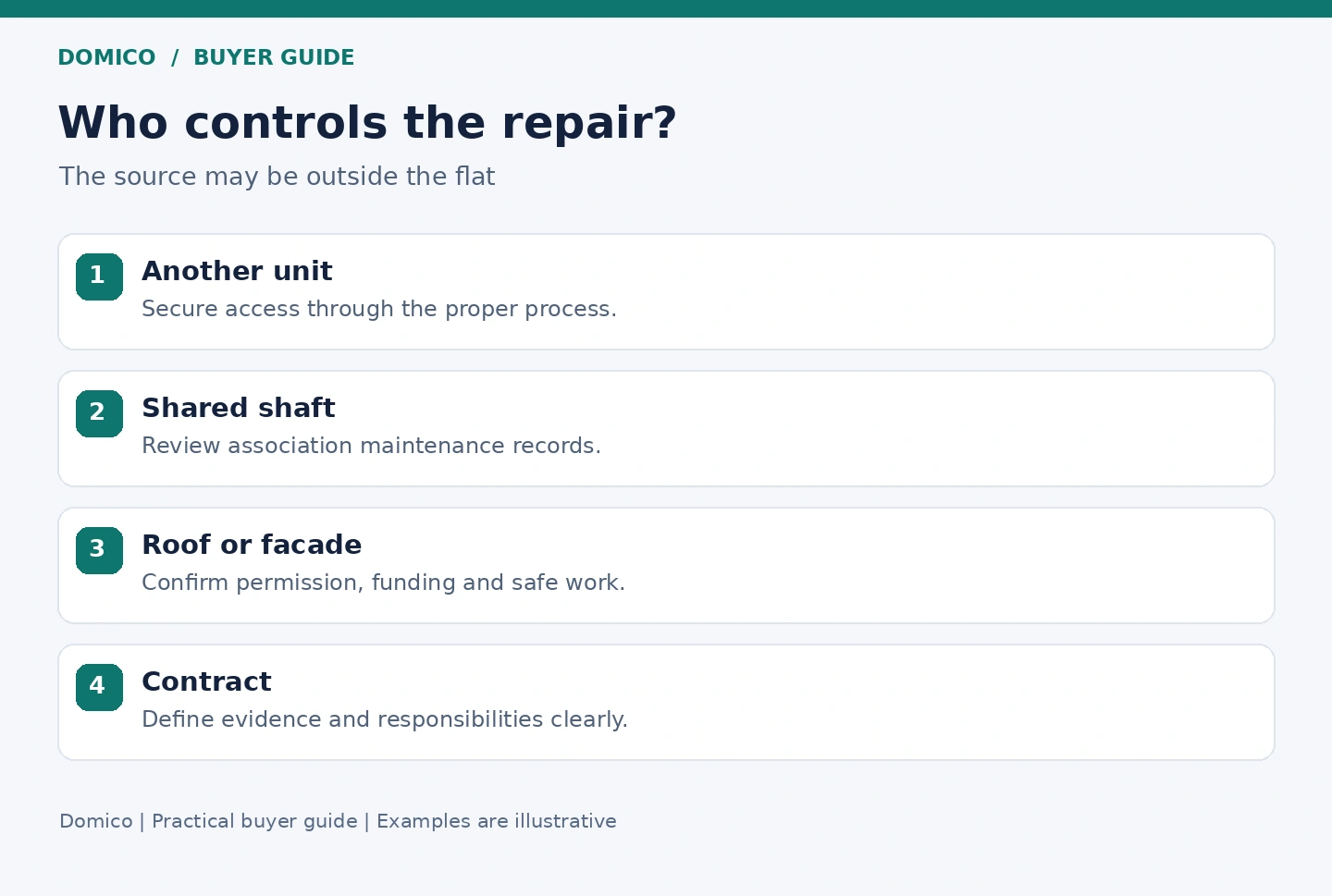
In a flat, the source may be outside the apartment you are buying. Water can travel from an upper unit, a shaft or a shared terrace. The visible stain may not sit immediately beside the entry point. Ask the inspector to explain the evidence behind any proposed cause.
Do not create your own flood or pressure test. Any testing should be planned by qualified people, with permission from affected owners and the society. An uncontrolled test can damage another home and still fail to reproduce the actual problem.
Ask for an itemised repair proposal. It should state the suspected source, proposed investigation, remedial work, affected finishes and verification method. A quotation for putty and repainting addresses appearance; it does not necessarily address moisture entry.
Where the diagnosis is uncertain, the proposal should say so. Staged investigation may be more honest than an immediate guarantee. Ask whether access is needed to another flat, external scaffolding, common plumbing or the terrace.
Clarify who will pay if the initial work fails. Read any contractor warranty carefully: its scope, exclusions, period, transferability and response process matter. A long warranty headline can have limited value if it excludes the component believed to be causing the leak.
Contact the authorised society representative with the seller's cooperation. Ask whether similar complaints exist in the same shaft, facade line or roof zone. Request relevant maintenance or repair records without seeking private information about unrelated residents.
If common-area work is needed, review the approval, funding and contractor arrangements. The seller cannot always promise a completion date for work controlled by the association or another owner. Have your lawyer clarify contractual responsibilities and any proposed purchase condition.
For a building where promoter obligations may still be relevant, have the dates and facts reviewed professionally. Avoid assuming that every damp patch automatically triggers a particular remedy. The source, agreement, applicable law and evidence need assessment.
Dampness and mould should be addressed rather than dismissed as decoration. UK Government guidance discusses the health concerns associated with damp and mould. It does not supply Indian housing law, and the buyer should not use the article to diagnose a family member's symptoms.
If someone in the household has relevant health concerns, seek appropriate medical advice and explain the intended occupancy timing to the inspector. Do not move in on the assumption that a smell will disappear after opening the windows.
Avoid touching or disturbing significant mould growth yourself during the purchase inspection. Ask for a safe professional approach to assessment, remediation and reoccupation. The purchase timetable should allow work to be completed and reviewed where that matters to the family.
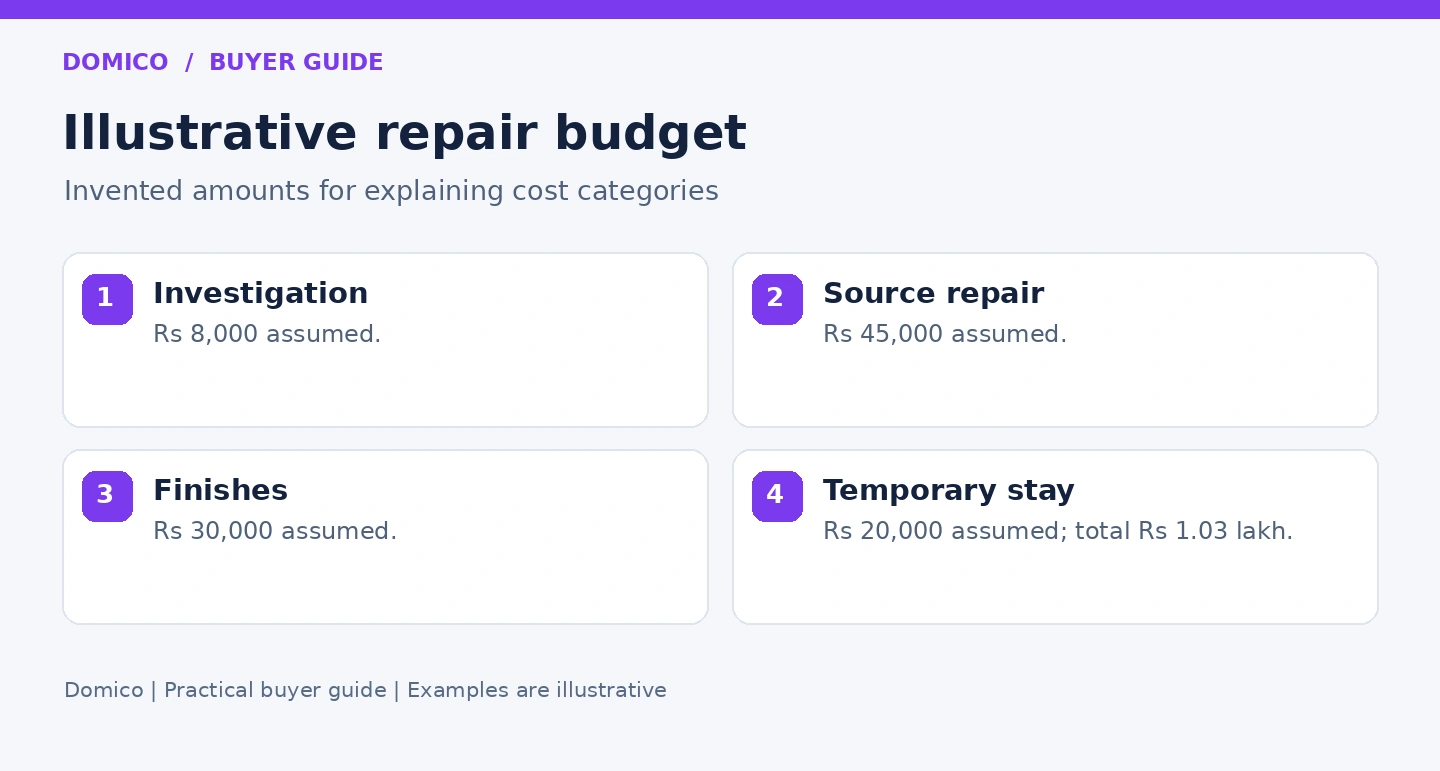
Consider a hypothetical flat offered for Rs 48 lakh. The seller agrees to a Rs 50,000 discount after showing a Rs 35,000 repainting quote. That arithmetic leaves Rs 15,000, but it says nothing about the cost of stopping the water source.
| Illustrative cost item | Assumed amount | Status to establish |
|---|---|---|
| Independent investigation | Rs 8,000 | Obtain actual scope and quotation |
| Source repair | Rs 45,000 | Depends on confirmed cause and access |
| Drying and finish restoration | Rs 30,000 | Timing depends on actual conditions |
| Temporary accommodation allowance | Rs 20,000 | Relevant if immediate occupancy is impossible |
| Example total | Rs 1,03,000 | Excludes unknown further work |
These invented amounts are not contractor rates. They show why a cosmetic discount can be misleading. The actual plan may cost less, more or require work that cannot yet be priced. A contingency is not a diagnosis and should not disguise an unmanageable uncertainty.
Discuss with your lawyer whether the agreement should require investigation, defined repairs, access permissions and a follow-up report before a specified payment or completion. A condition needs clear evidence of completion and a remedy if it is not met.
Do not write your own vague line saying “seller will solve all seepage.” Define the identified locations, agreed scope and which professional will confirm the outcome. If repairs depend on monsoon performance, acknowledge that a dry-season visit has limits.
A retention or delayed payment may be proposed in some transactions, but its legality, lender acceptance and practicality need professional advice. Never assume that withholding an arbitrary amount after signing protects the buyer.
Pause if the seller prevents a reasonable inspection, refuses to explain repeated repairs or asks you to pay before shared-access issues are settled. Also pause if a professional identifies a possible structural concern or unsafe electrical condition. The right next step is specialist review, not an amateur severity score.
Walking away may be appropriate if the cause, cooperation or funding cannot be resolved. Equally, a well-documented local repair with access and successful follow-up can be a manageable purchase issue. The evidence should support the decision in either direction.
| Before you proceed | Evidence to retain | Remaining question |
|---|---|---|
| Diagnosis | Independent report and photographs | How certain is the source? |
| Access | Written consent where required | Can the actual repair be carried out? |
| Funding | Itemised scope and responsible party | Who pays for recurrence or extra work? |
| Completion | Repair record and follow-up findings | Has the agreed outcome been verified? |
| Contract | Lawyer-reviewed conditions | What happens if the condition fails? |
Ask the inspector which follow-up conditions would meaningfully test the proposed repair. That might involve observing an ordinary plumbing-use cycle or relevant weather under an agreed professional method. Retain the before-and-after photographs and exact scope. If the repair has not yet faced the conditions that caused the original problem, record that limitation honestly in the purchase decision.
No. Investigate the cause, extent and repair feasibility. A documented local defect differs from a recurring shared-system problem with no cooperation or reliable diagnosis.
A reading is one part of an investigation. Its interpretation depends on materials, method and surrounding conditions. Ask the inspector how the reading supports the conclusion rather than treating a displayed number as a complete answer.
Fresh paint is common before sale. Ask about repair history and inspect carefully, especially where local patches, odours or damaged finishes remain. Do not accuse the seller without evidence.
Responsibility depends on the source, documents and applicable law. Obtain the society's records and have the issue reviewed locally. An agent's statement is not a legal determination.
Follow the inspecting professional's advice for the actual material and defect. There is no reliable universal waiting period that proves every repair successful, particularly when weather-related recurrence is involved.
A clean finish is the last step. A clear explanation of the water source should come first.
Download the topic-specific review checklist. Use it to record evidence, unanswered questions and follow-up actions for the exact property.
Planning to buy or rent in Indore? Browse verified properties in Indore or read more Indore guides.
Check who owes the lender, how builder-paid interest works, when support ends and whether you can carry the loan if payments stop.



