Buying Guide
Pre-EMI vs Full EMI: Construction-Period Loan Costs
Understand pre-EMI and full EMI with disbursement examples, rent-overlap costs, construction-delay checks and a practical household budget.

Table of contents
An interest-only payment can ease today’s budget while leaving tomorrow’s loan intact.
An under-construction home can make you pay for two places at once: rent for the home you live in and loan interest for the home still being built. That is why pre-EMI offers attract attention. The initial payment may be much lower than a full EMI, but the difference needs to be understood before it becomes a long-running commitment.
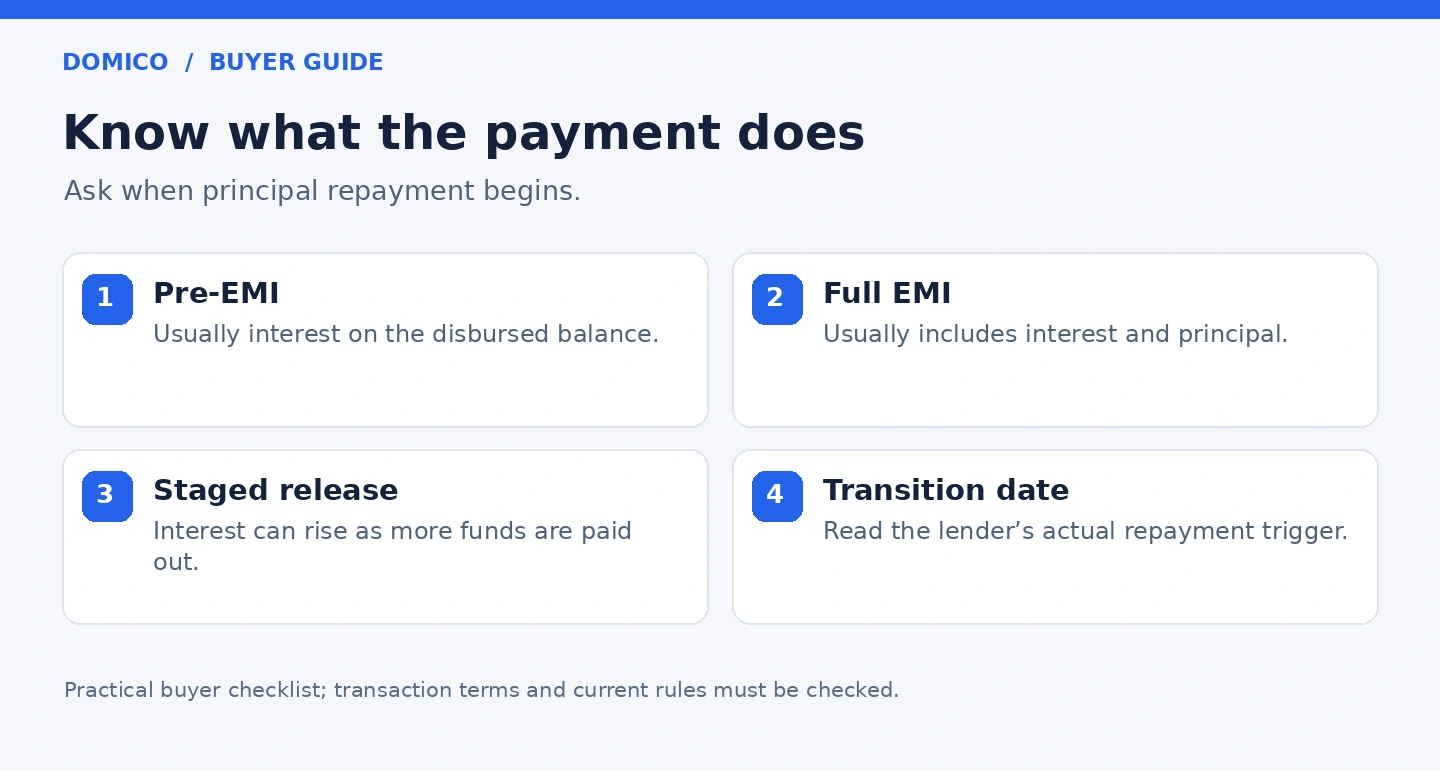
Pre-EMI usually refers to interest paid on the amount already disbursed during the agreed construction or pre-repayment phase. A full EMI generally includes both interest and principal. Product arrangements vary, so the loan agreement must explain the precise treatment rather than leaving you to interpret a marketing phrase.
The distinction that matters
If you pay only interest, the principal already released does not reduce merely because you have made that payment. If you pay an amortising EMI, part can reduce principal after interest and relevant charges are applied. Ask the lender when principal repayment begins and how the instalment changes as disbursements increase.
A staged loan is not necessarily fully disbursed on sanction. The lender may release funds against construction milestones and other conditions. Your interest obligation depends on the actual releases and their dates. Keep the bank's disbursement statement alongside the builder's demand schedule.
| Question | Pre-EMI arrangement | Full EMI arrangement |
|---|---|---|
| What is usually being paid? | Interest on funds already disbursed | Interest plus principal under the repayment structure |
| Does principal automatically reduce? | Usually not from interest-only payments | It can, according to the schedule |
| Starting monthly outflow | Often lower at a low disbursed balance | Often higher |
| Construction-delay exposure | Interest-only phase may continue under terms | Principal may reduce, but rent overlap still matters |
| Essential document | Interest and transition provisions | Amortisation and staged-disbursal provisions |
A simple pre-EMI calculation
Suppose a lender has disbursed ₹10 lakh at an illustrative 8.5% annual interest rate. A rough monthly interest calculation is ₹10,00,000 × 8.5% ÷ 12, or approximately ₹7,083. If the disbursed balance becomes ₹20 lakh at the same rate, the rough monthly interest becomes ₹14,167.
These are planning illustrations. Actual interest may use daily balances, exact release dates and the contract's calculation method. A release midway through a month will not necessarily produce the same charge as money outstanding for the whole month.
The useful point is that pre-EMI can rise before possession even without a rate increase. More of the loan has been released. Ask for a month-by-month estimate using the expected construction demands, then test a delayed schedule as well.
A construction delay has a measurable cost
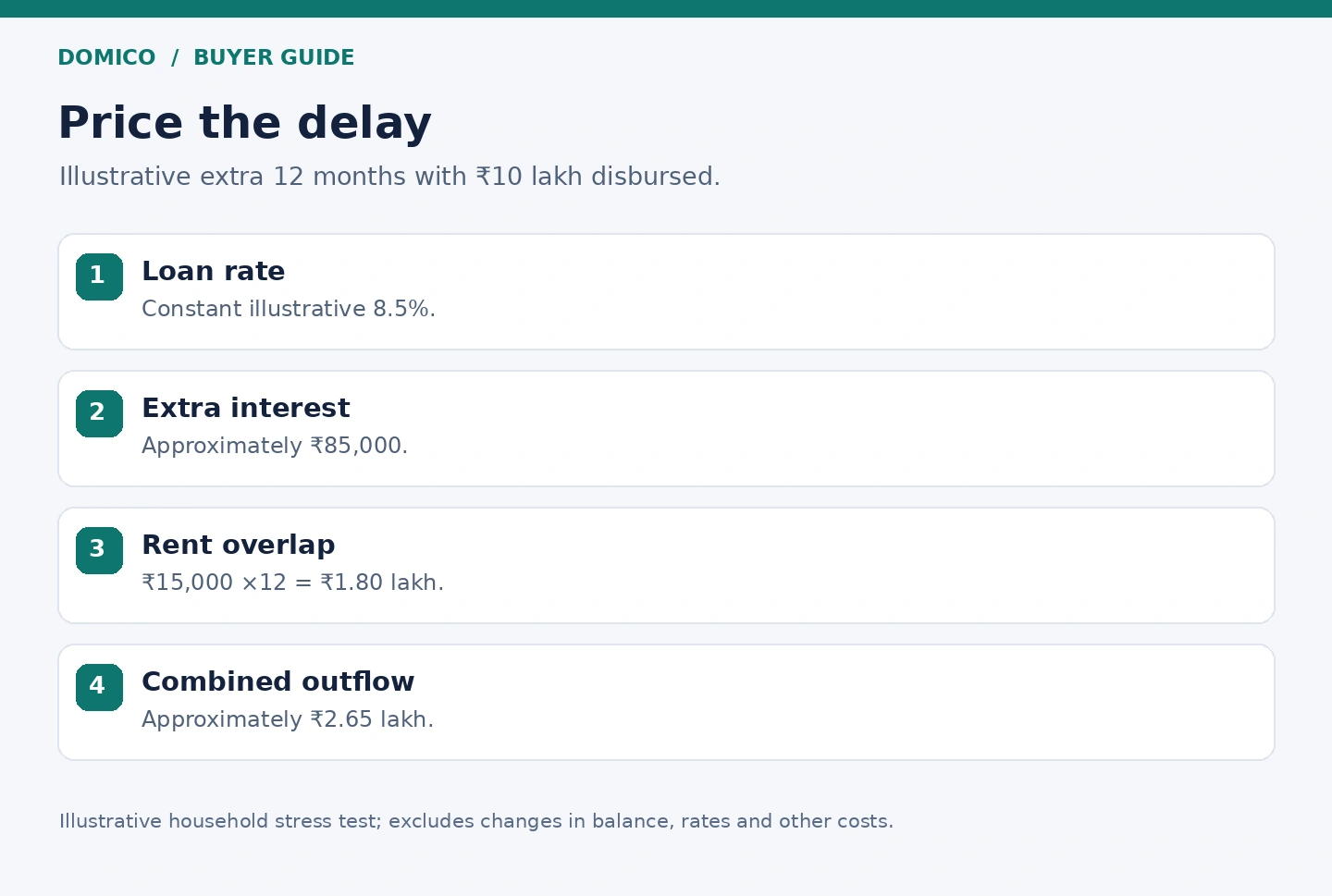
Imagine ₹10 lakh remains disbursed for twelve extra months at an unchanged illustrative 8.5%. Interest for that additional year is approximately ₹85,000 before accounting for payment-date effects or changes in balance. If rent is ₹15,000 a month during that period, the additional rent is ₹1.80 lakh.
Together, those two items create approximately ₹2.65 lakh of extra cash outflow over the year. This is not a prediction or an estimate of compensation. It is a household stress test. Other costs, including storage, travel and price changes for fit-out, can increase the disruption further.
| Extra 12-month delay: illustrative assumptions | Calculation | Additional cash outflow |
|---|---|---|
| Interest on ₹10 lakh at 8.5% | ₹10,00,000 × 8.5% | ₹85,000 |
| Rent at ₹15,000 a month | ₹15,000 × 12 | ₹1,80,000 |
| Combined amount | Interest plus rent | ₹2,65,000 |
A buyer should therefore assess construction progress and contractual remedies separately from the convenience of the initial payment. A low pre-EMI does not make an uncertain possession date harmless.
What a full EMI can improve
Where the product allows principal repayment during construction, a full EMI can begin reducing the debt earlier. That can lower the balance that remains at possession and may reduce interest compared with an otherwise similar interest-only approach.
However, this does not mean full EMI is always the better household choice. If the larger payment consumes the emergency reserve while you are also paying rent, you may replace home-loan interest savings with expensive short-term borrowing. Affordability must include the full overlap period, not only the month of booking.
Ask for two written illustrations using the same disbursement schedule. One should show the offered pre-EMI structure, and the other the full-EMI alternative if available. Compare cumulative cash paid, principal outstanding at a realistic possession date and the remaining repayment period.
Questions that uncover the real structure
Find out whether the quoted EMI is based on the sanctioned amount or on each disbursed portion. Ask whether paying more than interest immediately reduces principal, whether a separate request is needed and whether later disbursements change the instalment.
Also ask when the pre-EMI phase must end. Is it tied to a particular date, a maximum period, full disbursement or a possession-related event? What happens if construction stops? A product name cannot answer those questions.
The lender's Key Facts Statement and schedule are useful starting documents. They should be read together with the sanction letter and agreement, especially if the early payments are different from the later regular EMI.
Match releases to genuine construction demands
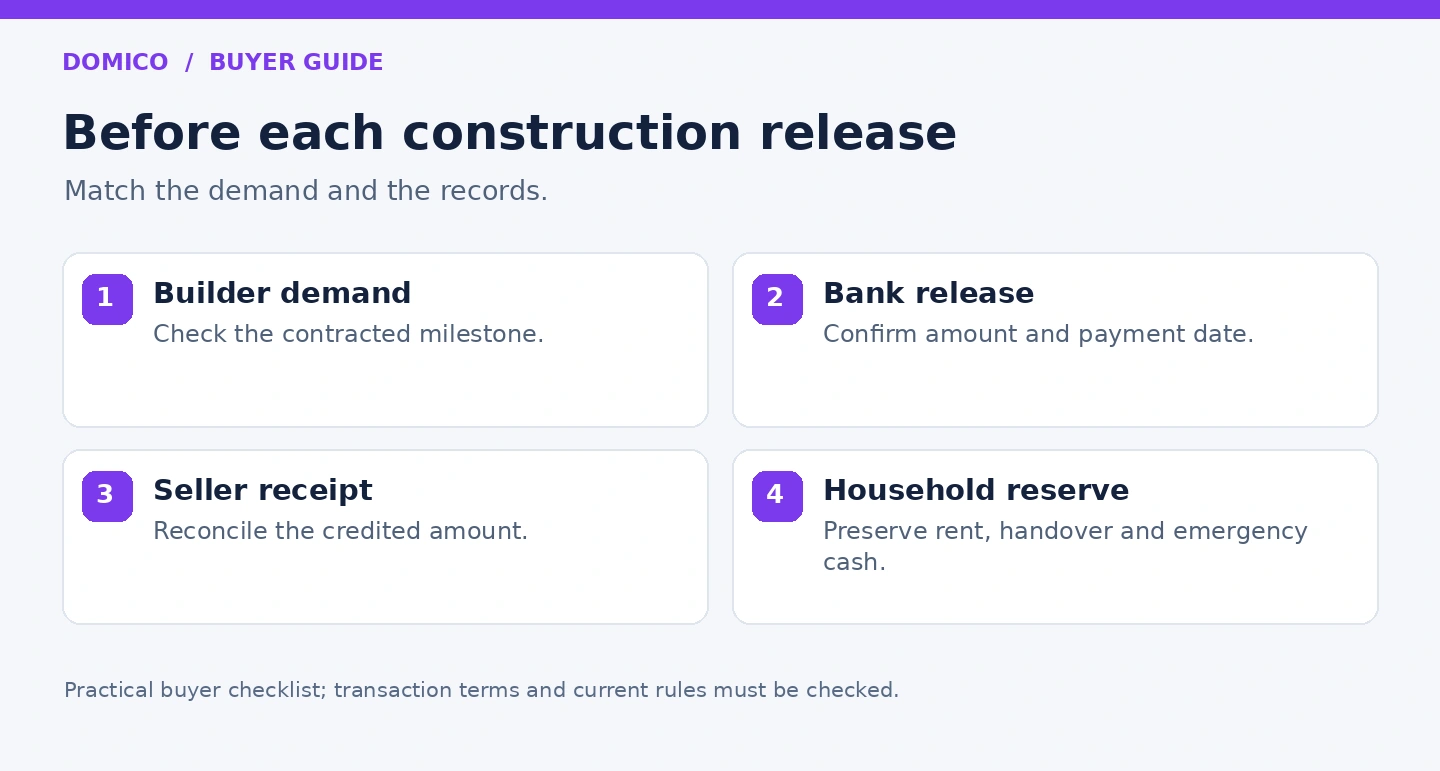
A builder demand is a request, not an instruction to stop checking. Match the demand with the sale agreement, applicable milestone and lender's inspection or release conditions. Ask the bank what evidence supports the next disbursement.
Keep records of amounts you paid from your own funds and amounts paid by the lender. The seller ledger and bank ledger should reconcile. If the bank releases ₹5 lakh and the builder's receipt does not show it, resolve the mismatch promptly rather than waiting until possession.
Do not authorise an early release only because someone says it will secure a small discount. Compare the discount with additional interest, construction risk and your contractual payment obligations. The lender's technical review also serves a different purpose from your independent assessment of the project.
Pre-EMI is different from a builder paying your EMI
A subvention or no-EMI-until-possession arrangement can involve the builder agreeing to pay interest or instalments for a period. Your loan documents may still make you responsible to the lender. A builder's payment failure can therefore matter even if the advertisement says you will not pay initially.
Read the three-way arrangement, payment limit, end date and consequences of delay. Check whose account makes the payments and monitor the loan statement yourself. Do not treat an agreement between the builder and bank as permission to ignore your credit obligations.
Keep tax treatment separate from monthly affordability
Interest paid before completion does not necessarily create an immediate deduction in the year it leaves your account. The property's status, completion, tax regime and applicable law affect the claim. For tax years from April 2026, consult the current provisions, including section 22 of the Income-tax Act, 2025, instead of relying only on old section numbers.
A possible future tax benefit is not cash available to pay this month's rent. Keep interest certificates and completion records, but build the monthly budget without assuming an unverified refund. If a deduction is later available, it can improve the outcome rather than rescue an unaffordable plan.
A buyer’s construction-period budget
| Budget line | What to record | Stress test |
|---|---|---|
| Current housing | Rent and likely annual increase | Add a longer overlap period |
| Loan | Disbursed balance and next releases | Use a higher rate and later completion |
| Own contribution | Payment milestones still due | Keep money available before release dates |
| Handover | Registration, essential fit-out and moving | Avoid spending this reserve on pre-EMI |
| Emergency cash | Family and income protection buffer | Preserve it through construction |
Check the first full EMI before possession
Ask the lender to estimate the regular EMI that will follow the construction-period arrangement and the date it is expected to start. Build that amount into a trial household budget now. A low interest-only payment can make the future full instalment feel more affordable than it really is.
One practical test is to save the difference between the current pre-EMI and the expected regular EMI for a few months, provided the household can do so without using its emergency fund. This is a budgeting exercise, not a required bank payment. It reveals pressure points and can build a handover reserve.
If the trial repeatedly fails because normal expenses consume the difference, reconsider the loan size or purchase budget before further commitments. Expected salary growth can help later, but it should not be the only explanation for how the compulsory payment will be met.
Printable buyer worksheet
Download the topic-specific review checklist. Use it to record evidence, unanswered questions and follow-up actions for the exact property.
Frequently asked questions
Is pre-EMI wasted money?
It pays for the use of disbursed funds, so it is a real financing cost. Its suitability depends on cash flow and alternatives. The important point is that an interest-only payment normally does not reduce the principal.
Can I choose full EMI from the beginning?
Some products permit early principal repayment or full-EMI structures, while others have specific conditions. Ask the lender for the available arrangement and a written schedule using your likely disbursement pattern.
Why did my pre-EMI increase when the interest rate stayed the same?
The disbursed balance may have increased, or the charge may cover a different number of days. Compare release dates, balance and interest calculation before assuming an error.
Does pre-EMI stop automatically when the builder promises possession?
Not necessarily. The transition follows the loan's terms and relevant events. Obtain the lender's written explanation and do not substitute a sales promise for the actual repayment condition.
What should I do if construction is delayed?
Update the cash-flow plan, retain demands and progress records, discuss repayment with the lender and separately assess your contractual and legal remedies. Avoid missing payments without understanding the consequences for your account.
Sources and related reading
- buyer-guide-100
- homebuyers
- pre-emi-full-emi
- indore
Planning to buy or rent in Indore? Browse verified properties in Indore or read more Indore guides.



