Home Loans
Plot Loan vs Home Loan: Eligibility, Down Payment and Documents
Understand plot and home loans in India, including eligibility, down payment, required documents and construction deadlines.
Table of contents
Buying a residential plot and buying a home can lead to very different loan decisions. A plot gives you space to build around your needs. A ready home gives you a clearer picture of the property you will use. The financing should match that choice.
Before paying a booking amount, check:
- Eligibility: Can you qualify for the loan?
- Down payment: How much must you arrange yourself?
- Documents: Which papers does the lender need?
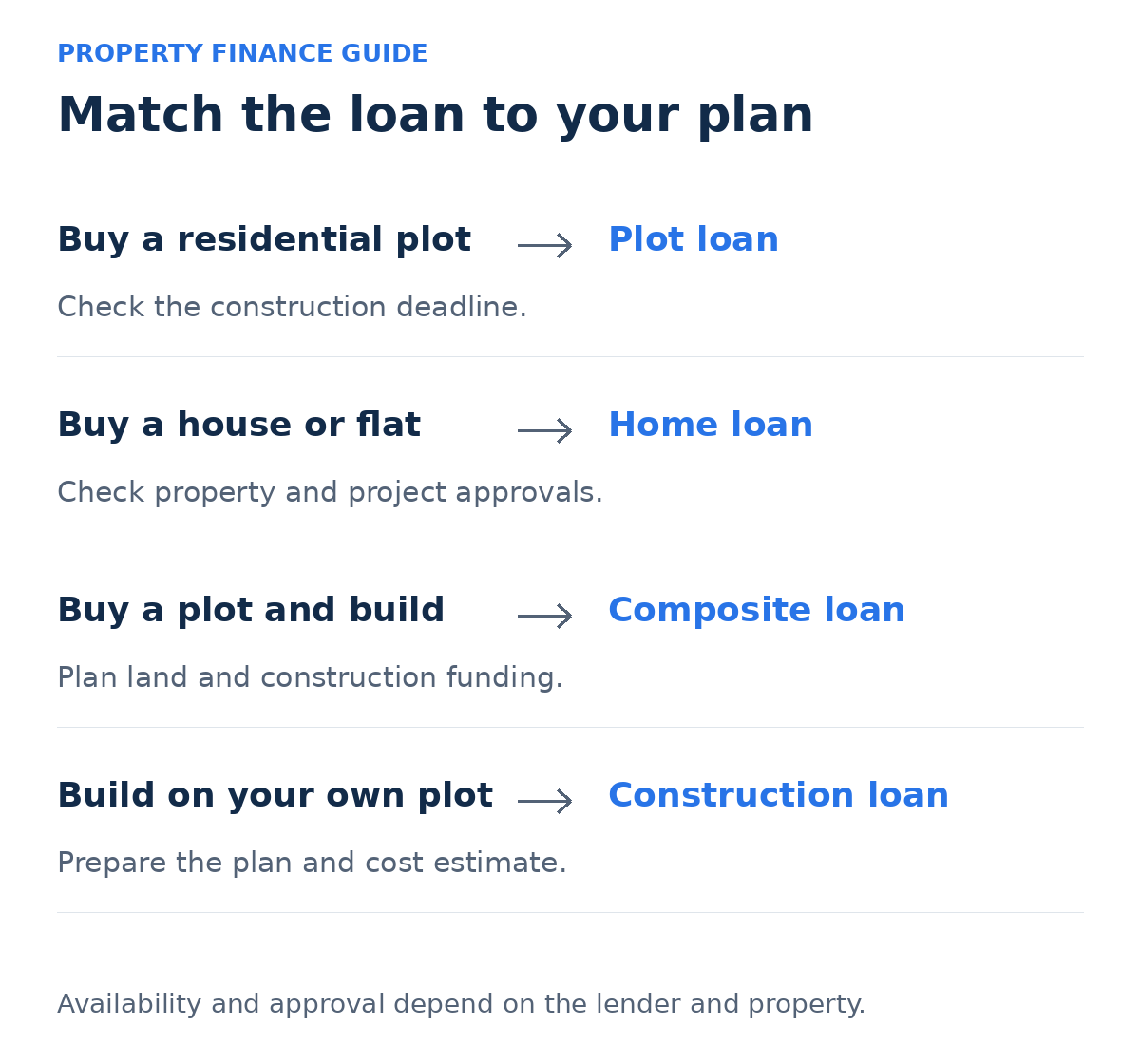
A plot loan generally finances eligible residential land intended for a house. A home loan can finance an eligible house or flat, including a property under construction. If you plan to buy land and build soon, a composite loan may fit the full project better.
This guide explains the differences in simple language, with document checklists and budget examples. Product conditions differ between lenders. The percentages and interest rates used in the calculations below are illustrations, not bank offers.
Choose the right loan
A plot loan, also called a residential land loan, helps you purchase a qualifying plot. It does not automatically provide the money required to build the house. Some lenders require construction within a stated period.
A home loan supports a qualifying residential purchase or construction purpose. For a purchase, the lender examines the house, flat or project alongside your repayment capacity.
A composite loan combines plot purchase and house construction under one financing arrangement. SBI, for example, offers a Combo Home Loan for these two purposes together. The approved construction component still follows the lender's release conditions. SBI Combo Home Loan
A construction loan is relevant when you already own suitable land and want to build on it. Ownership papers, an approved plan and a construction estimate become important. PNB loan document checklist
Start with your actual plan. “Buy land now and decide later” is different from “buy land and begin building this year.” Tell the lender which situation applies before choosing the product.
Plot loan vs home loan
| Feature | Plot loan | Home loan for purchase |
|---|---|---|
| Purpose | Buy eligible residential land | Buy an eligible house or flat |
| Property | Land on which to build a house | A ready or under-construction home |
| Property checks | Title, land use, access and approvals | Title, building/project approvals and completion papers |
| Construction deadline | May require starting or completing a house by a deadline | Depends on the property and product |
| Funding scope | Separate finance for building unless part of a composite loan | Covers the eligible purchase cost |
| Down payment | Based on funding limit and accepted valuation | Based on funding limit and accepted valuation |
| Loan tenure | Product-specific; check the offered term | Product-specific; check the offered term |
| Fund release | After purchase and mortgage conditions are met | As approved; construction funding may be staged |
For residential land conditions, see ICICI Bank's Land Loan. For purchase and construction documentation, see SBI's home loan FAQs.
Loan eligibility
Loan eligibility has two parts: the lender must accept your financial profile and the property must qualify. A strong income does not resolve a problem with land use or missing property papers.
Income and existing EMIs
Lenders assess the stability of your earnings and the amount already committed to other loans. Salaried applicants usually show employment income. Self-employed applicants show business or professional income through the records accepted for that product.
An existing car loan or personal loan can reduce the room available for another EMI. An EMI is the monthly instalment used to repay a loan. Eligibility calculators provide an estimate; they do not replace document verification or a credit decision. ICICI Bank eligibility guidance
For your own budget, write down income, existing EMIs, household expenses and regular savings. Then test the proposed property EMI against what remains. The amount a lender offers and the amount you can comfortably repay may be different.
Credit, age and work history
Repayment history, age and continuity of employment or business can affect the offer. Minimum income, credit-score requirements and age limits vary between products. There is no single set of numbers that guarantees approval across lenders. PNB Housing eligibility criteria
Check your credit report early. If it contains an incorrect entry, begin the correction process before relying on a financing deadline. A good repayment record is helpful, but approval also depends on the property and the lender's assessment.
Joint applications
A permitted co-applicant with independent income may strengthen repayment capacity. The lender decides whose income it can count and which relationships it accepts. ICICI Bank eligibility guidance
Discuss ownership and repayment responsibilities before applying together. Adding a name should follow a clear family agreement about the property, contributions and monthly payments.
Down payment and LTV
The down payment is the part of the purchase price you pay from your own funds. Loan-to-value, or LTV, describes the loan as a percentage of the property value accepted for financing.
A useful starting calculation is:
Your contribution towards the price = purchase price − loan actually available for the purchase.
The final amount can be lower than a headline funding percentage because of income eligibility, property valuation or other product conditions. Ask the lender to assess the specific property rather than planning around an advertisement.
Example: a ₹30 lakh purchase
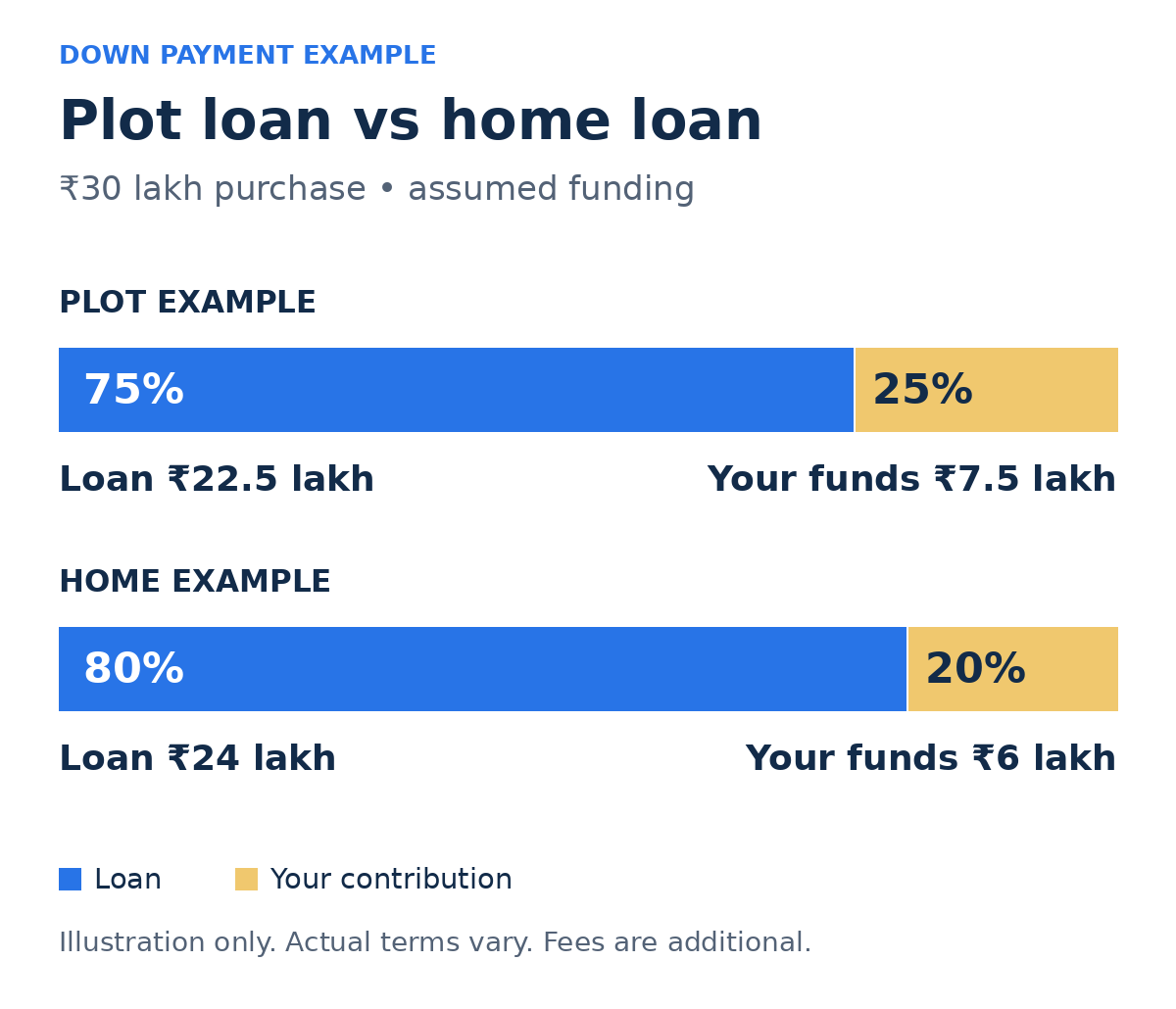
Assume the accepted property value equals the ₹30 lakh purchase price. For this example only, assume 75% funding for a plot and 80% funding for a home.
| Budget item | Plot example | Home example |
|---|---|---|
| Purchase price | ₹30,00,000 | ₹30,00,000 |
| Assumed funding percentage | 75% | 80% |
| Illustrative loan | ₹22,50,000 | ₹24,00,000 |
| Contribution towards purchase price | ₹7,50,000 | ₹6,00,000 |
| Transaction charges | Additional | Additional |
The plot buyer needs ₹1.5 lakh more towards the purchase price in this example. That difference comes from the assumed funding percentages. It is not a rule that applies to every plot loan or home loan.
If the lender's valuation is lower
Suppose you agree to buy a plot for ₹30 lakh, but the lender accepts a value of ₹28 lakh. If the hypothetical funding limit is 75% of that accepted value, the loan would be ₹21 lakh.
You would then need ₹9 lakh towards the purchase price, plus transaction charges. That is ₹1.5 lakh more than the first plot example.
Use this possibility when deciding how much cash to keep available. A small change in the valuation can materially change the amount you must arrange before the purchase is completed.
Other costs to budget for
A purchase budget should include more than the contribution towards the price.
| Cost to plan for | What to confirm |
|---|---|
| Stamp duty and registration | Applicable amount for the actual transaction |
| Processing, legal and valuation charges | The lender's written fee details |
| Mortgage-related expenses | Charges for the chosen security arrangement |
| Brokerage or professional fees | Agreed amount and payment stage |
| Property dues or development charges | Which amounts remain payable and by whom |
| Construction or move-in costs | Work needed after the purchase |
Do not assume that every expense can be added to the loan. Confirm what the lender will finance and what you must pay separately.
Keep an emergency reserve outside the purchase budget. If the booking payment, down payment and fees use all your savings, the first few months of ownership may become difficult even when the EMI initially looks manageable.
For a plot, prepare a second budget for the future house. Include design, approvals, construction, services and a contingency for changes. Land finance alone does not settle the question of how the building will be funded.
Construction deadlines
A residential plot product may require you to build within a specified period. The deadline can concern starting work or completing the house. These are different obligations.
Published examples show the variation:
| Lender and product | Published construction condition |
|---|---|
| SBI Realty | House completion within three years; its page refers to sanction/disbursement |
| ICICI Bank Land Loan | House completion within four years of loan disbursement |
| ICICI Home Finance Plot + Construction Loan | Construction must begin within two years of buying the plot |
Sources: SBI Realty, ICICI Bank Land Loan, and ICICI Home Finance. ICICI Bank and ICICI Home Finance are separate lenders.
Ask for the exact starting date, required milestone and consequence of delay in your written terms. If your plans depend on a future job move, uncertain savings or a later decision to build, check whether you can realistically meet that obligation.
A longer repayment tenure does not necessarily give you the same amount of time to construct the house.
Personal and income documents
Create one folder for each applicant and a separate folder for the property. Keep scans readable and complete. Ask the lender which originals it needs to inspect and which documents it retains.

Photographic illustration: organise applicant and property documents before applying.
Documents for all applicants
Common requests include a completed application, photographs, PAN or the permitted tax declaration, accepted identity and address proof, age proof, bank statements and existing loan details. The lender's KYC checklist determines which documents are acceptable for each purpose. SBI Realty document requirements
The exact list can change with your profile and the property. A clean file is useful; an incomplete file can still require follow-up even when you meet the income criteria.
Salaried applicants
| Document | Why it helps |
|---|---|
| Recent salary slips | Shows current employment earnings |
| Salary-account statements | Shows salary credits and financial activity |
| Form 16 or income-tax returns, as requested | Supports declared annual income |
| Employment confirmation, if requested | Helps verify employment details |
| Existing loan statements | Shows outstanding repayments |
SBI's home loan FAQ lists three months of salary slips, six months of bank statements, and Form 16 or income-tax returns for two years in its checklist. Treat this as a lender example, not a universal requirement. SBI home loan FAQs
Self-employed applicants
| Document | Why it helps |
|---|---|
| Personal and business tax returns | Supports reported income |
| Profit-and-loss statements and balance sheets | Shows business performance |
| Personal and business bank statements | Shows receipts and financial commitments |
| Business registration or existence proof | Supports business continuity |
| Professional qualification, where relevant | Supports the professional profile |
PNB Housing's plot-loan checklist includes three years of tax returns and financial statements, with twelve months of personal and business bank statements for self-employed applicants. Ask for the checklist that applies to your own product. PNB Housing plot-loan documents
If you lack standard income records, ask whether the lender offers a suitable alternative assessment programme. Such programmes have their own eligibility rules. PNB Housing eligibility guidance
Property documents
Income documents explain repayment capacity. Property documents help establish what is being purchased, who can sell it and whether it is acceptable as security.
| Document or check | Residential plot | House or flat |
|---|---|---|
| Seller's ownership and earlier title papers | Establishes the ownership chain | Establishes the ownership chain |
| Sale agreement or allotment letter | Records plot and purchase terms | Records home and purchase terms |
| Receipts for payments already made | Supports the buyer's contribution | Supports the buyer's contribution |
| Encumbrance or other title checks | Identifies recorded claims or charges | Identifies recorded claims or charges |
| Relevant permissions for leasehold property | May be needed for transfer and mortgage | May be needed for transfer and mortgage |
| Approved building plan | Needed when financing construction | Relevant to the building being financed |
| Completion or occupancy documents | Relevant once a house is built | Relevant for a completed property, where applicable |
PNB's checklist distinguishes plot purchase, purchase of a built home and construction. Construction applications also require an estimate prepared by a qualified engineer or architect. PNB property checklist
For a plot, also confirm acceptable residential land use, the layout and any conversion approval needed for the case. ICICI Home Finance includes land-conversion documentation where applicable. ICICI Home Finance property documents
A building plan and a plot-layout approval are different documents. ICICI Bank allows its land loan application without an approved house-construction plan initially; that does not mean other property checks can be ignored. ICICI Bank Land Loan FAQs
Ask a property lawyer to explain documents you do not understand. A lender's willingness to finance a property should not replace your own review of the purchase.
How the loan process works
Expect several stages rather than a single approval message:
- Discuss the purpose and budget. Explain whether you are buying land, buying a home or planning construction.
- Submit applicant documents. Provide the requested income, identity and repayment records.
- Submit property documents. Give the lender the papers for the specific property.
- Complete legal and technical checks. Resolve questions raised about the documents or valuation.
- Review the sanction and conditions. Check the loan amount, tenure, rate, contribution and pending requirements.
- Complete the required purchase and mortgage formalities. Confirm the sequence with the lender and seller.
- Receive funds under the approved release conditions. Construction funding may arrive in stages.
ICICI Home Finance describes inspections and stage-based releases for construction. ICICI Home Finance loan guidance
Before committing to a payment date, ask which conditions must be met before funds can reach the seller or builder. A provisional sanction is not the same as money being available for every payment immediately.
For construction, compare the lender's release stages with the contractor's payment schedule. This helps you identify any period when you must contribute cash before the next loan instalment is released.
Interest, EMI and borrowing cost
Compare offers for the same loan amount and tenure. Otherwise, a smaller EMI may simply reflect a longer repayment period.
Ask for the Key Facts Statement, or KFS, before signing. RBI's KFS framework provides key terms in a standard format. It includes the Annual Percentage Rate, or APR, which reflects interest and other charges associated with the credit facility. This makes APR useful alongside the quoted interest rate. RBI KFS guidance
Also confirm how a floating rate can change your repayment, the applicable prepayment conditions and the charges relevant to your case.
Example: 15 years vs 20 years
Assume a ₹25 lakh loan at a constant 9% annual interest rate, with monthly repayments on a reducing balance.
| Repayment period | Approximate monthly EMI | Approximate total interest |
|---|---|---|
| 15 years | ₹25,357 | ₹20,64,200 |
| 20 years | ₹22,493 | ₹28,98,356 |
These are mathematical examples, not a quote for either product. Fees and future rate changes are excluded. EMIs are rounded to the nearest rupee; total interest is calculated using the unrounded EMI.
In this example, the twenty-year option reduces the monthly payment by about ₹2,864 but adds about ₹8.34 lakh in interest over the full term. Choose a repayment plan that works for your monthly budget while understanding its long-term cost.
Tax considerations
Do not assume that buying an empty plot provides the same tax deductions as an eligible housing loan. ICICI Bank's Land Loan FAQ states that its land loan does not itself provide an income-tax benefit. ICICI Bank Land Loan
Housing-related deductions depend on the applicable tax regime, use of the property, construction or completion conditions and current law. Ask a qualified tax adviser how these rules apply to your situation. Income Tax Department house-property guidance
Build your affordability calculation around the actual repayment first. Any deduction you can claim should be assessed separately.
Checks for buyers in Indore
If you are comparing properties in Indore, inspect the site and the documents together. Match the location, boundaries and area described in the papers to the property shown to you.
For a plot, ask about residential use, layout permissions, road access and the services already available. Confirm whether development charges are included in the price. If building soon is part of the loan condition, include the cost and time required to get the site ready.
For a house or flat, ask about building approvals, completion or occupancy documents where applicable, unpaid dues and the work needed before moving in.
For a development covered by RERA registration requirements, verify the project's registration and disclosures with the state authority. Exemptions exist, so the position must be checked for the actual project. Real Estate Act, Section 3
Keep a written record of the seller's commitments. Use the same property details when discussing the purchase with your lawyer and lender, so each person is assessing the same transaction.
Frequently asked questions
Is a plot loan always more expensive than a home loan?
No universal comparison applies. Compare written offers for your profile and property, using the same amount and repayment term. Include fees and APR, not only the advertised starting rate.
Can I finance agricultural land with a residential plot loan?
Do not assume so. A residential plot product is intended for an eligible residential purpose. Ask the lender which product, if any, suits the actual land category and intended use.
Can I get a loan if I already own the plot?
A construction product may be relevant if you plan to build and the land qualifies. Provide ownership papers, the approved plan and the cost estimate required by the lender.
Can I buy a plot and wait many years before building?
Check the product's construction condition first. Some products impose deadlines. Choose financing only after confirming that your building plan fits the written terms.
Is there one minimum credit score for all property loans?
No. Requirements vary between lenders and products, and the credit score is only one part of the assessment. Confirm the criteria for the product you intend to use.
Can a co-applicant guarantee a larger loan?
No. An eligible co-applicant's income may help, but the lender still evaluates income, obligations, credit and the property before deciding the amount.
Does a loan sanction guarantee the property is suitable for me?
No. Review ownership, access, approvals, condition and purchase terms for your own needs. Financing approval is one part of the decision.
Which option fits your plan?
Choose a plot when you want to build your own home and can plan for the land contribution, construction budget and relevant deadlines. Choose a home when the property and its stage of completion better match your housing needs. Explore composite finance when land purchase and construction form one planned project.
Before paying a booking amount, aim to have a realistic cash budget, a suitable document checklist and a written explanation of the lender's conditions.
Comparing properties in Indore? Use Domico to explore your options or request a callback to discuss your property requirements. Confirm financing terms directly with your chosen lender before finalising the purchase.
Lender examples and official guidance checked on 13 October 2026. Product terms can change. Illustrative images do not represent a listed property.
Official sources
- ICICI Bank residential Land Loan
- ICICI Bank eligibility guidance
- SBI Realty for plot purchase
- SBI Combo Home Loan
- SBI home loan FAQs
- ICICI Home Finance Plot + Construction Loan
- PNB Housing plot-loan document checklist
- PNB Housing eligibility criteria
- Punjab National Bank property and application checklist
- RBI Key Facts Statement framework
- Income Tax Department house-property guidance
- Real Estate Act registration requirements
- plot loan
- home loan
- down payment
- loan documents
- property buying
- indore