Buying Guide
Parents Funding Your Down Payment: Gift and Loan Records
Plan a parent-funded home down payment with clear gift or loan terms, bank trails, source records and an honest household funding worksheet.
Updated 8 min read

Buying Guide
Plan a parent-funded home down payment with clear gift or loan terms, bank trails, source records and an honest household funding worksheet.
Family support works best when the money, intention and records all tell the same story.
Parents often help an adult child buy a first home. The contribution may be a gift, a temporary loan or money paid in return for an ownership share. Families can discuss these possibilities casually, but the bank, tax return and property documents need a clear account of the actual arrangement.
The objective is not to make a family conversation unnecessarily formal. It is to prevent a large transfer from being misunderstood later, especially when a loan application, sibling expectations or a future sale brings the original intention back into focus.
A genuine gift is provided without an obligation to repay. A loan creates a repayment obligation even when the parties are related. An ownership contribution may mean the parent is acquiring a share in the property. These are different arrangements and should not be described interchangeably.
Before the transfer, discuss whether repayment is expected, whether interest applies, whether the parent wants an ownership interest and whether the money affects future family arrangements. If the intention is uncertain, resolve it before using the funds as a down payment.
| Arrangement | Key feature | What to document |
|---|---|---|
| Gift | No repayment obligation | Donor, recipient, amount, relationship and intention |
| Family loan | Money is repayable | Amount, repayment terms and any interest |
| Joint purchase | Parent acquires an ownership interest | Title share, contribution and borrowing arrangement |
| Direct payment to seller | Parent pays on the buyer’s behalf | Link between transfer, buyer and property purpose |
Do not call money a gift in a bank declaration while privately agreeing to repay it every month. That can misstate the household's debt obligations and affect affordability. Use the genuine arrangement consistently.
The Income Tax Department's relative-gift guidance includes lineal ascendants within the relevant relationship definition. The current section 92 also contains the specified-relative exception in the 2025 Act framework.
A genuine monetary gift from a parent to an adult child can therefore receive different treatment from a gift from an unrelated friend. The relationship exception does not remove the need to establish the donor, the actual transfer and the genuine source of money.
Do not assume that a tax-exempt receipt is also a deduction for the parent. Giving money for a child's down payment does not by itself create a home-loan deduction for the donor. Any deduction claim requires its own statutory basis.
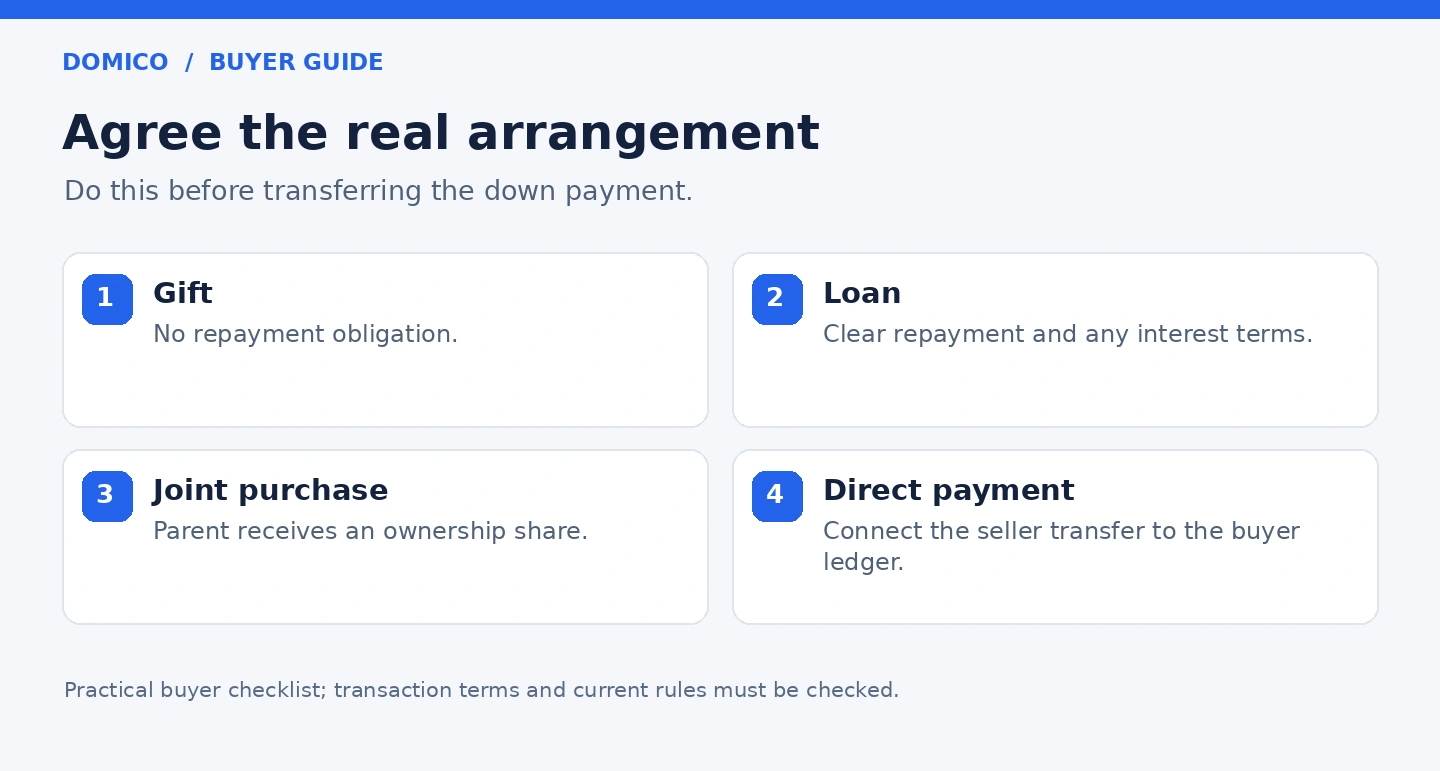
A bank transfer from the parent to the adult child makes the movement easier to explain. Keep the transfer reference, relevant account statements and a contemporaneous record of the intention. If the parent pays the seller directly, connect that transfer clearly to the buyer's contribution and the property ledger.
Ask the lender how it wants the source of the down payment documented. A genuine family gift may be acceptable subject to its process, but an undisclosed family loan can affect the repayment assessment. Obtain the requirements before the registration deadline.
Avoid last-minute cash deposits followed immediately by a large transfer without an explainable source. A banking channel records movement; it does not itself establish that the funds came from lawful income or savings. Keep the relevant source evidence available.
Record the donor and recipient, relationship, amount, transfer date and payment reference. State that the money is given voluntarily and whether there is no repayment obligation. Identify the intended home-purchase purpose without making claims inconsistent with the actual ownership arrangement.
Have a professional advise whether a letter, deed or other formalities are appropriate in the particular jurisdiction and facts. Do not assume every monetary gift requires the same registration or notarisation process. Transferring money is also different from gifting an existing immovable property, which raises its own deed and duty requirements.
The record should be accurate, not elaborate. A short genuine document supported by a clear transfer can be more useful than a long template containing facts the family has not agreed to.

Suppose a buyer plans a ₹50 lakh home and estimates ₹4 lakh of separately verified purchase and essential initial costs. The total funding requirement is ₹54 lakh. The approved loan is ₹38 lakh, the buyer contributes ₹8 lakh of savings and the parents provide an ₹8 lakh genuine gift.
| Illustrative source or use | Amount | Record |
|---|---|---|
| Property price | ₹50 lakh | Agreement and deed |
| Assumed other purchase and initial costs | ₹4 lakh | Actual official calculations and quotations needed |
| Home loan | ₹38 lakh | Sanction and disbursement records |
| Buyer’s savings | ₹8 lakh | Account trail |
| Parents’ gift | ₹8 lakh | Gift record and bank transfer |
| Total sources and total uses | ₹54 lakh each | Reconciled funding worksheet |
The ₹4 lakh allowance is hypothetical, not an official charge rate. The important check is that the same money is not counted twice. If the parent's gift is also being counted as their own retirement emergency fund, the household needs another conversation before committing it.
Ask whether the contribution leaves enough for living costs, medical needs and emergencies. A home purchase should not quietly transfer an unaffordable burden to a retired parent. Review any investment sale, deposit closure or borrowing used to fund the gift.
If a parent sells an asset, the sale can create its own tax and timing questions. Gifting the proceeds does not automatically remove tax arising on the parent's transaction. Have that position checked before promising the entire gross sale amount as the down payment.
Also consider whether the contribution is immediate or expected later. A buyer should not pay a non-refundable token using money that a parent plans to obtain from an uncertain future sale. Match the purchase deadlines with funds actually available.
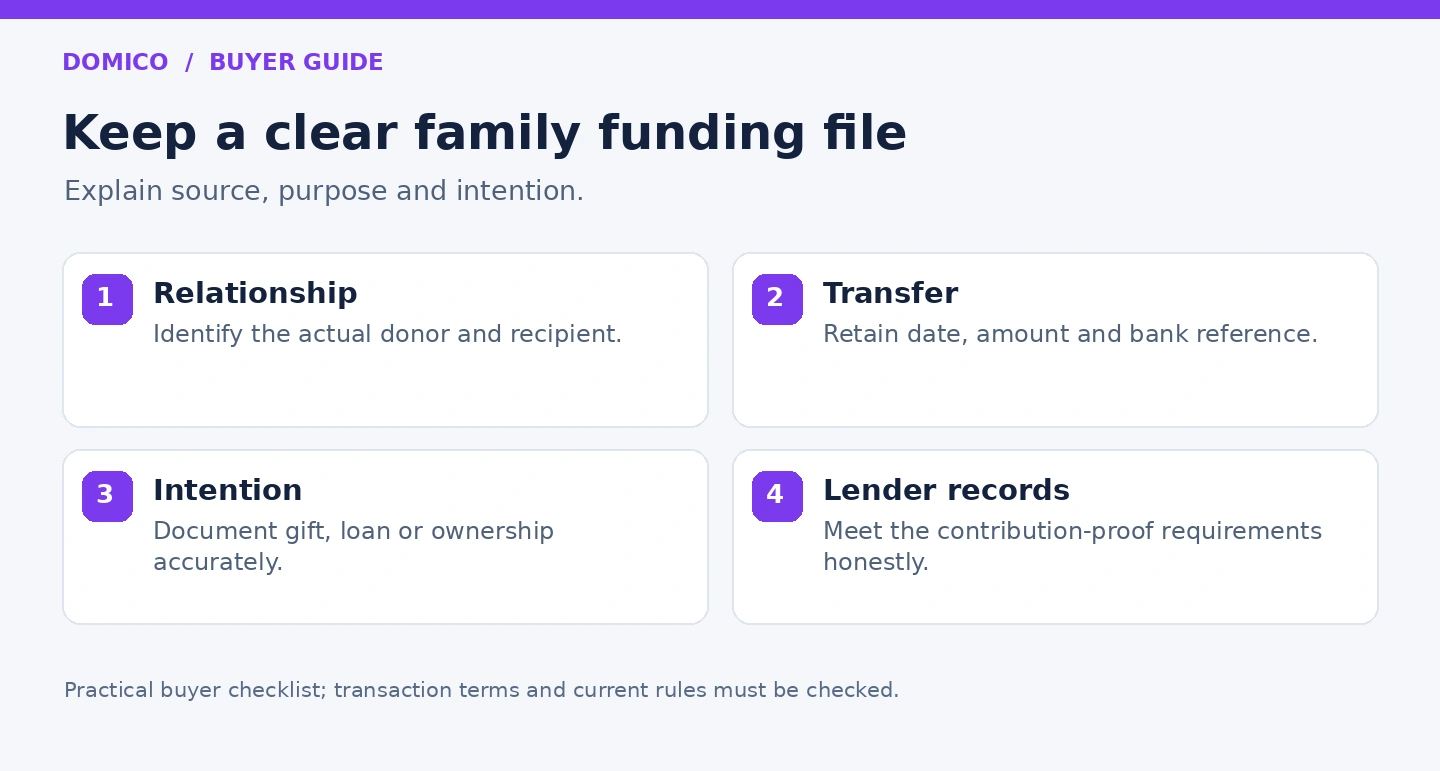
Provide the documents requested through the lender's verified process. Do not submit invented gift declarations to disguise a repayable loan. If parents expect regular repayment, include that obligation in the household budget and disclose it as required.
The lender may ask how the buyer's own contribution reaches the seller. Maintain the chain from parent to buyer to seller, or document a legitimate direct transfer. Keep the seller's receipt clear about whose price obligation has been discharged.
Where parents also join the loan or title, obtain advice on the combined arrangement. A gift-only example no longer answers every issue once the donor becomes a co-owner or borrower. Ownership shares, repayment and future succession need separate documentation.
A parent may intend the gift only for one child's home, while another family member sees it as an advance against inheritance. The legal effect depends on the facts, but clear communication can reduce later disagreement.
If there are conditions, such as repayment after sale or an expectation that the parent can live in the property, discuss whether this is really an unconditional gift. Ask a lawyer to document the actual intention rather than leaving significant rights in a vague message.
A well-kept record also helps if the parent is unavailable later and a bank, tax authority or family member asks about the transfer. The goal is continuity of evidence, not suspicion within the family.
Cross-border transfers can involve foreign-exchange rules, banking requirements and tax reporting in more than one country. Do not assume that a domestic parent-gift example covers a non-resident donor or money remitted from abroad.
Transfers to a spouse or minor can also raise different clubbing or attribution questions from a direct gift to an adult child. A parent-in-law funding a different family member should not be processed using a relationship description that is not accurate. Have the exact donor-recipient relationship and use of money reviewed.
| Situation | Additional question | Professional input |
|---|---|---|
| Parent borrowed to contribute | Is repayment genuinely expected from the child? | Lending and affordability review |
| Parent sold an asset | What tax arises on that sale? | Parent’s tax computation |
| Direct seller payment | How is buyer credit documented? | Contract and lender reconciliation |
| Cross-border transfer | Which banking and reporting rules apply? | Tax and foreign-exchange advice |
| Ownership share expected | Is it a joint purchase rather than a gift? | Title and succession advice |
Download the topic-specific review checklist. Use it to record evidence, unanswered questions and follow-up actions for the exact property.
The specified-relative exception can apply to a genuine parent-to-adult-child monetary gift. Establish the relationship and transfer rather than applying the unrelated-person threshold without context.
Not merely because they provide a genuine gift. If ownership is intended, document a joint purchase. If it is a gift, the records should state that actual arrangement.
It can be structured with proper documentation, but the buyer, seller and lender records should clearly connect the payment to the purchase. Confirm the lender's process before transferring.
No. Use truthful records and disclose obligations as required. A concealed family debt can make the affordability assessment misleading.
Not automatically. A deduction requires a separate legal basis and qualifying facts. The recipient's exemption and the donor's deduction are different questions.
Planning to buy or rent in Indore? Browse verified properties in Indore or read more Indore guides.
Check who owes the lender, how builder-paid interest works, when support ends and whether you can carry the loan if payments stop.



