Buying Guide
Older Apartment Structural Audit: What Buyers Should Ask
Learn when an older apartment needs structural review, which reports and repair records to request, and how to assess scope, costs and limitations.
Updated 8 min read

Buying Guide
Learn when an older apartment needs structural review, which reports and repair records to request, and how to assess scope, costs and limitations.
A new kitchen can improve an old flat. It cannot tell you the condition of the building carrying it.
Older apartments can offer established neighbourhoods, occupied communities and room layouts that appeal to a buyer. They also deserve a purchase review that looks beyond the apartment's interiors. Shared structural elements, repair history and alterations in other units can matter as much as what you see inside the home.
A structural audit is a professional assessment with a defined scope. It is different from an agent's visual reassurance, a valuation report or a general home inspection. The useful question is when to seek that assessment and how to understand the evidence it provides.
Two buildings of the same age can have different design, exposure, maintenance and alteration histories. Avoid a universal rule that an apartment becomes unsafe at a particular anniversary. Equally, do not treat long occupation as proof that there is no problem.
Check the building's age through relevant completion or occupancy records and the society's documents. Ask whether additions or changes were approved and whether structural assessments have already been carried out. A recent decorative renovation should not reset the age of the underlying structure.
A July 2026 MoHUA statement published by PIB explains that enforcement of periodic structural and seismic safety audits lies with States, Union Territories and urban local bodies. Buyers should therefore verify the applicable Indore and MP requirements rather than import another city's audit schedule.
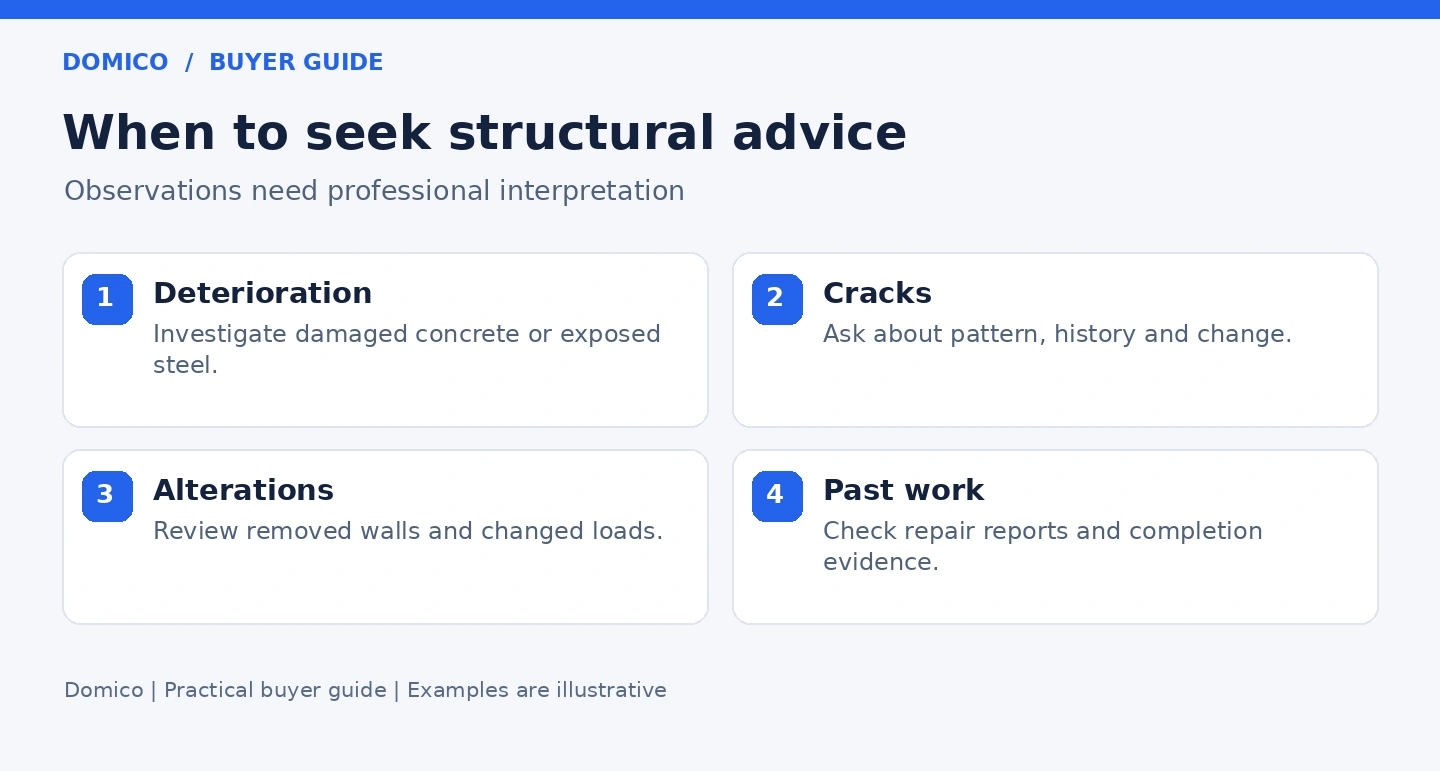
Seek independent structural advice where there are unexplained cracks, concrete deterioration, exposed reinforcement, noticeable deformation, recurrent water-related damage or a history of major repairs. Do not use photographs to decide on your own whether a defect is merely cosmetic.
Also investigate removed walls, altered columns, new openings, heavy additional loads or changes of use. A seller may know only the changes in the unit being sold. The society's records can reveal work elsewhere that affects the building.
If there are signs of an immediate hazard, keep away from the affected area and contact the appropriate qualified professionals or authorities. A purchase inspection should never involve entering a visibly unsafe space to collect better photographs.
| Information or observation | Why it matters | Appropriate next step |
|---|---|---|
| Unexplained cracking | Cause and significance are uncertain | Structural professional assesses the pattern and history |
| Deteriorated concrete | Hidden extent may exceed visible area | Establish access and suitable investigation |
| Major past repairs | Quality and completeness need review | Obtain reports, design details and completion evidence |
| Altered walls or loads | Original assumptions may have changed | Compare approvals and seek engineering assessment |
| Missing records | Limits confidence in the review | Agree what additional evidence is needed |
Ask the professional to explain whether the assignment is a preliminary visual inspection, a detailed structural audit, a specific defect assessment or another service. Those terms should not be treated as interchangeable.
The scope should identify the building or unit covered, accessible areas, documents reviewed, proposed tests, exclusions, deliverables and fee. Clarify whether foundations, concealed components and other apartments can be inspected. The report should state important limitations plainly.
A qualified structural engineer may recommend further testing after the initial visit. Buyers should understand what each test aims to establish and how results will be interpreted. A single instrument reading should not be sold as a complete building-safety guarantee.
Ask the society for available structural drawings, prior reports, repair specifications, contractor records and relevant notices. Identify the names and dates of assessments rather than accepting a statement that “an engineer checked it once.”
Find out whether recommendations were implemented. A report that lists repairs is not evidence that the repairs happened. Request the work orders, completion records and any professional follow-up. Ask whether the association has budgeted for remaining items.
The National Building Code overview includes structural design and asset-management topics. Buyers should use appropriately qualified local professionals to interpret the building's technical documents and applicable requirements.
A tidy apartment can sit within a building that needs expensive shared work. Conversely, worn finishes inside a flat do not establish structural inadequacy. Keep the unit's interior defects and the building's structural questions in separate parts of your purchase file.
A general inspector may identify concerns and recommend an engineer, but the buyer should check who is qualified to issue the requested structural opinion. Clarify conflicts of interest if the same contractor diagnosing a problem also proposes the repair.
A lender's valuation or technical check serves the lender's purpose and may have a different scope. Ask what it covers rather than assuming that loan approval means a comprehensive assessment has been completed for your benefit.
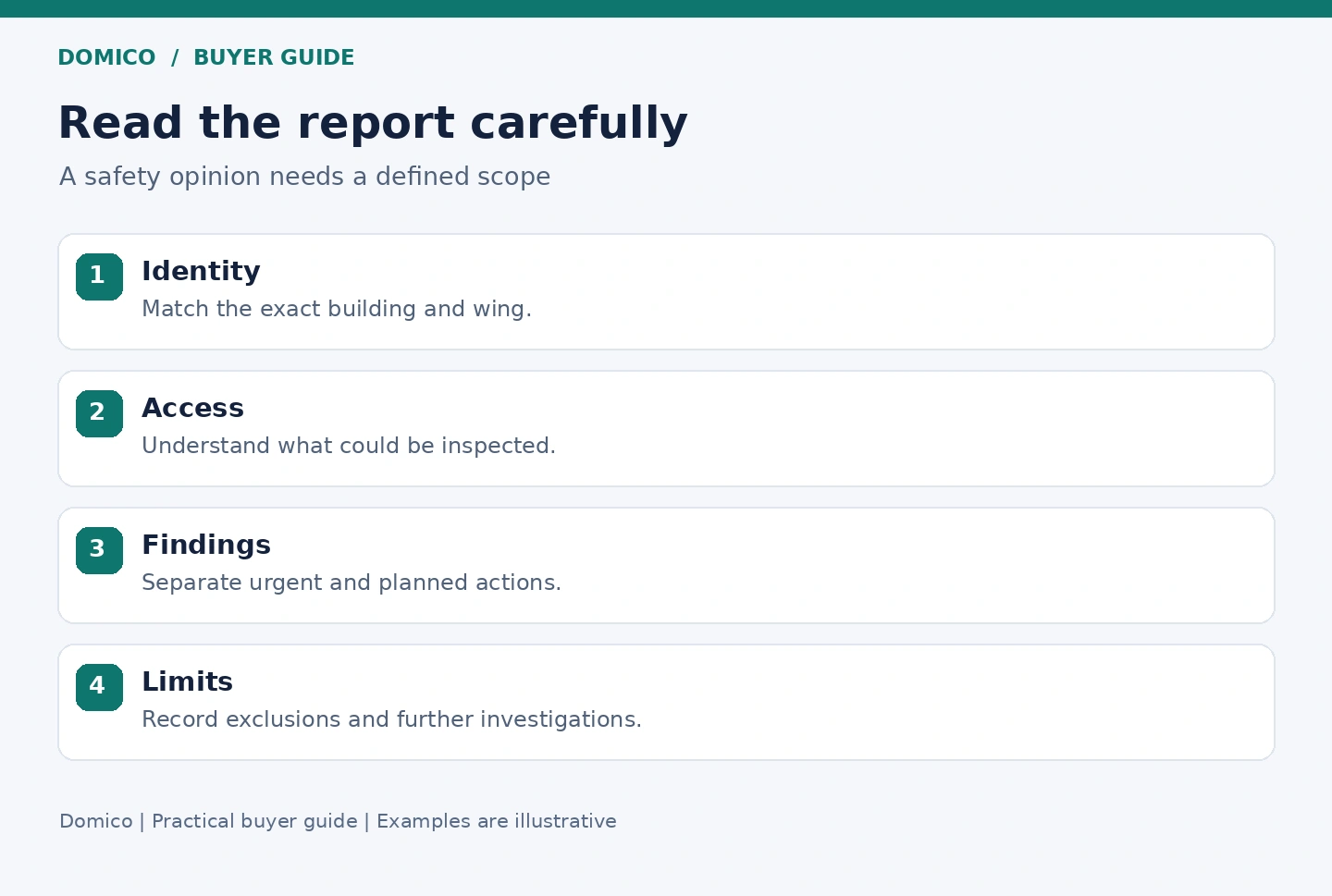
A useful report should connect observations, investigations and recommendations. Ask the engineer to explain urgent actions, planned work, monitoring needs and areas that could not be assessed. If terminology is unclear, request a plain-language explanation.
Pay attention to dates. A report prepared before major alterations, flooding or later deterioration may need review. Also check whether the report applies to the exact building and wing containing the flat.
Do not ask for a guaranteed remaining life based on a short visit. If a professional gives a service-life estimate, understand the assumptions, maintenance conditions and uncertainty. Purchasing a home requires managing that uncertainty rather than replacing it with a reassuring number.
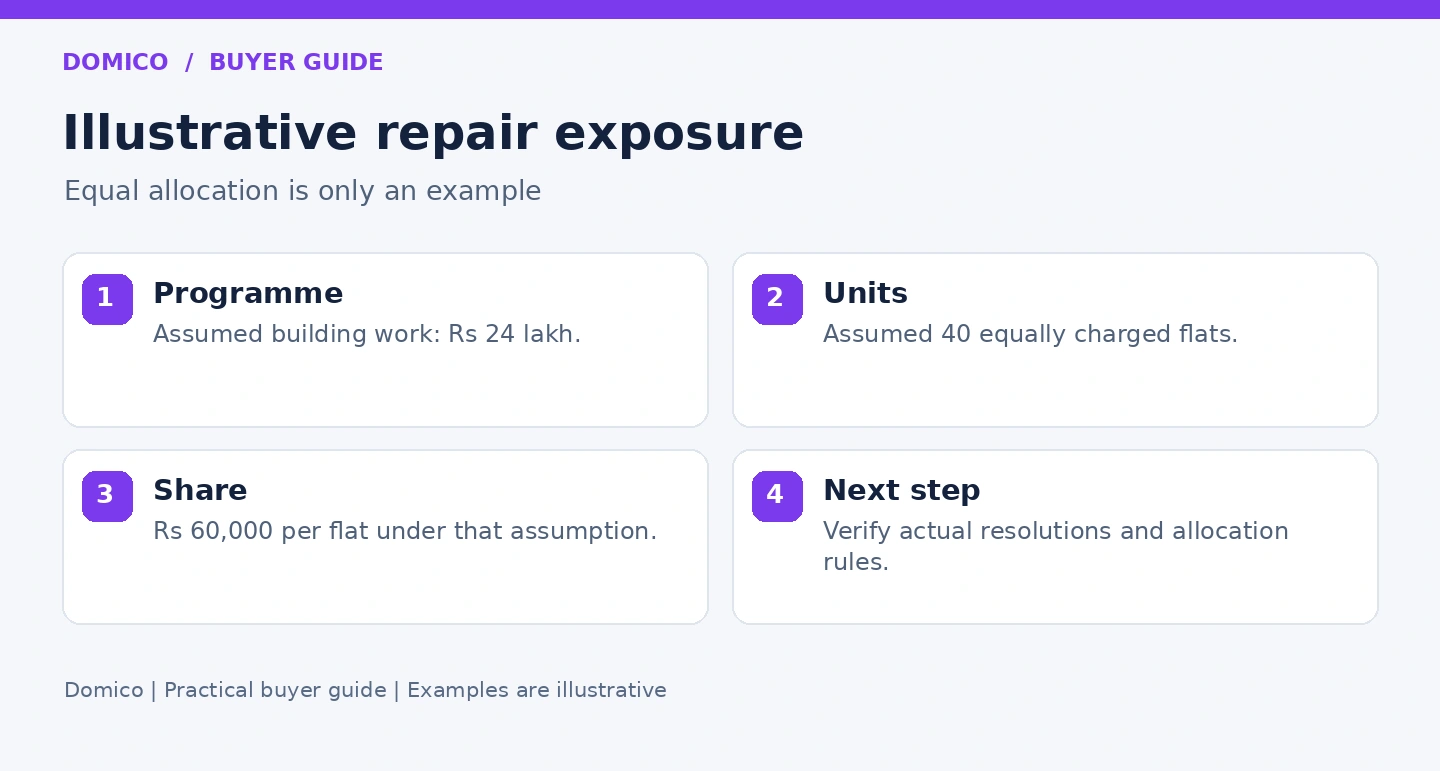
Suppose an association has an illustrative Rs 24 lakh repair programme for a 40-flat building. If the valid allocation method happened to be equal per flat, the simple share would be Rs 60,000. That is arithmetic, not a rule that every society must charge equally.
| Hypothetical buyer expense | Assumed amount | Question before purchase |
|---|---|---|
| Shared repair contribution | Rs 60,000 | What allocation and resolution authorise it? |
| Unit-specific restoration | Rs 35,000 | Is this separate from the common work? |
| Professional review | Rs 15,000 | What is the agreed scope? |
| Example known total | Rs 1,10,000 | What remains unpriced or uncertain? |
Use actual approved budgets and quotations for a real purchase. A contingency can help with cost uncertainty but cannot make a safety concern acceptable. If recommended work is unfunded or dependent on an unresolved association vote, the buyer needs to understand that risk before paying.
Ask your lawyer who will bear an existing special assessment and how the agreement will record it. A verbal promise from the seller can be difficult to reconcile with later society demands.
A report may be technically clear while execution remains uncertain. Ask whether access is available, residents have approved the work, a suitable contractor is appointed and funds are collected. Identify any dispute affecting the schedule.
For work that could require temporary vacancy, ask how residents plan to manage it. Do not assume that moving furniture or staying elsewhere will be unnecessary. Have the competent professional explain relevant restrictions and sequencing.
If the association has repeatedly deferred important work, that history is part of the purchase assessment. An attractive price should not hide the practical difficulty of obtaining cooperation after you become an owner.
| Before committing | Evidence to seek | If it is missing |
|---|---|---|
| Current technical view | Report for the exact building and scope | Arrange appropriate independent assessment |
| Repair status | Completion and follow-up records | Treat recommendations as still unresolved |
| Funding | Approved budget and collection position | Clarify buyer exposure and execution risk |
| Governance | Relevant notices and decisions | Ask the authorised association representative |
| Contract | Allocation of known liabilities | Obtain lawyer-reviewed wording |
Check whether the professional is independent of the seller and proposed repair contractor, and ask about relevant qualifications and experience. Agree who may rely on the report, because a document commissioned for another purpose may not automatically serve the incoming buyer. Make sure the final report is signed, dated and delivered with its scope and exclusions intact.
Requirements vary by jurisdiction and building circumstances. Verify current local rules and notices with the competent authority. Do not assume a schedule used in another State automatically applies in Indore.
Check the person's qualifications and the service scope. A general inspection may identify defects but is not automatically equivalent to a structural engineering assessment.
A buyer should not classify safety by crack width alone. Pattern, location, change over time, construction and other evidence need professional interpretation.
It can provide history, but its relevance depends on age, scope and later changes. Ask an independent professional whether an update is needed for the purchase decision.
Understand the technical conclusion, urgency, funding and execution plan first. The decision may be manageable in some circumstances, but an unresolved safety issue cannot be solved solely by negotiating a discount.
An older home can be a considered purchase when its building condition is understood. Make the shared structure part of your due diligence, not an afterthought to the interiors.
Download the topic-specific review checklist. Use it to record evidence, unanswered questions and follow-up actions for the exact property.
Planning to buy or rent in Indore? Browse verified properties in Indore or read more Indore guides.
Check who owes the lender, how builder-paid interest works, when support ends and whether you can carry the loan if payments stop.



